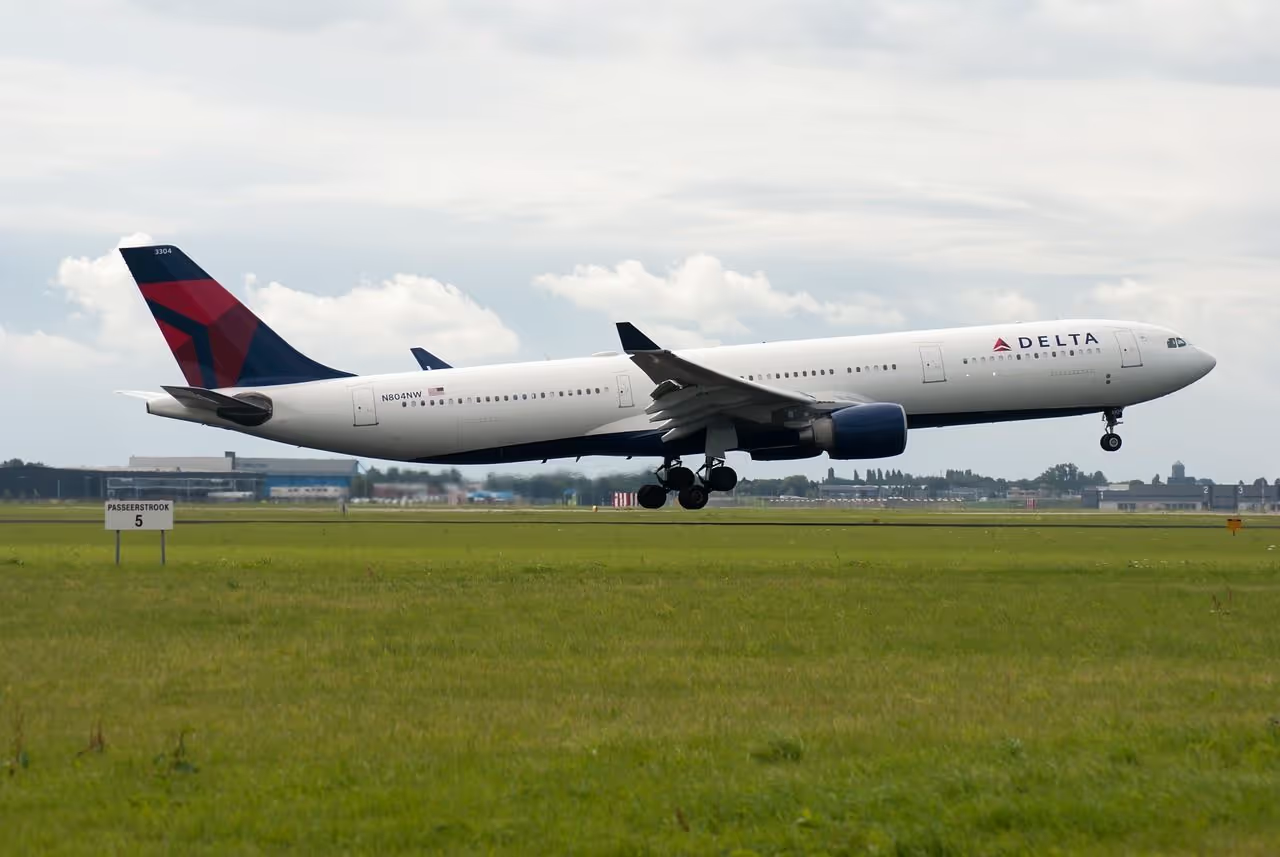
Delta SkyMiles is the most-earned airline currency in the United States, and the program in 2026 looks almost nothing like the program most readers remember from five years ago. The award chart has been gone since 2015. Medallion Qualifying Miles and Medallion Qualifying Segments were retired at the end of the 2023 status year, leaving Medallion Qualifying Dollars as the only path to elite status. Sky Club access tightened in February 2025. And the dynamic-pricing model means the cash value of a SkyMile lands in a wide band depending on what you're booking and how you're booking it.
This guide is built for 2026: how SkyMiles actually earn, how the elite program works under the MQD-only framework, where the program's award value is strongest (hint: it's mostly through partner bookings, not Delta metal), and which Delta SkyMiles credit cards are worth carrying given the new Sky Club rules. If you fly Delta out of an Atlanta, Detroit, Minneapolis, Salt Lake City, or New York hub, this is the program you're stuck working with, so let's work it well.
Quick Answer
Delta SkyMiles is a fully dynamic frequent-flyer program: no fixed award chart, no MQM, no MQS, MQD-only elite qualification since 2024. SkyMiles redeem at roughly 1.1 to 1.4 cents per point on Delta metal, and 1.6 to 2.5 cpp through partners (Flying Blue, Virgin Atlantic, Air France-KLM) for the same flight inventory. Earn through Delta cards, Amex Membership Rewards transfers (1:1), and SkyMiles partners; redeem through Flying Blue or Virgin Atlantic when you're booking Delta partner premium cabins.
How SkyMiles Earn in 2026
SkyMiles earning is straightforward. Points never expire as long as the account exists. The earning rates that matter:
- Paid Delta tickets. Five SkyMiles per dollar of base fare for general SkyMiles members, scaling to seven (Silver), eight (Gold), nine (Platinum), and eleven (Diamond) per dollar at the elite tiers.
- Delta-branded American Express cards. Two miles per dollar on Delta purchases (three on the Reserve cards), one mile per dollar on most other spend, with category multipliers on the Gold and Platinum cards. The cards are also the cleanest path to elite status under the MQD-only system, because they generate MQD on welcome offers and bonus accelerators.
- American Express Membership Rewards transfers. 1:1 SkyMiles transfer ratio. Transfer bonuses to Delta are rare; Amex runs them roughly once or twice a year, usually 20 to 30 percent. If you have Membership Rewards points, the Amex MR vs. Chase UR comparison shows where Delta sits in the broader transfer-partner picture.
- SkyMiles Shopping portal and SkyMiles Dining. Standard online-shopping and restaurant earning portals. Useful for chipping away at MQD targets, less useful for primary earning.
- Starbucks Rewards link. Linked accounts earn one SkyMile per dollar at Starbucks.
- Hertz, Lyft, Airbnb partnerships. Modest per-dollar earning. The Hertz integration is the strongest of the three for frequent renters.
A few earning notes: SkyMiles do not expire. The miles you earn on a Delta-marketed flight book to your account in the same denomination regardless of who operated the flight (Delta, Air France, KLM, Virgin Atlantic). And miles earned on partner-operated tickets booked through partner sites earn at partner rates, which are usually lower. If you fly KLM via klm.com using your SkyMiles number, you'll earn fewer miles than if you'd booked the same KLM flight through delta.com. There's a full earning rule breakdown that covers the edge cases.
The Award-Pricing Reality
Delta dropped its published award chart in 2015 and went fully dynamic. There is no "this flight costs X miles." Award prices on Delta metal float with cash fares, demand, and seat inventory. Practically:
- Domestic main cabin saver awards start around 7,500 to 12,000 miles one-way for off-peak short routes, but routinely hit 20,000 to 35,000 for prime schedules.
- Mainline domestic main cabin standard awards typically run 25,000 to 45,000 each way.
- Transatlantic main cabin ranges from 30,000 (rare flash sale) to 90,000 each way.
- Transatlantic Delta One has cleared at 95,000 miles in flash sales, but the standard band is 200,000 to 400,000 each way. This is where SkyMiles redemption value falls apart.
Delta runs flash sales on SkyMiles redemptions every few weeks, sometimes deeper than 50 percent off the standard band. These are real and worth booking when the route lines up with a trip you were already planning. They are not a strategy for redeeming a 200,000-mile balance. They're a tool for clearing 20,000 to 30,000 miles on a domestic ticket.
Expect Delta-metal redemption value to land between 1.1 and 1.4 cents per mile on average. That's below most of the major US programs, and it's why the partner-redemption playbook matters so much.
Where the Real Value Lives: Partner Redemptions
If SkyMiles redemption value is weak on Delta metal, the program has a second life through partner programs that price the same SkyTeam (and JV partner) inventory more favorably. Two partners do most of the heavy lifting in 2026:
Virgin Atlantic Flying Club prices Delta metal flights through a partner award chart. The headline sweet spot most points readers know: Virgin Atlantic's award chart for Delta One transcontinental flights sits in the 50,000-mile range each way, well below the 200,000-plus Delta charges directly. The Virgin Atlantic redemption guide walks through the full chart and how to book through Virgin's call center. Virgin Atlantic transfers from Amex MR (1:1), Chase UR (1:1), Bilt (1:1), and Capital One (1:1).
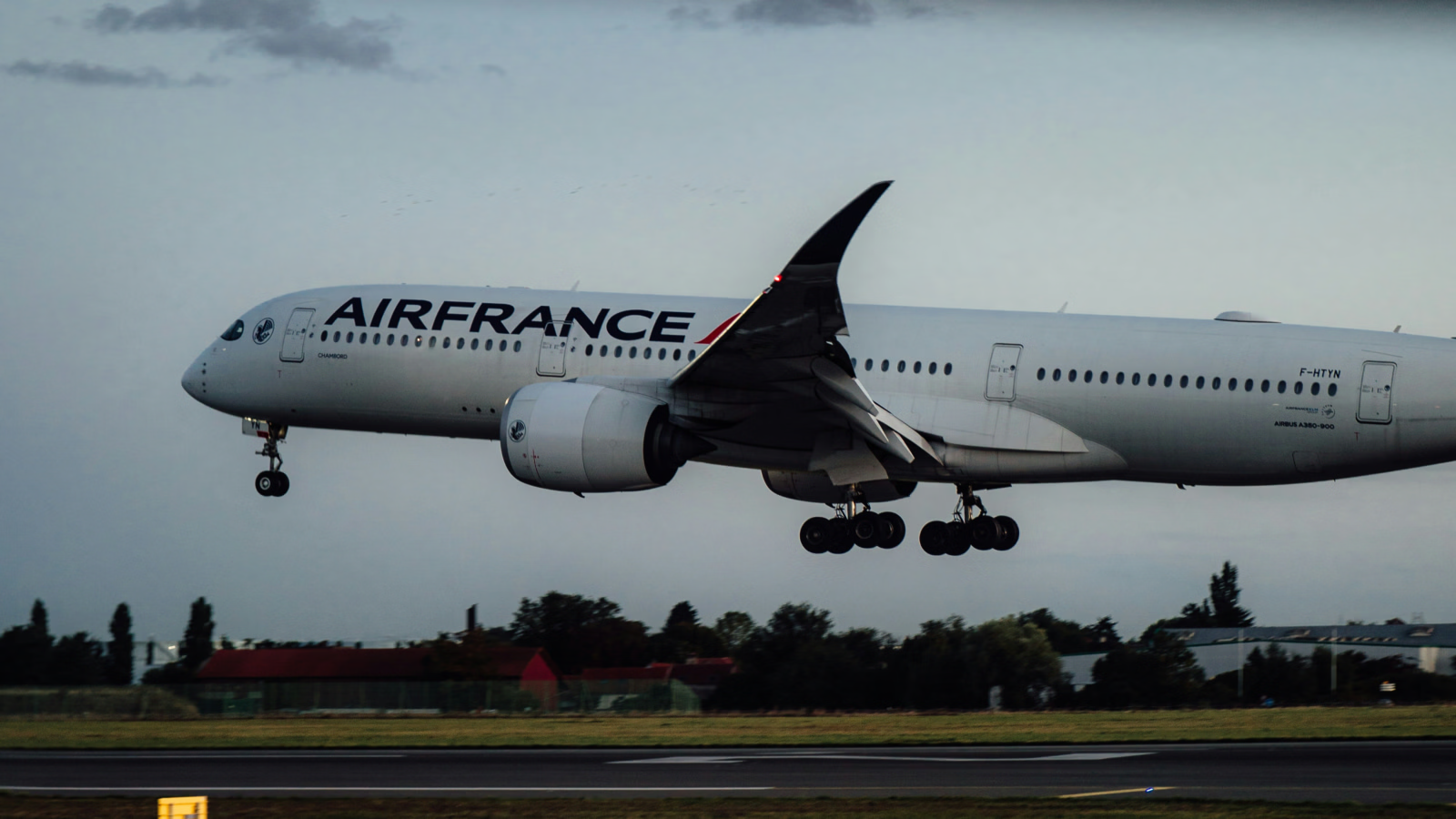
Air France-KLM Flying Blue prices Delta-operated transatlantic flights at lower mile counts than Delta does, particularly for premium cabins. Flying Blue runs Promo Rewards every month, with discounted award redemptions on rotating routes that often include Delta flights. The Flying Blue program guide covers the earning and redemption mechanics. Flying Blue transfers from Amex MR (1:1), Chase UR (1:1), Bilt (1:1), and Capital One (1:1).
The play, when you have Delta metal you actually want to fly, is to book it through one of these partners using transferable points instead of through Delta directly. You'll pay fewer miles for the same seat. The only catch is award availability: Delta releases partner award space less generously than its own SkyMiles flash sales, so you won't always find what you want on the dates you want it.
Delta SkyMiles Credit Cards in 2026
The Delta SkyMiles co-brand portfolio is your most reliable lever for earning miles, generating MQD, and (for some cards) accessing Sky Club lounges. American Express issues all of them. Quick rundown of the personal-card lineup as of April 2026:
- **Delta SkyMiles Blue.** No annual fee. Two miles per dollar on Delta and dining, one mile per dollar elsewhere. The right card for an occasional Delta flyer who wants priority boarding and a 20 percent inflight discount without paying a fee.
- **Delta SkyMiles Gold.** $150 annual fee (waived first year). Two miles per dollar at restaurants, US supermarkets, and on Delta. $200 Delta flight credit after $10,000 in spend. The first-checked-bag-free benefit alone covers the annual fee for travelers who fly Delta two or three times a year. There's a full Delta credit card comparison that breaks out the per-card math.
- **Delta SkyMiles Platinum.** $350 annual fee. Three miles per dollar on Delta and hotels, two miles per dollar at restaurants and US supermarkets. Annual companion certificate (main cabin, domestic) at renewal, which is the headline benefit. Status Boost adds 2,500 MQD when you spend $25,000 on the card in a calendar year.
- **Delta SkyMiles Reserve.** $650 annual fee. Three miles per dollar on Delta. Companion certificate good in first class, Comfort+, or Premium Select. Sky Club access (with a 15-visit cap, see below). 2,500 MQD per $25,000 of spend, repeating up to four times a year for 10,000 MQD. The card pulls hard for travelers chasing Platinum or Diamond status.
The business versions of the Gold, Platinum, and Reserve carry slightly different welcome offers and MQD accelerators but operate on the same template.
If your goal is to actually fly Delta multiple times a year, the Gold is the most straightforward value. If you're chasing Platinum or Diamond status, the Reserve plus the business Reserve pairing is the cleanest path under the MQD-only system.
Sky Club Access: The 2025 Rules
This is the single biggest change since the original version of this article was written. Effective February 1, 2025, Delta tightened Sky Club access in three meaningful ways:
- Reserve cardholders are capped at 15 Sky Club visits per Medallion year, unless they spend $75,000 on the card during the year, at which point unlimited visits resume.
- Consumer Amex Platinum cardholders no longer have Sky Club access at all. The grandfathered "fly Delta same-day on a paid ticket and get in" benefit was removed.
- Business Amex Platinum cardholders retain Sky Club access, but only on same-day Delta-marketed paid flights, with a 10-visit annual cap unless they spend $75,000 on the card.
The Reserve change in particular affects how you should think about the card. If you previously valued it as an unlimited-Sky-Club card, that math no longer holds for casual users. The card still makes sense for travelers who fly Delta heavily but don't fly enough to clear 15 visits, and for elite-chasers using the MQD accelerator. For travelers who used to lounge-hop on the consumer Amex Platinum, the access is simply gone. There's a full Sky Club access guide covering the remaining ways in (Delta One ticket, paid Sky Club membership, Centurion lounges via Delta-flight bookings on certain Amex cards). For the Reserve specifically, the updated Reserve review walks through whether the $650 fee still pencils.
Medallion Status Under MQD-Only
The 2024 status year was the first year of the MQD-only framework. The MQM and MQS thresholds are gone permanently. Qualification now runs on a single metric: Medallion Qualifying Dollars, earned through paid tickets and through Delta credit card spend. The current 2026 thresholds:
- Silver Medallion. 5,000 MQD.
- Gold Medallion. 10,000 MQD.
- Platinum Medallion. 15,000 MQD.
- Diamond Medallion. 28,000 MQD.
Delta lowered the thresholds twice between the original 2023 announcement and the 2026 status year after backlash. The numbers above reflect the current schedule. There's a Delta 360 invitation-only level above Diamond; Delta does not publish qualifying criteria for it.
The benefits scale predictably. Silver gets free same-day standby and a checked bag. Gold adds upgrade priority and 2x checked bags. Platinum gets a Choice Benefit (typically Regional Upgrade Certificates or a SkyMiles Gift), priority earlier in the upgrade queue, and 3x checked bags. Diamond gets four Choice Benefits, the highest upgrade priority, and Delta One upgrade eligibility.
Card-spend MQD is the cleanest accelerator. Status Boost on the personal Reserve generates 2,500 MQD per $25,000 of spend, four times per year. Pair the personal and business Reserves and you've stacked $200,000 of qualifying spend into 20,000 MQD, which puts Platinum within reach without flying Delta heavily. This is a real strategy, not a hypothetical, and it's why the Reserve is the card most aligned with status-chasers in 2026.
How to Actually Use SkyMiles
Here's the strategic call for a typical SkyMiles balance in 2026:
If you have fewer than 50,000 miles, your best move is a domestic short-haul redemption during one of Delta's flash sales. Off-peak redemptions clear at 7,500 to 12,000 miles each way and produce solid value for a balance you don't have a long-haul plan for.
If you have between 50,000 and 150,000 miles, you have two reasonable plays. Either stack toward a Delta One transcon flash sale (which clears around 95,000 miles each way), or transfer the discussion: stop earning SkyMiles directly and start funneling future miles through Amex MR, where the same future flight can be booked through Virgin Atlantic Flying Club or Flying Blue at a better rate.
If you have more than 150,000 miles, look hard at partner bookings before redeeming on Delta. A 200,000-mile Delta One ticket to Europe is, frankly, the worst option in front of you. The same seat through Virgin Atlantic Flying Club typically prices in the 90,000-to-120,000 range when availability opens up.
Across all three brackets, the underlying truth is the same: SkyMiles redemption value on Delta metal is below the program's competitors, the redemption value through partners is competitive, and the program's strongest assets are its earning network and its co-brand card portfolio rather than its award redemptions.
What I'd Actually Do
If I were building a SkyMiles strategy from scratch in 2026, I'd carry the SkyMiles Gold (or business Gold) for the Delta-spending multiplier and the checked-bag benefit, and I'd put my non-Delta dining and grocery spend on a Membership Rewards card so I have a flexible balance I can transfer to Flying Blue or Virgin Atlantic when an interesting sweet spot opens up. I'd add the Reserve only if I'm seriously chasing Medallion status or flying Delta enough to clear 15 Sky Club visits.
For redemptions, I'd treat SkyMiles as a domestic-and-flash-sale currency and let Membership Rewards carry the load for international premium cabins. That split puts every mile in the right pool: SkyMiles where Delta prices fairly (short-haul, sales), Amex MR where the partner programs price better (long-haul, business class).
That's the program in 2026. It's not the highest-value airline currency in the United States, but it's the easiest to earn at scale, and the partner-program workarounds keep its premium-cabin redemptions competitive even when Delta's direct redemptions don't.
This article contains affiliate links. If you apply through our links, we may earn a commission at no cost to you, which helps us continue sharing points and miles strategies with the community.
Some of the links in this article are affiliate links. We may receive a small commission at no extra cost to you if you apply through these links. This helps us keep the site running and continue creating free content.