Virgin Atlantic Flying Club is one of those programs that frequent flyers either rave about or completely overlook, and the overlookers are the ones leaving real money on the table. The program has three things working in its favor that nobody else in the loyalty space puts together quite this way: a published award chart that still tells you exactly what a redemption costs, a partner roster that includes Delta, ANA, and Air France-KLM, and access from five of the six major transferable currencies in the U.S. market. That combination turns Virgin Atlantic miles into one of the most flexible currencies out there, and it explains why the program shows up in so many trip reports from people booking premium cabins on Japanese and European carriers.
The headline reason most people end up paying attention to Virgin: 95,000 miles round-trip for ANA business class between the U.S. and Japan. That is the sweet spot the entire points world has been talking about for years, and at last verification it was still on Virgin's published award chart. We will get to that one in detail, but it is not the only reason this program deserves a slot in your strategy. The Delta One off-peak rate to Europe, the Air France La Première first-class redemption, the short-haul Delta domestic awards: there is genuinely a half-dozen different ways to extract real value here, and the program rewards readers who learn the structure rather than treating it as a generic transfer destination.
What follows is the full mechanics: how to earn the miles, how the award chart actually works, where the sweet spots live, how to search availability, how to book, and the traps that catch people who skip the prep work.
How to earn Virgin Atlantic miles
The earning side is genuinely the easiest part of this program, because Virgin Atlantic partners with nearly every major transferable points currency in the U.S. market at a clean 1:1 ratio. As of last verification, you can move points into Flying Club from:
- American Express Membership Rewards at 1:1, typically with periodic transfer bonuses of 20-30% running through the year.
- Chase Ultimate Rewards at 1:1, no transfer bonuses historically but the reliability is the point.
- Citi ThankYou Points at 1:1, occasional transfer bonuses.
- Capital One Venture Miles at 1:1, sometimes with promotional bumps to 1.25:1 or better.
- Bilt Rewards at 1:1, plus Bilt's monthly Rent Day promotions that frequently include a Virgin transfer bonus.
Five major currencies, all at 1:1, all transferring within 24-48 hours in most cases. That earning footprint is why Virgin Atlantic is one of the easiest premium-cabin currencies to accumulate without committing to a co-branded card. You can run a portfolio of flexible-point cards across multiple issuers, watch for transfer bonuses, and only move points when you have a specific award held or confirmed.
Bilt deserves a callout because the Rent Day promo (the first of every month) frequently runs a Virgin transfer bonus alongside the standard 100% point earning on rent. Stacking those two mechanics means you can build a Virgin balance from rent payments alone, which most readers do not realize is possible.
Beyond transfers, you can earn Virgin miles by flying Virgin Atlantic itself or any of its partner airlines (Delta, ANA, Air France, KLM, and the broader SkyTeam roster credit to Flying Club). Co-branded Virgin Atlantic credit cards exist but are mostly geared to the UK market, so the transfer path is what matters for U.S. readers.
One housekeeping note that catches people: Virgin Atlantic miles expire after 36 months of account inactivity. Any earning or redemption activity resets the clock. A single transfer in or out keeps your balance alive for another three years, so this is not a program where points evaporate on you if you are paying any attention at all.
The award chart structure
Virgin Atlantic still publishes an award chart, which puts the program in a small and shrinking club of legacy programs that have not moved to dynamic pricing. The chart is zone-based: it groups destinations into regions, then prices flights based on the route, cabin, and whether you are flying in peak or off-peak season.
The basic structure for partner awards looks like this:
- U.S. to Europe in Delta One business class: 50,000 miles one-way off-peak, 57,500 peak.
- U.S. to Japan on ANA in business class: 47,500 miles one-way off-peak, plus a small fuel surcharge. Round-trip pricing of 95,000 miles in biz is the published rate.
- U.S. to Japan on ANA in first class (where offered): 110,000 miles one-way.
- Europe to East Africa in business: roughly 37,500 miles one-way, depending on routing.
- Domestic U.S. on Delta in coach: 7,500-12,500 miles one-way short-haul, 12,500-20,000 miles in first class.
Off-peak versus peak is published in Virgin's calendar and skews heavily in the redeemer's favor: most of October through May is off-peak on transatlantic and transpacific routes, with carve-outs around major holidays. Tuesday-through-Thursday departures price out cheaper than weekends on many routes too. If you can flex your travel dates by even a few days, the off-peak rate is often 15-25% cheaper than peak.
Sweet spots worth saving for
Here is where Virgin Atlantic earns its reputation, and the order below is roughly how I would rank these by value-per-mile.
1. ANA business class, U.S. to Japan: 95,000 miles round-trip. This is the sweet spot of sweet spots. ANA's business class (The Room on the 777, The Suite on the 777-300ER) is one of the best business products flying. Cash fares routinely run $7,000-$9,000 round-trip from the West Coast and higher from the East Coast. At 95,000 miles for a round-trip in that cabin, you are extracting north of 7 cents per mile in value, which is multiples above what a transferable point would get you in almost any other booking. The trick: ANA awards on Virgin require a phone call to book, and availability is tight. We will cover the workflow below.
2. Delta One business class to Europe, off-peak: 50,000 miles one-way. Delta sells its own SkyMiles awards dynamically, often pricing this same seat at 100,000-150,000 SkyMiles or more. Going through Virgin Atlantic, you get a flat 50,000-mile off-peak rate. If you are flying transatlantic in winter, spring, or fall and avoiding major holidays, this is probably the single best Delta One redemption available anywhere in the points world.
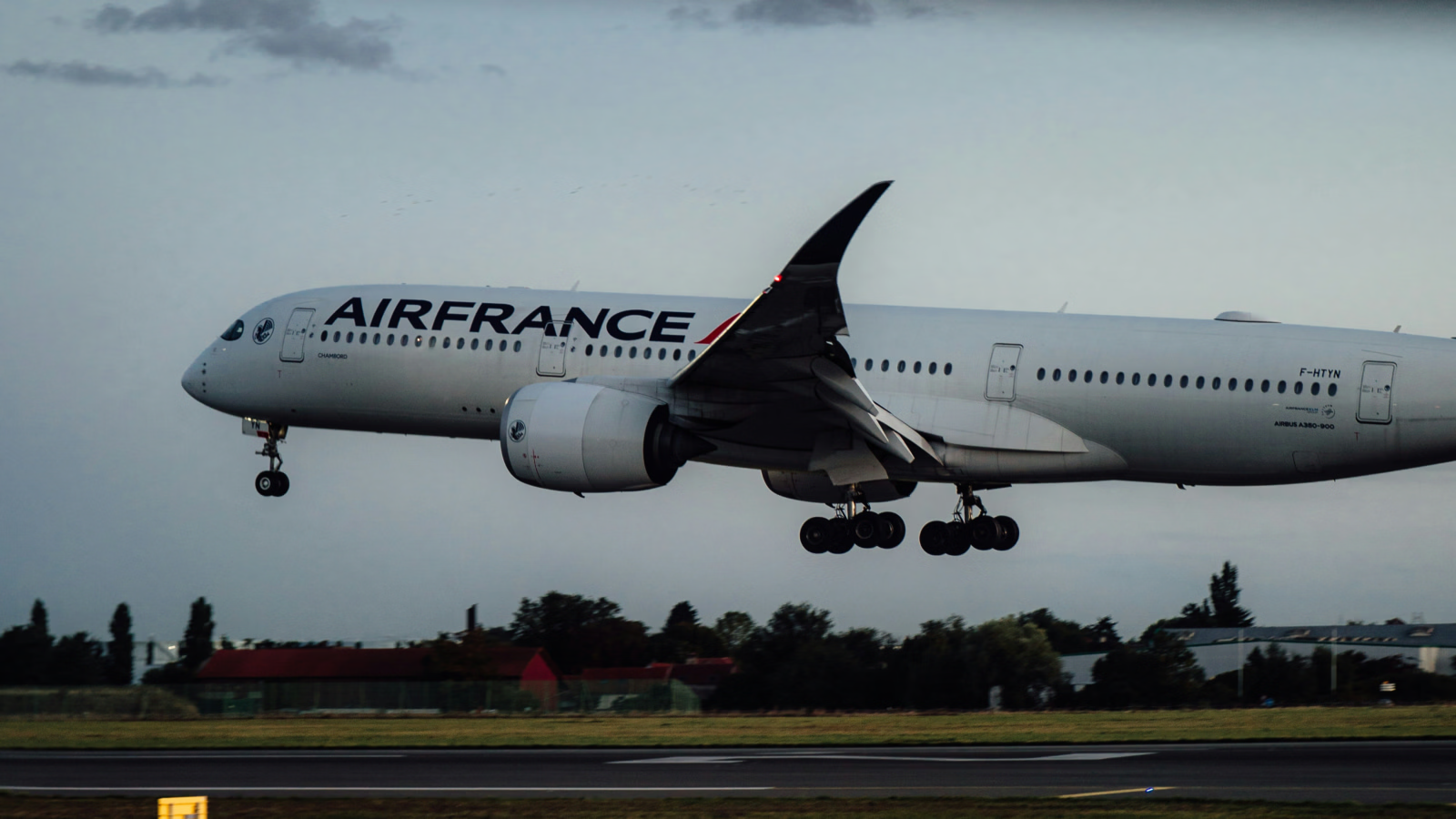
3. Air France La Première, U.S. to Paris: 100,000 miles one-way. La Première is Air France's first-class product, and it is genuinely one of the top three first-class experiences in the sky. Booking it through Flying Blue typically costs 200,000+ miles plus fees. Virgin Atlantic prices it at a published 100,000 miles one-way, which is a significant discount if you can find the availability, which is a real if. La Première releases very few award seats.
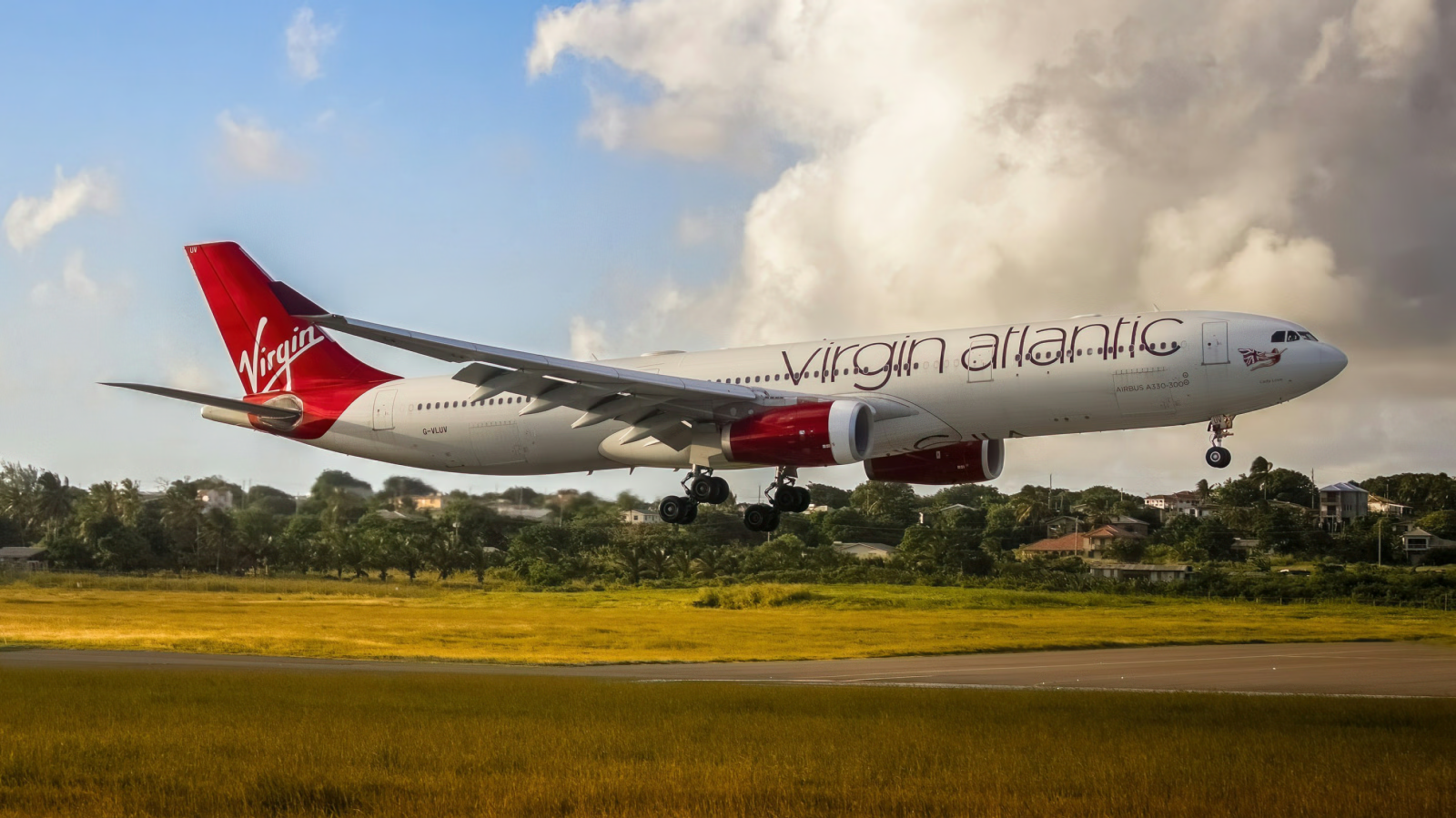
4. Virgin Atlantic Upper Class, U.S. to London: 50,000-60,000 miles one-way. This is Virgin's own premium product, and it is solid: flat-bed seats, decent food, the Clubhouse lounge on the LHR side. The catch here is fuel surcharges out of Heathrow, which we will discuss in the UK APD section. The redemption is fine when you can find an inbound from London where the surcharges are smaller, or when you accept the surcharge cost as the price of admission.
5. Delta domestic first class: 12,500-20,000 miles one-way. Underrated. A transcon Delta One flight (JFK-LAX, JFK-SFO, BOS-LAX, BOS-SFO) can price as low as 20,000 Virgin miles when you find availability, versus Delta's own dynamic pricing that frequently runs 40,000-80,000 SkyMiles for the same seat. Short-haul domestic at 7,500-12,500 miles in coach is also competitive for what Delta charges in cash on shorter routes.
6. Europe to East Africa in business class: 37,500 miles one-way. This one rewards readers who think in terms of multi-leg trips. You can position to Europe on a separate award, then connect onward to Nairobi, Kigali, or Johannesburg in Kenya Airways business class for 37,500 miles. That is a phenomenal rate for a long-haul intra-Europe-to-Africa segment in a flat-bed seat.
How to search availability
Virgin Atlantic's own website does not show partner award availability for most carriers, which is the program's biggest frustration. You have to search elsewhere and then call to book (or in some cases book online once you know what is available).
Here is the workflow that actually works:
-
Delta partner awards: Search on Delta.com. Look for "Saver" or low-level partner award space on the routes you want. Once you see availability on Delta's site at a reasonable SkyMiles price, that same seat is almost always bookable through Virgin Atlantic for the published partner rate. Delta One off-peak transatlantic shows up here regularly.
-
ANA partner awards: Search on United.com (United is a Star Alliance partner with ANA and shows ANA award space cleanly). Find ANA business or first class space on the routes and dates you want, note the flight numbers, then call Virgin Atlantic to book. ANA awards on Virgin are phone-only.
-
Air France and KLM partner awards: Search on AirFrance.com or KLM.com. Look for award seats at the lowest level. Once found, call Virgin Atlantic.
-
Virgin Atlantic's own flights: Search directly on Virgin's website.
The phone-booking requirement for ANA is the single biggest barrier for new Flying Club users. Virgin Atlantic charges a phone-booking fee (currently around $25-$50 depending on the agent), and the agents themselves vary wildly in how comfortable they are pricing partner awards. If the first agent cannot find what you are looking for, HUACA (hang up and call again). This is a normal part of working with Virgin's call center.
Booking workflow
Online bookings are limited to Virgin Atlantic's own flights and a subset of Delta routes. Everything else (ANA, Air France, KLM, Kenya Airways, the rest of the partner network) requires a phone call to Flying Club. The phone-booking fee runs roughly $25-$50 in most cases, occasionally waived when an online booking is impossible due to a known system issue.
The right sequence is always: confirm partner availability first (Delta.com for Delta, United.com for ANA, AirFrance.com for AF/KLM), then transfer points only after you have verbal confirmation from a Virgin agent that they can see the same award space at the published price. Transfers from Chase, Amex, Citi, Capital One, and Bilt are one-way and irreversible. Moving 95,000 Amex points to Virgin and then finding out the ANA award is gone is a bad day.
For ANA specifically: have the flight numbers, dates, passenger names, and a backup itinerary ready before you dial. Agents work faster when you do the homework.
The UK APD problem
The single biggest catch with Virgin Atlantic redemptions is fuel surcharges and UK Air Passenger Duty (APD) on flights departing London Heathrow. A round-trip Virgin Upper Class booking from JFK to LHR and back can carry $800-$1,200 in cash co-pays on top of the miles, almost all of it driven by the LHR outbound leg. That is not a small footnote. It can turn a great award into a mediocre one.
How to minimize it:
- Book one-way awards. Take the cheap-direction trip (U.S. to London) on Virgin Atlantic miles, then either fly back on a different carrier (cash or other miles) or position out of LHR by train to a nearby European city and fly home from there.
- Use partner airlines that do not pass through London. ANA U.S.-Japan awards have minor Japanese fuel surcharges but nothing like the APD problem. Delta One transatlantic flights to Amsterdam, Paris, or Rome do not get hit by UK APD because they do not touch London.
- Position by Eurostar. A train from London to Paris is under $200 and lets you depart from Paris on Air France or KLM (where APD does not apply) instead of from Heathrow.
The pattern most experienced Flying Club users follow: outbound to London, but never the return. Or, if you want Virgin's Upper Class product specifically, book it as the inbound from LHR-to-U.S. and find your way to London by other means.
Peak versus off-peak
Virgin Atlantic publishes its peak and off-peak calendar, and the difference is real money. Off-peak generally covers most of October through May with carve-outs around Christmas, New Year, Easter, and major school holidays. Peak covers summer, Christmas week, and the school holiday windows.
A U.S.-Japan ANA business class redemption is 47,500 miles one-way off-peak and 55,000 miles peak. A U.S.-Europe Delta One redemption is 50,000 miles off-peak and 57,500 peak. Across a round-trip with a partner and a kid, the off-peak savings add up to a free additional award ticket pretty quickly.
If you have any flexibility in your travel calendar, off-peak Virgin redemptions are where the program really shines. The shoulder seasons (October, November, February, March, early May) tend to have the best combination of availability and off-peak pricing.
Upgrade awards
Virgin Atlantic offers upgrade awards from paid economy or premium economy into Upper Class on its own flights. The math on these is rarely better than just booking an Upper Class award outright. You are paying a published cash fare plus miles to upgrade, when in many cases you could have booked the same Upper Class seat for 50,000-60,000 miles one-way directly. Upgrade awards make sense in very narrow cases, usually when you already had to take a specific cash itinerary for other reasons, but as a strategy, they are not where the program's value lives.
If you are excited about flying Virgin Upper Class, book the award directly. Skip the upgrade path.
Virgin Atlantic versus the alternatives
A few comparisons that come up constantly.
Versus Delta SkyMiles. Delta sells the same Delta One transatlantic seat for 100,000-150,000 SkyMiles dynamically priced. Virgin Atlantic books that same seat for a flat 50,000 miles off-peak. There is no scenario where SkyMiles is the right currency to book a Delta One transatlantic award if you can use Virgin instead. None.
Versus ANA Mileage Club. ANA's own program prices its own metal a bit lower in some cases (round-the-world awards in particular are a sweet spot), but ANA's program is harder to earn into (Amex is the only U.S. transfer partner) and has its own quirks. For a straightforward U.S.-Japan round-trip in business, Virgin Atlantic at 95,000 miles is the cleaner play.
Versus Air France-KLM Flying Blue. Flying Blue is dynamically priced these days, which means promo awards exist but standard pricing is often higher than Virgin's published chart. For Air France La Première specifically, Virgin's 100,000-mile rate beats Flying Blue's pricing by a wide margin when La Première space is available.
Versus United MileagePlus. United's program is excellent for Star Alliance partners (Lufthansa, Singapore, Swiss) but cannot book ANA via the Virgin pricing. You would book ANA on United at United's own dynamic rates, which are higher. Different programs for different metal.
The general rule: when you want to book Delta, ANA, Air France, or KLM premium cabins from the U.S., check Virgin Atlantic Flying Club first. It is the lowest-cost path more often than not.
Common mistakes
The patterns that catch new Flying Club users, in rough order of frequency:
- Transferring points before confirming the award. Always confirm availability and pricing with a Virgin agent (or via a successful online booking attempt) before moving points in. Transfers are irreversible.
- Ignoring the off-peak calendar. Booking a peak-season redemption when shifting by a week would have saved 15-25% of the mileage cost.
- Missing the ANA phone-call requirement. ANA awards cannot be booked online on Virgin's website. You have to call. Plan for it.
- Overlooking UK APD. Routing through London on a round-trip without modeling the fuel surcharge cost can add $800-$1,200 to what looked like a great award.
- Booking upgrade awards instead of straight awards. Upgrade awards on Virgin are almost always worse value than booking the premium cabin directly.
- Forgetting that Virgin miles expire on 36 months of inactivity. This one is easy to fix (a single transfer in or out resets the clock), but people lose balances over it anyway.
Action plan
If you are new to Flying Club and trying to figure out where to start, here is the sequence I would actually run:
- Open accounts at Chase, Amex, Capital One, and Bilt if you do not already have flexible points. The Chase Sapphire Preferred and Chase Sapphire Reserve are the highest-leverage starting points for Chase Ultimate Rewards, and the Capital One Venture X gives you another transferable currency at 1:1 to Virgin. Bilt is the rent-payment play.
- Sign up for a Virgin Atlantic Flying Club account. Free, takes two minutes.
- Identify the redemption you want first. ANA business U.S.-Japan is the headline target for most readers. Delta One off-peak transatlantic is the runner-up.
- Search availability on the right tool. United.com for ANA. Delta.com for Delta. AirFrance.com for AF/KLM.
- Call Virgin Atlantic to confirm pricing and hold the seat (where holds are possible).
- Transfer the exact number of points needed. Not more. The transfer is one-way.
- Book the award. Pay the small phone-booking fee if applicable.
- Track your account activity to keep the 36-month expiration clock from running out on any residual balance.
Virgin Atlantic Flying Club is one of the rare programs where the math still works the way you want it to: published chart, real partners, transferable from almost everywhere, and a handful of redemptions that punch dramatically above what dynamic-pricing competitors charge for the same seat. The program rewards readers who learn the structure rather than treating it as a generic transfer destination. Spend an hour with the chart, identify the redemption that gets you excited, and start building the balance toward it.
This article contains affiliate links. If you apply through our links, we may earn a commission at no cost to you, which helps us continue sharing points and miles strategies with the community.
Some of the links in this article are affiliate links. We may receive a small commission at no extra cost to you if you apply through these links. This helps us keep the site running and continue creating free content.