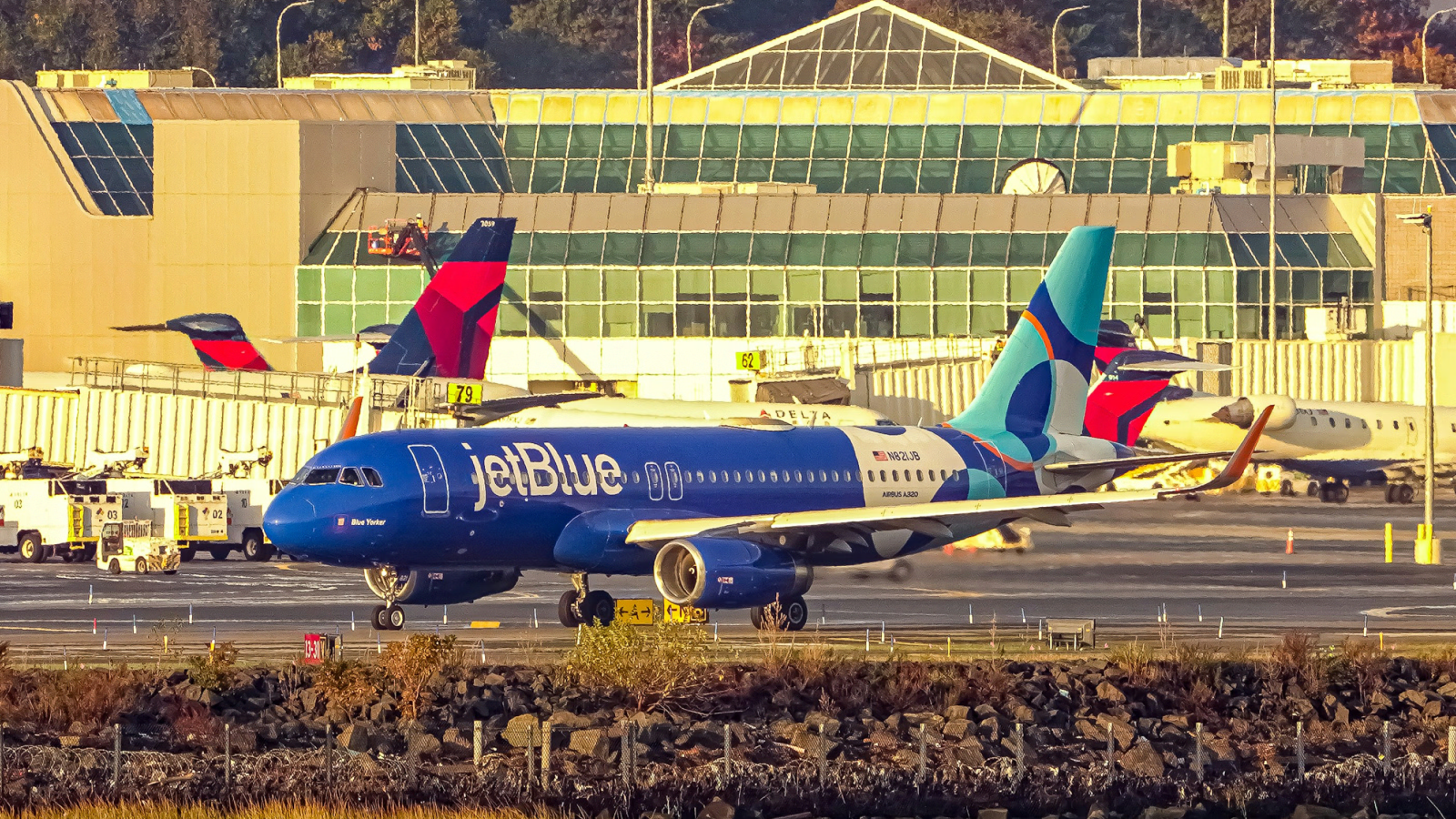
Two months into JetBlue's merger exploration, no deal has been announced and no clear front-runner has emerged. The carrier hired financial advisers in March 2026, the stock jumped about 13 percent on the news, and the names that kept surfacing as potential partners were United, Alaska, and Southwest. Since then, public statements have been measured, the regulatory mood has stayed mixed, and TrueBlue members have been left holding miles in a program that may or may not exist in its current form a few years out.
I sat down to write this because the questions I keep getting from friends and readers are basically the same: should I burn my TrueBlue miles now, should I cancel my JetBlue card, and should I be moving aggressively into a partner program. The honest answer is more boring than any of those, and it depends on which of these scenarios actually plays out. So here is where each one stands today, what the historical record suggests is likely, and what I am actually doing with my own TrueBlue balance while we wait.
The takeaway: every major U.S. airline merger in the last fifteen years devalued the acquired program within 18 to 36 months. Diversify into transferable points now, book the aspirational Mint redemption you have been putting off, and keep your JetBlue cards open until a deal is signed.
Why JetBlue Is Seeking A Merger Now
JetBlue has not posted an annual profit since 2019. The carrier carries roughly $7.3 billion in net debt as of the most recent filings, and its margins have lagged the big four U.S. carriers consistently through the post-pandemic recovery. The previous attempt to merge with Spirit Airlines was blocked on antitrust grounds in early 2024, and the Northeast Alliance partnership with American Airlines was unwound by court order around the same time. Neither outcome made standalone survival easier.
The regulatory window is part of why this is happening now. The current administration has been more open to airline consolidation than the previous one, and that posture is unlikely to last past the next election cycle. From management's perspective, if a merger was going to happen, the next 18 months were the realistic window to get a deal announced, reviewed, and approved. Waiting longer carried the risk of a less friendly DOJ and a more hostile reception from the courts.
The reason this matters for points members is straightforward. A struggling carrier with a strong loyalty program is a takeover candidate, and the loyalty program is usually one of the cleanest assets on the balance sheet. TrueBlue is profitable. Mint is a respected premium product. The Boston and JFK slots have real strategic value. Whichever airline ends up buying JetBlue is buying access to the Northeast and to a customer base that flies a particular kind of route that the big network carriers serve less efficiently.
The United Scenario
United is the name that has been mentioned most often in industry reporting, and it is the scenario I assign the highest probability to today. The two carriers already operate a partnership called Blue Sky, which gives TrueBlue and MileagePlus members reciprocal earning on selected flights. United's CEO Scott Kirby publicly said the ball was in JetBlue's court, which is the kind of statement that gets made when conversations have already been happening.
For points value, United would be the best outcome on international premium redemptions. MileagePlus has access to Star Alliance, which is 26 carriers including Lufthansa, ANA, Singapore Airlines, and Turkish. The redemption rates on Polaris business class through partner programs like Avianca LifeMiles and Aeroplan are some of the most consistently bookable in the market. A TrueBlue member who converted into MileagePlus would gain a route map and partner network that TrueBlue cannot match on its own.
The risk in this scenario is regulatory. United has Newark, JetBlue has JFK and Boston. Combining those three airports in a single carrier would face heavy DOJ scrutiny, and slot divestitures are almost certain. The Boston market is where I expect the most friction. JetBlue and Delta are the two biggest carriers there, and a United-JetBlue combination would consolidate enough Boston capacity to draw genuine antitrust attention.
The Mint product is the other open question. United has Polaris on widebody international flights, but Mint flies on narrowbody transcons and to the Caribbean. My guess is that Mint as a brand survives for two to three years after a deal closes, then gets folded into a unified premium product on the surviving fleet. The transcon market is competitive enough that whoever owns those routes will keep flying lie-flat seats; the question is just what they call them.
The Alaska Scenario
Alaska is the scenario I find most strategically interesting and least operationally likely. The networks barely overlap. Alaska is the West Coast plus a growing transpacific franchise built on the Hawaiian Airlines acquisition. JetBlue is the Northeast plus Florida plus the Caribbean. A combined carrier would be coast-to-coast in a way that mirrors what Virgin America and Alaska tried to build a decade ago, with more scale on each end.
For TrueBlue members, the appeal would be Alaska Mileage Plan, which is still one of the best mid-tier programs in the country. Some partner award charts remain distance-based, the Cathay Pacific, Japan Airlines, and Qantas partnerships are usable for genuine sweet-spot redemptions, and Mileage Plan elite status has historically been easier to maintain than the equivalent on United or American. The companion fare benefit on the Alaska Airlines Visa Signature pairs especially well with a coast-to-coast route map.
The reason I rate this as less likely is timing. Alaska is still mid-integration of Hawaiian, which closed in September 2025. The IT consolidation, fleet harmonization, and crew contract work for that merger will extend well into 2027. Layering a JetBlue acquisition on top of an unfinished Hawaiian integration would be unprecedented in U.S. aviation. Alaska's management has been clear publicly that the Hawaiian integration is the priority, and an opportunistic JetBlue purchase would stretch the operations team thin in ways that have historically caused merger problems.
The fleet question compounds the timing issue. Alaska is essentially all-Boeing, with 737s as the mainline workhorse and Embraer regional jets through Horizon. JetBlue runs four Airbus types: A220, A320, A321, and A321LR. That is not a small operational difference. Pilot bidding, maintenance bases, training infrastructure, and parts inventory all become significantly more complex with a mixed-fleet acquisition. None of this is fatal, but all of it is expensive and slow.
The Southwest Scenario
Southwest is the wild card. The fleet incompatibility argument is genuine, since Southwest operates only 737s and JetBlue operates none, but the strategic logic has gotten more interesting in the past year. Southwest announced moves toward assigned seating and premium cabin offerings in 2024 and 2025, which is a significant departure from the cattle-call boarding model that defined the carrier for decades. The leadership team has been openly discussing moving the airline upmarket.
JetBlue's Mint experience and customer base would accelerate that evolution. If Southwest is going to add premium seating and assigned boarding, acquiring an airline that already runs a respected premium product across most of its network is a faster path than building one from scratch. The Northeast hub gap is also real. Southwest is weak in JFK, weak in Boston, and absent at LaGuardia. JetBlue would fill those gaps in a way that no other target could.
The points problem in this scenario is significant. Rapid Rewards is a revenue-based program with dynamic pricing, no airline partner network beyond Southwest itself, and no premium-cabin redemption opportunities of the kind TrueBlue and Mint enable today. A TrueBlue member converting into Rapid Rewards would get a more consistent domestic redemption value but would lose access to Mint as a points play entirely.
The upside is the Companion Pass, which is one of the best benefits in U.S. airline loyalty. Earn 135,000 Rapid Rewards points or fly 100 qualifying segments in a calendar year and you get a companion who can fly with you for taxes and fees on every Southwest flight for the rest of that year and all of the next. For families and frequent leisure travelers, that single benefit can be worth more than a year of elite status on any other carrier. If the merger went this direction, getting the Companion Pass before the integration completed would be the obvious play.
The American Dark Horse
American Airlines is not in any current reporting on the JetBlue exploration, but I think it deserves a mention because the Northeast Alliance history matters. American and JetBlue ran a coordinated partnership in Boston and New York from 2020 until a federal court ordered it unwound in 2023. The two carriers' networks fit together cleanly, and the operational integration was already partially built before the court intervened.
The reason American is unlikely today is balance sheet. AA has been working through its own debt overhang and has not signaled appetite for a major acquisition. But the airline industry is cyclical, oil prices move, and if a year from now American's financial position has improved and the JetBlue exploration has stretched longer than expected, AA emerging as a bidder would not surprise me. The Oneworld alliance access through AAdvantage would be the points upside, with the British Airways, Iberia, Japan Airlines, Qatar, and Qantas partnerships still offering genuine sweet spots for award travelers. The Boston market integration that the Northeast Alliance was already building toward would also resume more naturally under common ownership than it ever could as a partnership.
What TrueBlue Holders Should Actually Do Now
The most important thing is not to panic. No merger announcement is imminent, and even if a deal gets signed in the next six months, the integration timeline puts any program changes 18 to 36 months out. There is no need to make hasty decisions with TrueBlue miles this week or this month.
First, diversify into transferable points. The Chase Ultimate Rewards, American Express Membership Rewards, and Citi ThankYou ecosystems each have multiple airline and hotel partners that protect you against any single program devaluing. If your loyalty has been concentrated on JetBlue, this is the moment to widen the base. The Chase Sapphire Preferred is the most accessible entry point at a moderate annual fee, and the Chase Ink Business Preferred carries a strong welcome bonus if you have a side business or any qualifying self-employment income. The Amex Platinum is heavier on annual fee but pairs well with Mint redemption opportunities through the Centurion lounge network at JFK, LAX, and the Caribbean gateways.
Second, book your aspirational Mint redemption now. Mint to London, Mint to Paris, Mint to the Caribbean in premium, all of these are still bookable through TrueBlue and through points pooling at reasonable rates. If you have been saving TrueBlue miles for a high-value redemption, the case for sitting on them weakened the moment merger exploration became public. Burn the speculative balance on a trip you actually want to take in the next twelve months.
Third, do not cancel your JetBlue cards yet. Card cancellations during a merger usually trigger transition bonuses or status matches at some point in the integration, and being a current cardholder is the cleanest way to qualify. The annual fee on the JetBlue Plus is modest enough to justify holding through the uncertainty.
Fourth, watch your Mosaic status if you have it. Status matches in U.S. airline mergers have generally been generous, and Mosaic members have historically been matched into either MileagePlus Gold or Alaska MVP Gold equivalents depending on which carrier ended up acquiring. If you are close to a Mosaic threshold this year, the case for pushing through to qualify just got stronger, since the status will likely carry forward in some form. The lookback rules JetBlue has used in recent years to recognize lifetime mileage and tenure also tend to influence how transition bonuses get structured, so longstanding Mosaic members usually fare better in a status match than newer arrivals at the same tier.
What Past Mergers Tell Us
The Alaska and Virgin America merger that closed in 2016 is the best-case template. Elevate points converted to Mileage Plan at a generous ratio, Virgin elite status was matched cleanly, and the integrated program retained the distance-based earning structure that made Mileage Plan attractive in the first place. The losers were Virgin loyalists who valued the in-flight experience, but the points and miles outcome was the best in any recent U.S. merger.
The United and Continental merger that closed in 2010 is the cautionary tale. The integration took years longer than projected, the merged MileagePlus program absorbed and then quietly devalued several of the better partner redemption sweet spots, and the customer service impact lingered into 2012 and 2013. For points members, the practical result was that miles got worse on a delayed timeline, with multiple smaller cuts rather than one big one. Anyone who held large balances through that period saw their effective value erode steadily.
The American and US Airways merger that closed in 2013 was smooth at the operational level, particularly compared to United-Continental. The AAdvantage program was preserved, and the early years were stable for elites and award travelers. But the devaluations came eventually. The 2016 award chart change tightened business class redemptions on partner carriers, and the elite qualification rules got harder to meet through the rest of the decade. The lesson here is that even a well-run merger usually devalues the acquired program within a few years of close.
The pattern is consistent enough that I treat it as a planning assumption. If a TrueBlue acquisition happens, expect the integration to be slower than promised, expect at least one meaningful devaluation within 24 months of close, and expect partner award charts to be the first place the cuts show up.
Realistic Timeline
A merger announcement could come at any point from later this year through 2027, but the regulatory review alone typically runs 12 to 18 months for a transaction of this size. Add operational integration on top, which is usually a multi-year project, and the practical timeline before TrueBlue as we know it changes meaningfully is at least 18 months from any announcement and more likely 24 to 36 months from today.
In practical terms, here is how the next two years are most likely to unfold if a deal materializes. The first six months after announcement are filled with regulatory filings, public comment periods, and DOJ review. The TrueBlue program runs unchanged during this period, and elite benefits hold. Months six through twelve bring the bulk of the antitrust analysis, potential slot divestitures, and any settlement negotiations needed to close. Months twelve through twenty-four cover the close itself plus the first wave of operational integration, which is when status matches and transition bonuses typically get announced. The first major TrueBlue program change usually comes in the second year post-close, often with limited advance notice.
That means decisions made this week about TrueBlue miles will play out against a backdrop of significant uncertainty for at least two years. The good news is that uncertainty is also opportunity. Mint redemption space tends to open up during periods of corporate transition because revenue management gets more conservative about unsold premium inventory. Status matches and transition bonuses cluster around merger announcements and integration milestones. Being a thoughtful, well-positioned TrueBlue holder through the next two years could end up extracting more value from the program than passive loyalty over the prior decade.
Bottom Line
JetBlue is exploring a merger because the financial pressure is real, the regulatory window is open, and standalone survival has gotten harder to model. United is the most likely partner, Alaska is the most strategically interesting, Southwest is the wild card, and American is the dark horse that nobody is currently talking about. Each scenario produces a different points outcome, but every realistic outcome involves some erosion of TrueBlue's current value within a few years of any deal closing.
The right response is not panic, not paralysis, and not premature mileage burns. The right response is diversification into transferable points, an aspirational Mint redemption while the program is still bookable on its own terms, and patience on card cancellations and elite status. Past mergers have rewarded patient, attentive members and punished people who either over-committed to the dying program or jumped ship too early. I plan to keep my TrueBlue balance modest, my Mint bookings active, and my JetBlue Plus open, and to revisit the analysis every quarter as the picture gets clearer.
This article contains affiliate links. If you apply through our links, we may earn a commission at no cost to you, which helps us continue sharing points and miles strategies with the community.
Some of the links in this article are affiliate links. We may receive a small commission at no extra cost to you if you apply through these links. This helps us keep the site running and continue creating free content.