Seven weeks ago, Delta announced a partnership with Amazon Project Kuiper to retrofit roughly 500 aircraft with low-earth-orbit satellite WiFi starting in 2028. The promise was free, fast connectivity for SkyMiles members across the entire mainline fleet. The press cycle was loud. The CEO quote about connectivity being "as essential as a comfortable seat" landed everywhere.
Sitting here in late May, the announcement still reads as the biggest scale commitment any U.S. carrier has made to inflight connectivity. It is also still a 2028 announcement. There are no equipped aircraft flying. No published speed tests. No list of first routes. Everything Delta said in April remains a forward-looking statement, and the carriers competing on the same product are already shipping. Here is what we actually know seven weeks in, and what is still vapor.
Delta's Kuiper deal is real in scope and unproven in execution. American Airlines already offers universal free domestic WiFi, United is mid-rollout with Starlink, and Delta is asking loyalists to wait until at least 2028 for a SkyMiles-gated answer.
What Delta Actually Committed To
The April 3 announcement laid out specific numbers. Roughly 500 aircraft across the Delta mainline fleet will be retrofitted with Amazon Project Kuiper satellite terminals, with the rollout beginning in 2028. Domestic flights are targeted first, with international widebody coverage following in the 2029-to-2030 window. The expected experience: free WiFi for SkyMiles members, no session fees, no tiered speed plans, no per-flight passes.
The 500-aircraft figure is the part that matters. That is essentially the entire mainline Delta fleet, not a trial subset. Most carriers test on a handful of planes for a year or two before committing fleet-wide. Delta skipped that phase publicly. Whether the operational reality matches the announcement is a question for 2028.
Free access stays tied to SkyMiles membership, the same gating Delta has used since it flipped its current Viasat product to free for members in early 2023.
The LEO Versus GEO Technology Reality
The technology gap between Project Kuiper and the legacy inflight WiFi providers is real, and it is the actual reason Delta made this bet.
Traditional inflight WiFi uses geostationary satellites parked around 22,000 miles above the equator. The physics produce high latency and slow throughput, and coverage falls apart over oceans. Anyone who has tried to load a webpage over the Atlantic on a 777 knows the experience.
Low-earth-orbit constellations like Project Kuiper and SpaceX Starlink operate at roughly 370 miles altitude. The latency is comparable to home broadband. Video calls work. Streaming holds. United is already demonstrating this on Starlink-equipped aircraft, where early reports describe a meaningful jump in usability over the older GEO-based products.
The catch: that ceiling means little until aircraft are actually flying with the equipment installed. As of late May, Delta has zero Kuiper-equipped planes in the air.
Where The Industry Now Sits
The competitive picture today:
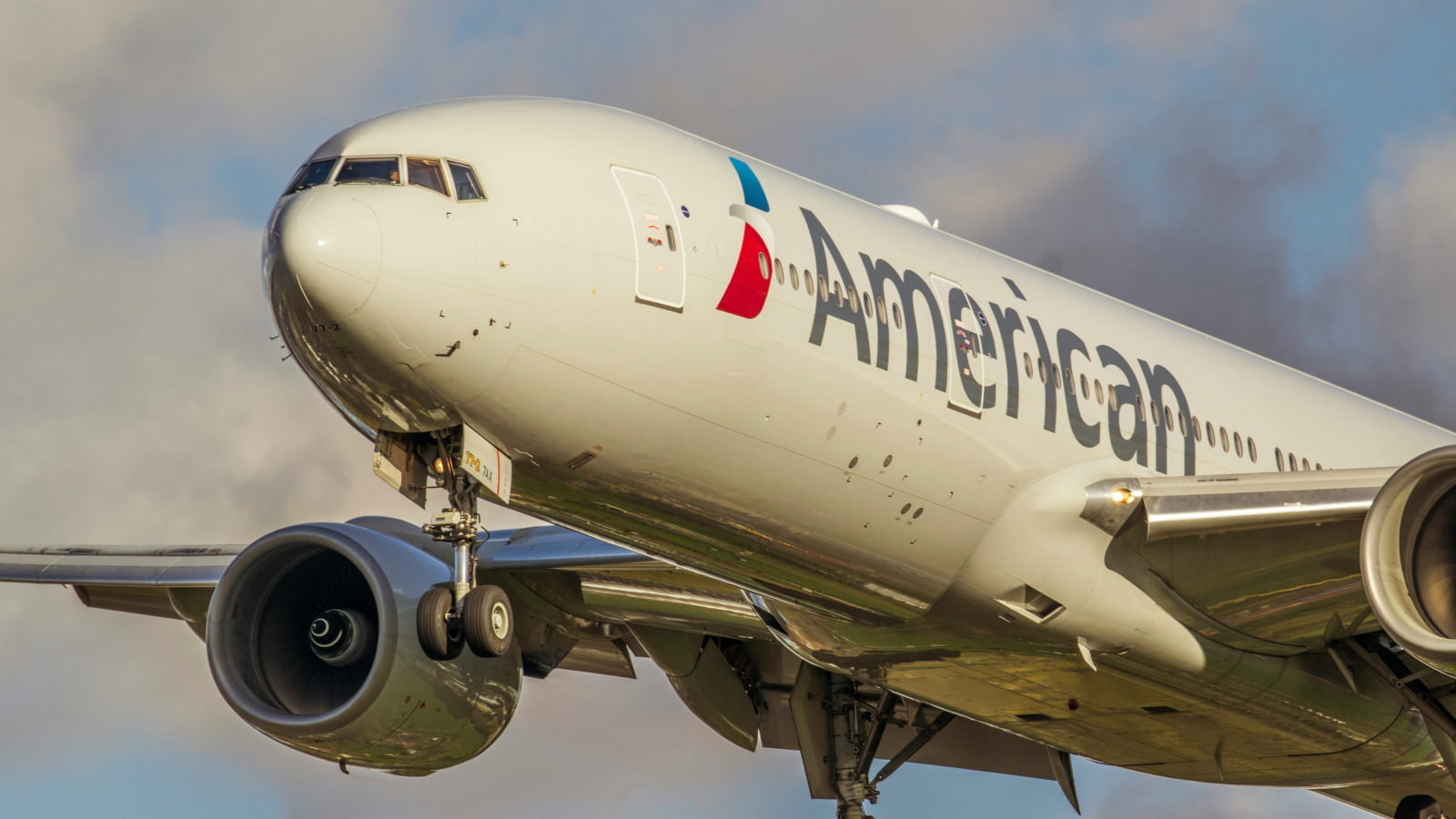
American Airlines finished its free domestic WiFi rollout in 2025. No AAdvantage login, no membership requirement, no email gate. It is the simplest free-WiFi experience on a U.S. carrier and it is live now on every domestic narrowbody.
United continues rolling out Starlink across its fleet through 2026 and into 2027. Coverage is patchy but expanding monthly, with positive early reports on speed. It is operational LEO connectivity flying today.
Delta sits in a strange position. Its current Viasat-based free product is the most consistent of the GEO offerings. Its future Kuiper product is the most ambitious announcement in the industry. The gap between those two states is roughly two and a half years of waiting. For 2028 and beyond, Delta could leapfrog both AA and United. That is the bet.
The SkyMiles-Linked Catch
The detail that gets glossed over in the press coverage: Delta is tying Kuiper access to SkyMiles membership, not making it universally free.
That keeps Delta consistent with its current model, where the existing free Viasat WiFi requires a SkyMiles account. United uses the same playbook with MileagePlus. American Airlines does not. AA's free domestic WiFi requires nothing.
The friction is small but real. Occasional Delta flyers without a SkyMiles account will be entering a name and email on a captive portal at 35,000 feet to access what the press release described as "free WiFi." The differentiator between Delta and AA on this dimension is loyalty enrollment, not connectivity. For frequent Delta flyers, this is a non-issue. For everyone else, AA wins on access flow unless Delta drops the gating before launch.
What's Still Vapor Until 2028
Stripping the announcement down to what is verified versus what is intent:
Verified: Delta has signed an agreement with Amazon Project Kuiper. The roadmap has been published. The CEO has talked about it on earnings calls. The technology partner is real and is launching satellites on a public schedule.
Vapor: No Delta aircraft has flown with a Kuiper terminal installed. No public speed benchmarks exist for Delta's specific configuration. No first routes have been announced. No retrofit timeline has been published past the 2028 starting marker. No clarity on whether the SkyMiles gating will hold or whether Delta will pivot to a fully open model to match AA.
Things that could shift between now and 2028: satellite deployment delays, retrofit certification delays, a competitive response forcing Delta to drop SkyMiles gating, or a fleet-mix change. None are predicted. All are possible.
Bottom Line For Delta Loyalists
For people deep in the SkyMiles ecosystem, the announcement is a real long-term positive and a non-event short-term. Nothing changes on Delta flights in 2026 or 2027. The current free Viasat product remains. Delta SkyMiles credit cards continue to earn the way they earn now. The Delta SkyMiles Gold, Delta SkyMiles Platinum, and Delta SkyMiles Reserve all retain their existing value propositions through the entire pre-Kuiper window.
If you do not have a SkyMiles account and you fly Delta even occasionally, create one. It is free, it takes two minutes, and it locks in access to whatever Delta ships in 2028 without a scramble.
If you are deciding between airlines today based on connectivity, choose American Airlines for the friction-free domestic experience or United for the Starlink rollout where it is already live. Delta's connectivity story is a 2028 story. The 2026 reality is a competent legacy product and an ambitious future commitment, separated by two and a half years of waiting.
This article contains affiliate links. If you apply through our links, we may earn a commission at no cost to you, which helps us continue sharing points and miles strategies with the community.
Some of the links in this article are affiliate links. We may receive a small commission at no extra cost to you if you apply through these links. This helps us keep the site running and continue creating free content.