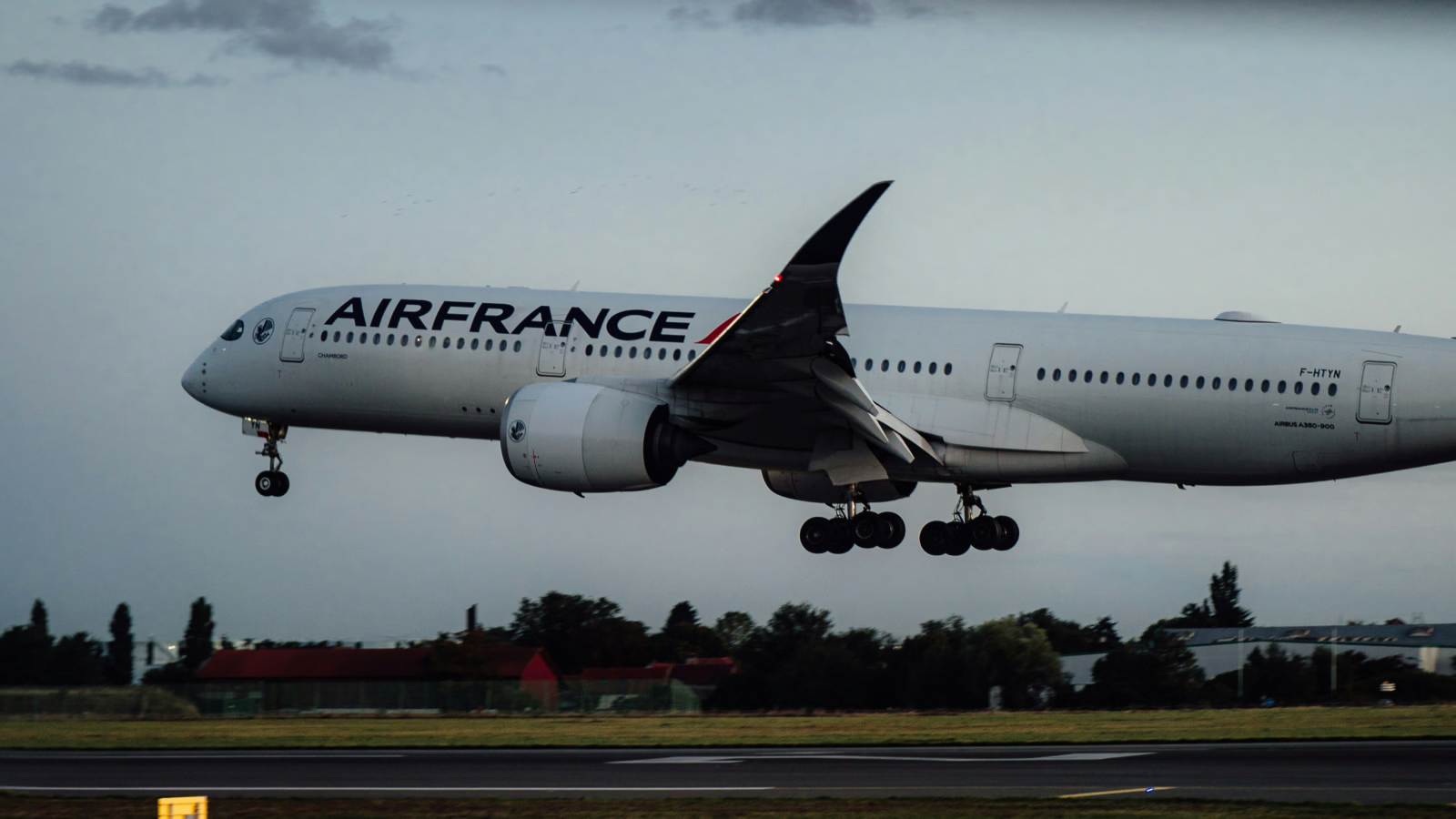
Flying Blue is the loyalty program of Air France, KLM, and a handful of smaller European carriers, and for U.S. travelers it sits in an unusual spot. Most readers will never fly Air France or KLM on a points booking. What they will do is transfer points from one of the four major U.S. transferable currencies into Flying Blue and use those miles to fly Delta in business class without the fuel surcharges Delta itself charges on partner award redemptions. That single mechanic is the program's defining feature for an American audience, and it is the reason Flying Blue belongs in a U.S. points stack even for travelers who have never set foot in Paris or Amsterdam.
The second reason is Promo Rewards. Once a month, Flying Blue discounts a rotating list of routes by 25 to 50 percent off the standard award price. Most months include a handful of transatlantic business-class routes from U.S. gateways, and at chart levels in effect as of mid-2026 the discounted prices have routinely landed below what Delta SkyMiles charges for the same seat in dynamic pricing.
There are constraints. Air France and KLM-operated long-haul flights pass through real fuel surcharges, often several hundred dollars on a round-trip business-class ticket. Change and cancellation fees are flat-rate but not free. The award search engine is functional but not great. And Flying Blue is one of the only programs in this category that transfers from all four major U.S. transferable currencies, which is a feature, except that Capital One transfers at the awkward 2:1.5 ratio.
Why Flying Blue matters in 2026
The Flying Blue case starts with Delta. Delta SkyMiles has spent the last several years pushing further into pure dynamic pricing, and the business-class redemptions U.S. readers used to celebrate at 75,000 to 95,000 SkyMiles one-way now routinely price at 200,000 to 350,000 SkyMiles or higher. The same seats, on the same flights, can be booked through Flying Blue at standard award rates that are dramatically lower, with the kicker that Flying Blue does not pass fuel surcharges on Delta-operated metal. That gap is the single most useful arbitrage in the U.S. transatlantic business-class market right now.
Set against the alternatives, Flying Blue holds its lane. Virgin Atlantic Flying Club also accesses Delta partner award space, sometimes at sharper prices for specific routes, but Virgin's chart is fussier and its award space on Delta has tightened in 2025. American AAdvantage prices Delta partner space rarely. United MileagePlus and Air Canada Aeroplan are Star Alliance programs that do not touch Delta. The other SkyTeam programs that do are harder for U.S. readers to earn into in volume. Flying Blue is the program that combines easy U.S. earning, full Delta access, no fuel surcharges on Delta metal, and a monthly discount mechanic that nobody else runs.
The constraint to internalize: this program is best when you fly Delta on the booking. The moment you board an Air France or KLM-operated long-haul flight, fuel surcharges show up in the taxes-and-fees column, and the math gets less interesting in a hurry.
How to earn Flying Blue miles
For U.S. readers, Flying Blue is one of the few programs that partners with all four major transferable points currencies, plus Marriott Bonvoy, plus flying.
The four flexible currencies are the main earning paths. American Express Membership Rewards transfers to Flying Blue at 1:1 with regular transfer bonuses. The Amex Gold and Amex Platinum are the two cards most U.S. readers should consider first for building a Flying Blue balance. The Gold is the choice for ongoing earning on groceries and restaurants, and the Platinum is the choice for welcome-bonus volume. Chase Ultimate Rewards transfers at 1:1 and posts roughly instantly. The Chase Sapphire Reserve and Chase Sapphire Preferred both feed Ultimate Rewards. Citi ThankYou Points transfers at 1:1 as well, and the Citi Strata Premier is the workhorse card on that side of the stack.
And then there is Capital One. Capital One miles transfer to Flying Blue at 2:1.5. That is not a typo. Two Capital One miles become 1.5 Flying Blue miles, which works out to a 75 percent transfer ratio. To put numbers on it: 80,000 Capital One miles become 60,000 Flying Blue miles. 100,000 Capital One miles become 75,000 Flying Blue miles. The Capital One Venture X is still a good card for many U.S. travelers, but if you are building a balance specifically for Flying Blue redemptions, Capital One is not the currency to lean on. Use Amex, Chase, or Citi first; treat Capital One as a top-up source only when you cannot avoid it.
Marriott Bonvoy transfers to Flying Blue at 3:1 with a 5,000-mile bonus per 60,000 Marriott points transferred, which works out to 60,000 Marriott to 25,000 Flying Blue. Not a great rate. Use it only when you are a few thousand miles short of a specific booking.
Flying on Air France, KLM, Delta, or any SkyTeam partner credits miles to Flying Blue at fare-class-dependent rates. Paid Delta tickets can credit to Flying Blue at competitive rates compared to crediting back to SkyMiles, especially in deep-discount economy. Frequent paid Delta flyers should at least model whether Flying Blue is a better home for their butt-in-seat miles than SkyMiles.
There is no U.S. co-brand credit card. No Flying Blue Amex, no Flying Blue Visa. Earning happens through transferable points, full stop.
The sweet spots
Flying Blue's chart is dynamic in the sense that prices move around standard award levels, but the program publishes those standard levels and the moves tend to be predictable. At chart levels in effect as of mid-2026, here is where the program delivers.
Delta business class transatlantic. This is the headline. East Coast to most Western European cities on Delta-operated metal runs in the 80,000 to 95,000 Flying Blue miles one-way range at standard award pricing, with taxes and fees in the $5 to $30 range because Flying Blue does not pass Delta's fuel surcharges. The same seat priced through SkyMiles can run 200,000 to 350,000 miles or more in dynamic pricing. The math is not close. Promo Rewards can take that 80,000 to 95,000 number down further on selected routes for selected months.
Air France and KLM business class to Europe. Standard award prices for transatlantic business on AF/KLM-operated metal sit in a similar 80,000 to 95,000 mile range one-way, but here the fuel surcharges land. Expect $400 to $700 per round-trip ticket in carrier-imposed fees. The miles cost is fine. The cash component is the trade-off. For travelers willing to absorb the surcharge to get specific routes or schedules, the value still holds. Go in eyes open.
Africa via Paris. Air France's African network is one of the most extensive in the world, and Flying Blue prices business class from the U.S. to West and East Africa via Paris meaningfully cheaper than the alternatives. The catch is fuel surcharges on the AF-operated portion. The win is access to routes most U.S. programs cannot touch.
Intra-Europe. Short-haul European flights price from 6,000 miles one-way in economy at standard levels, sometimes lower in Promo Rewards months. Competitive for a points-funded positioning hop after a transatlantic redemption.
Domestic Delta in a pinch. Flying Blue prices Delta domestic at standard levels that beat SkyMiles dynamic pricing during peak travel periods. Not the first place to look, but the second.
Promo Rewards: the monthly discount mechanic
Promo Rewards is the feature that separates Flying Blue from the pack. Each month, Flying Blue publishes a rotating list of routes, typically 30 to 80 city pairs, at 25 to 50 percent off the standard award price. Discounts apply to specific cabin classes (economy and business are most common), specific origin and destination pairs, and a defined travel window that usually sits a couple of months out from when the promotion is announced.
The mechanic to internalize: Promo Rewards is published on the first or second day of each month, the discounted booking window is fixed, and the inventory at discounted prices is real but limited. The play is to check the list early in the month, decide if the available routes fit a trip you actually want to take, and transfer points to book quickly if the answer is yes. Promo Rewards routes do sell out at the discounted price even though they remain bookable at standard pricing for the same flights.
Recent monthly deals through 2025 included transatlantic business class out of multiple U.S. gateways at sub-standard pricing, intra-European economy at single-digit-thousand prices, and occasional Africa and Asia routes. Specifics rotate. Treat Promo Rewards as a monthly check-in mechanic, not a list to memorize.
A practical note on transferable points and Promo Rewards: because the discounted booking window can close mid-month, and because Capital One, Citi, and (in some cases) Amex transfers to Flying Blue can take longer than the few-minutes-to-instant timing Chase offers, you should not transfer points speculatively for a Promo Rewards deal you have not confirmed is bookable. Confirm award availability through the Flying Blue search engine first, then transfer, then book.
The fuel surcharge map
Surcharges are the single most misunderstood part of Flying Blue. Here is the map that matters.
Delta-operated flights: No fuel surcharges through Flying Blue. Taxes and fees on a transatlantic Delta business award typically run $5 to $30 one-way. This is the core sweet spot.
Air France and KLM-operated long-haul: Real fuel surcharges. A transatlantic AF or KLM business-class round-trip can carry $400 to $700 in carrier-imposed fees on top of standard taxes. Short-haul intra-Europe AF/KLM segments carry smaller surcharges that still hit $50 to $100 per direction.
SkyTeam partners on Flying Blue redemptions: Mixed. Surcharges depend on the operating carrier. Korean Air segments carry surcharges. Some partners do not. Always check the taxes-and-fees line in the Flying Blue search results before transferring miles. This is the single most expensive mistake new Flying Blue users make.
Non-SkyTeam partners (Virgin Atlantic, GOL, Aircalin): Flying Blue can sometimes price awards on these carriers, with surcharge treatment that varies. Less commonly used by U.S. readers, but worth flagging.
The takeaway: when you are reaching for Flying Blue specifically to dodge Delta's SkyMiles dynamic pricing, you are reaching for Delta-operated flights specifically. The moment you swap to an AF or KLM-operated segment, ask whether the cash component still makes the trade worth it.
Award booking workflow
The workflow that works:
Step one, search before you transfer. Flying Blue's award search lives on the main flyingblue.com site once you sign in, and it shows standard awards, Promo Rewards, and partner space across SkyTeam. The engine is imperfect and occasionally misses partner space that phone agents can ticket, but it is good enough to confirm availability before you move points.
Step two, transfer the points. Chase Ultimate Rewards transfers tend to land within a few minutes. Amex Membership Rewards transfers usually take a couple of hours to land but can stretch longer during heavy transfer-bonus periods. Citi ThankYou and Capital One transfers can take longer; allow up to two business days. Do not transfer speculatively.
Step three, book. Flying Blue does not let you hold awards. If the seat is there and you have the miles, ticket immediately. Award space disappears fast on competitive routes.
If the online search misses a partner segment you can see in ExpertFlyer, calling Flying Blue is an option. Phone agents can ticket partner space the website misses, though phone booking surcharges may apply.
Change and cancellation rules
The Flying Blue change and cancellation structure has settled into a flat-fee model. As of mid-2026, the fee to cancel and redeposit miles is 50 EUR per passenger per ticket. Changes to date or routing on an existing ticket carry the same 50 EUR fee. There is no per-leg fee stacking, which is genuinely friendly compared to programs that charge per segment.
Refunds of miles back to the Flying Blue account on a cancellation typically post within a few days, but I would budget a week to be safe before counting on those miles for another booking. Taxes and fees refund to the original payment method on the issuing bank's timing.
What Flying Blue does not have is free changes on award tickets. Compare to United MileagePlus, where most changes on partner awards are free more than 30 days out, and Flying Blue's flat fee feels less generous. Compare to American AAdvantage, where partner award changes can be brutal, and Flying Blue looks reasonable. Middle of the pack.
Flying Blue versus the alternatives
For Delta partner awards, the question is Flying Blue versus Virgin Atlantic Flying Club. Virgin sometimes prices specific Delta routes more cheaply. Delta One transcons and certain U.S.-to-Caribbean routes can hit 50,000 Virgin miles one-way at standard pricing. Virgin also passes Delta partner fuel-surcharge treatment cleanly. The downside is that Virgin's award search is worse than Flying Blue's, Virgin pricing has tightened through 2025, and Virgin's award space on Delta has gotten harder to find. For a U.S. reader who wants reliable access to Delta business class to Europe with predictable pricing, Flying Blue is the cleaner pick. For specific routes where Virgin's chart is sharper, it is still worth checking both.
For SkyMiles itself, the comparison is mostly one-sided. SkyMiles is useful at Delta's flat redemption rates on cheap domestic fares and for spending down a balance built through Delta-branded Amex spending. For any premium-cabin transatlantic redemption on Delta, Flying Blue beats SkyMiles by a wide margin at chart levels in effect as of mid-2026.
For Star Alliance travel, Flying Blue does not apply. That side of the alliance is United MileagePlus territory, or Air Canada Aeroplan for the better partner pricing and stopover rules. If your trip is on Lufthansa, ANA, or Singapore Airlines, Flying Blue cannot help.
Status program
Flying Blue's status tiers (Silver, Gold, Platinum) are earned by flying, and for U.S. readers who do not fly Air France or KLM frequently they will be hard to reach. Silver kicks in with priority check-in and a small upgrade benefit. Gold adds lounge access, priority boarding, and Star Alliance Gold-equivalent SkyTeam Elite Plus benefits across the alliance. Platinum stacks additional lounge guest rights and a higher upgrade priority.
For most readers reaching Flying Blue through transferable points, status is not the play. The program is an award-booking tool, not a status home. If you do fly AF/KLM enough to chase status, Gold is the level where the benefits become meaningful, particularly the lounge access across SkyTeam.
When NOT to use Flying Blue
Flying Blue is not the right tool for every booking.
Short-haul European travel, especially on British Airways or other oneworld carriers, prices more cheaply through British Airways Avios, which charges by distance and routinely beats Flying Blue's 6,000-mile floor for very short hops. If you are flying London to Amsterdam or Paris to Madrid on a oneworld carrier, Avios is the play.
Domestic U.S. travel rarely warrants reaching for Flying Blue. Delta SkyMiles' dynamic pricing on domestic Delta routes is often cheaper than Flying Blue's standard award levels, and any other domestic carrier such as Southwest, JetBlue, Alaska, or American sits outside the SkyTeam alliance and cannot be booked at all through Flying Blue.
Pure economy long-haul is usually a poor use of Flying Blue miles. The value-per-mile math on economy redemptions tends to land below 1.5 cents, and any major transferable currency can match or beat that through a portal booking. The exception is intra-Europe economy in Promo Rewards months and short-notice transatlantic economy when cash prices are sky-high.
And anything that requires routing on an AF/KLM-operated long-haul segment where you are not comfortable with $400 to $700 in fuel surcharges. The miles cost might be fine. The cash add-on might not be.
Action plan
If you do not have a Flying Blue account yet, open one. It takes five minutes and miles can sit there indefinitely as long as you have one earning or redemption activity every two years. Then audit your transferable points balances. If you have Amex Membership Rewards, Chase Ultimate Rewards, or Citi ThankYou Points, you are sitting on Flying Blue currency at 1:1. Hold those points; do not transfer until you have a specific booking ready.
Build a habit around Promo Rewards. The list drops at the start of each month. Check it. Most months will not have a route you want. The months that do will pay for the habit.
The first redemption to plan, for most readers, is a transatlantic Delta business-class booking. Find a route and date that work. Confirm Flying Blue shows availability on the Delta-operated flight at the standard award price. Transfer points only when you are ready to ticket. Book the same day.
For Capital One earners, the 2:1.5 ratio makes Capital One a secondary Flying Blue funder. The Capital One Venture X still earns useful miles for other transfer partners; just do not plan your Flying Blue strategy around it. For Amex earners, the American Express Gold Card and American Express Platinum Card are the cards to anchor on, with the Platinum's larger welcome bonus making it the faster path to a one-shot business-class booking. For Chase earners, the Chase Sapphire Reserve and Chase Sapphire Preferred feed Ultimate Rewards, which transfers to Flying Blue at 1:1 and posts roughly instantly. For Citi earners, the Citi Strata Premier is the workhorse.
Flying Blue is not the most exciting program in the points world. No first-class chart to chase. No co-brand card. But it solves a specific, expensive problem (getting U.S. travelers into transatlantic business class on Delta metal at sane prices with no fuel surcharges) better than any other program in the U.S. points stack. For that one job, it earns a spot.
This article contains affiliate links. If you apply through our links, we may earn a commission at no cost to you, which helps us continue sharing points and miles strategies with the community.
Some of the links in this article are affiliate links. We may receive a small commission at no extra cost to you if you apply through these links. This helps us keep the site running and continue creating free content.