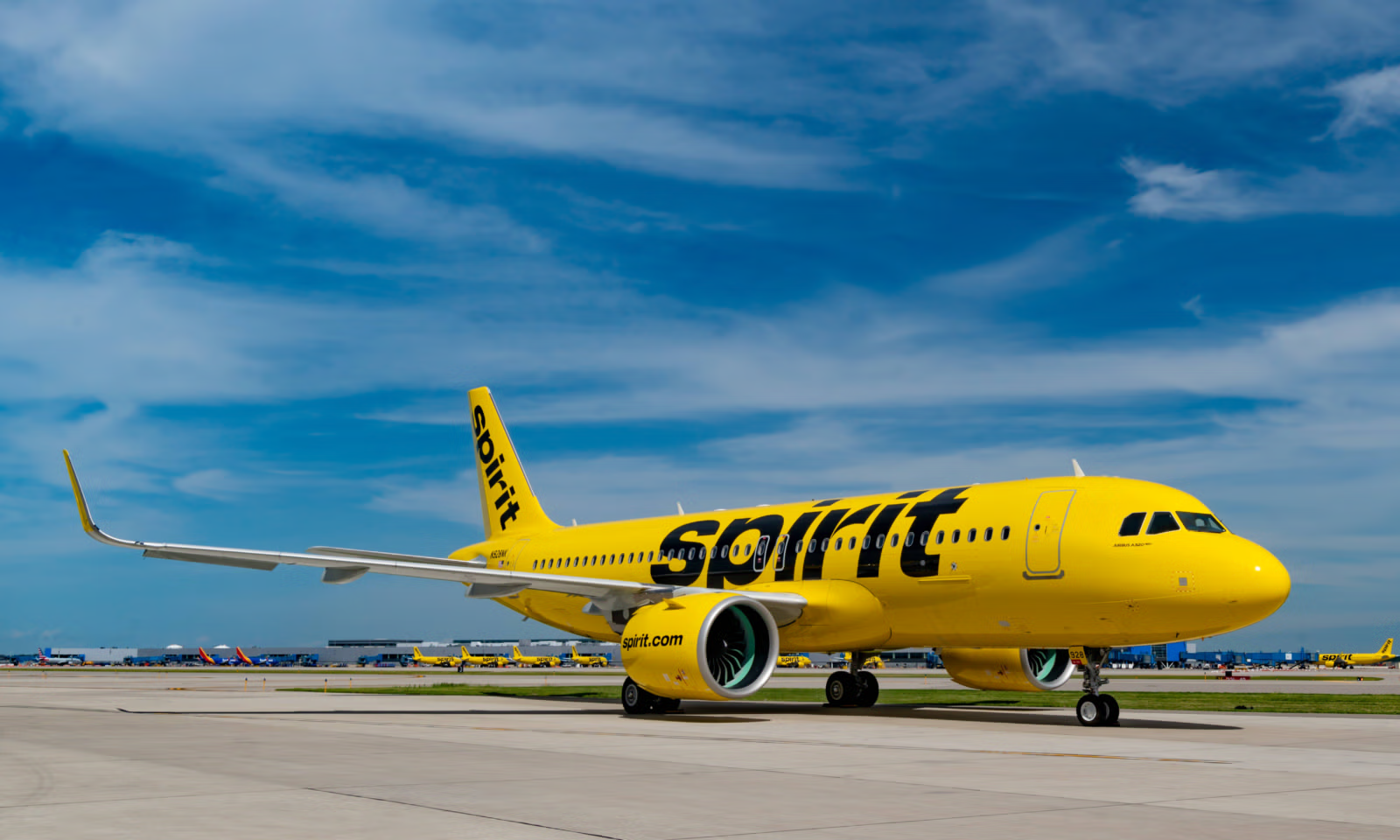
Spirit Airlines is not the same carrier it was three years ago. After emerging from Chapter 11 in 2024 and a second, shorter restructuring in 2025, the airline has spent the back half of the cycle quietly rebuilding itself as a "premium-curious" ULCC. The Big Front Seat is still the flagship product, but it now sits inside a bundle-pricing model that mirrors what Frontier and JetBlue have been selling for years. The honest question for a points-and-miles reader in 2026 is not whether Spirit's front-cabin product is fine (it is). It is whether paying for it ever beats just flying Delta Comfort+ or American Main Cabin Extra on the same route, especially when you factor in card-portal bookings and the elite-status earning you give up.
This guide is a buyer's framework, not a press release. We will walk through what Spirit's premium product actually includes today, what the bundle add-on typically costs on real routes, where it wins against a legacy main-cabin or extra-legroom seat, where it loses, and how the booking math changes when you run the fare through Capital One Travel, Chase Travel, or Amex Travel using transferable points. The verdict at the end depends almost entirely on where you live and which legacy carrier dominates your local airport.
What Spirit's premium product looks like in 2026
Spirit's front cabin is built around two rows of 2-by-2 leather seating with a wider pitch and a fixed armrest, marketed as the Big Front Seat. Behind it sits an extra-legroom block in the first several rows of the standard 3-by-3 cabin. The pitch on the Big Front Seat is closer to legacy domestic first than to a Comfort+ or Main Cabin Extra seat. The pitch on the extra-legroom block is in the ballpark of what United Economy Plus or Delta Comfort+ delivers. Both products are sold as a seat fee on top of the base fare, or as part of a bundle that wraps in a checked bag, a carry-on, priority boarding, and (on some routes) inflight wifi access.
The bundle pricing is the structural shift. Spirit used to charge for everything separately, which made the cash advertised fare misleading once you actually built a trip. The bundles surface a closer-to-real total at the point of sale. The trade-off is that the cheapest fare on the page still does not include a carry-on, a seat assignment, or a printed boarding pass. Read the fare ladder before you book. The advertised low fare is real, but it is also the version with none of the things most travelers consider standard.
Inflight, the bundles include a basic snack and a non-alcoholic drink, which Spirit historically charged for separately. Wifi is rolling out across the retrofitted fleet but is not universal. If you need to work in the air, check the aircraft type on your specific flight rather than assuming wifi is there. Spirit lists wifi-equipped routes on the booking flow.
What the premium seat actually costs
The Big Front Seat upgrade typically runs $50 to $120 each way on transcon routes, depending on demand, time to departure, and whether you grab it at booking or at the airport. On shorter routes (say, MCO to BWI or DFW to LAX), the add-on is usually in the $40 to $90 range. Bundles that pair a Big Front Seat with a checked bag and a carry-on tend to land $30 to $50 higher than the seat alone, which is the closest apples-to-apples version of a Delta Comfort+ or American Main Cabin Extra fare that already includes a carry-on.
For comparison: Delta Comfort+ as a paid upgrade on a transcon route typically runs $40 to $80 over a main cabin fare. American's Main Cabin Extra runs roughly the same. JetBlue Even More Space is in the same band. So Spirit's premium add-on is not categorically cheaper than the legacy extra-legroom product. It is sometimes cheaper, sometimes more expensive, and the gap depends almost entirely on the underlying base fare. The reason Spirit can be the right answer is that the base fare itself is often $80 to $200 lower than the legacy carriers on routes where Spirit competes seriously.
The route where this matters most is anywhere a legacy carrier holds near-monopoly pricing. Fort Lauderdale, Orlando, Newark, and Atlantic City have historically been Spirit strongholds, and the cash savings on those routes can be substantial even after you stack on the premium-seat add-on. Two examples that come up often in reader questions: Fort Lauderdale to Los Angeles, where the legacy main cabin fare can run $280 to $380 round-trip during high season while Spirit's all-in Big Front Seat bundle often lands $180 to $260; and Orlando to Boston, where the same dynamic shows up on JetBlue's home turf because JetBlue's Even More Space upcharges plus checked-bag fees often push the legacy total past Spirit's bundled fare. Run the math on the dates you actually want to fly, not the dates a fare-tracker website is featuring. The savings move week to week. The route where it matters least is anywhere Southwest serves with frequency, because Southwest's two-bags-included pricing structure usually beats Spirit's bundle once you do the math.
Where Spirit wins, where it loses
Spirit's front-cabin product wins on three specific kinds of trips. The first is a leisure trip on a route where Spirit's all-in price (base fare plus bundle) lands $50 to $150 under the legacy main cabin. On those routes, you are getting better-than-Comfort+ pitch at less than legacy main cabin pricing, and the math is clean. The second is a family trip where you need three or four bundles and the legacy carrier's bag fees plus seat assignments cancel out the fare difference. Spirit's bundle pricing tends to read flatter for larger groups. The third is a one-off trip where you do not value elite-status earning on a legacy program because you do not have status, are not chasing it, and would not earn meaningful miles on the fare class you would actually buy.
Spirit loses on three other kinds of trips. The first is any business trip where you need flexibility. Spirit's change and cancellation policy improved in 2025 but still lags Southwest and the legacy carriers' main cabin (non-basic) flexibility. The second is any trip where you are within striking distance of elite status on Delta, American, United, or Alaska. Buying a non-status-earning Spirit fare resets the math against you on the year-end qualifying-spend calculation. The third is any trip where you genuinely need lounge access, an upgrade chance, or international connectivity on a single ticket. Spirit does not offer the first two and has limited partner integration for the third.
The honest framing is that Spirit's premium product is a coach upgrade, not a domestic first equivalent. It is wider and roomier than Comfort+, but it does not come with a meal, a higher service standard, or a credible upgrade path. Compare it to the legacy extra-legroom seat plus the cash savings on the base fare, and the answer is sometimes yes and sometimes no. Compare it to legacy domestic first, and the answer is almost always no.
Booking Spirit through Capital One Travel, Chase Travel, or Amex Travel
This is the part most points-and-miles guides skip, and it is where a Kay-style breakdown actually pays off. Spirit fares are bookable through all three major bank travel portals as of May 2026, but the experience and the value math are not identical.
Capital One Travel is the cleanest of the three for Spirit bookings. The portal sells Spirit's standard fares and most bundle options through the same booking flow it uses for legacy carriers, and Venture Miles redeem at 1 cent per mile against the total. The Venture X annual $300 portal credit applies to Spirit bookings the same way it applies to a hotel booking. Spirit-specific seat add-ons (the Big Front Seat upsell) are sometimes inventoried in the portal and sometimes not, depending on the routing.
Chase Travel sells Spirit fares but with thinner bundle support. The fare itself books normally, and Ultimate Rewards points redeem at 1.5 cents each on the Sapphire Reserve or 1.25 cents on the Sapphire Preferred. If the Big Front Seat is not bookable in the portal for your specific routing, you can buy the seat directly on spirit.com after ticketing without losing the Chase booking benefits.
Amex Travel is the weakest of the three for Spirit bookings. Membership Rewards points redeem at 0.7 cents on Amex Travel for non-airline-portal bookings, which is a meaningful cut from the transferable-points playbook. The Platinum's $200 airline fee credit does not apply to Spirit. For most Amex cardholders, the cleaner play is to pay cash on the Platinum or the Gold, take the 5x on flights booked through Amex Travel, and skip the points-as-currency conversion.
The general rule: if you have Capital One or Chase points sitting around and your route is well-served by Spirit, the portal booking is competitive with paying cash. If you have Amex points, transfer-partner bookings on a legacy carrier almost always beat a Spirit portal booking.
The card pairing that makes Spirit worth a second look
If you fly Spirit even occasionally, the card that quietly does the most work is the Capital One Venture X. The annual fee is $395, offset by a $300 annual travel portal credit and 10,000 anniversary miles worth $100 at the portal rate, which puts the net effective fee at negative $5 before you spend a dollar on the card. The 2x rate on everything plus the 10x on hotels and 5x on flights through the portal stacks cleanly with Spirit's bundle pricing.
The runner-up is the Chase Sapphire Reserve at a $550 annual fee with the same $300 travel credit applied broadly, including Spirit. The points are worth 1.5 cents through the Reserve's portal multiplier. The Reserve also brings Priority Pass lounge access, which Spirit does not provide on its own. If you fly Spirit out of an airport with a Priority Pass-eligible lounge, that pairing alone changes the calculus.
A no-annual-fee pairing worth mentioning: the Capital One Venture (not the X) at $95 still gives you the 2x on everything and the same 1-cent-per-mile redemption against Spirit fares, just without the annual portal credit. For someone flying Spirit twice a year, this is the cleaner break-even than either premium card.
The honest verdict
Spirit's premium product in 2026 is genuinely better than it was three years ago, and the bundle-pricing model is a real improvement over the old a-la-carte chaos. The Big Front Seat is a competitive coach-plus product, not a domestic first knockoff, and pricing it against a legacy carrier's main cabin (not main cabin extra) is the wrong comparison to start from.
The right comparison is this: take the all-in Spirit total (base fare plus bundle that matches what you actually need), put it next to Delta Comfort+ or American Main Cabin Extra on the same route on the same dates, and see which one wins on cash. If Spirit is $80 or more cheaper for a comparable level of comfort, the math favors Spirit. If the gap is under $50, the legacy product almost always wins because of the status earning, the change flexibility, and the network reliability that come with it. If the gap is negative (Spirit is more expensive), book the legacy carrier and move on.
A worked example to anchor the framework. Say you are flying MCO to LAX round-trip in November 2026 and you check four options on the same dates. Delta main cabin: $312 round-trip, no Comfort+, one carry-on included, no checked bag, basic-economy restrictions. Delta Comfort+: $412. American Main Cabin Extra: $398. Spirit Big Front Seat bundle (seat plus checked bag plus carry-on plus priority boarding): $268. Spirit wins by $130 against Comfort+ and by $116 against Main Cabin Extra, with a wider seat than either. That gap pays for the trip rebooking risk that comes with Spirit's network being thinner. If the Spirit price had been $375 instead, the answer would flip to Delta because the $37 gap is not worth giving up status earning and rebooking flexibility. Same framework, different answer, driven entirely by the cash spread on the day you book.
The bigger principle worth holding onto: ULCC math only works when the ULCC actually undercuts. A more comfortable Spirit seat at the same total price as a legacy extra-legroom seat is not a deal. It is just another option.
This article contains affiliate links. If you apply through our links, we may earn a commission at no cost to you, which helps us continue sharing points and miles strategies with the community.
Some of the links in this article are affiliate links. We may receive a small commission at no extra cost to you if you apply through these links. This helps us keep the site running and continue creating free content.