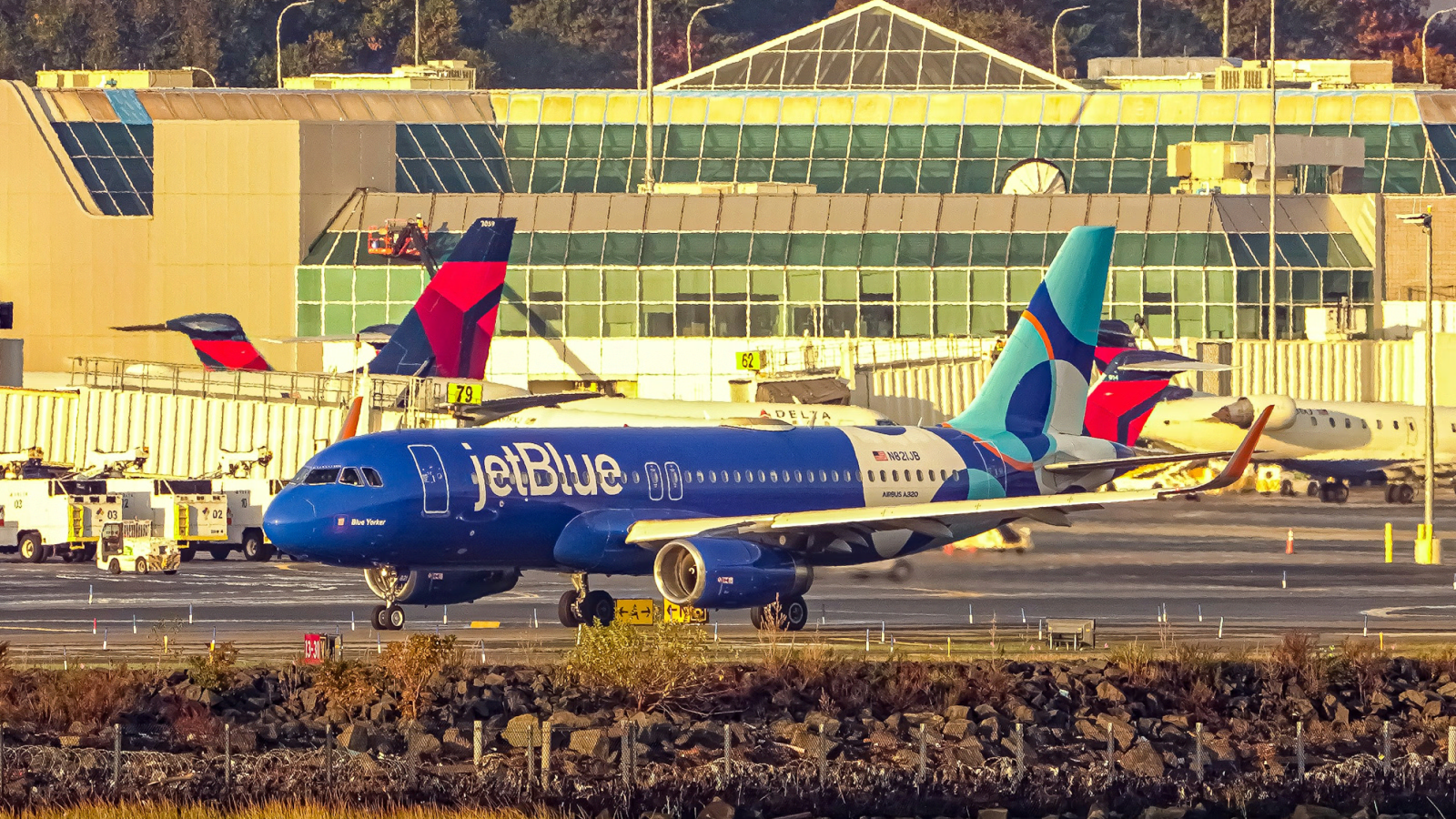
Southwest Airlines does something almost no other US carrier does: it refuses to load its full year of flights at once. Instead, the schedule extends in rolling chunks every few months, and each extension drops on a single morning to the second. If you live in the points-and-miles world, that release date matters. It's the closest thing Southwest has to an award calendar opening, and it sets the price floor for every Wanna Get Away fare on the new dates. The question isn't whether to pay attention. It's what to actually do when the new chunk goes live: book on the spot, wait it out, or build a Companion Pass play around it.
Quick Answer
Southwest releases its schedule in rolling chunks, typically extending the bookable window by four to six months at a time. Book immediately when you need a specific date, route, or holiday slot, or when you're using points and the Wanna Get Away fare is already at the route's typical floor. Wait one to three weeks if your dates are flexible and the initial fare looks high relative to historical pricing. Southwest's no-change-fee policy plus the points-refund-to-cash-rebook trick mean you carry almost no risk either way.
Why Southwest's Schedule Works This Way (and Why It's Actually a Gift)
Every other big US airline loads roughly 330 days of flights in advance and lets you book the whole window. Southwest doesn't. The airline releases new dates in batches throughout the year, currently extending the schedule by about six months at a time and sometimes a little less. When you check Southwest.com today, you can typically book through a specific end-date, and then a few months from now that window will extend again.
The release calendar isn't a secret. Southwest publishes its schedule extensions on its newsroom, and the points-and-miles community tracks every drop. Each release goes live on a single morning, usually around 6:00 AM Central, and the new dates appear all at once across every route the airline flies.
This is genuinely useful for two reasons. First, the floor price for any given route on those new dates is set at the moment of release, meaning you can see the lowest Wanna Get Away fare almost immediately, without waiting for the airline to "release" cheaper inventory the way Delta or United might. Second, every Southwest fare is fully flexible. No change fees, no cancellation fees, and points always refund back to your account in full if you cancel an award booking. That means the consequence of "booking too early" is roughly zero, which changes the entire calculus.
If you're familiar with how United or American manage their cheapest award space, you already know where this is going. Southwest doesn't do dynamic award pricing in the same controlled-inventory sense. Every cash fare has a points equivalent, and that ratio stays remarkably consistent at around 78 to 84 Rapid Rewards points per dollar of base fare. So when the cash price moves, the points price moves with it. Schedule release day is when both prices get set.
What "Schedule Drop" Actually Means for Your Bookings
When the new schedule extension goes live, three things happen in the same minute:
The new dates appear in Southwest's booking engine, so you can search routes you couldn't search the day before. The Wanna Get Away cash fares get assigned, which sets the points price on every fare class. And here's the part people miss: the existing dates in the current bookable window often get a small repricing pass at the same time. Sometimes that's downward. Sometimes it isn't.
If you're booking a flight that falls inside the newly-opened window, you're playing one game. If you're rebooking an existing trip to take advantage of price movement on dates already on sale, you're playing a different one. Both are worth understanding.
For new-window bookings, the most-asked question is whether prices typically drop after release day or hold steady. Honest answer: it depends on the route and the time of year. Major hub-to-hub routes on non-peak dates tend to settle within a week of release. Holiday-week flights (Thanksgiving, Christmas, spring break) almost never get cheaper after the initial release, and frequently get more expensive as the date approaches. Lightly-trafficked routes can move in either direction.
What's consistent: the spread between the cheapest Wanna Get Away fare and the next tier up (Wanna Get Away Plus, then Anytime) is usually $30 to $80 each way. If you're seeing only Anytime fares available on release day for a route that historically has Wanna Get Away inventory, that's a flag that the cheap fares already sold out. That happens fastest on Friday afternoons, Sunday evenings, and any leg that touches Hawaii or a Caribbean destination.
What to Do When the New Chunk Opens
Here's the move I actually make, in order:
Set a calendar reminder for the morning of the next scheduled extension. Southwest typically announces the release date one to two weeks in advance on its newsroom page. Log in to your Rapid Rewards account before 6:00 AM Central on release day so you're not fighting the authentication queue when the inventory drops.
The first ten minutes after release are the only ones that matter for the highest-demand dates. If you're booking Thanksgiving, Christmas, or anything touching a sun destination on a holiday weekend, refresh repeatedly between 6:00 and 6:10 AM Central on the release date and pull the trigger when you see a price you'd be willing to pay later. The full refund policy is your insurance. If it gets cheaper, you cancel and rebook. If it gets more expensive or sells out, you locked in.
For everything else (non-holiday weeks, mid-tier routes, flexible dates) there's no rush. Check on release morning to set your baseline, then check again three days later, and again at one and two weeks. If the fare hasn't moved by week two, it's probably your number for that booking.
Set price alerts on Google Flights and on the Hopper app for any specific routes you're watching. Both tools will email you when a Southwest fare drops, which is faster than checking manually every few days.
The Points-vs-Cash Decision on Release Day
Southwest is the rare program where the points-to-cash ratio is straightforward enough to evaluate in your head. Rapid Rewards points consistently redeem at roughly 1.2 to 1.4 cents per point on Wanna Get Away fares, with slightly worse ratios on Wanna Get Away Plus and noticeably worse on Anytime fares. That ratio is the entire decision.
If you have transferable Chase Ultimate Rewards points and you're deciding between transferring to Southwest at 1:1 or booking through the Chase travel portal at 1.25 to 1.5 cents per point (depending on which Sapphire card you hold), the math usually favors transferring to Southwest for Wanna Get Away fares, but only just. The portal route is often within a couple hundred points of the transfer route on shorter flights, and the portal gives you the cash-equivalent benefits (full Rapid Rewards earning, full flexibility through Southwest's policy if you book the Southwest ticket directly, but losing those benefits if you book through the portal).
For Marriott Bonvoy points, the math is different. Marriott transfers to Southwest at 3:1, with a 5,000-point bonus for every 60,000 transferred. That's a redemption value of roughly 0.45 cents per Marriott point on Southwest. Fine if you have no other use for the Marriott balance, but worse than transferring those same points to a hotel partner where 0.7 to 1.0 cent per Marriott point is achievable.
Where the points play really shines is on holiday cash fares that have already crossed the $400-each-way threshold. A $450 holiday flight prices at roughly 36,000 to 38,000 Rapid Rewards points, a 1.2-cent-per-point redemption that beats the cash-back floor on most points currencies. When you see Wanna Get Away fares above $300 each way on release day, that's where points earn their keep.
The Companion Pass Angle (This Is the Real Game)
If you're earning, holding, or burning a Southwest Companion Pass, schedule release day is twice as important. The Companion Pass lets your designated companion fly with you for just the taxes and fees on every Southwest flight you book, paid or award. That benefit applies to every fare available on release day, which means every new flight you book during the new window is effectively a two-for-one.
The strategic move is to plan your Companion Pass earning year so that you trigger the pass early in a calendar year, then book heavily on the next schedule release with the pass already active. A pass earned in February gives you the rest of that calendar year plus the entire next calendar year of two-for-one flying. If a schedule extension drops in May covering travel through the end of the year, you have full pass benefits across every booking you make that day.
If you don't have the pass yet but you're earning toward it, schedule release day is where you decide whether to book on points (which counts toward the qualifying points threshold for Companion Pass) or on cash with a Southwest co-branded card (which doesn't directly earn qualifying points but lets you keep the cash points untouched for later). The Companion Pass earning rules count points from credit card welcome bonuses, card spend, partner activity, and base flight points, so book strategically depending on what you're tracking.
The fastest current path to the pass is through a welcome-bonus offer on one of the Chase Southwest cards combined with the right timing window. We've covered the full strategy in our 2026 Companion Pass guide, and the current offer landscape changes frequently enough that it's worth checking before you commit.
Southwest's Devaluation History (and Why That Matters for Booking Timing)
Here's the part the booking guides usually skip. Southwest has quietly devalued Rapid Rewards multiple times over the past decade, with each round pushing the points-per-dollar ratio modestly upward. The pattern is consistent: every two to three years, the program adjusts pricing such that the same cash fare costs slightly more points than it did the year before.
What that means in practical terms: holding a large Rapid Rewards balance for years on end is a slow loss. Points earned today are worth a bit more than the same points spent five years from now, and there's no public roadmap for when the next adjustment hits. The community has gotten good at spotting them within hours of implementation, but they're never announced in advance.
The booking-timing implication: when you're sitting on a healthy points balance and you see a Wanna Get Away fare you like on release day, burning the points is almost always better than holding. If the cash equivalent is $250 and the points price is 19,000 Rapid Rewards, you're locking in a known value today against an unknown future devaluation. The no-change-fee policy means you can rebook later if the fare drops further. The "I'll save the points for a better deal" instinct is, on this program specifically, usually wrong.
Cash bookings carry the same logic in reverse. If you're going to take the flight anyway and you have a Southwest co-branded card that earns bonus points on Southwest purchases, paying cash adds to your Companion Pass progress without burning your existing balance.
The No-Change-Fee Insurance Policy (Your Real Edge)
Every other major US airline lets you cancel a flight for some form of credit, but Southwest is the only one that lets you cancel a points booking and get every point back in your account, refunded to taxes-and-fees only, with no fee and no expiration. That's the policy that turns schedule release day from a high-pressure decision into a low-risk one.
The practical workflow looks like this. On release day, you book the trip you want at the price showing. Two weeks later, the price drops by $40. You cancel the original booking, get your points refunded, rebook at the lower price, and pocket the difference. If the price drops by $40 four times over the next three months, you do that four times. There's no fee, no penalty, no friction beyond two minutes of rebooking work.
The one caveat: cash bookings cancel back to travel credit, not to a refund of the original cash payment (with the exception of Anytime and Business Select fares, which do refund to the original payment method). If you book Wanna Get Away in cash and cancel, you get Southwest travel funds, which never expire under the current policy but only spend at Southwest. Points bookings don't have this constraint. The points come back, full stop.
The practical implication: book the flight you want on release day. If it goes up, you're protected. If it goes down, you rebook. The only outcome you can't recover from is not booking and watching the flight sell out.
Common Mistakes to Avoid
A few patterns we see repeatedly when readers ask about Southwest release-day strategy:
Treating release day like an inventory drop. Southwest doesn't release "cheap seats" the way other airlines release saver award space. The full fare cabin opens at once. Refreshing fanatically through release morning to "catch" a sub-fare doesn't help. The price you see at 6:05 AM Central is the price the airline set for the cabin, and it'll move based on demand from there.
Waiting for a holiday flight to get cheaper. Thanksgiving and Christmas Wanna Get Away inventory on the most-trafficked routes sells out on release day. If you need to be home for Thanksgiving and you see a fare you can stomach when the schedule drops, book it. The "let me wait two weeks and see" approach loses on holiday routes more than it wins.
Not understanding that Marriott-to-Southwest is a poor transfer. The 3:1 ratio is one of the worst transfer ratios in the points universe. Move Marriott points to a hotel partner; book Southwest with cash, Chase points, or the Southwest co-brand card. (For a deeper breakdown of which programs actually transfer well to Rapid Rewards, see our transfer partners guide.)
Picking the wrong Southwest card for your travel volume. The Plus card at $69 a year is a worse deal than it looks once you account for foreign transaction fees and the lower point multipliers. The Premier at $99 is the version most travelers should hold. The Priority at $149 earns its keep if you take more than three or four Southwest flights a year because of the $75 travel credit and the upgraded boarding benefits. Pick the card based on actual usage, not annual fee.
Forgetting that Wanna Get Away Plus exists. The middle fare class adds same-day standby and a transferable flight credit if you cancel. For travelers with unstable schedules, the $30-to-$50 upcharge often pays for itself the first time you need to move a flight at the last minute.
How to Build a Release-Day Routine That Actually Works
If you fly Southwest more than three times a year, treat the schedule extension calendar as part of your annual planning. The routine that works:
Subscribe to email alerts from Southwest's newsroom or follow the points-and-miles communities that track these dates. The release date is always announced one to two weeks in advance.
A week before the extension, write down the flights you'd want from the new window. Specific dates, specific routes, ballpark fares you'd accept. This step matters more than people realize. The reason holiday inventory sells out is that travelers without a target end up scrolling instead of booking.
The morning of the release, log in early. Don't try to log in for the first time at 6:01 AM Central, because the authentication system gets slow when thousands of people hit it at once. Be logged in at 5:55, search ready at 6:00, click-to-book by 6:05 if you see a fare on a high-demand date.
For low-demand routes and flexible dates, set price alerts on Google Flights or Hopper and let the tools do the watching for you. Check back at the two-week and four-week marks. If the price hasn't moved meaningfully by then, you have your answer.
And keep the Companion Pass calculation in mind on every booking. If you're within striking distance of triggering the pass, every Southwest spend you can route through a co-branded card earns qualifying points. If you already hold it, every flight you book on release day during the new window is effectively two flights for the price of one. Pre-loading the back half of your pass year with two-for-one travel is the kind of compounding move the points hobby is built on.
What I'd Actually Do This Year
If I were sitting down to plan a year of Southwest flying right now: I'd be holding either the Premier or the Priority card (Plus only if I genuinely never travel internationally and don't want the higher fee). I'd be tracking the release calendar on a recurring reminder. I'd be earning toward Companion Pass through a Chase Southwest welcome bonus timed to land in January or February so the pass covers nearly two full years of two-for-one flying. And on release morning, I'd book the high-demand holiday flights immediately, set alerts on the flexible ones, and lean on the no-change-fee policy to recover any value the market gives me back later.
The Schedule Drop isn't a price-volatility puzzle to solve. It's a planning event with a flexible insurance policy attached. Treat it that way and the decision of when to book gets a lot quieter.
This article contains affiliate links. If you apply through our links, we may earn a commission at no cost to you, which helps us continue sharing points and miles strategies with the community.
Some of the links in this article are affiliate links. We may receive a small commission at no extra cost to you if you apply through these links. This helps us keep the site running and continue creating free content.