Key Points
- Southwest Airlines retired open seating on January 27, 2026, ending a 50-year boarding policy and rolling out assigned seats across its fleet.
- The new system uses eight boarding groups and three seat tiers (Standard, Preferred, and Extra Legroom), with seat selection at booking on most fare types.
- A-List and A-List Preferred members get free Preferred and Extra Legroom seat selection respectively, making mid-tier elite status materially more valuable than it was a year ago.
TL;DR
As of January 27, 2026, Southwest Airlines flies with assigned seats. Boarding now runs in eight groups across three seat tiers, and elite status determines how early you can pick a seat for free.
The change took effect January 27, 2026
Southwest Airlines operated its first scheduled flight with assigned seating on January 27, 2026, ending an open-seating policy the carrier had used since 1971. The rollout matched the timeline Southwest first announced in July 2024.
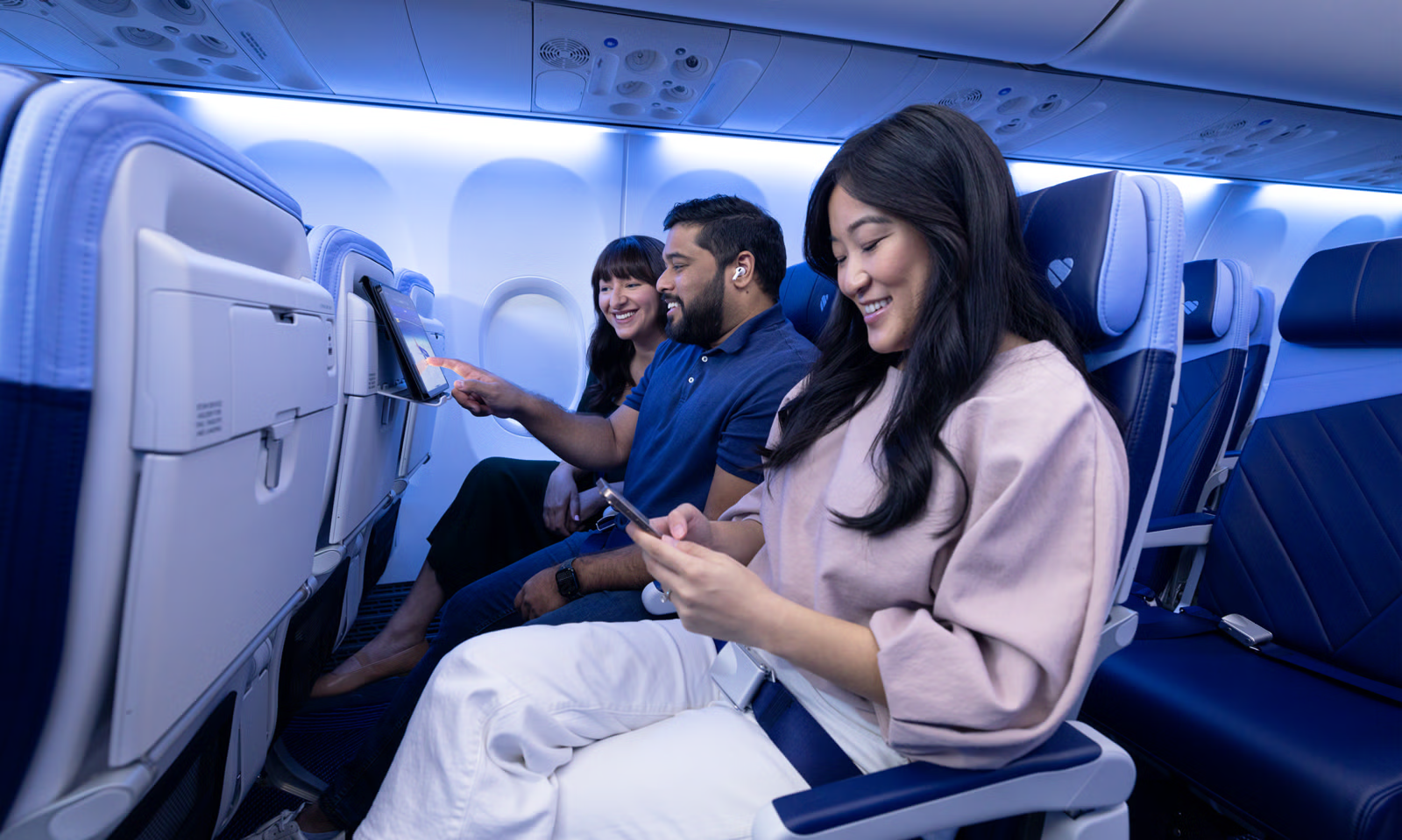
The new boarding model replaces the old A/B/C groups and 1-60 numbered positions with eight boarding groups, in line with the structure used by American and Delta. Cabins are now segmented into three seat types: Standard, Preferred, and Extra Legroom. Standard makes up the bulk of the aircraft. Preferred sits forward of the wing and offers earlier deplaning. Extra Legroom seats sit at the front of the cabin and in the exit rows, with up to five additional inches of pitch, according to Southwest's seat maps.
Customers booking on or after January 27 now see a seat map at checkout, the way they would on any legacy carrier. Southwest confirmed in a December 2025 statement that pre-existing bookings for travel after the launch were assigned seats automatically, with reassignment available through the manage-booking flow.
Why Southwest did it
The change is the most visible result of pressure from activist investor Elliott Investment Management, which took a roughly $2 billion stake in Southwest in mid-2024 and pushed for a strategic overhaul. Southwest's own consumer research, cited by then-CEO Bob Jordan on the airline's July 2024 earnings call, found that 80% of current customers and 86% of prospective customers preferred assigned seating, and that open seating was the single biggest reason travelers chose competitors.
The financial logic is straightforward. Assigned seating with fare-class differentiation generates ancillary revenue that open seating cannot. Southwest told analysts on its Q4 2024 call that the broader transformation, including assigned seats, premium seating, redeye flights, and bag-policy changes, should add roughly $1.5 billion in incremental EBIT by 2027. That number is now the benchmark against which the rollout will be judged.
How seat selection works at booking
Southwest sells three primary fare buckets that affect the seat selection experience. Basic, the new entry-level fare, does not include free seat selection at booking; passengers either pay to choose a seat or are assigned one at check-in. Choice and Choice Extra, the mid and premium fares, include seat selection at booking, with Choice Extra also including a free Extra Legroom seat where available. Specifics of fare names and inclusions continue to evolve, so the current rules on Southwest's site are the source of truth before you book.
You'll see the seat map immediately after fare selection, the same as on American Airlines or United. Boarding groups are assigned automatically based on fare and elite status. Priority Boarding remains available as a paid add-on within 24 hours of departure for travelers who want an earlier group regardless of fare.
What an upgrade actually costs
Paid seat selection now runs roughly the same range you'd see on American or Delta. Preferred seats typically cost around $5 to $35 each way on shorter domestic flights, with Extra Legroom climbing to roughly $25 to $80 each way on transcon and Hawaii routes, based on prices visible on Southwest.com in April 2026. The cabin's still all-economy, but the gap between Standard and Extra Legroom adds up round-trip for a family. Pricing varies by route, demand, and timing.
What loyalty status gets you for free
The status program did the heavy lifting on softening the change for frequent flyers. A-List members can select Preferred seats at booking on any fare, and Extra Legroom seats within 48 hours of departure when available. A-List Preferred members can select Extra Legroom seats at booking on any fare and board in Groups 1-2. Both tiers kept their existing perks: free same-day standby, priority check-in, and bonus point earning. The Southwest Companion Pass extends the primary member's seating benefits to the companion.
Cardholder benefits are smaller but useful. All Southwest consumer credit card holders can select a seat within 48 hours of departure on Basic fares and board no later than Group 5. That's the one thing keeping the Southwest co-branded cards competitive for travelers who fly the carrier two or three times a year on cheap fares.
Industry context: Southwest now looks a lot like everyone else
The end of open seating is the most visible step in a broader convergence. Southwest added redeye flights in February 2025, started selling premium seating, and tightened its bag policy on third-bag fees. The "Bags Fly Free" line, Southwest's last unambiguous operational differentiator, is now the subject of analyst speculation about whether even the two-free-bag policy survives the next fare review. Southwest has publicly committed to keeping two free checked bags as of its most recent earnings call, but the trajectory has industry watchers skeptical.
What's left of the old Southwest is mostly intangibles: no change fees on most fares, Rapid Rewards points that don't expire, the Companion Pass, and a customer-service culture that outranks the legacy three. Those still matter. They're just no longer enough to make Southwest categorically different.
What this means for booking now
Two practical takeaways. First, book early when seat selection matters. Premium seats on transcon and Hawaii routes sell out a week or more ahead, especially on Friday and Sunday departures. If you have a non-negotiable preference, pay for it at booking rather than gambling on availability later.
Second, A-List status is more valuable than it was twelve months ago. The math used to be marginal: priority boarding mattered most, and any organized traveler could get a decent seat anyway. Now A-List Preferred buys free Extra Legroom on every flight, which on a frequent-flyer's schedule is worth several hundred dollars a year. If you were on the bubble between qualifying for status or not, the calculus has shifted toward qualifying.
The era of sprinting down the jet bridge to grab a window is over — worth a moment of acknowledgment, then worth getting on with planning the next trip under the new rules.
This article contains affiliate links. If you apply through our links, we may earn a commission at no cost to you, which helps us continue sharing points and miles strategies with the community.
Some of the links in this article are affiliate links. We may receive a small commission at no extra cost to you if you apply through these links. This helps us keep the site running and continue creating free content.