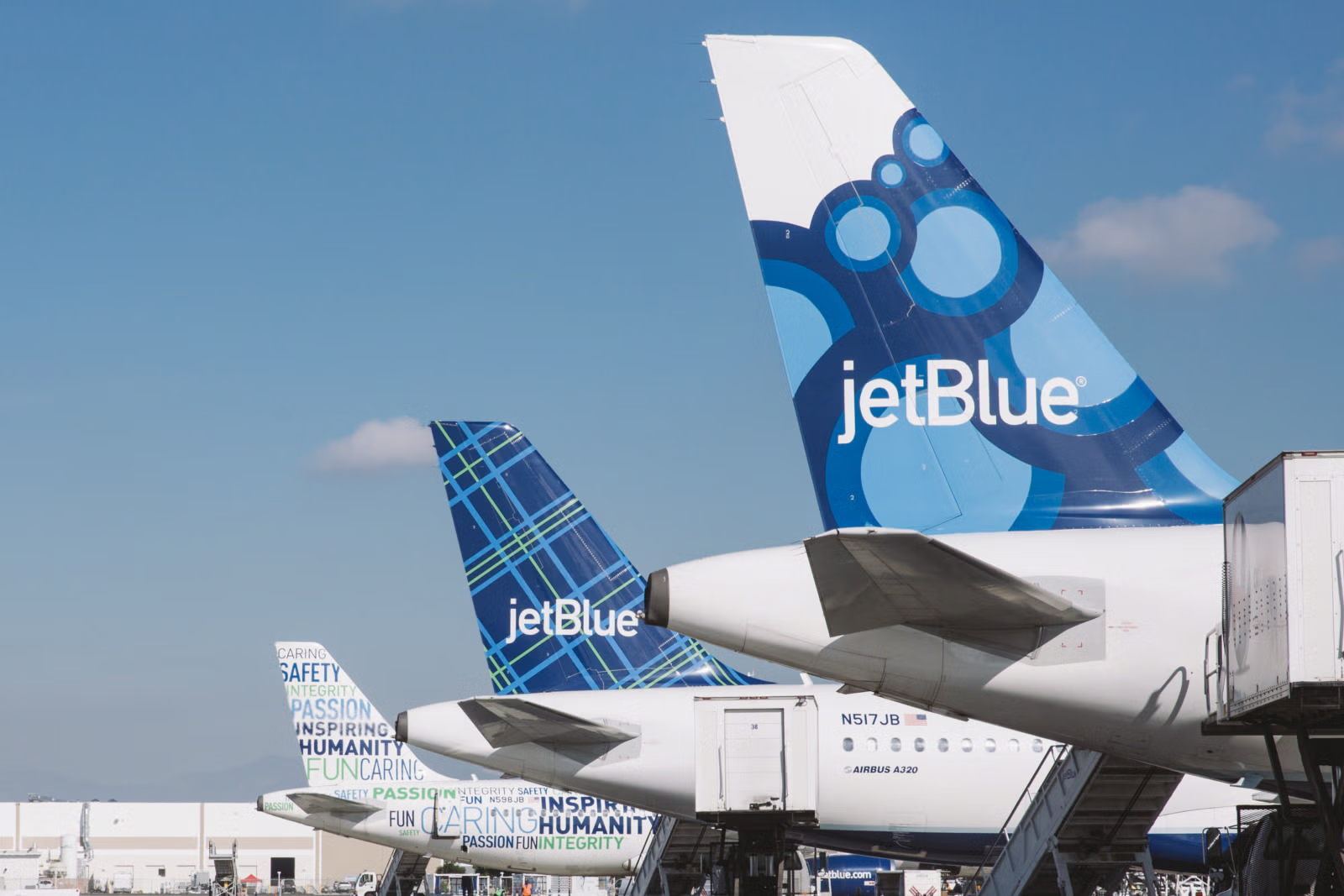
JetBlue TrueBlue Partners Guide for 2026
Key Points
- TrueBlue is a revenue-based program where points are worth roughly 1.3 to 1.5 cents on JetBlue flights, so transferring in only makes sense when you have a specific redemption in mind.
- The American Airlines Northeast Alliance was unwound in 2023, and the new United "Blue Sky" partnership rolling out through 2026 is now the redemption story worth paying attention to.
- Amex transfers to TrueBlue at a punishing 1.25:1 ratio, while Citi and Capital One both move points 1:1, which makes them the only transferable currencies you should seriously consider for TrueBlue.
Introduction
JetBlue's TrueBlue program gets a bad rap in points circles, and a lot of it is deserved. The earning is revenue-based, the redemption chart is revenue-based, and most of the airline "partners" listed on JetBlue's site are codeshare relationships that let you earn a few points on a flight you booked anyway. That's not a sweet spot. That's a footnote.
But there's still a real reason to pay attention to TrueBlue in 2026, and it's not the American Airlines partnership your favorite blog wrote about three years ago. It's the Blue Sky partnership with United, which is genuinely interesting, plus a handful of JetBlue-only redemptions where the cash price is high and the points price hasn't fully caught up. Let me walk you through what's actually worth your time and what isn't.
Quick Answer
TrueBlue points are worth roughly 1.3 to 1.5 cents on JetBlue flights. Sweet spots: Mint business class to Europe at 60,000 to 80,000 points and short-haul JetBlue flights under 10,000 points. Skip Amex transfers, which cost 20% at 1.25:1.
How TrueBlue Earning Actually Works
TrueBlue is a revenue-based program, which is a fancy way of saying you earn points based on what you spend, not how far you fly. The base earn is 3 points per dollar on JetBlue flights, and that scales up if you have status or one of the co-branded credit cards. Mosaic members earn 6 points per dollar, and JetBlue Plus or Premier cardholders earn 6 points per dollar on JetBlue purchases.
Here's the math that matters. A $200 JetBlue ticket earns you 600 base points. If you have Mosaic status, that doubles to 1,200. With the Plus card, you'd earn the credit card's 6x on top of any base earning, which can stack into the 1,800 to 2,400 range on a single ticket. None of this gets you anywhere near the earning rate of, say, an old American AAdvantage redemption on partner metal. You're not flying long-haul to Asia and coming back with 50,000 TrueBlue points in your account.
The redemption side is similarly revenue-based. JetBlue prices awards at roughly 1.3 to 1.5 cents per point depending on the route, the season, and the cabin. A $200 ticket usually costs 13,000 to 15,000 points. A $1,500 Mint business class fare to London usually prices around 60,000 to 80,000 points, which is where the program gets a little more interesting.
The JetBlue Co-Branded Cards Worth Knowing
There are three JetBlue cards in 2026, all issued through Barclays. Verify all annual fees and earning rates at jetblue.com/cards before you apply.
JetBlue Card is the no-fee version. It earns 3x on JetBlue, 2x on dining and groceries, and 1x everywhere else. If you fly JetBlue twice a year and don't want to pay an annual fee, this is fine.
JetBlue Plus Card has a $99 annual fee and earns 6x on JetBlue, 2x on dining and groceries, and 1x everywhere else. The headline benefits are a free first checked bag for you and up to three companions, 5,000 anniversary bonus points, a 10% points rebate on award redemptions, and a path to Mosaic status if you spend $50,000 in a calendar year. For anyone who flies JetBlue four or more round-trips a year, this card pays for itself on bag fees alone.
JetBlue Premier Card has a $499 annual fee and is JetBlue's attempt at a premium product. It earns 6x on JetBlue, 3x on dining and groceries, and 2x on travel. You get $200 toward annual JetBlue purchases, a $100 statement credit toward Global Entry or TSA PreCheck, accelerated Mosaic qualification, and lounge access through Priority Pass. The math gets harder here. If you're flying JetBlue ten-plus times a year and using the Mint cabin, the Premier might pencil out. For anyone else, the value isn't there.
If you want a broader take on whether airline-branded cards make sense at all, our are airline credit cards worth it breakdown walks through the math.
Transfer Partners: Where the Math Gets Painful
This is where TrueBlue stops being charming and starts being frustrating. Of the four major transferable currencies, only two transfer to JetBlue at a useful ratio.
Capital One Venture Miles: 1:1 transfer ratio, usually instant. This is the cleanest path into TrueBlue if you don't have an immediate JetBlue redemption in mind, because Capital One has a long list of better partners (Turkish, Air Canada, British Airways) you can pivot to. See our Capital One transfer partners guide for the full picture. If you're considering the Capital One Venture, it's a more flexible currency than TrueBlue itself.
Citi ThankYou Points: 1:1 transfer ratio. Citi also transfers to American AAdvantage at 1:1, so if you're choosing between TrueBlue and AAdvantage for the same trip, run both prices and pick the cheaper one. Our Citi-American Airlines transfer partner deep-dive lays out when AAdvantage is the better pick.
American Express Membership Rewards: 1.25:1 transfer ratio. This is brutal. Every 1,250 Amex points becomes 1,000 TrueBlue points, which is a 20% haircut before you do anything. Amex has 18-plus transfer partners with better ratios, including Air Canada Aeroplan, Virgin Atlantic, ANA, and Singapore. Transferring Amex to TrueBlue is something you do under duress, not by default. The full breakdown is in our American Express transfer partners guide. If you're choosing a flexible-points card from scratch, the Chase Sapphire Preferred is a better starting point than chasing Amex-to-TrueBlue value.
Chase Ultimate Rewards: Despite what some old guides claim, Chase does not currently transfer to JetBlue TrueBlue. The Marriott workaround (transferring Marriott points to TrueBlue at 3:1 with a bonus) still exists, but it's a poor use of either currency.
Marriott Bonvoy: Transfers at 3:1 to TrueBlue with a 5,000-point bonus on every 60,000 transferred. Effectively 65:20, or about 3.08:1. Marriott points are worth more as Marriott points. Don't do this unless you have a specific JetBlue redemption you can't fund any other way.
The honest take: if you're sitting on Amex and you want to fly JetBlue Mint, run the math against booking the same Mint flight with Capital One miles transferred 1:1, or just paying cash and earning Amex points on a different category card. The Amex-to-TrueBlue transfer almost never wins.
The Airline Partnership Picture in 2026
This is the section that requires the most updating, because the loudest claims from older guides are no longer true.
American Airlines: The NEA Is Gone
The American Airlines-JetBlue Northeast Alliance was vacated by federal court in May 2023, and JetBlue formally exited the alliance later that year. The deep codesharing, the reciprocal elite benefits, and the ability to redeem TrueBlue points for American Airlines flights are essentially gone. There's still a basic frequent flyer agreement that lets you earn TrueBlue points on some American-operated flights when you add your TrueBlue number, but the days of booking AA flights with TrueBlue points through jetblue.com are over.
If you see a 2022 or 2023 guide telling you to redeem TrueBlue points for transcon American flights in business class, that information is obsolete. As of April 2026, that redemption path is closed.
United Airlines: The Blue Sky Partnership
This is the partnership that actually matters now. JetBlue and United announced "Blue Sky" in May 2025 as a non-equity interline partnership. The first phase rolled out in late 2025, with reciprocal earning between TrueBlue and MileagePlus on most JetBlue and United flights, plus cross-airline elite benefits like priority boarding and complimentary preferred seats.
The full reciprocal redemption capability, where TrueBlue members can use points to book United flights and vice versa, is being phased in through 2026. As of April 2026, partial redemption availability exists, and the full integration is expected to complete later this year. The most useful piece is United's global network: 269 destinations, including hard-to-reach spots like Cape Town and Tahiti where United is the only US carrier.
JetBlue is also giving United access to JFK starting in 2027, and the two airlines are exchanging slots at Newark. None of that affects your points strategy directly, but it tells you both airlines are committed to making this work.
The redemption math on Blue Sky is still revenue-based, which means TrueBlue points spent on United flights will price similarly to TrueBlue redemptions on JetBlue. Don't expect Star Alliance-style award charts. Expect 1.3 to 1.5 cents per point on most routes, with occasional outliers where cash prices spike.
The Codeshare Partners
JetBlue lists Hawaiian, Aer Lingus, Cape Air, Etihad, Icelandair, and JSX among others as partners. For the most part, these are earning-only relationships. You can add your TrueBlue number to a partner-operated flight and earn a modest number of TrueBlue points. You generally cannot redeem TrueBlue points to book these flights.
The exception worth knowing about is JSX, the public charter operator with semi-private terminals. JSX flights can be booked with TrueBlue points in some cases, and the redemption value is occasionally interesting if you live near one of JSX's hubs. JetBlue made an investment in JSX in 2023 and the integration has slowly deepened. Verify current redemption availability at jsx.com/trueblue before you plan around it.
For the rest, treat them as ways to top up your TrueBlue balance, not as redemption options.
The Sweet Spots Actually Worth Chasing
Here's where I'd actually deploy TrueBlue points in 2026.
Short-haul JetBlue flights. Northeast hops like JFK to BOS, JFK to BUF, or BOS to PIT often price between 6,000 and 10,000 TrueBlue points one-way. When cash prices spike around holidays or weather events, those redemptions can hit 2 cents per point or better. This is the most consistent sweet spot in the program.
Mint business class to Europe. JetBlue's Mint cabin to London Heathrow, Amsterdam, Paris, and Dublin typically prices between 60,000 and 80,000 points one-way for cash equivalents in the $1,500 to $2,500 range. That's roughly 1.8 to 2.5 cents per point, which is well above TrueBlue's average. Availability is the catch. Mint awards open inconsistently and disappear quickly. Set alerts and book the moment you see a date that works.
Mint business class to Caribbean and Latin destinations. When cash prices spike for peak winter travel to places like Barbados, Aruba, or Cartagena, Mint redemptions can hit 1.7 to 2.0 cents per point. This is more seasonal than transatlantic Mint, but worth checking.
Last-minute domestic. JetBlue doesn't charge close-in booking fees, so when you're 14 days out and cash prices have surged, TrueBlue points can quietly outperform if you have them sitting around.
What I would not chase: any redemption that comes in under 1.3 cents per point, basic economy redemptions where you give up seat selection and bag rights, or anything where you'd need to transfer Amex in to fund the booking.
Family Pooling: The Underrated Feature
JetBlue's family pooling lets you create a pool of up to seven people and combine all their points into a single redeemable balance. The head of household manages the pool, and members can be added or removed as needed. Points contributed to the pool can be redeemed by the head of household for any pool member.
This is genuinely useful if you have a partner or kids who fly JetBlue occasionally and accumulate small balances that would otherwise expire or sit unused. The pool keeps everyone's points liquid and usable.
The catch: when a member leaves the pool, they take their proportional share, but any pool-earned bonus points stay with the pool. So set the pool up thoughtfully and don't move people in and out casually.
Mosaic Status: When It's Worth Pursuing
JetBlue Mosaic is the airline's elite tier, earned through 50 segments plus 5,000 base points, or 30 segments plus 12,000 base points, or by spending $50,000 on the JetBlue Plus or Business card in a calendar year. Mosaic Plus tiers (Mosaic 2, 3, 4) are earned through additional spending and tile activity.
The benefits worth caring about: free same-day standby and switches, expedited security at JetBlue hub airports, free first and second checked bags, dedicated phone line, and a 6x earning rate on JetBlue flights. There's also no change fee on Even More fares, which can save real money on flexible trips.
The honest take: Mosaic is worth chasing if you fly JetBlue 15-plus segments a year out of New York or Boston. If you fly less than that, the status doesn't earn back its required commitment, and you're better off using the Plus card's bag benefit and not worrying about elite tier.
Common Mistakes to Avoid
- Transferring Amex to TrueBlue without checking alternatives. The 1.25:1 ratio is so bad that almost any other Amex transfer partner is a better use of the points. Run the math first.
- Booking AA flights expecting TrueBlue redemption to still work. The Northeast Alliance is over. If your strategy involves redeeming TrueBlue points for American Airlines flights, you're working from outdated information.
- Treating TrueBlue like a sticker-chart program. Points don't expire as long as your account is active, but TrueBlue is not a program where holding 200,000 points buys you magical redemptions. The value is in matching specific points balances to specific JetBlue flights at the right price.
- Ignoring family pooling. If you and your partner both fly JetBlue, pooling your points into a single account is free and makes redemption much easier.
- Buying points speculatively. JetBlue runs occasional sales on TrueBlue points, but the buy price almost never beats the redemption value unless you have a specific high-value Mint redemption already in your sights.
Conclusion
TrueBlue isn't a program you build a strategy around. It's a program you use opportunistically, when you have a specific JetBlue redemption that prices well in points or when you're already a frequent JetBlue flyer who naturally accumulates the currency. The Blue Sky partnership with United is the most interesting development in years, and it's worth watching as the full reciprocal redemption rolls out through 2026. But the headline strategy still holds: earn TrueBlue points by flying JetBlue or holding the Plus card, transfer points in only when you've already identified a redemption, and lean on Capital One or Citi if you have to transfer at all. Skip the Amex-to-TrueBlue path unless you have no other option.
Match the program to the trip you're taking, not the other way around. That's where TrueBlue actually shines.
This article contains affiliate links. If you apply through our links, we may earn a commission at no cost to you, which helps us continue sharing points and miles strategies with the community.
Some of the links in this article are affiliate links. We may receive a small commission at no extra cost to you if you apply through these links. This helps us keep the site running and continue creating free content.