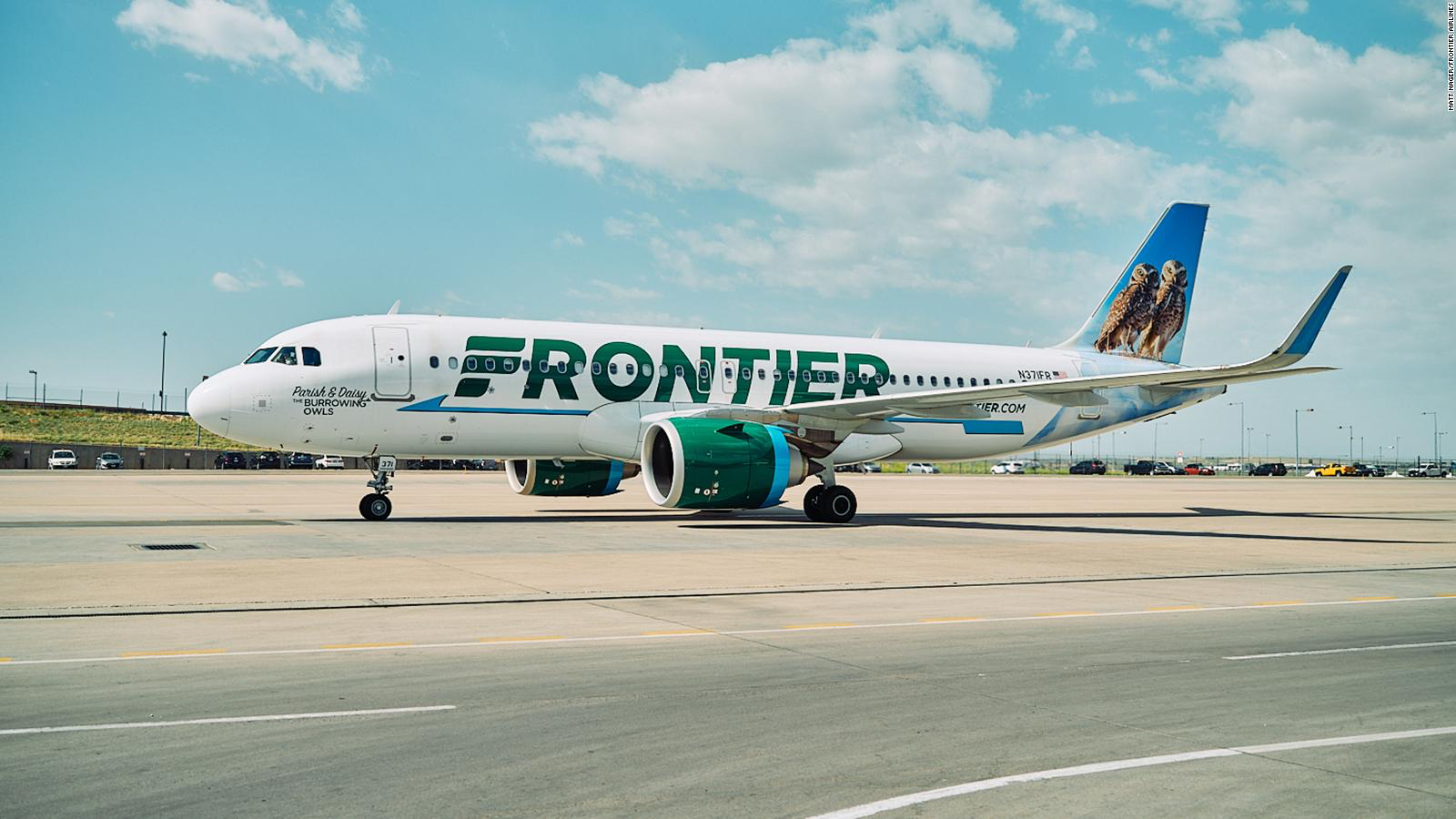
Frontier Unlimited Companion Pass: How It Works and Whether It's Worth Chasing in 2026
Key Points
- The Frontier Unlimited Companion Pass is an Elite Platinum and Elite Diamond benefit, not a standalone product you can buy. Hit the status threshold and your companion flies for taxes only on every Frontier flight you book.
- The companion can be a different person every flight. That flexibility is the headline difference between this pass and Southwest's, which locks you to one designated companion until you change them.
- The math only works if you live near a Frontier hub and fly Frontier anyway. Chasing 50,000 Elite Status Points purely for the pass is rarely the right move; if you already fly the airline 8 to 12 times a year, it pays off fast.
TL;DR
Frontier's Unlimited Companion Pass is a Platinum and Diamond elite benefit. Companion flies for $5.60 each way in taxes, unlimited times, and you can pick a different companion every flight. You earn it at 50,000 Elite Status Points per year.
Introduction
Frontier's Unlimited Companion Pass is one of the more interesting moves in domestic airline loyalty right now, and most readers I talk to have it filed under "I think I read about that, wasn't it Southwest?" It isn't Southwest. It's Frontier, it sits inside FRONTIER Miles elite status, and it does something Southwest doesn't: it lets you bring a different person on every flight.
That single mechanic is what makes the pass worth understanding. It's also why I keep getting questions about whether it's worth chasing the elite status that gets you there. The short answer is "depends on whether you'd fly Frontier anyway." The long answer is what the rest of this guide is for. We'll cover how the pass actually works, the math on when it pays for itself, the real differences between this and Southwest's Companion Pass, and the gotchas that show up at the booking step rather than the planning step.
What the Pass Actually Is
The Frontier Unlimited Companion Pass is a benefit attached to two FRONTIER Miles elite tiers: Elite Platinum and Elite Diamond. There's no separate product you buy and no certificate you redeem. Once your status posts, the companion option appears in the booking flow whenever you're logged in.
When you use it, your companion pays only government-mandated taxes and fees, starting at $5.60 each way for domestic flights. International routings carry higher taxes. Mexico, the Caribbean, and Central America are inside Frontier's network and the fees on those routes can run $30 to $80 each way depending on the destination.
What separates this from every other companion pass on a U.S. carrier is the lack of designation. Southwest makes you name a companion. Alaska's annual companion fare locks you to whoever you book with. Delta's certificate requires both passengers on the same booking but you only get one cert per year. Frontier just lets you add anyone with a FRONTIER Miles account at booking time. Different friend on the next flight? Fine. Spouse this trip, sister next trip, work colleague the trip after that? Also fine.
A few rules worth pinning down upfront because they trip people up:
- The companion must have a FRONTIER Miles account. Free to create, takes about a minute.
- You and the companion must be on the same reservation, same flights, same fare class.
- One companion per flight. You can't bring two using the pass.
- The benefit is added at booking. You can't retroactively attach a companion to a ticket you already bought.
- Companion flights don't earn FRONTIER Miles or Elite Status Points for the companion.
- If your status lapses, the pass goes away. Already-booked companion tickets are honored.
- Baggage and seat selection aren't included. Frontier charges for both, à la carte, per passenger.
That last point matters more than it sounds. We'll come back to it in the math section.
How to Earn Frontier Elite Status
Here's where the calculus gets interesting. Earning Frontier elite status is structurally different from earning status on a major U.S. carrier because Frontier fares are cheap, route stage lengths are short, and the program is built around Elite Status Points rather than miles flown.
The two tiers that include the Companion Pass:
- Elite Platinum at 50,000 Elite Status Points in a calendar year
- Elite Diamond at 100,000 Elite Status Points in a calendar year
Below those, Elite Gold (20,000 ESP) and Elite Silver (10,000 ESP) exist but neither tier includes the unlimited companion benefit. So the threshold you actually care about is 50,000.
Elite Status Points come from three places: paid Frontier flights and ancillaries booked through flyfrontier.com or the app, FRONTIER Miles World Mastercard spending, and the occasional Status Challenge promotion. Frontier's earning rules give you 1 Elite Status Point per dollar spent on flights, bags, seats, and bundles, which means a $200 round-trip with a checked bag and seat selection might generate roughly 250 to 300 ESP. To hit 50,000 on flying alone, you're looking at somewhere in the $50,000 spend range with the airline. That's a lot of Frontier.
Most people who hold the pass got there one of three ways:
1. Co-brand card spending. The FRONTIER Airlines World Mastercard from Barclays earns 1 Elite Status Point per dollar on every purchase, on top of the FRONTIER Miles you earn. If you can run $25,000 to $30,000 of organic spend through the card in a year, you're halfway to Platinum without setting foot on a plane. New cardholders also pick up an instant Elite Gold tier on the first purchase, which doesn't include the Companion Pass but does include free bags for everyone on the booking. Useful while you're working toward 50,000.
2. Combining card spend with regular flying. This is the realistic path for most readers. If you fly Frontier 12 to 18 round-trips a year out of a hub like Denver, Orlando, or Las Vegas, you'll generate something in the 15,000 to 25,000 ESP range from flights and ancillaries. Add a $20,000-to-$25,000 spend year on the World Mastercard and you clear Platinum.
3. Status Challenges. Frontier ran a $99 Platinum Status Challenge that closed enrollment on December 31, 2025. Pay the fee, earn 12,500 ESP within 90 days, get Platinum through the end of 2026. The challenge is gone for now, but Frontier reruns this kind of promotion in cycles. If the Companion Pass is the goal and you're not currently a Frontier flyer, the smart move is to wait for the next challenge window rather than try to grind your way up the long way. Sign up for FRONTIER Miles emails so you catch the next launch.
A note on what doesn't count toward Elite Status Points. Award flights booked with FRONTIER Miles don't generate ESP. Bookings made through online travel agencies don't earn ESP either; these have to come through flyfrontier.com or the Frontier app. Buying GoWild! Pass flights doesn't earn ESP, since those are intentionally separated from the elite program.
The Math: When the Pass Actually Pays Off
This is the section that decides whether the pass is worth chasing. Walk through it before committing to the spending or flying it takes to get there.
Start with what your companion would normally pay. A typical Frontier round-trip on a leisure route in 2026 prices somewhere between $90 and $180 round-trip during normal demand, jumping to $250 to $400 round-trip on peak weekends or around holidays. The pass replaces that fare with $11.20 in domestic taxes (round-trip), or $40 to $160 on international routings.
Some honest scenarios:
Scenario A. Six couple round-trips per year, all domestic, average $140 round-trip fare. Without the pass: 6 × $140 = $840 in companion fares With the pass: 6 × $11.20 = $67.20 Annual savings: $772.80
Scenario B. Twelve round-trips a year with rotating companions, mix of domestic and short international, average $175 round-trip. Without the pass: 12 × $175 = $2,100 With the pass: roughly 8 × $11.20 + 4 × $80 = $409.60 Annual savings: about $1,690
Scenario C. Three round-trips a year, all domestic, $120 average. Without the pass: 3 × $120 = $360 With the pass: 3 × $11.20 = $33.60 Annual savings: $326.40
Now compare those savings to what it actually costs to maintain Platinum. If you're already doing $25,000 of organic spend on the FRONTIER World Mastercard and flying Frontier 8 to 10 times a year, you're capturing the savings against essentially zero incremental cost. The card has a $99 annual fee. Net positive in scenarios A and B, marginally positive in scenario C.
If, on the other hand, you'd need to redirect $25,000 of spend that's currently earning 2x flexible points elsewhere (Chase Sapphire Preferred, Capital One Venture X, Amex Gold) to a card that earns only Frontier Miles, the opportunity cost gets ugly fast. You're trading away roughly $500 in flexible-points value to capture $326 in companion savings. That's the wrong trade.
The Companion Pass math works best for travelers who are already on Frontier, already flying out of a Frontier hub, and already running enough Frontier-aligned spend through the World Mastercard to make the elite path low-cost. Force any of those, and the math turns against you.
Frontier vs Southwest: The Comparison That Actually Matters
Southwest's Companion Pass is the benchmark in this category, and it deserves a direct comparison because most readers asking about Frontier are weighing it against Southwest specifically.
Southwest advantages:
The earning path is cleaner. 135,000 qualifying Rapid Rewards points or 100 qualifying flights in a calendar year, with welcome bonuses on Southwest credit cards counting toward the 135,000. The two-card stack with the annual 10,000-point boost has gotten people to the threshold in three to four months of bonus chasing for years.
Southwest's network is bigger, the operations are more reliable, and Southwest 2.0 still includes a free checked bag for A-List and Business Select fares. Frontier charges for everything à la carte. Your companion is paying for their bags and seat regardless of how cheap the ticket is.
The Companion Pass earned in early 2026 runs through December 2027, so a well-timed earn in Q1 buys you nearly 24 months of paired travel.
Frontier advantages:
Different companion every flight. This is the only U.S. carrier that lets you do this without restrictions. If your travel pattern involves rotating travel partners (different family members, work colleagues, weekend trips with different friends), Southwest forces you to redesignate your companion each time, with limited changes per year. Frontier doesn't.
The base fares are usually lower. A $140 Frontier ticket plus $50 in bags is still cheaper than a $250 Southwest ticket on the same route in many cases. The companion pays nothing on the fare differential and only their own ancillaries.
No blackout dates. The pass works on any flight with available seats, including peak holidays. Southwest's pass is also blackout-free, but Alaska, Delta, and most carrier companion benefits have meaningful restrictions on peak dates.
The structural difference: Southwest's pass rewards consistency (one designated companion, simple, predictable). Frontier's pass rewards flexibility (different companions, more complex booking, more savings if your trip pattern is varied). Pick based on how you actually travel, not on which one earns the bigger savings on paper.
The Gotchas That Cost Real Money
A few traps that show up in the booking step and the trip itself.
Baggage stacks fast. Frontier charges for carry-ons and checked bags separately, per passenger, per direction. A round-trip with one carry-on and one checked bag for two people can add $200 or more to the booking. The Companion Pass takes the fare to nothing but doesn't touch ancillaries. If you're not careful, the "free companion" trip ends up costing more than a full Southwest ticket would have. The fix is the FRONTIER Airlines World Mastercard, which gives the cardholder one free checked bag and a free carry-on for all passengers on the reservation when the booking is made on the card. That benefit alone often justifies the $99 annual fee for active flyers.
Seat selection is paid. Frontier charges for seat assignment, with prices varying by location in the cabin and proximity to departure. If you and your companion want to sit together, you're paying for both seats. UpFront seats and Stretch seats run higher. Plan for this in the trip cost, not after.
Premium fare classes aren't free. Frontier is launching domestic First Class in 2026, and Platinum status comes with eligible upgrades to those seats. But the Companion Pass still books your companion in standard Economy on the same flight unless you pay for their upgrade. The pass and the First Class upgrade benefit don't combine into a paired First Class trip.
Status maintenance is annual, not lifetime. Whatever path got you to Platinum has to be repeated every calendar year to keep the pass alive. Most people who chase the pass once burn out on the maintenance grind by year two unless they're flying Frontier as their primary airline anyway.
Discount Den fares stack, but read the rules. Frontier sells a Discount Den subscription that opens up deeper-discount fares; the Companion Pass works on Discount Den fares, which can produce some of the lowest paired-travel costs available on any U.S. carrier. The combo only makes sense if you're actually using Discount Den's lower fares on flights you'd take anyway.
Where the Pass Pays Off Best
The Pass earns its keep when the earning lines up with how you already live and travel. The clearest "yes" cases:
- You live in or near Denver, Orlando, Las Vegas, Atlanta, Phoenix, or another Frontier focus city. Route availability matters more than any other variable.
- You take 8 or more domestic round-trips a year and a meaningful share of those are with someone else.
- You're comfortable with Frontier's no-frills service model and don't expect free bags, lounge access, or free seat selection.
- You travel with rotating companions (different friends, different family members, different colleagues) rather than the same partner every trip. This is where Frontier beats Southwest decisively.
The clearest "no" cases:
- You'd need to redirect significant credit-card spend away from a flexible rewards earner just to chase Platinum.
- Your home airport doesn't have meaningful Frontier service. The pass only matters if you can actually use it.
- You always travel with the same companion. Southwest's pass is simpler, the network is bigger, and the included bags handle the ancillary problem on their own.
- You value premium-cabin upgrades on the companion ticket. The pass doesn't extend to First Class.
Booking the Pass: Step by Step
Once Platinum or Diamond posts to your account, the booking flow is straightforward.
- Log in to your FRONTIER Miles account at flyfrontier.com or in the Frontier app. The companion option only appears for logged-in elite members.
- Search flights as normal, selecting at least two passengers in the search.
- On the passenger details page, enter your companion's name, date of birth, and FRONTIER Miles number. If they don't have an account, create one for them right there. Takes a minute.
- Continue to payment. The companion fare line should show $0.00 with $5.60 (or higher international taxes) added separately.
- Pay for both tickets and any ancillaries you want, including bags, seats, and bundles. Use the FRONTIER Airlines World Mastercard if you have it, both for the bag benefit and for the Elite Status Points on the spending.
- Confirm both passengers appear on the itinerary. If only one shows, call FRONTIER Miles support before departure.
The benefit doesn't stack with online travel agencies. Booking through a third-party site won't apply the companion pricing; it has to be done direct.
What I'd Actually Do
If you're already a Frontier flyer with a hub airport, run the World Mastercard, lean toward the Status Challenge when it next runs, and treat the pass as a savings layer on travel you'd be doing anyway. The math works.
If you're not currently a Frontier flyer and you're shopping for "the best companion pass," the answer is probably still Southwest. Easier earning path, more reliable operations, bigger network, free bags built in. The Frontier pass is a specialist's tool, not a beginner's recommendation.
The middle ground: if you fly Frontier four or five times a year, get the FRONTIER Airlines World Mastercard for the bag benefit and the instant Elite Gold tier, and keep an eye out for the next Platinum Status Challenge. Don't grind for Platinum the long way unless you're already most of the way there organically.
Frontier built a genuinely interesting benefit here. It's not for everyone, and the existing ecosystem of $25-checked-bag, $30-seat-selection, no-frills service is part of the deal. But for the right traveler (hub-based, flexible, comfortable with the Frontier model), the unlimited paired travel is real money saved on every trip.
This article contains affiliate links. If you apply through our links, we may earn a commission at no cost to you, which helps us continue sharing points and miles strategies with the community.
Some of the links in this article are affiliate links. We may receive a small commission at no extra cost to you if you apply through these links. This helps us keep the site running and continue creating free content.