If you just crossed 200,000 transferable points and you're staring down a long-haul flight, the question pretty much asks itself: do you blow the stack on international first class, or play it safer with business? In 2026, the math is not what it was a decade ago. Modern business cabins have closed a lot of the gap, true first class only exists on about 15 airlines, and the price tag in points is usually somewhere between 1.5x and 2x what J costs on the same route.
I've sat in both, and I've also burned an embarrassing number of evenings running award searches that went nowhere. So this is the version I wish someone had handed me when I first hit a six-figure points balance. I'll walk through what first class actually means in 2026, where it still exists, three concrete redemption matchups, and how to decide whether the marginal miles are worth it for the trip you're planning.
If you have to ask whether F is worth twice the points, business class is almost certainly the right answer this trip.
What "First Class" Actually Means In 2026
The phrase "first class" covers three completely different products, and conflating them is how people end up disappointed.
The first version is domestic first inside the US. It's a wide recliner with about 38 inches of pitch, a complimentary drink, and a tray meal on longer routes. On narrowbody jets it's a 2-2 or 1-1 layout. By international standards it lands somewhere around premium economy. If a US carrier is selling you "first class" on a transcon, that's what you're getting. It is not what the rest of this guide is about.
The second is international business class, which is a different animal entirely. Lie-flat seat, direct aisle access, fully enclosed suite on the newer products like Qatar Qsuites and ANA's "The Room," multi-course meal, premium lounge access on the ground, amenity kit, pajamas on the top operators. As of 2026, this is the cabin most points readers are actually shopping for. It's also the cabin the major US carriers have standardized on for their long-haul flagships.
The third version is true international first class, the one that costs roughly twice the points. It only exists on aircraft that also have a business cabin, which is part of what makes it rare. About 15 airlines still fly it, mostly concentrated in the Middle East and Asia with a couple of European holdouts. Expect a fully enclosed suite of 50 to 60 square feet, dedicated check-in and security, a crew-to-passenger ratio around 3-to-1, vintage champagne, and dining that's been built around named chefs.
What Actually Separates F From J
If you're going to spend an extra 40,000 to 70,000 miles, you should know what you're actually buying. Five things move the needle.
The first is space and privacy. Business class suites in 2026 already have doors on most premium operators, plus six and a half feet of fully flat sleeping surface and decent storage. First class moves you from roughly 25 to 35 square feet of personal space up to 50 or 60. Emirates' refreshed 777 first product even has virtual windows in the center suites. It's nicer. Whether it's 50,000 miles nicer is the actual question.
The second is the ground experience, and this is where F separates most decisively from J. Frankfurt's First Class Terminal is a separate building from the rest of the airport with a private immigration channel and a chauffeur to the aircraft. Singapore's Private Room sits inside the regular SilverKris lounge but feels nothing like it, with a la carte dining and limo service inside about a 30-mile radius. Emirates' first class lounges in Dubai have a direct boarding bridge to the gate. You don't queue. You don't share a "Group 1." You walk straight on.
The third is service ratio. Economy runs around 50 passengers per flight attendant, business around 10 to 15, first usually 2 to 4. Ordering a cappuccino at 3 am in F is unremarkable. In J it's possible but feels like a minor imposition. That ratio is also why F dining feels personal in a way J dining can't quite replicate.
The fourth is the food and drink. Business class meals in 2026 range from acceptable to genuinely good, with 3 or 4 courses and decent champagne that isn't vintage. First class typically runs 5 to 7 courses, with unlimited caviar service on Emirates, dine-on-demand on the better operators, Dom Pérignon or Krug, and chef partnerships across the board. Air France La Première works with Alain Ducasse. Singapore's Book the Cook program in F uses premium ingredients and lets you preorder several days ahead. The wine list at the front of the plane is a different list than the one in business.
The fifth is the amenities. J gives you a kit, sometimes pajamas (JAL, ANA, and Singapore are the standouts there), and a thin mattress pad. F gives you La Mer or Lalique or Diptyque kits, premium pajamas you'll actually keep, a real mattress topper, turndown service, and on Emirates A380s and Etihad A380s an onboard shower. The shower is genuinely fun the first time. By the third long-haul F flight, it's a checklist item.
The Airlines Still Flying First In 2026
The list shortened in the 2020s and kept shortening. As of 2026, the live operators break out roughly like this.
In the Middle East, Emirates still flies F on the A380 fleet and on select 777s, and they've publicly committed to keeping it on the A380. Booking through Alaska Mileage Plan runs 140,000 to 180,000 miles one-way US to Dubai. Etihad keeps F on the A380 only with very limited availability, around 115,000 American AAdvantage miles. Qatar still flies F on the 777-300ER but has signaled the cabin is being phased out, with 70,000 to 110,000 AA miles off-peak while it lasts.
In Asia, Singapore Airlines runs F on the A380 and select 777s. ANA flies F on the 777 with a small route network, bookable through Virgin Atlantic Flying Club at 110,000 to 120,000 miles. JAL operates F on the 777 in 80,000 to 100,000 AA miles territory off-peak. Asiana, Korean (A380 and 747), and Cathay all keep F on a handful of routes with very limited inventory.
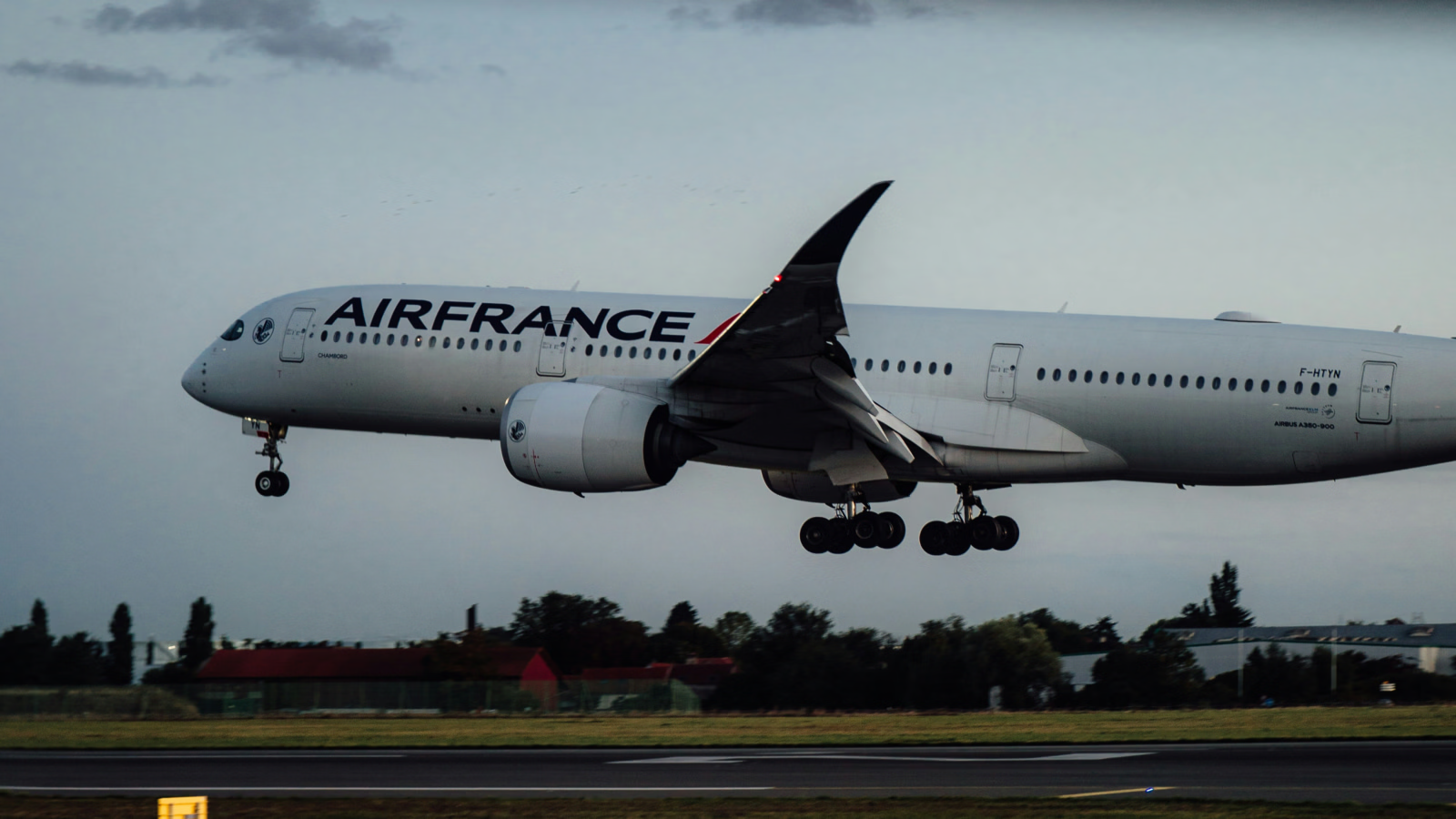
In Europe, Lufthansa keeps F on the 747-8 and the A380, bookable for 118,000 United miles. Swiss flies F only on the 777-300ER. Air France keeps La Première on select 777s, around 115,000 to 160,000 miles through Virgin Atlantic.
North American carriers don't fly true international F at all anymore. Delta eliminated their product in 2017, American retired the 777-300ERs that carried it, and United's Polaris is a business cabin no matter how nicely marketed. If you want F from the US, you're flying a foreign carrier.
Three Redemptions To Anchor The Decision
Numbers help more than adjectives here. These are the same three pairings I run people through when they ask whether to splurge.
The first is Emirates Dubai to New York. Cash fare for F runs $14,000 to $21,000. Through Alaska Mileage Plan, business is 115,000 miles one-way, first is 180,000. The marginal cost is 65,000 miles to go from J to F, which at a generous 1.6 cents per mile valuation is roughly $1,040 of points value. You're paying that for the suite, the ground experience in Dubai, the shower, and the service ratio. On a 14-hour overnight where you actually plan to sleep, I think this one passes the sniff test if you have the miles to spare. On a daytime flight where you'd mostly be awake and eating, it's harder to justify.
The second is ANA Tokyo to New York. Cash for F is $18,000 to $24,000. Through Virgin Atlantic Flying Club, business is 90,000 miles one-way and first is 110,000. That's a 20,000-mile marginal cost, worth maybe $300. This is one of the best F redemptions on the planet right now. If you can find availability, take it. The Room is already excellent in J, but for 20,000 extra miles you're stepping into "The Suite," which is in a different category, plus dine-on-demand and the ANA F amenity kit. As of 2026, ANA still releases F space about 355 days out, so plan ahead.
The third is Lufthansa Frankfurt to San Francisco. Cash for F runs $15,000 to $19,000. Through United MileagePlus, J is 77,000 miles one-way and F is 118,000. Marginal cost is 41,000 miles, around $615 of value. The deciding factor here is whether you can access Lufthansa's First Class Terminal in Frankfurt, which is genuinely the best ground experience in commercial aviation as of 2026. If you're connecting through FRA and you have a couple of hours to use the terminal, that alone justifies the upgrade for a lot of travelers. The catch is that Lufthansa restricts F partner space pretty aggressively, so you're often searching for weeks before something opens up.
Three different routes, three different verdicts. The pattern: marginal cost in the 20,000 to 40,000 mile range is usually a green light, 50,000 to 70,000 is a coin flip that depends on the trip, and anything above that needs a real reason.
When First Class Is The Right Call
A few situations push the calculus toward F. The cleanest is when the marginal cost lands under 30,000 miles, which is mostly the ANA NRT-US redemption and occasionally Qatar off-peak before they finish phasing the cabin out. At that price the upgrade is close to a no-brainer if availability exists.
The next is when you specifically value the ground experience. If you're connecting through Frankfurt, Dubai, or Singapore and you can use the dedicated F facilities, that alone can flip the decision. The First Class Terminal in FRA includes a cigar lounge, a private bathtub on request, and a Porsche or Mercedes ride to the plane. Doha's Al Safwa is a smaller version of the same idea.
The third is sleep-space constraints. If you're over six feet two, business class seats vary a lot in fully flat length. F gives you more bed in every direction, including width, which matters on a 13- or 14-hour flight if you actually want REM sleep.
Special occasions count too. If this is a honeymoon, a milestone birthday, or the once-a-decade big trip, the marginal points are easier to justify because you're not going to make this trade again next quarter.
Finally, F sometimes makes sense purely because the award space exists. If you're trying to fly Tokyo to New York on specific dates and the only thing open in the cabin you want is F, the question changes from "is F worth it" to "do I want to take this trip or not."
When Business Class Is Smarter
The mirror situations are where J is the right call. If you're booking close to departure, F availability is usually gone and J is realistic. If you're traveling with a partner or family, F costs scale brutally; two F seats can be 360,000 miles where two J seats are 180,000, and most people would rather take the second trip than upgrade the first.
J is also smarter when you want flexibility on dates. There's simply more J inventory across most partner programs. Lufthansa, Air France, and Swiss release F space stingily; ANA and Emirates are friendlier but still constrained.
The strongest case for J in 2026, though, is that some of the products are now genuinely excellent. Qatar Qsuites with the center "quad" mode, JAL's Sky Suite, the new Singapore Airlines business class, and ANA's The Room are all so good that the gap to F has narrowed to amenities and ground service rather than seat comfort. If your priority is sleeping well on the flight, modern J on the right operator does that job.
The other quiet argument for J is points conservation. 100,000 miles back in your account is one more round trip you can take next year. Every F redemption is two or three J trips you didn't take.
How To Find F Award Space In 2026
Award space is where most F plans die. A few patterns worth knowing.
For Emirates F, Alaska Mileage Plan at 180,000 miles DXB to US is the headline rate and the best value as of 2026. JAL Mileage Bank also books Emirates F at around 165,000 miles. Avoid Air France Flying Blue for Emirates, which prices above 260,000 for the same award. Transferable points partners feeding Alaska are limited (Bilt is the cleanest path for most people), so plan the points side before searching.
For ANA F, Virgin Atlantic Flying Club at 110,000 miles is the gold standard. Avianca LifeMiles books the same at 120,000. Air Canada Aeroplan books at 110,000 with lower taxes on certain routes. ANA's own KrisFlyer-style program charges its own members more, which is unusual but worth knowing.
For Singapore F, KrisFlyer is the only program that books the SQ flagship aircraft, at 110,000 to 141,000 miles depending on route. Virgin Atlantic books some Singapore routes but pricing has shifted.
For Lufthansa F, United MileagePlus at 118,000 miles is the standard. Aeroplan books at 88,000 to 110,000 but with higher carrier-imposed fees. Avianca LifeMiles books at 87,000 with low fees and is the best-value option if availability appears.
For Qatar F while it lasts, AA AAdvantage prices at 70,000 off-peak and 115,000 peak. The cabin is being wound down so don't plan future trips around it.
On the space side: ANA tends to release F about 355 days out and the inventory holds up reasonably well. Emirates F regularly appears in award searches throughout the year. Singapore opens space but it gets cleared quickly by KrisFlyer members. Qatar F is minimal because of the phase-out. Lufthansa is notoriously stingy with partner space and Swiss is worse. Air France La Première to partners is close to nonexistent.
A useful workaround is mixed-cabin booking. ANA J outbound at 90,000 plus F return at 110,000 totals 200,000 for the round trip, versus 220,000 for double F. You get the F experience on one leg and free up 20,000 miles. Most major partner programs allow this kind of pairing.
One more thing: when an airline announces it's eliminating F, space sometimes opens up in the months before the cabin is retired. That's how a lot of last-call Qatar F bookings happened in late 2025.
F Is Shrinking, Who's Cutting And Who's Keeping
The trajectory in 2026 is clear. Delta eliminated international F back in 2017. United never offered true F as a separate cabin. American retired the 777-300ERs that carried Flagship First. Air France has signaled La Première is phasing out across the fleet. Cathay reduced F to a handful of routes. KLM never offered it. Virgin Atlantic and Qantas have committed to J-only on new aircraft, including Project Sunrise.
The operators that have publicly committed to keeping F: Emirates (the A380 commitment is firm), Singapore (it's a flagship product), ANA (heavily branded), JAL (smaller but stable), and Etihad (A380 only). Lufthansa is keeping F on the 747-8 and A380 for now, though long-term that depends on the future of both aircraft.
The takeaway: if there's a specific F product you want to try, the next two to three years are probably your window. The list is going to keep shrinking.
A Realistic Recommendation
If you've never flown a premium long-haul cabin and you're asking which one to pick first, book J. The value math is better, availability is friendlier, and the modern products are good enough that you won't feel cheated. Pick a top-tier operator (Qatar Qsuites, ANA The Room, JAL Sky Suite, the new Singapore J) and treat the flight as a destination in itself.
If you've already flown J once or twice and you're curious about F, treat it as a one-time bucket-list redemption. Aim for Emirates A380, ANA, or Singapore where the marginal points cost is reasonable and the product is genuinely a step up. Don't try to do F regularly. The math doesn't support it for most people.
For ongoing premium travel year over year, stay in J. You'll fly twice as many trips for the same points balance, and the difference in inflight experience is smaller than the difference in trips you actually take.
For special occasions, F shines and the upgrade is easier to justify. Honeymoon, milestone, parent's 70th, whatever. Use the points there.
Bottom Line
First class in 2026 is a luxury product that's both better than it's ever been and rarer than it's ever been. Business class is the answer for almost every real-world question. The marginal points cost from J to F is steep, the ground experience is the real differentiator, and the cabin is disappearing from more operators every year. If you have the miles and a reason, book it once through Emirates, ANA, or Singapore. Otherwise, take the J seat and the second trip.
This article contains affiliate links. If you apply through our links, we may earn a commission at no cost to you, which helps us continue sharing points and miles strategies with the community.
Some of the links in this article are affiliate links. We may receive a small commission at no extra cost to you if you apply through these links. This helps us keep the site running and continue creating free content.