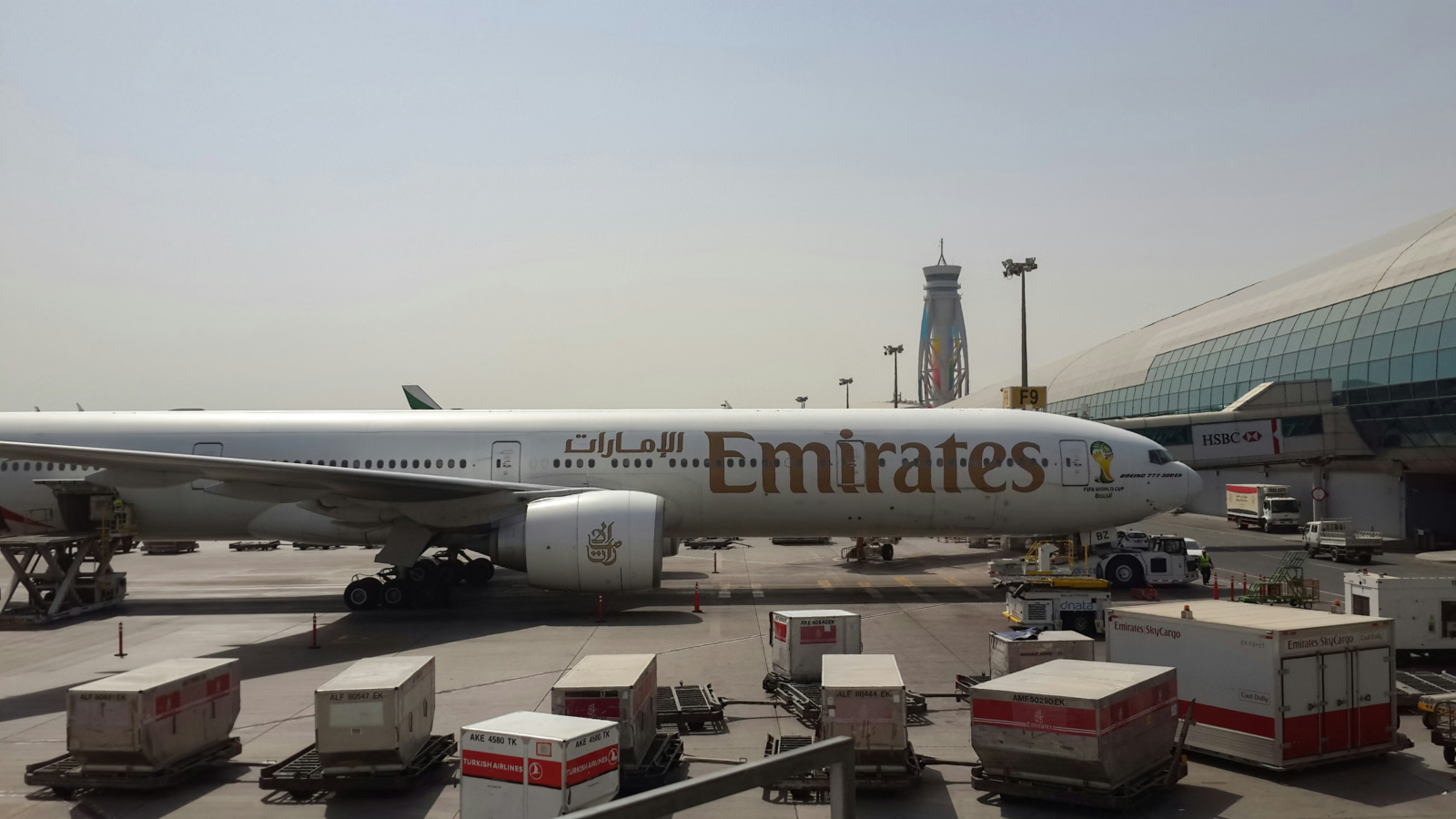
Emirates is the rare airline where upgrades with miles are actually worth the math. Last-seat availability at the airport, upgradable award tickets, and the occasional routing where the upgrade path costs fewer miles than booking the cabin outright, this program rewards the people who read the fine print.
I've been watching the Skywards program get more expensive in waves since 2024. Chase pulled the plug on transfers in October 2025. Citi devalued in July. Amex US dropped from 1:1 to 5:4 in September, then dropped again to 2:1 on February 1, 2026. Capital One landed at 2:1.5 on January 13, 2026. Bilt is now the only 1:1 transfer left for U.S. cardholders.
That backdrop matters, because it changes the calculus on upgrades specifically. When transfer ratios are bad, every mile in your Skywards account is more expensive to replace, which makes the cases where an upgrade beats a direct award redemption more valuable than they were a year ago. Here's how I'd actually work this program in 2026.
Fare types decide everything
Emirates buckets every ticket, cash or award, into four fare brands: Special, Saver, Flex, and Flex Plus. Your upgrade options live and die by which brand you booked.
Special fares are the bottom-of-the-funnel cash fares, and they're not upgradable. Period. They don't exist on the award side either, so you'll only see this brand on revenue tickets.
Saver fares are upgradable, but only on departure day at the airport or onboard. No advance confirmations, no waitlists. If you booked a Saver award and want the upgrade, your job is to show up at the airport early and ask nicely. This is less of a downgrade than it sounds, Emirates' day-of-departure policy is unusually generous, which I'll get to below.
Flex and Flex Plus fares are upgradable any time from booking through departure, including in advance and onboard. These are the brands to book if you want to confirm an upgrade weeks out.
One requirement that trips people up: the ticket has to be issued on Emirates ticket stock. If you booked Emirates metal through Qantas, Air Canada, or another partner program, you can't add a Skywards upgrade to it, even with miles in your account. Check the ticket number prefix. If it starts with 176 (Emirates' carrier code), you're good. Anything else and the upgrade option doesn't exist for that itinerary.
You can only step up one cabin class per upgrade, with one exception: economy passengers can jump straight to business class, skipping premium economy. Economy-to-first is off the table.
The first class upgrade loophole
In May 2025, Emirates restricted first class award bookings to Skywards elite members, Silver, Gold, and Platinum. Blue-tier members lost access entirely. If you've been sitting on miles dreaming of an A380 shower suite redemption, that door closed unless you've earned status.
The upgrade path is still open to everyone, though. Non-elite Blue members can still upgrade into first class with miles. That makes upgrades the only realistic route into Emirates first class for the vast majority of points collectors, and it's the single most important thing to understand about this program in 2026.
The one fine-print restriction: children eight and under can't fly Emirates first class on award tickets or upgrades. They're allowed on paid tickets only. If you're traveling with young kids, plan around it.
What an upgrade actually costs
Skywards upgrade pricing scales with route, cabin, and fare brand. Emirates publishes a public miles calculator, punch in your origin, destination, and target cabin and it spits out the exact mileage requirement. Use it before you transfer any points in.
A few sample data points from current charts (these shift, and Emirates is making selected adjustments throughout 2026):
- Newark to Athens, business to first, Flex Plus: around 39,000 miles one-way
- JFK to Dubai, business to first, Flex Plus: around 70,000 miles one-way
- JFK to Dubai, economy to business, Flex Plus: around 70,200 miles one-way
The good news on the cost side: Emirates does not pile carrier-imposed surcharges onto upgrade rewards. You pay miles plus any genuine government taxes that differ between cabins, UK Air Passenger Duty is the usual culprit, since it's higher in premium cabins out of London. On most non-UK routes, the cash component of an upgrade is small or zero.
If you're staring at a five-figure mile cost for the upgrade you want, run the math on Skywards+. The paid subscription tier offers up to a 20% rebate on Upgrade Reward costs (along with other perks like complimentary upgrades at higher tiers). It only applies to commercial tickets booked on emirates.com and upgrades processed through emirates.com, partner-booked tickets and Special/Saver fares don't qualify. For a single big international upgrade, the rebate can cover the subscription cost several times over.
Where the miles come from in 2026
The transfer partner landscape changed substantially over the last twelve months, so let's do a clean rundown of where you can move points into Skywards as of now:
- Bilt Rewards, 1:1. The last 1:1 transfer partner for U.S. cardholders. The Bilt Mastercard earns 3x on dining and 2x on travel (with the no-fee version requiring five transactions per statement). Bilt is the headline transfer for Skywards full stop, if you're serious about flying Emirates, the Bilt Mastercard belongs in your wallet specifically for this.
- American Express Membership Rewards, 2:1 (as of February 1, 2026). Down from 5:4 last fall and 1:1 before that. This is the harshest devaluation of the bunch, and it changes the calculus on cards like The Platinum Card from American Express and the American Express Gold Card for Skywards specifically. Amex MR still has great uses, ANA, Virgin Atlantic, Air Canada, but Emirates is no longer one of them.
- Capital One Miles, 2:1.5 (1,000 miles = 750 Skywards), effective January 13, 2026. The Capital One Venture X still earns flexibly, but the Emirates path has gotten 25% more expensive in points.
- Citi ThankYou Rewards, 5:4 (1,000 = 800) for premium cards like the Citi Premier Card, and roughly 1.78:1 for the non-premium ones. Citi's premium ratio matches Amex's old ratio, which makes it look better only because the comparison set got worse.
- Marriott Bonvoy, 3:1. Not a path I'd actively pursue, but worth knowing if you have Bonvoy points sitting idle.
Chase Ultimate Rewards ended Skywards transfers on October 16, 2025. If you're holding Chase points hoping the math works out, it won't. Move them somewhere else. The Chase chart without Emirates is still strong, particularly Hyatt and the airline partners.
The headline if you're choosing where to earn for Emirates specifically: Bilt or nothing. The 2x dining multiplier on the Bilt Mastercard doesn't blow away premium-card multipliers in isolation, but when every other transfer partner takes a 20-50% haircut on the way in, the 1:1 ratio becomes the entire ballgame.
Confirming an upgrade in advance
Emirates applies capacity controls to advance upgrades, confirmable upgrade space mirrors whatever award inventory exists in that cabin on that flight. If a saver-level business award is available, the business upgrade is too. If not, you're looking at a waitlist or the day-of-departure play.
To find confirmable space, sign in to your Skywards account and search the route. Flights with available upgrade inventory show a "Miles upgrade available" tag below the schedule. Click it and you'll see exact mileage requirements for each cabin step.
If nothing's available, you can join the waitlist, which stays active until 48 hours before departure. If your upgrade hasn't cleared by then, the waitlist closes, but you can still chase it at the airport.
The day-of-departure play is the real trick
This is the part of Emirates' program that separates it from American, Delta, and United. Emirates offers last-seat availability for day-of-departure mileage upgrades. If a premium cabin seat is unsold when you arrive at the airport, you can typically upgrade into it with miles. No award inventory buckets, no elite priority queue, no complex revenue-management logic. Just available seats and your Skywards balance.
This applies to all three upgradable fare brands:
- Flex Plus, confirm in advance, on waitlist, or at the airport
- Flex, confirm in advance, on waitlist, or at the airport
- Saver, at the airport only
The strategy writes itself: book the cheapest upgradable fare you can stomach as your fallback, arrive at the airport at the start of check-in, and ask. Most long-haul Emirates flights have at least a few premium cabin seats unsold at airport check-in, even on popular routes, Emirates flies a lot of premium capacity (the A380 in particular has 14 first class seats and ~76 business seats to sell on every rotation).
This day-of-departure mechanic is the single most valuable thing about the program. Combined with the fact that first class upgrades are open to non-elite members, it's the only realistic path for most people to fly Emirates' flagship product without paying $20,000 cash. Show up early, ask politely, and a meaningful percentage of the time the upgrade clears.
When the upgrade math actually beats a direct award
Here's the move that's worth running every time you book Emirates with miles. On certain routes, booking a lower cabin award and immediately upgrading costs fewer total miles, and substantially less in cash, than booking the premium cabin directly. The miles calculator is the same source for both numbers, so this isn't theoretical. You can verify it before you transfer a single point.
The textbook example, JFK to Dubai one-way:
- Direct business class award: 138,000 Skywards miles + $835.40 taxes/fees
- Economy Flex Plus award + upgrade to business: 50,000 miles + $203.40 for the economy ticket, then 70,200 miles for the upgrade, total 120,200 miles + $203.40
Choosing the upgrade path saves 17,800 miles and $632 in cash. At a 1:1 transfer from Bilt, that's 17,800 Bilt points back in your pocket plus the cash savings. Run this on the routes you're actually considering, it doesn't work everywhere, but on long-haul routes with high direct-award fuel surcharges, the gap can be enormous.
The catch: once you upgrade from economy to business, you've used your one cabin step. You can't upgrade again to first. If you're chasing first class, you'd need to start with a business-class award and upgrade from there, which carries its own math.
Practical tactics for getting upgrades to clear
A few rules I'd run by if I were chasing this seriously:
Book a refundable fare brand if you're banking on the airport upgrade. Flex and Flex Plus are refundable; you're not stuck if plans change. Saver is non-refundable, so make sure you're okay flying the original cabin if the upgrade doesn't clear.
Search multiple dates. Confirmable upgrade space swings hard by departure date. Off-peak Tuesdays and Wednesdays consistently have more inventory than Friday-Sunday peaks. If you have flexibility, scan a two-week window and pick the best day.
Don't waste time on the waitlist for Saver fares. Saver upgrades only process at the airport anyway. Skip the watching-the-app routine and just plan to show up early.
Use the 48-hour rule to your advantage. If your Flex/Flex Plus waitlist doesn't clear at the 48-hour mark, it auto-cancels, but you can re-request at the airport under last-seat availability. The cleared/not-cleared status at T-48 isn't your final answer.
Be strategic with transfers. Given the recent devaluation wave, only transfer to Skywards when you have a specific redemption locked in. Skywards miles do still expire after 36 months of inactivity (Emirates has extended some expiry dates into June 2026 due to regional travel disruptions), so points sitting in transferable currencies are safer than points sitting in Skywards.
When upgrades make sense, and when they don't
Upgrades are the right move when:
- You want Emirates first class but don't have Silver+ status
- Someone else paid for your ticket and you're spending miles for the comfort upgrade
- The upgrade math beats the direct award (the JFK-Dubai pattern above)
- You're on a Saver fare and want to take a swing at last-seat availability
- You booked conservatively and have miles to burn
Upgrades are not the move when:
- You're starting from scratch and award space exists in your target cabin (book the cabin directly)
- The upgrade cost approaches the direct premium award (rare, but check)
- You're traveling with kids under nine who can't fly first class via upgrade
- You need the option to climb two cabins (upgrades are one step only)
Where I'd actually start
If I were planning an Emirates redemption today, my sequence would be:
- Decide your cabin and route. Pull up the miles calculator and price both the direct award and the lower-cabin-plus-upgrade for the route you want. If the upgrade path is cheaper, book it. If not, book the direct award.
- Check confirmable upgrade inventory while logged in. If you can confirm in advance, do it. If not, decide whether you're willing to play the airport game.
- Transfer miles only after confirming the redemption is bookable. Skywards transfers are usually instant from Bilt, near-instant from Amex, and 1-2 days from Capital One. The risk of speculative transfers is real.
- Use Bilt if you can. Bilt Mastercard at 1:1 is the only ratio that doesn't actively punish you. The 2x travel multiplier means every $1,000 in Emirates revenue spending earns 2,000 Skywards miles directly. If you fly Emirates regularly, the Bilt Mastercard is the card I'd put on the booking.
Emirates Skywards is not the program it was three years ago. Transfer ratios are worse, first class is gated, and the calculator is creeping up. But the upgrade mechanic, particularly last-seat availability and the open door to first class for non-elites, is still one of the most reader-friendly setups in the global loyalty world. If you've been waiting for the right time to try the A380 shower suite without paying cash, the upgrade path is your ticket.
This article contains affiliate links. If you apply through our links, we may earn a commission at no cost to you, which helps us continue sharing points and miles strategies with the community.
Some of the links in this article are affiliate links. We may receive a small commission at no extra cost to you if you apply through these links. This helps us keep the site running and continue creating free content.