If you've already got a Capital One travel card and you know what the portal does at a basic level, this guide is about how to extract the most value from it. We're not going to explain Hopper-powered price prediction or which cards earn miles versus cash back. This is the strategy layer that sits on top: how to spend the Venture X $300 credit, when the Premier Collection actually clears the math, when to skip the portal and transfer to Aeroplan or Flying Blue instead, and what the optimal annual workflow looks like for a Venture X holder in 2026.
Capital One built the portal to capture a meaningful share of each travel card's value. The $300 annual credit only redeems through the portal. Premier Collection perks only book through the portal. Lifestyle Collection only books through the portal. Ignore those features and you're paying the annual fee twice and using the card once. Over-index on the portal and you leave 5-7 cents per mile on the table on premium international cabins. The job is to play both lanes well.
The Premier Collection Deep Dive
The Premier Collection is the single most underrated perk in the Capital One travel stack, and it's the reason the Venture X annual fee clears for a lot of readers.
Mechanics: Venture X-only program. A hand-picked set of luxury and upper-upscale hotels worldwide. Two-night minimum on most properties. Every booking includes a typical $100 experience credit (usable at the property on food, beverage, or spa), daily breakfast for two, complimentary Wi-Fi, room upgrade when available, and early check-in and late check-out when available.
The value floor math is what most readers miss. On a single two-night stay you're getting:
- $100 experience credit (face value, easy to use).
- Breakfast for two for two mornings. At a typical Premier Collection property, room-service breakfast runs $40-$80 per person, so $160-$320 of value depending on the property.
- Wi-Fi, which is increasingly bundled but is worth $15-$30 at the upper end.
- Room upgrade and early/late check-out, both subject to availability and worth zero on the days the property says no and a meaningful amount on the days they say yes.
Floor value per stay: roughly $260 in nameable perks, before you count the upgrade and timing benefits. Stay twice a year on Premier Collection bookings and you're at $520 in captured value against the Venture X $395 annual fee, before the $300 portal credit, before the 10x earn on hotels, before the 10,000 anniversary miles. The card pays for itself on the Premier Collection alone if you stay twice.
The closest comparison is Amex Fine Hotels and Resorts. FHR sits behind the Platinum's $695 annual fee. Same perk stack in shape, broader property selection, FHR includes a guaranteed noon check-in. But you're paying $300 more per year for those incremental perks. Unless you're hitting Platinum's other credits at face value, Premier Collection at the Venture X's $395 fee is the more efficient lane.
The catch: Premier Collection's property list is smaller than FHR's. If you have a specific aspirational hotel in mind and it's not on the list, Capital One can't help. Check inventory before assuming it'll work for your travel pattern.
The Lifestyle Collection (and Why It's Often the Better Lane)
The Lifestyle Collection sits one tier below Premier Collection. Mid-tier and boutique hotels. No two-night minimum. Every booking includes a $50 experience credit, daily breakfast for two, complimentary Wi-Fi, room upgrade when available, and early check-in and late check-out when available.
Crucially, both Venture X and Venture cardholders get Lifestyle Collection access. So if you're carrying a Venture at $95 a year, you still have a hotel-perks program. That's worth knowing.
Where Lifestyle Collection actually beats Premier Collection: if your travel pattern is upper-mid hotels, not aspirational luxury, the inventory is broader and the no-two-night-minimum rule doesn't constrain a one-night business trip. Three Lifestyle Collection stays a year deliver:
- $150 in experience credits (3 x $50).
- Six mornings of breakfast for two at, say, $30 per person, which is roughly $360.
- Total nameable value floor: roughly $510 across three stays.
For a reader booking Hyatt Place-tier or boutique properties at $200-$350 a night, Lifestyle Collection captures more value per dollar of annual fee than Premier Collection, because the cadence is higher. Premier Collection is for the once-or-twice-a-year aspirational stay. Lifestyle Collection is for the four-or-five-times-a-year mid-tier rhythm.
The Transfer-Partner-vs-Portal Decision Tree
Capital One miles are transferable to a long list of airline and hotel partners at 1:1 ratios. At the portal, those same miles redeem at exactly 1 cent each. The decision is mechanical once you know the rules.
Transfer when the cabin is premium and international. Domestic economy and short-haul flights rarely clear more than 1 cent per mile through any transfer partner. The portal at 1 cpp is fine. International business and first class is where transfer partners hand you 3-7 cents per mile, sometimes more.
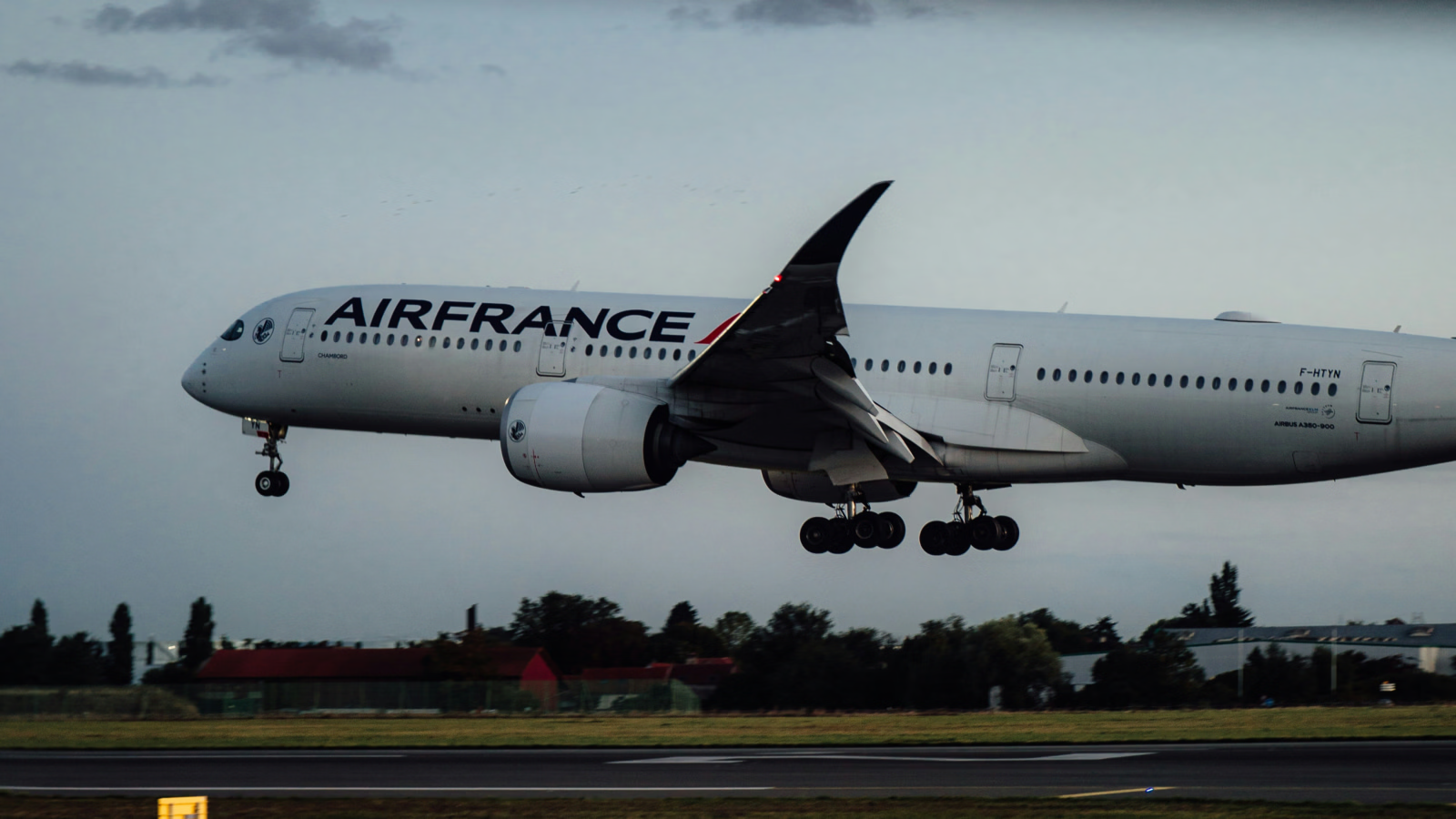
Worked example, JFK to CDG, Air France business class. A one-way mid-week paid fare runs roughly $3,800. Through the portal at 1 cpp, you'd burn 380,000 miles. Transferring to Flying Blue during a monthly Promo Rewards window, the same seat is 55,000 miles plus around $250 in taxes. That's 6.9 cents per mile in value, against the portal's 1-cent floor.
The partner shortlist. Air Canada Aeroplan (Star Alliance breadth, fair pricing). Air France/KLM Flying Blue (Promo Rewards months for European business). Turkish Miles&Smiles (United domestic at 7,500 miles one-way; sweet spots are real, service support is uneven). Virgin Atlantic (ANA first-class redemptions are a known sweet spot, though availability is tight). Wyndham Rewards (Vacasa vacation rentals and all-inclusive resort properties). British Airways Avios, Asia Miles, KrisFlyer, Etihad round out the list.
The decision tree, in order.
- Cash fare is under $400. Book direct or through the portal with miles. Don't bother transferring.
- Cash fare is $400-$1,000 and domestic. Portal at 1 cpp is usually fine. Transfer only if a specific sweet spot is open (Turkish to United, Aeroplan domestic short-haul).
- Cash fare is over $1,000 and international economy. Compare. Aeroplan and Flying Blue often beat 1 cpp here, but not always.
- Cash fare is over $1,500 and international premium cabin. Transfer almost always. Pull up two or three partners and check award availability before committing.
- Hotel night is at a Premier or Lifestyle Collection property. Book through the portal, even if you're paying cash. The perks are worth the booking lane.
- Hotel night matters for elite status or you're chasing nights at a chain. Book direct. Portal bookings generally don't earn loyalty points or count toward status.
That decision tree is the entire game. Run it before every booking over a few hundred dollars and you'll capture most of the value that's available.
The Venture X $300 Annual Travel Credit Workflow
This is the credit that decides whether the Venture X annual fee makes sense for occasional travelers, and it's the credit most readers misuse.
The rule: the $300 has to be spent through the portal. Any portal booking qualifies, but every dollar spent there is a dollar not spent through transfers or direct booking. So the question is which $300 portal booking captures the most stacked value.
The wrong move: burning the $300 on a $300 domestic flight that you could have paid for with Capital One miles separately. You've converted $300 in cash credit into a flight at 1 cent per mile of equivalent value. Net: $300 of credit captured, no incremental benefit.
The right move: stacking the $300 onto a Premier Collection or Lifestyle Collection hotel booking each year. The math compounds.
Worked example. Two nights at a Premier Collection property at $500 per night. Booking cost: $1,000. Apply the $300 credit: out-of-pocket drops to $700. Earn 10x miles on the $700 (or the full $1,000 depending on how Capital One treats credit application; typically the earning is on net spend): roughly 7,000-10,000 miles. Plus the $100 experience credit captured at the property. Plus breakfast for two for two mornings, worth roughly $200. Plus any upgrade or late checkout.
Total captured value on a single stay: roughly $300 (credit) + $100 (experience credit) + $200 (breakfast) + $70-$100 (earned miles at 1 cpp) = $670-$700 in value on a $1,000 booking that costs you $700 in real cash after the credit. That's the Venture X annual fee justified in one transaction.
Don't fragment the $300. Spend it in one place where the perk stack compounds.
The 10,000 Anniversary Miles (Pure Upside)
Each cardmember anniversary, Venture X holders receive 10,000 miles. At the portal that's $100 in floor value. Transferred to Aeroplan or Flying Blue at a sweet spot, that's $200-$700.
This is the cleanest line in the Venture X math: keep the card past the anniversary date and the 10,000 miles land automatically. Count it at $100 floor in any annual-fee-vs-value calculation. If you transfer them well, count more.
The When-to-NOT-Use-the-Portal Matrix
The portal is a tool, not a default. There are four scenarios where the right call is to ignore the portal entirely:
-
Status-earning hotel stays. If you're chasing Bonvoy Platinum, Hyatt Globalist, or Hilton Diamond, every portal hotel night is a wasted night. Book direct with the hotel's brand site, capture the loyalty points and the elite-night credit, accept that you lose the Premier or Lifestyle Collection perks.
-
Aspirational airline awards in premium cabins. Already covered in the decision tree. Transfer Capital One miles to a partner and book the award seat through them. The 1 cpp portal floor is the floor for a reason.
-
Promotional rates beating portal rates. Hotel chains occasionally run rate sales that come in below what the portal shows. Always cross-check the brand site before booking the portal. Capital One's price match feature exists, but it's a chat-support workflow, not automatic. Easier to just shop both lanes first.
-
Bookings where airline elite status or partner status matters. Portal flight bookings are usually published-fare tickets and do earn airline miles and elite-qualifying credit, so this matters less than the hotel case. But if you're booking a specific airline because you're chasing top-tier elite, double-check that the fare class in the portal earns the elite-qualifying revenue or miles you need.
A clean heuristic: portal is the default for mid-tier hotels and domestic economy flights. Direct booking is the default for status-mattering stays. Transfer partners are the default for premium international cabins. Run the matrix in that order.
The Capital One Lounge Stack
The Capital One Lounge program runs alongside the portal as part of the Venture X benefit package. Free entry for cardholder plus two guests at Capital One Lounges, plus Priority Pass enrollment for additional locations.
The Capital One Lounges currently sit in DFW, IAD, DEN, LGA, and a couple of additional locations announced in rolling rollouts. If your home airport is on the list, the value floor is real: a typical visit replaces a $40-$60 cash spend on airport food and beverage, plus the seating and Wi-Fi value. Two visits a month across travel days captures roughly $1,000-$1,400 a year in food-and-beverage substitution.
If your home airport isn't on the Capital One Lounge list, Priority Pass is the fallback, still worth $200-$400 a year for a moderately frequent traveler.
For travelers based at a Capital One Lounge airport, the lounge access alone is one of the three or four perks that justify the $395 fee. Stack it with the Premier Collection math and the $300 credit and the card clears handily.
The Optimal Annual Workflow
Pulling it all together, here's what a Venture X holder should run each year to maximize the card.
-
Spend the $300 portal credit on a Premier Collection or Lifestyle Collection hotel booking. Stack credit, experience credit, breakfast, and upgrade together on a single stay. Don't fragment.
-
Earn 10x miles on every portal hotel and rental car booking you make beyond the $300 credit stack. Earn 5x miles on every portal flight booking. Portal booking is the right call for mid-tier hotels and domestic economy.
-
Plan at least one premium international transfer redemption per year. Aeroplan, Flying Blue Promo Rewards, Turkish, or Virgin. This is where the highest cents-per-mile value sits. One transfer redemption a year captures more value than 20 portal redemptions at 1 cpp.
-
Use Capital One Lounges on every domestic travel day where you're routing through DFW, IAD, DEN, LGA, or any other Capital One Lounge city. Bring guests. The two-guest allowance is part of the value.
-
Collect the 10,000 anniversary miles each year. Don't let the card lapse before the anniversary date if you've held it 11 months. The 10,000 miles are worth at least $100 floor, more in transfer.
Run that workflow consistently and the Venture X's $395 fee turns into roughly $1,500-$2,500 of captured value annually for an average-frequency traveler. That's the ceiling case; the floor case is still well above the fee for anyone who travels three or four times a year.
Conclusion
The portal is the layer where you either capture or leak Capital One travel-card value. Premier Collection clears the Venture X fee on two stays a year. Lifestyle Collection clears the Venture fee at three stays a year. The $300 credit and 10,000 anniversary miles compound on top. Transfer partners sit in parallel for the trips where the portal is the wrong lane. Build the annual workflow around all four levers and the card pays for itself with room left.
This article contains affiliate links. If you apply through our links, we may earn a commission at no cost to you, which helps us continue sharing points and miles strategies with the community.
Some of the links in this article are affiliate links. We may receive a small commission at no extra cost to you if you apply through these links. This helps us keep the site running and continue creating free content.