Best Alaska Airlines Credit Cards for 2026
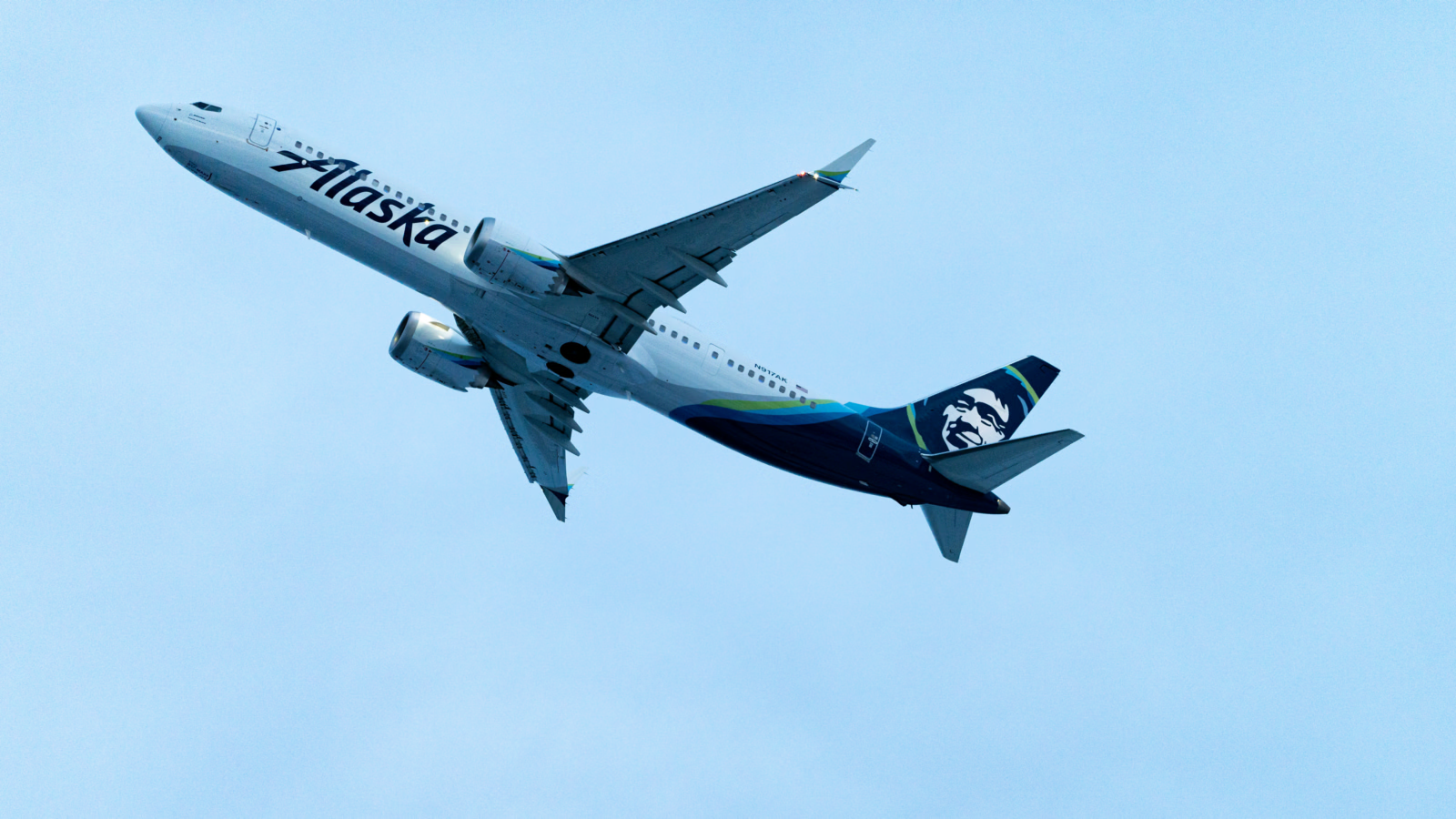
Alaska Airlines rebranded Mileage Plan as Atmos Rewards on August 20, 2025, folding Hawaiian Airlines' loyalty program in alongside it. The credit cards followed in early 2026: the old Alaska Airlines Visa Signature is now the Atmos Rewards Ascent Visa Signature, the business card became the Atmos Rewards Visa Signature Business, and Bank of America launched a brand-new premium card, the Atmos Rewards Summit Visa Infinite. Three cards, one program, three very different price points. Here's which one earns its keep in your wallet, and which one quietly loses to a card you probably already carry.
The Program in Brief (Read This First)
If you're new to Atmos Rewards, you need three facts before evaluating the cards.
First, your old Mileage Plan miles converted 1:1 to Atmos points on October 1, 2025. Same account number, same balance, same elite tier mapped to the new ladder (MVP became Silver, MVP Gold became Gold, MVP Gold 75K became Platinum, MVP Gold 100K became Titanium). Nothing was devalued in the conversion itself.
Second, Atmos kept the award charts. While Delta and United price awards dynamically (meaning the same Tokyo flight can cost 80,000 points one day and 220,000 the next), Atmos still publishes regional award charts for partner redemptions and a distance-based chart for Alaska and Hawaiian metal. That predictability is the program's single biggest competitive advantage in May 2026.
Third, Atmos has 25-plus airline partners, anchored by the full oneworld alliance (American, British Airways, Cathay Pacific, Japan Airlines, Qantas, Qatar Airways, Iberia, Finnair, Malaysia Airlines, and others) plus non-alliance carriers like Korean Air, STARLUX, Condor, Icelandair, Air Tahiti Nui, and Hainan. One important callout: the Emirates partnership ended in 2021 when Alaska joined oneworld. If you read an older guide telling you to use Alaska miles for Emirates first class, that hasn't been true in five years. Qatar Airways Qsuites is the closest replacement, and it's a better product anyway.
One thing Atmos still doesn't do: it doesn't partner with any transferable currency. You can't move Chase Ultimate Rewards, Amex Membership Rewards, Capital One miles, or Citi ThankYou points into Atmos. The only way in is flying Alaska or Hawaiian, shopping their dining and shopping portal, or earning on an Atmos credit card. That's why the credit cards matter more here than they do for, say, United or Delta.
Atmos Rewards Ascent Visa Signature: The Default Pick
The Ascent is the card most people should hold. It carries a $95 annual fee, same as the old Alaska Visa Signature, and through May 2026 Bank of America is running an increased welcome offer: 80,000 bonus points plus a $99 Companion Fare plus a 50% flight discount code after $4,000 in spend in the first 120 days. That's up from the standard 70,000-point offer and matches the best public bonus this card has ever carried.
Earning is straightforward: 3 points per dollar on Alaska and Hawaiian purchases, 2 points per dollar on gas, EV charging, cable, streaming, and local transit, 1 point per dollar everywhere else. The non-Alaska categories are new under Atmos: the old Alaska Visa was 3x on Alaska and 1x on everything else, so this is a real upgrade. It's still not a card you want as your daily driver if you carry a Chase Sapphire Preferred or Capital One Venture X (both earn 2x on all travel and dining, with more useful points), but the new bonus categories make it less of a one-trick pony than it used to be.
The signature benefit is the $99 Companion Fare. After spending $6,000 on the card in your card anniversary year, you earn a certificate that lets a second passenger fly with you for $99 plus taxes and fees (typically $23 to $50 round trip). That $6,000 trigger is the catch most older reviews miss. It used to be automatic with the annual fee, and it's now a spend hurdle. If you don't hit $6,000 in card spend, you don't get the companion fare. For couples who fly Alaska once or twice a year, hitting $6,000 is easy and the benefit pays for the annual fee three times over. For light spenders who only pull the card out at the airport, the math is harder.
You also get a free checked bag for the cardholder and up to six guests on the same reservation, 20% back on inflight purchases, priority boarding, and a 50% flight discount code each year on a qualifying flight. The discount code is genuinely useful and not something the old card had.
Best for: West Coast flyers (Seattle, Portland, the Bay Area, LA, San Diego, Anchorage) who fly Alaska or Hawaiian at least once or twice a year, want to use partners like Japan Airlines and Qatar for premium-cabin awards, and can hit $6,000 in annual spend to keep the companion fare alive.
Atmos Rewards Visa Signature Business: The Best Bonus
The business card is the same product wrapped in a business application. Annual fee is $70 for the company card plus $25 per additional employee card. Welcome offer through May 2026: 80,000 bonus points plus a $99 Companion Fare after $5,000 in spend in 90 days. According to TPG's valuation, that bonus is worth roughly $1,120, the best the business card has ever offered.
Earning structure: 3 points per dollar on Alaska and Hawaiian, 2 points per dollar on gas, plus 1 status point for every $3 spent (with no cap as of January 1, 2026, which is unusual; most cards stop earning status credits at some threshold). For business owners chasing Atmos elite status without flying every week, that uncapped status earning is a real lever. Spend $100,000 on the card and you've earned 33,000 status points toward Gold (which requires 60,000 points) or Platinum (80,000).
The business card carries the same $99 Companion Fare logic as Ascent (earned after $6,000 in anniversary-year spend) and the same free checked bag, priority boarding, and inflight discount benefits. It doesn't report to personal credit bureaus, which keeps the $5,000 minimum spend off your personal utilization.
Most importantly, you can hold both the Ascent and the business card. Bank of America doesn't enforce a one-bonus-per-program rule the way Chase does on the Sapphire family, and many readers chase both welcome offers. That's 160,000 points combined right now, enough for a one-way Cathay Pacific business class ticket from the US West Coast to Hong Kong (75,000) with most of a second long-haul business class redemption left over.
Best for: Anyone with a legitimate side business or sole proprietorship (rideshare, freelance, consulting, Etsy) who's already holding or considering Ascent. The 80,000-point bonus is the strongest case for a second Atmos card right now.
Atmos Rewards Summit Visa Infinite: Only If The Math Works
The Summit is Bank of America's new premium swing. Annual fee is $395, welcome offer is 100,000 bonus points plus a 25,000-point Global Companion Award plus a 50% flight discount code after $6,500 in spend in 90 days. The 25,000-point Global Companion Award is the headline benefit and it's worth understanding: it lets a companion fly with you on any Atmos award redemption (including partner premium cabins) for a flat 25,000 points (plus taxes and the cost of your own ticket). One award is issued at account opening, another every account anniversary, and a third 100,000-point version if you spend $60,000 in an anniversary year.
That benefit is genuinely good. Use the 25,000-point award on a Japan Airlines business class redemption alongside your own 60,000-point ticket and you've flown two people in business class to Tokyo for 85,000 Atmos points plus taxes, roughly $11,000 worth of paid fares. The math gets even better on Cathay Pacific or Qatar.
The earning structure helps justify the fee too: 3 points per dollar on Alaska and Hawaiian, 3 points per dollar on dining worldwide, and 3 points per dollar on all foreign purchases. Summit is the first airline card to earn bonus points specifically on foreign currency transactions, and it makes the card a credible alternative to the Capital One Venture X or Chase Sapphire Reserve as an international daily driver. Add in eight Alaska Lounge passes annually (two per quarter), primary rental car coverage, and the usual Visa Infinite travel protections, and there's a real bundle of benefits here.
But $395 is real money, and the comparison set matters. The Chase Sapphire Reserve ($795 after the 2025 hike) is in a different league of benefits. The Capital One Venture X ($395) gives you 10,000 anniversary miles, a $300 travel credit, Priority Pass, and earns 2x on all spend with a more flexible point currency. The Citi Strata Elite ($595) earns 12x on hotels and 6x on flights through their portal. The Summit's case rests almost entirely on the companion award and the Atmos point earning rate. If you don't redeem the companion award most years, you're paying a premium fee for an airline card without lounge access at most domestic hubs.
Best for: Couples or frequent travel partners who fly Alaska or Hawaiian premium cabins together at least once a year, value the 25,000-point Global Companion Award, and want a card that earns well on international spend. Military servicemembers covered by the MLA pay $0 annual fee, which changes the math entirely in their favor.
Picking Between the Three
The clean version: most readers should hold Ascent only. The $95 fee is low, the 80,000-point welcome offer is at its all-time high through May 2026, and the companion fare alone covers the fee for couples who fly once a year. Stop there unless you have a specific reason to add another.
Add the business card if you can qualify for it. The 80,000-point bonus is the highest the business card has ever offered, and you can hold both Ascent and Business simultaneously. Bonus stacking is the single highest-value move available to a typical Atmos earner in May 2026.
Reach for the Summit only if you're already flying Alaska or Hawaiian premium cabins, the 25,000-point Global Companion Award solves a real travel problem (e.g., flying your partner in business class to Japan once a year), or you're a military servicemember with the fee waiver. For everyone else, the $395 is better spent on a Sapphire Reserve, a Venture X, or splitting the Ascent plus a transferable-points premium card like Amex Platinum.
Sweet Spots Worth Earning Points For
The Atmos program's partner awards are where the points actually shine, and these prices are date-stamped to the May 2026 award chart:
Japan Airlines business class from the US West Coast to Tokyo costs 60,000 points one way. Same routes on United, Delta, or American dynamic pricing typically run 90,000 to 180,000. Cathay Pacific business class to Hong Kong is 75,000 points one way from the West Coast. Qatar Airways Qsuites (widely considered the best business class product in the world) runs 70,000 to 85,000 points depending on origin. Air Tahiti Nui business class to Papeete is 75,000 points.
On the domestic side, Alaska and Hawaiian metal still uses a distance-based chart that starts at 4,500 points for short-haul flights under 700 miles and tops out around 30,000 for West Coast to Hawaii one way in coach. Those are competitive numbers in 2026: not the steals they were before the dynamic pricing era, but still predictable, which is the whole point.
Stopovers are still allowed on one-way partner awards. That means a Seattle to Tokyo to Bangkok itinerary on JAL can price as a single one-way award with a week-long stopover in Tokyo. Most programs killed that benefit years ago.
Comparison Snapshot
Against United MileagePlus, Atmos wins on award chart predictability and loses on domestic route breadth. Against Delta SkyMiles, Atmos wins on almost every dimension: Delta abandoned award charts entirely, and a Tokyo business class redemption on Delta routinely costs 250,000-plus miles versus Atmos's 60,000 on JAL. Against American AAdvantage (where I covered the Citi transition in detail), Atmos and AAdvantage share a lot of oneworld partners, but Atmos has cleaner award pricing and a more useful credit card lineup at the mid-tier.
The honest comparison nobody makes: if you live in a city Alaska doesn't serve well, the partner-redemption angle still works, but you'll positioning-fly to a West Coast hub more often than you'd like. East Coast readers who can also stomach a connection should consider whether American or a transferable currency like Chase Ultimate Rewards (which transfers to British Airways and Aer Lingus, two of the same oneworld partners) gives them more flexibility for the same award goal.
What I'd Actually Do
If I were starting from zero in May 2026 with no Atmos history, I'd open the Ascent for the 80,000-point welcome offer (it's the best public offer this card has ever carried, and it expires when Bank of America says it does, likely by late summer). I'd hit the $4,000 spend in the 120-day window, redeem the welcome bonus on a Japan Airlines business class one-way to Tokyo (60,000 points) with 20,000 left over, and use the companion fare on a domestic trip to make the annual fee neutral.
Ninety days later, if I had a side business that could justify a business application, I'd open the Visa Signature Business for the second 80,000-point welcome offer. That stacks me to two long-haul business class redemptions for $165 in combined annual fees.
I'd skip the Summit unless the 25,000-point Global Companion Award solved a specific recurring travel problem. For most readers, the Capital One Venture X or the Amex Gold at the same fee tier earns more flexible points on more categories of spend.
This article contains affiliate links. If you apply through our links, we may earn a commission at no cost to you, which helps us continue sharing points and miles strategies with the community.
Some of the links in this article are affiliate links. We may receive a small commission at no extra cost to you if you apply through these links. This helps us keep the site running and continue creating free content.