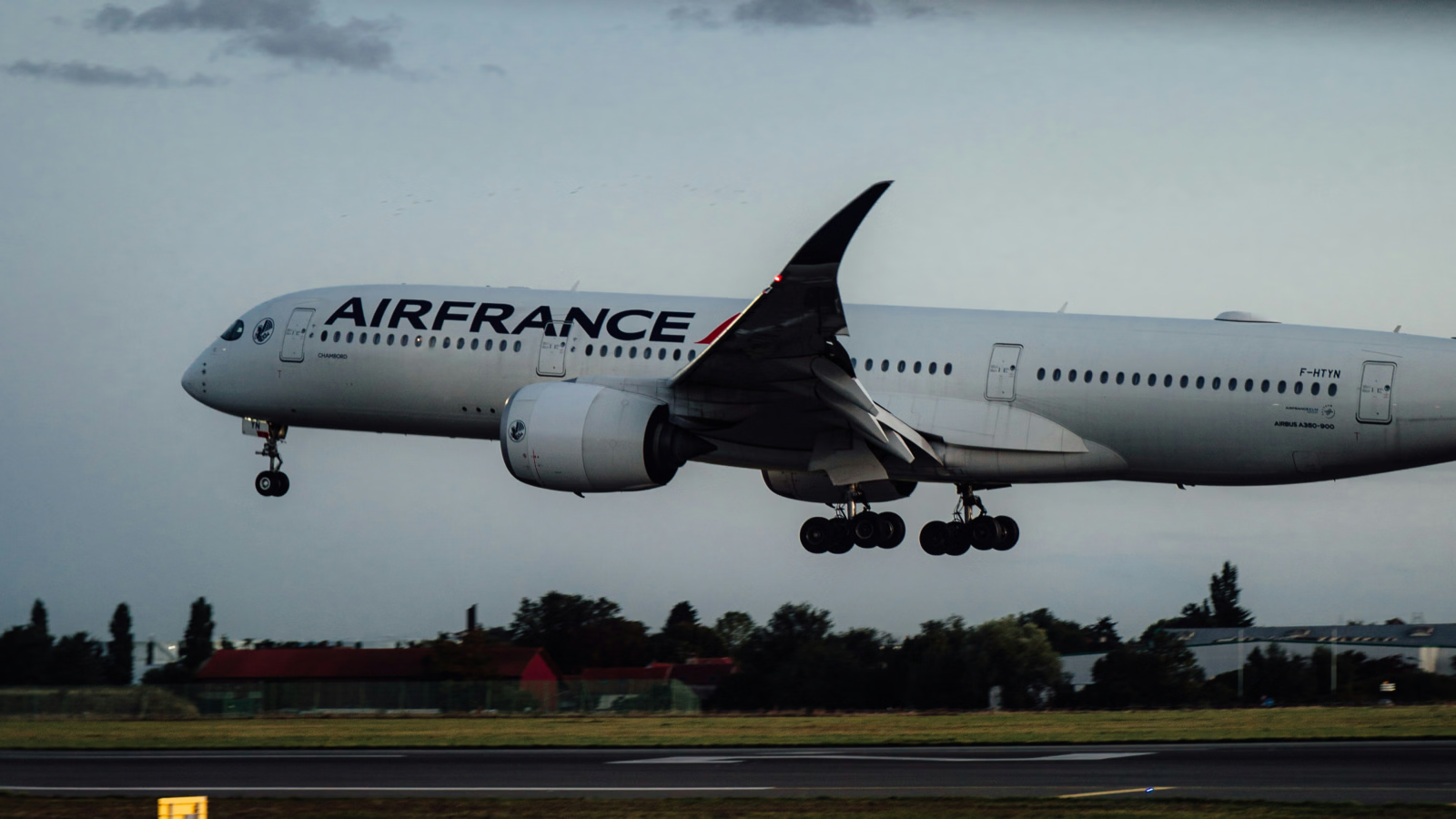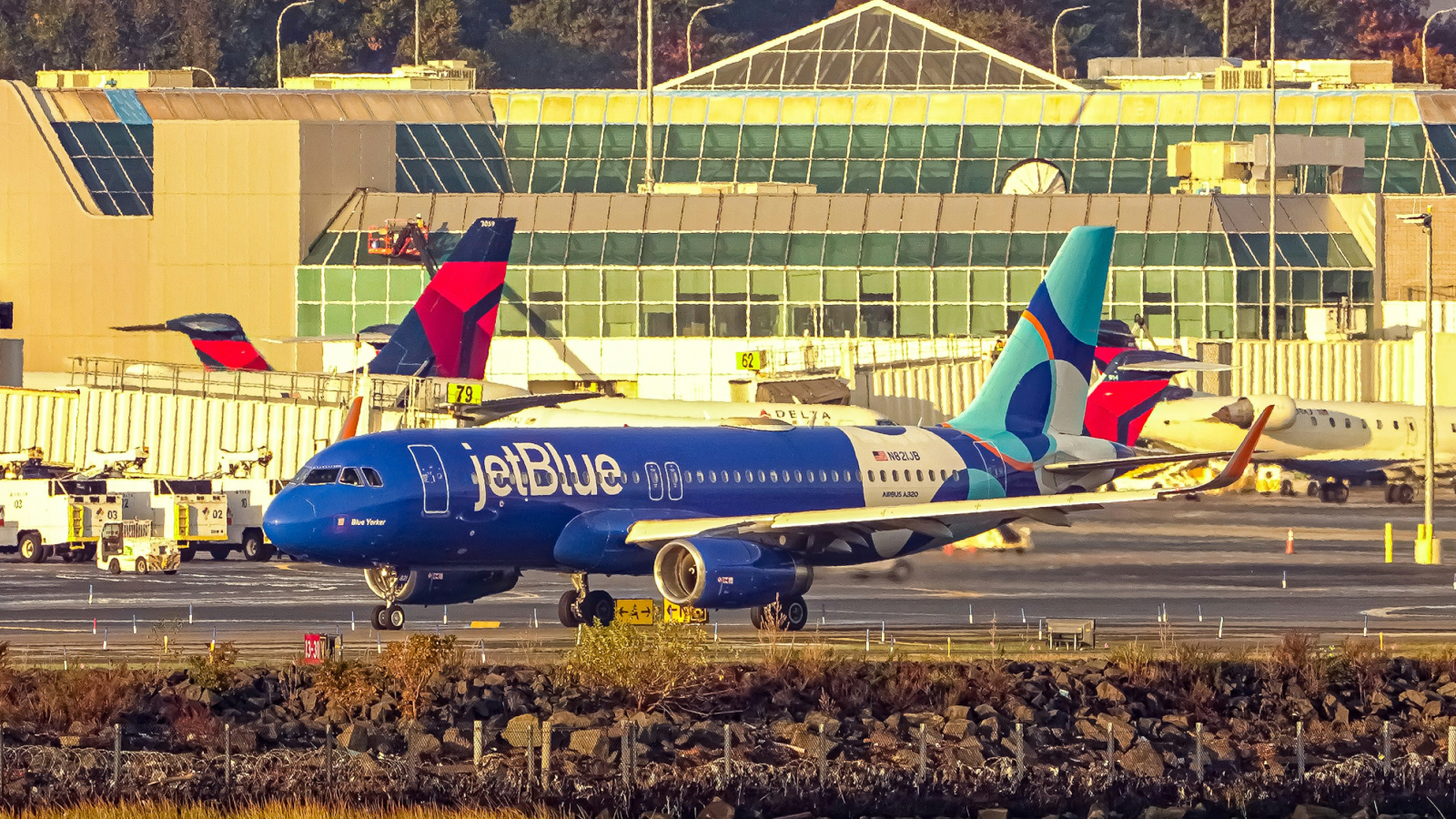
The Atmos Rewards Ascent Visa Signature sits in an interesting spot on the airline-card shelf. At $95 annually, it's priced like an entry-level co-brand, but the welcome bonus, day-of-travel perks, and partner redemption access push it into territory usually occupied by cards costing two or three times as much. The question isn't whether the card is interesting. It is. The question is whether the ongoing benefits justify keeping it past year one for your specific travel pattern, and whether the $99 companion fare is as useful as the marketing implies.
I've carried this card long enough to have opinions about who it's for. As of April 2026, here's the honest math.
Quick Summary
Best For: West Coast flyers who use Alaska or Hawaiian at least twice a year and want airline benefits without committing to a $400+ premium card. Standout Benefit: The annual $99 companion fare on Alaska-operated flights, which can save $500+ per year if you book a long-haul domestic ticket with a partner. Biggest Drawback: Atmos Rewards points don't transfer in from Chase, Amex, or Capital One. What you earn on the card is what you have. Annual Fee: $95.
What the Atmos Ascent Actually Is
The Atmos Ascent Visa Signature is the mid-tier Alaska Airlines/Hawaiian Airlines co-brand card issued by Bank of America after the carriers merged their loyalty programs into Atmos Rewards. The $95 annual fee sits between the no-fee Atmos Rewards starter card and the $395 Atmos Summit, the new top-tier product that includes lounge passes and a stronger benefits stack.
Atmos Rewards is the new program name. Alaska Mileage Plan miles and HawaiianMiles balances were converted 1:1 into Atmos Rewards points in 2026. The redemption options carry over: Oneworld partner awards (Japan Airlines, British Airways, American, Cathay Pacific, Qantas), Hawaiian's neighbor-island flights, and non-alliance partners like Condor, Fiji Airways, and Singapore Airlines. The current welcome offer is 70,000 Atmos Rewards points plus a $99 companion fare after $3,000 in spend within 90 days. Welcome offers change. If you're reading this and the bonus is different, the framework below still applies.
Welcome Offer Math
Atmos Rewards points are worth roughly 1.4 to 1.6 cents apiece if you redeem strategically. Using 1.5 cents as the midpoint, 70,000 points equals about $1,050 in travel value. Add the $99 companion fare: used on a $500 round-trip Seattle to San Diego, you save about $378 (the second seat costs $99 plus ~$23 in taxes, call it $122, versus $500 cash). On an $800 Hawaii round-trip, you save closer to $678.
That puts first-year value between $1,400 and $1,700 depending on how you use the companion fare. Net of the $95 annual fee, year one returns $1,300 to $1,600 before any ongoing benefits. The $3,000 minimum spend earns another 3,000 to 9,000 points depending on category mix.
The 1.5 cent valuation assumes partner premium-cabin redemptions or peak-season Alaska awards. Burn 12,500 points on a one-way you could've bought for $129, and effective value drops to a penny per point. Don't waste the welcome bonus on cheap economy redemptions. And remember the companion fare is Alaska-operated flights only. Hawaiian-operated flights, including the lucrative Hawaii routes, don't qualify.
Earning Structure
The card earns:
- 3x points on Alaska Airlines and Hawaiian Airlines purchases (tickets, in-flight purchases booked at point of sale, baggage fees paid directly to the airline)
- 2x points on gas, EV charging, cable, streaming services, and rideshare
- 1x point on everything else
The 3x airline category is standard for a $95 airline card. The 2x grouping is sensible if you Uber and drive: gas, rideshare, and streaming/cable cover real categories for most households.
The card breaks down as an everyday earner because of the 1x base rate. If you carry a Chase Freedom Unlimited at 1.5x Ultimate Rewards or a Citi Double Cash at 2% back, your non-bonus spend belongs there. Use this card for Alaska/Hawaiian purchases, gas, rideshare, and streaming. Everything else goes on a card with a better base rate or a more flexible currency.
Bank of America Preferred Rewards bonus. Maintain $20,000+ in combined BofA deposit and Merrill investment balances, and you'll earn a 25% to 75% points bonus on card purchases depending on your tier. At Platinum Honors ($100,000+), that turns the 3x airline rate into 5.25x. Meaningful if you already bank with BofA, not a reason to move savings if you don't.
The Companion Fare, In Practice
The annual companion fare is the benefit most often cited as this card's killer feature. The value is real but conditional.
Each cardmember anniversary, if you've spent at least $6,000 on the card in the previous 12 months, you'll receive a $99 companion fare code. Book two economy tickets on Alaska Airlines, pay full fare for the first, and use the code to get the second for $99 plus taxes starting around $23 domestically. Second-ticket cost: roughly $122 on most domestic itineraries.
The savings depend entirely on the cash fare you book against. An $800 round-trip Portland to Maui yields about $678 in cash savings against the ~$122 companion cost. A $500 Seattle to Newark saves $378. A $250 Los Angeles to San Francisco saves $128. A $180 sale fare may not be worth the certificate at all.
Critical restrictions to track:
- Alaska Airlines-operated flights only. Hawaiian-operated, codeshare, and partner segments don't qualify.
- Both travelers on identical itineraries, booked together.
- Both tickets must be paid for with the Atmos Ascent card.
- Saver (basic economy) fares are excluded. You're booking Main Cabin or above.
- Subject to capacity controls. Popular flights in peak season may show no companion availability.
- The certificate expires one year from issue date. No extensions.
The $6,000 annual spend threshold matters. If you're naturally putting $500 a month on the card, you'll hit it. If you'd have to force spend onto this card to qualify, factor the opportunity cost: $6,000 at 1x earns 6,000 points; the same $6,000 on a 2% cash back card earns $120 in value, roughly equivalent to 8,000 Atmos points at 1.5 cents per point.
Companion Fare vs. Southwest Companion Pass
This comparison comes up constantly because both programs use the word "companion," and they are not the same product. If you're choosing between optimizing for Atmos versus optimizing for Southwest's Companion Pass, here's the side-by-side.
Southwest's Companion Pass lets one designated companion fly with you for just the taxes (typically $5.60 each way for domestic flights) on every flight you book, paid or award, for the rest of the calendar year you earn it plus the entire following year. You earn it by hitting 135,000 qualifying points or 100 qualifying one-way flights in a calendar year. The two-Southwest-credit-cards strategy (one personal, one business) plus their welcome bonuses can get you most of the way there in a single year.
The Atmos companion fare gets you one trip per year, on Alaska only, with a $99-plus-taxes minimum, on full-fare economy.
If you live on the West Coast and Alaska's your default carrier, Atmos wins because Southwest's network is thin in Seattle and the Pacific Northwest. If you fly Southwest's hubs (Denver, Las Vegas, Baltimore) regularly with a partner, Companion Pass is the more valuable benefit by a wide margin. Different geographies, not different priorities.
Annual Fee Justification, Year One vs. Year Two
Year one is straightforward. Even ignoring the ongoing benefits, the welcome bonus alone returns 12 to 17 times the $95 annual fee. There's no reasonable argument that the card doesn't pay for itself in year one if you can hit the spend requirement.
Year two is where you have to do real math. Strip out the welcome bonus and ask: do the recurring benefits justify the $95?
Free checked bags. When you book Alaska or Hawaiian flights with the card, you and up to six companions on the same reservation each get one free checked bag. Alaska charges $35 per bag each way as of April 2026. Two round-trip flights with one bag each = $140 in fee avoidance. One family trip of four with checked bags = $280. The bag benefit alone can offset the annual fee on a single family trip.
The exclusion: if you have Alaska MVP (Silver) elite status or higher, you already get two free checked bags, so the card's bag benefit is redundant. And if you don't check bags, this perk earns you nothing.
20% in-flight purchase rebate. Buy food, drinks, or Wi-Fi on Alaska or Hawaiian flights with the card, and you'll get a 20% statement credit. Most in-flight purchases run $8 to $15. A frequent flyer who buys $8 Wi-Fi on 10 flights a year recoups $16. Useful, not transformative.
Priority boarding (Group 2). You'll board ahead of general boarding but behind first class, MVP Gold, and MVP Gold 75K. Useful on full flights when overhead bin space matters. Worthless if you only travel with a personal item or always book first.
$100 Alaska Lounge+ membership discount. Standard Alaska Lounge+ runs $695 per year as of April 2026. Cardholders pay $595. Real savings if you were already buying lounge access. Don't count the $100 as benefit value if lounge membership wasn't already on your shopping list. You don't get to credit a discount on something you weren't going to buy.
Conservative year-two value for an Alaska regular: $140 in bag avoidance + $20 in Wi-Fi rebates + $50 of subjective priority-boarding value = about $210. Net of the $95 fee, you're up roughly $115 before the companion fare. Add the companion fare and the math turns clearly positive. If you don't fly Alaska, year-two retention is harder to justify, and a downgrade to the no-fee Atmos starter card is the right move.
How It Compares to the Capital One Venture X
The Atmos Ascent and the Capital One Venture X get cross-shopped surprisingly often, even though they sit in different categories. The Venture X is a $395 transferable-points card. The Ascent is a $95 airline co-brand. Here's the framework.
Earning rate on general spend. Venture X earns 2x miles on everything. Atmos earns 1x on non-bonus spend. For a household putting $30,000 a year on a primary card, that's a 30,000-mile gap before you even start earning bonus categories. The Venture X wins this comparison decisively as an everyday card.
Premium travel benefits. Venture X includes a $300 annual Capital One Travel credit, a 10,000-mile anniversary bonus, Priority Pass and Capital One Lounge access, a $120 Global Entry/TSA PreCheck credit, primary rental car insurance, and trip delay/cancellation protection. The Ascent has none of those. After the travel credit and anniversary bonus, the Venture X's effective annual fee drops below zero.
Airline-specific perks. This is where the Ascent stands its ground. Venture X gets you no free bags on Alaska, no priority boarding on Alaska, no companion fare, and no path to Atmos status. If you fly Alaska eight times a year, the Ascent's bag, boarding, and companion benefits are worth more than the Venture X's general-purpose perks for that specific use case.
Currency flexibility. Capital One miles transfer to 15+ partners. Atmos Rewards points don't transfer in or out of any other currency. What you earn is what you have, redeemable only on Atmos's partner chart.
The honest answer: most points-and-miles readers should hold the Venture X (or a similar transferable-points card) as their primary spender and add the Ascent as a supplement if they fly Alaska enough to use the bag and companion benefits. The cards aren't substitutes; they're complementary tools.
Pros and Cons
Pros
- Strong welcome bonus value relative to the $95 annual fee.
- Free checked bag for cardholder plus up to six companions on the same reservation.
- Annual companion fare with real-world savings of $300 to $700 when used on longer flights.
- No foreign transaction fees, making this a usable card abroad.
- Atmos Rewards points open the door to high-value Oneworld premium-cabin redemptions.
- Bank of America Preferred Rewards multipliers can push earning rates significantly higher.
Cons
- 1x base earning rate is uncompetitive for a primary spender.
- Atmos Rewards points don't transfer in from Chase, Amex, or Capital One.
- Companion fare doesn't work on Hawaiian-operated flights, including the heavily traveled Hawaii routes.
- $6,000 annual spend requirement to qualify for the companion fare excludes light spenders.
- Limited utility if you live outside Alaska's primary West Coast network.
Who Should Apply
West Coast flyers who use Alaska or Hawaiian regularly. Seattle, Portland, Anchorage, San Francisco, Los Angeles, Honolulu, San Diego: if Alaska's network is your default, the bag, boarding, and companion benefits stack up quickly. The math justifies the fee on its own without leaning on the welcome bonus.
Points collectors targeting Oneworld premium cabins. Atmos Rewards is one of the better-kept secrets in points circles for partner premium awards: Japan Airlines business class to Tokyo, Cathay Pacific business to Hong Kong, Qantas business to Sydney. If those aspirational redemptions are on your list, the welcome bonus alone gets you most of the way there, even if you rarely fly Alaska itself.
Travelers wanting airline perks without a premium-card commitment. $95 for free bags, priority boarding, and a usable companion fare is a fair trade if you're not ready for a $400+ card.
Who Should Skip
Infrequent Alaska flyers. If you fly Alaska once a year or less, you'll struggle to extract $95 of recurring value. The welcome bonus is great, but applying for a card you won't use long-term is a one-trick pony.
Flyers based outside the Alaska network. If Atlanta, Dallas, Charlotte, or Chicago is your home airport, an American Airlines or Delta co-brand will align better with your actual flight patterns.
Travelers who prioritize point flexibility. If you'd rather hold a currency you can transfer to multiple programs, a transferable-points card like the Chase Sapphire Preferred or American Express Gold gives you broader redemption options at the same $95 to $325 fee tier.
Final Verdict
The Atmos Ascent is a focused airline card, not an everyday spender. Used as such, for Alaska/Hawaiian bookings, gas, rideshare, and the annual companion fare, it earns its $95 fee handily for anyone who flies Alaska's network with any regularity. Year one is a clear win for almost anyone who can hit the spend requirement. Year two and beyond depend on whether you actually use the bag and companion benefits.
If you're a West Coast flyer who books at least two Alaska trips a year, apply now and don't overthink it. If you're shopping for a primary travel card with broader redemption flexibility, look at a transferable-points card first and consider the Atmos Ascent as a complement rather than a replacement. And if you rarely fly Alaska, you'll find better fits elsewhere, which is the honest answer, not a knock on this card.
This article contains affiliate links. If you apply through our links, we may earn a commission at no cost to you, which helps us continue sharing points and miles strategies with the community.
Some of the links in this article are affiliate links. We may receive a small commission at no extra cost to you if you apply through these links. This helps us keep the site running and continue creating free content.