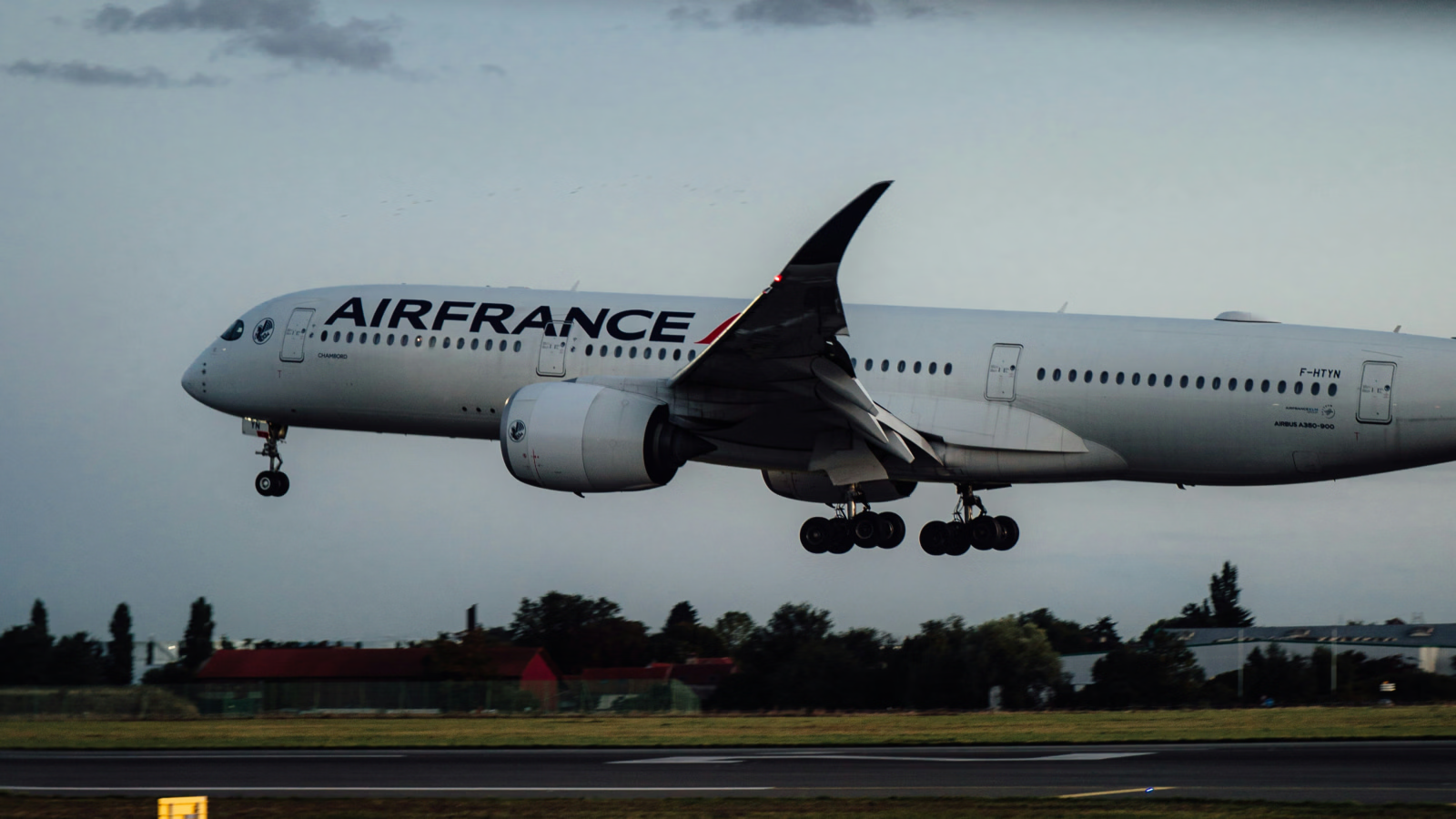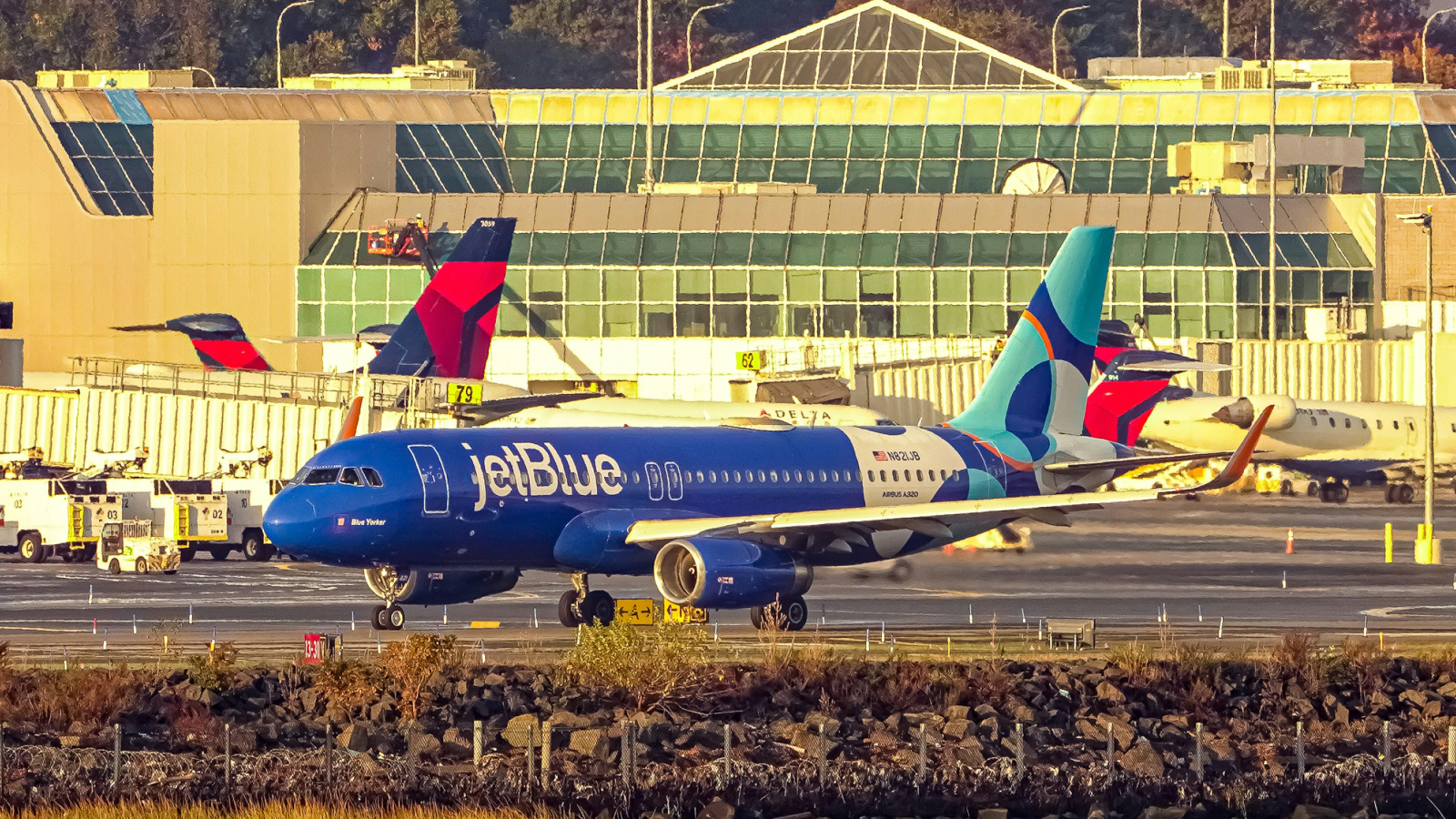
U.S. commercial aviation has had zero fatal accidents on scheduled passenger service for more than a decade through May 2026, according to the National Transportation Safety Board's accident database and Federal Aviation Administration reporting. That record covers every domestic scheduled passenger flight on every certificate, from Delta and American at one end of the price spectrum to Spirit, Frontier, Allegiant, Avelo, and Breeze at the other. The price of the ticket is not the variable that determines whether the flight is safe.
This guide walks through how that's actually true: why U.S. airline safety operates the way it does, what budget carriers do differently from the legacies, where the real trade-offs live (and they exist), and how to think about specific carriers if you're weighing a cheap fare against a more familiar brand.
Quick Answer
Yes, U.S. budget airlines are safe. Every U.S. scheduled passenger carrier flies under the same Federal Aviation Administration regulatory framework, the same FAA Part 121 certificate requirements, the same pilot training and rest rules, the same maintenance oversight, and the same NTSB accident investigation regime. The fare class does not determine the safety regime. What budget airlines actually compromise on is legroom, baggage policies, change flexibility, and customer service, not safety.
How U.S. airline safety actually works
The single most important fact about U.S. airline safety is that it isn't a function of brand reputation. It's a function of certification. Every U.S. airline operating scheduled passenger service does so under FAA Part 121, the regulatory framework that governs commercial air carriers. Part 121 sets the rules for aircraft maintenance programs, pilot qualifications and training, dispatcher requirements, crew rest, weather minimums, and emergency procedures. Spirit Airlines operates under the same Part 121 framework as Delta. Allegiant operates under the same framework as American.
That's the headline fact, and it does most of the work of answering the question.
Pilot training requirements in the United States are particularly demanding. Since 2013, the FAA has required first officers at Part 121 carriers to hold an Airline Transport Pilot certificate with 1,500 flight hours of experience (with some reductions for military pilots and graduates of specific four-year aviation degree programs). That requirement applies whether the pilot is flying for United or for Avelo. Recurrent training, simulator checks, and medical certification all follow the same cadence regardless of carrier.
Aircraft maintenance is also FAA-regulated. Every airline must operate an FAA-approved Continuous Airworthiness Maintenance Program, with prescribed inspection intervals, parts-traceability requirements, and FAA-certificated repair stations doing heavy maintenance. The FAA's oversight inspectors visit every Part 121 carrier on a continuous basis. When the FAA finds problems, it issues fines, mandatory corrective action plans, or in the most serious cases pulls or suspends an airline's certificate. The agency does not differentiate the regulatory bar by ticket price.
The NTSB independently investigates every aviation accident and incident, publishes findings, and makes safety recommendations to the FAA. That process is identical for a Southwest event and an Allegiant event.
The fleet-age argument
One real difference between many budget carriers and the legacies is fleet age, and on this point the budget carriers often look better, not worse.
Frontier's fleet is one of the youngest in U.S. commercial aviation, dominated by Airbus A320neo and A321neo family aircraft delivered in the last several years. Spirit's pre-bankruptcy fleet was similarly Airbus A320 family dominated, with a meaningful share of A320neos. Breeze flies Airbus A220-300s, a newer-generation aircraft type that entered service in 2016. Avelo flies Boeing 737-700s and -800s, older airframes but well-understood ones. The legacies, by contrast, fly a mix that includes some genuinely new aircraft alongside Boeing 757s, 767s, and other airframes that have been in service for decades.
Newer aircraft come with newer avionics, newer flight-control systems, and newer engine generations. None of that makes an older aircraft unsafe, since Part 121 maintenance requirements scale with airframe age, but it does mean the fleet-age argument cuts in the budget carriers' favor more often than against them.
The single-fleet-type argument
Several budget airlines deliberately operate a single aircraft type, and there's a real operational and safety benefit to that approach. Southwest Airlines has flown only the Boeing 737 family since the carrier launched in 1971. Spirit and Frontier are Airbus A320 family operators. Allegiant transitioned from a mixed fleet to an all-Airbus A320 family fleet over the last several years.
The advantage is concentration of expertise. Pilots, dispatchers, and especially mechanics develop deep familiarity with a single aircraft type. Training programs simplify. Parts inventory simplifies. Standard operating procedures simplify. Industry safety analysts have long argued that a single-fleet operation reduces the cognitive load on flight crews and the complexity load on maintenance, both of which correlate with fewer human-factors incidents.
Delta, United, and American by contrast operate complex fleets that include multiple Boeing types, multiple Airbus types, and multiple regional aircraft on subsidiary certificates. They manage that complexity well, but it is genuine complexity.
The Boeing 737 MAX question
The Boeing 737 MAX 8 and MAX 9 were grounded worldwide in March 2019 after two fatal crashes (Lion Air Flight 610 in October 2018 and Ethiopian Airlines Flight 302 in March 2019), both involving the Maneuvering Characteristics Augmentation System. The FAA cleared the MAX to return to service in November 2020 after software changes, additional pilot training requirements, and an extensive recertification process.
Since the 737 MAX returned to service, the aircraft type has flown billions of passenger miles globally. The January 2024 Alaska Airlines Flight 1282 door-plug incident involved a MAX 9 but was traced to a manufacturing quality issue at Boeing's Renton facility, not to the MCAS-related design problems that grounded the type in 2019. The FAA and NTSB investigations into the door-plug incident produced corrective action at Boeing's factory and an FAA-imposed cap on Boeing's MAX production rate while quality control was rebuilt.
Several U.S. budget carriers fly the 737 MAX, including Southwest. None of the post-2020 safety record across U.S. carriers operating the MAX undercuts the broader point: U.S. scheduled passenger service has remained fatal-accident-free through May 2026.
The maintenance-budget question
Where budget airlines genuinely cut costs is in areas that affect customer experience, not areas that affect FAA-mandated safety. Maintenance spending is FAA-floored: an airline cannot operate aircraft that fall below the airworthiness requirements of its maintenance program, period. What budget carriers spend less on is the things outside that floor: newer interiors, in-flight entertainment systems, larger flight attendant teams, premium cabin investment, and the operational margin that lets legacy carriers absorb disruption more gracefully.
The Allegiant maintenance reputation question is worth addressing directly. A 2018 CBS News "60 Minutes" segment raised concerns about the carrier's older McDonnell Douglas MD-80 fleet and the rate of in-flight mechanical issues those aircraft experienced. Allegiant subsequently retired the MD-80 fleet entirely and transitioned to an all-Airbus operation. Industry observers including Aviation Week have noted that Allegiant's post-transition operational reliability has improved meaningfully. The carrier's safety record on scheduled passenger service remains fatal-accident-free.
Specific U.S. budget and value carriers in 2026
Carrier-by-carrier, here is what the landscape looks like as of May 2026.
Southwest Airlines. The oldest of the U.S. low-fare carriers, with operations since 1971 and a single-fleet-type discipline that the industry has studied for decades. Southwest's transition to assigned seating, announced in 2024 and rolling out through 2026, marks a meaningful shift in its product but has no bearing on safety. The carrier's accident record across more than five decades is the strongest argument that the low-fare model can be operated indefinitely without compromising safety.
JetBlue Airways. JetBlue has been pulling away from the strict "budget" designation, expanding its Mint premium product across more transcon and transatlantic routes and adding domestic premium-economy-style seating. Its safety record on scheduled passenger service is fatal-accident-free.
Frontier Airlines. Still a true Ultra Low Cost Carrier (ULCC) in 2026, with one of the youngest fleets in U.S. aviation and the standard ULCC unbundled fare structure. Frontier's safety record on scheduled passenger service is fatal-accident-free.
Spirit Airlines. Spirit emerged from Chapter 11 bankruptcy in 2025 after the JetBlue merger was blocked in 2024. The restructured carrier is smaller, with a trimmed route network, but continues to operate as a ULCC under its original Part 121 certificate. Safety oversight has not changed through the bankruptcy process. Spirit's safety record on scheduled passenger service is fatal-accident-free.
Allegiant Air. Post-MD-80-retirement, Allegiant operates an all-Airbus A320 family fleet primarily serving leisure markets from smaller U.S. cities to vacation destinations. Safety record on scheduled passenger service is fatal-accident-free.
Sun Country Airlines. A hybrid carrier flying a Boeing 737 fleet on scheduled passenger service plus a significant cargo operation for Amazon. Safety record on scheduled passenger service is fatal-accident-free.
Breeze Airways. Launched in 2021 by JetBlue founder David Neeleman. Breeze operates Airbus A220-300s on point-to-point routes between underserved U.S. cities. As a relatively new entrant, the carrier has a shorter operational record, but it has had no fatal incidents on scheduled passenger service and operates under standard FAA Part 121 oversight.
Avelo Airlines. Also launched in 2021, operating Boeing 737-700s and -800s with a focus on leisure routes from secondary airports. Like Breeze, a relatively new entrant with a shorter record but no fatal incidents on scheduled passenger service.
Third-party safety rankings
AirlineRatings.com is an independent Australian aviation review site that publishes annual safety rankings for airlines worldwide, including a specific low-cost-carrier safety ranking. The methodology considers operational history, fleet age, audit results from the International Air Transport Association's Operational Safety Audit (IOSA) program, FAA and EASA regulatory standing, and recent incidents. AirlineRatings.com's rankings change year to year, and several U.S. ULCCs have historically appeared on its safest-low-cost-carriers lists. The site is a useful third-party signal but it isn't a regulator. The actual safety floor in U.S. aviation is set by the FAA, not by any review publication.
The customer-experience trade-off
This is where the honest part of the budget airline conversation lives.
Budget airlines deliver demonstrably worse customer experience on most measures. The J.D. Power North America Airline Satisfaction Study has placed the major ULCCs at or near the bottom of its rankings every year since the methodology started covering them. Department of Transportation Air Travel Consumer Report data consistently shows ULCCs with higher complaint rates per 100,000 passengers than the legacies. Cancellation and delay performance varies by carrier and by year, but ULCC operations tend to be more vulnerable to disruption because they typically run thinner buffers between scheduled flights.
The trade-off is real. You are not getting an unsafe flight when you book Spirit or Frontier. You are getting a flight where the seat pitch is tighter, the baggage rules are stricter, the change fees are less forgiving, and the recovery from a cancellation will likely be slower and clunkier than what you'd get on Delta or American.
What budget airlines actually compromise on
A practical list of where the cost savings come from, since this is the part that matters when you decide whether the fare is worth it.
- Seat pitch and width: ULCCs typically operate 28 to 30 inches of pitch versus 31 to 33 on the legacies.
- Carry-on and checked baggage: ULCCs charge for both, including overhead bin space on some.
- Seat selection: free assignment is rare; reserved seats cost extra.
- Change and cancellation flexibility: most ULCC tickets are nonrefundable and changes carry fees, though the post-2020 elimination of change fees at the legacies has not extended to ULCCs.
- In-flight food and beverage: pay-as-you-go on ULCCs, complimentary on most legacies for at least a basic option.
- Co-branded credit card and loyalty value: thinner programs with fewer redemption options.
- Operational recovery: ULCCs typically have fewer same-day rebooking options when things go wrong.
Add up the fees you'll actually pay on a given itinerary before you book. The all-in cost of a ULCC fare with bags, seat selection, and any change risk often closes more of the gap to a legacy fare than the headline price suggests.
Common myths
A few of the persistent ones worth retiring.
Cheap equals unsafe. Not in U.S. scheduled passenger aviation. The FAA does not regulate by ticket price.
Older carriers are inherently safer. Operational history matters for understanding a carrier, but the FAA's continuous oversight applies equally to new entrants. Breeze and Avelo are newer carriers but they operate under the same certification framework as Southwest.
A maintenance shortcut would obviously show up in an accident. This is the framing that fuels the cheap-equals-unsafe perception, and it ignores how aviation safety is actually regulated. FAA inspectors don't wait for accidents to act. They issue findings, mandate corrective action, fine carriers, and in serious cases ground operations.
Foreign budget carriers and U.S. budget carriers face the same scrutiny. They don't. U.S. scheduled passenger service is regulated by the FAA. Foreign carriers operating to the U.S. must also meet FAA standards, but foreign carriers operating only domestically in their home country are regulated by that country's civil aviation authority. The U.S. record is the U.S. record. When evaluating a non-U.S. budget airline, the IOSA audit certification is a useful signal.
What to do with this
If you're choosing between a $180 Spirit fare and a $280 Delta fare for the same domestic itinerary, the safety dimension should not be the tiebreaker. The tiebreaker is whether the customer-experience trade-off (the seat, the bag fees, the flexibility) is worth the $100 to you on this specific trip. For a short hop with a carry-on and no flexibility needs, the ULCC fare is often the right answer. For a long-haul connection with elderly relatives and checked bags, the legacy fare often closes the gap once the ancillaries are priced in.
The honest verdict: U.S. budget airlines are safe. They are also a different product than the legacies. Pick the product that fits the trip.
This article contains affiliate links. If you apply through our links, we may earn a commission at no cost to you, which helps us continue sharing points and miles strategies with the community.
Some of the links in this article are affiliate links. We may receive a small commission at no extra cost to you if you apply through these links. This helps us keep the site running and continue creating free content.