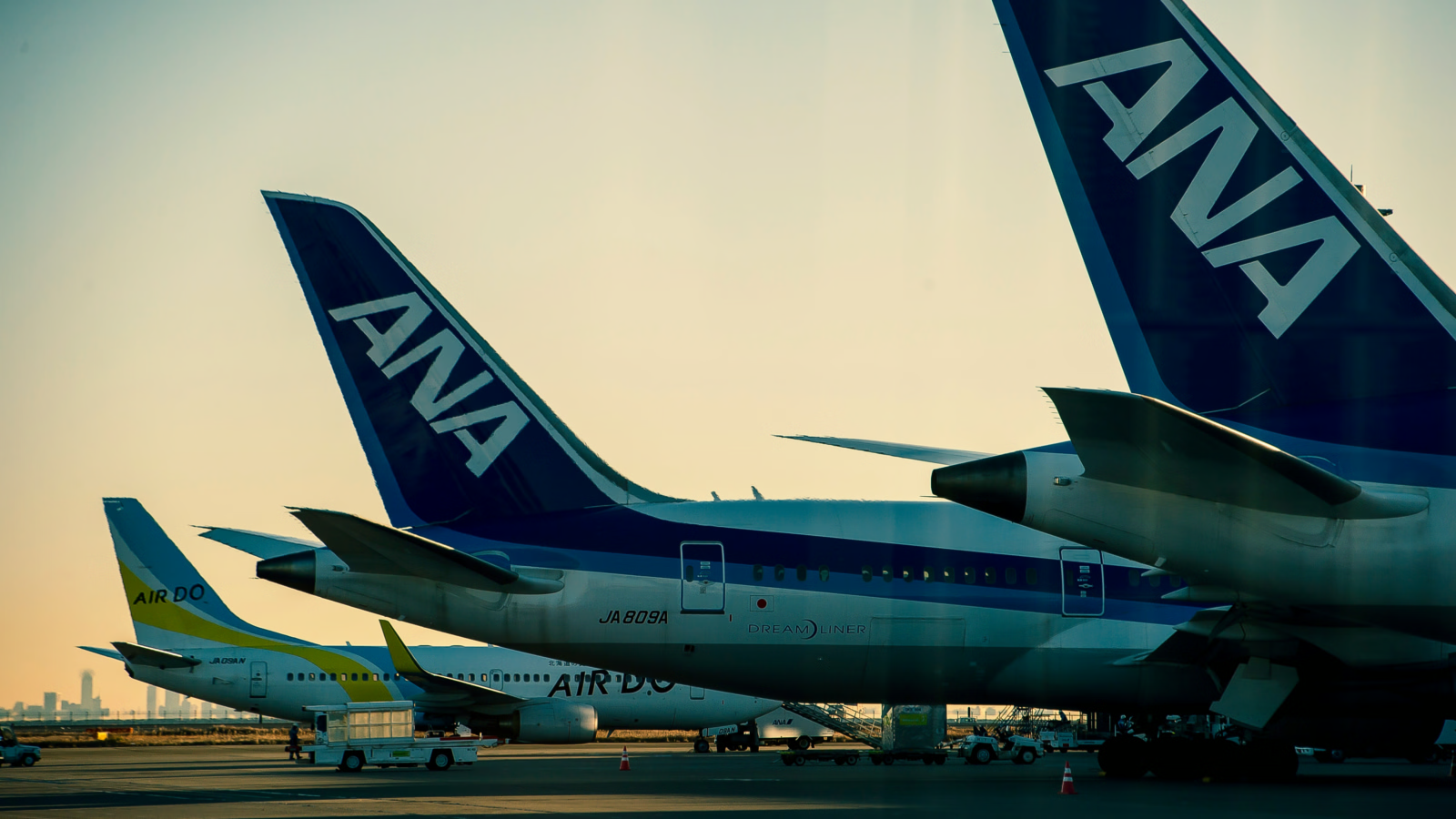
ANA Mileage Club is the program U.S. travelers reach for when they want premium-cabin Star Alliance awards on a published chart, paid for with American Express Membership Rewards points. The published chart matters because most airline charts are now dynamic. The Star Alliance access matters because ANA partners with 25-plus carriers. And Amex matters because in the U.S., Amex is essentially the only way most people earn ANA miles in volume.
The program is also a program of constraints. Awards are round-trip only. Partner awards can only be booked for the cardholder and a registered list of family members. Amex transfers sit in a 48-hour holding pattern before they land. And you have to ticket at least four days before departure. None of these rules are new in 2026, but they shape every booking decision.
What follows: how to earn ANA miles, how the post-2024 chart actually works, which redemptions still hold up, and which routes I would save miles for starting from zero today.
Why ANA still matters in 2026
ANA pushed through a meaningful chart devaluation in April 2024, raising partner award prices and reshaping which redemptions felt sharp versus merely decent. That moved a lot of points-and-miles writers off the program. Two years later, the picture is calmer than the post-devaluation hot takes suggested.
ANA is still in the conversation because the structural advantages did not change. The chart is still published. Partner pricing is still zone-based, which means Los Angeles to Tokyo costs the same whether you fly it nonstop or with an awkward connection. ANA still does not pass through fuel surcharges on a long list of partner carriers. And ANA is still an Amex Membership Rewards transfer partner at 1:1, which is the most important fact about earning miles in the U.S.
The redemptions that hold up best in 2026 are the ones that always held up: business class to Japan, business class to Europe on partners flown via low-surcharge gateways, business class to South America on Avianca and Copa, and the round-the-world chart for travelers willing to plan. Cash-equivalent value on those runs from roughly 2 cents per mile on the conservative end to well over 4 cents on aspirational business and first-class redemptions. That math keeps the program relevant.
How to earn ANA miles
For U.S. readers, the practical earning conversation has three tiers.
The primary path is American Express Membership Rewards. Amex transfers to ANA at 1:1, which makes any Membership Rewards-earning card a de facto ANA earning card. The American Express Gold Card and American Express Platinum Card are the two cards most U.S. readers should think about first. The Amex Gold earns 4x at restaurants and U.S. supermarkets, so a household spending $2,500 a month across groceries and dining earns roughly 120,000 points a year before counting the welcome bonus. The Amex Platinum trades lower category multipliers for a welcome bonus regularly in the 80,000 to 175,000 point range depending on the cycle. For a one-time top-up before a specific business-class booking, the right Amex welcome bonus is the fastest route to the miles you actually need.
A note on the 48-hour delay: Amex transfers to ANA are not instant. They process in batches and typically arrive within 48 hours. That is ANA's policy, not Amex's. Plan your transfer at least three or four days before you intend to ticket.
The secondary path is Marriott Bonvoy. Marriott transfers to ANA at 3:1, with a 5,000-point bonus every 60,000 Marriott points transferred. The effective rate is 60,000 Marriott to 25,000 ANA, or 2.4:1. Marriott is not a great way to build an ANA balance from scratch. It is useful when you are 5,000 to 10,000 miles short of a specific booking and have Marriott points sitting around. The Marriott Bonvoy Brilliant American Express and the Marriott Bonvoy Boundless are the two cards that build a Marriott balance most efficiently.
The third path is flying. ANA and Star Alliance partners credit miles to ANA Mileage Club at varying rates based on fare class. If you fly Star Alliance for work, this can add up over a year. For most readers, it is the smallest bucket.
What ANA does not do: it does not partner with Chase Ultimate Rewards or Capital One Venture. If your points are sitting in Chase or Capital One, you are not getting them to ANA. That is the single biggest reason readers who earn primarily through Chase end up using United or Air Canada Aeroplan for Star Alliance redemptions instead.
The award chart structure
ANA runs three different award charts, and the most common point of confusion is mistaking which chart applies to which booking.
The first is the ANA-operated chart. When you redeem ANA miles to fly ANA, the price varies by season. ANA defines low, regular, and high seasons, and the same route can cost noticeably different amounts depending on whether you fly in February versus mid-July. The published business-class price for Tokyo to the U.S. West Coast sits in the 75,000 to 90,000 mile round-trip range in low season at recent chart pricing, climbing into the low six figures in high season. First class is roughly 1.5x business. These are round-trip numbers because ANA does not sell one-way awards on its own metal.
The second is the partner award chart. When you redeem ANA miles on any of the 25-plus Star Alliance partners, the price is set by zone. North America to Europe is one price, North America to South America another, Asia 1 to Asia 2 another, and so on. Season does not apply. The post-2024 partner chart raised most prices but kept the structure. At chart levels in effect as of mid-2026, business class North America to Europe sits at roughly 100,000 miles round-trip, North America to Japan in the 105,000 to 110,000 range, and the South America zone in a similar range to Europe. Partner first class, where available, runs roughly 60 to 80 percent above business.
The third is the round-the-world chart, and it is the most underused product in the ANA catalog. RTW is mileage-based, not zone-based. You build an itinerary traveling in one continuous direction around the globe, with a maximum of eight stopovers, totaling up to a given mileage band. Business class RTW at the lower bands has historically priced in the 125,000 to 165,000 mile range at recent chart pricing, which is wild when you remember that a single one-way business class fare from the U.S. to Asia can cost $7,000 or more. RTW takes planning. It rewards readers willing to sit down with a calendar and a map.
Sweet spots worth saving for
Not every ANA redemption is worth the miles. These are the ones I would actually plan around.
Business class to Japan on ANA is the headline. The product is consistently rated among the best business-class hard products in the world, the route network from Tokyo Haneda and Narita reaches most major U.S. gateways nonstop, and the ANA-operated chart's low-season pricing makes the round-trip math work even post-devaluation. Fly late January, early February, or the shoulder season around late August and early September for the lowest published prices.
Business class to Europe on Lufthansa, Swiss, Brussels, or Austrian, flown via gateways that do not trigger high fuel surcharges. The catch is the surcharge map. Lufthansa Group carriers pass through fuel surcharges. United, Air Canada, TAP Portugal, SAS, and Brussels (in some markets) do not when ticketed on ANA. The cleanest version of this redemption connects on United or Air Canada metal across the Atlantic. The round-trip-only rule is less of a constraint on a Europe trip because most readers were planning to come home anyway.
Business class to South America, especially deep South America like Buenos Aires or Santiago. Avianca and Copa are low-surcharge carriers, the chart price is reasonable, and the cash price on long-haul South America business class routinely runs $4,000 to $6,000. One of the most consistently underrated ANA redemptions.
Business and first class to Asia outside Japan. The Asia 1 and Asia 2 zones open up first-class redemptions on Singapore (where space exists, which is the asterisk) or business class on Thai, EVA, or Asiana. The mileage cost is not the lowest in the program, but the products are some of the best in the sky.
The Australia and Oceania zone. Air New Zealand in particular holds up because the carrier does not pass through significant surcharges, and the cash prices on West Coast U.S. to Auckland in business class are punishing.
How to search award space
ANA's own search tool works, but it is slower and less flexible than the workarounds most readers will end up using.
The primary workaround is United.com. United and ANA are both Star Alliance, and United's award search shows most of the same partner space ANA can ticket. Search United.com with miles for your route and dates, find flights showing "Saver" award space (United's term for the inventory partners can also see), then book them with ANA miles. This is faster and shows more flights than ANA's tool. One caveat: United occasionally sells inventory ANA cannot ticket, and ANA occasionally sees space United does not. Treat United as the primary search and ANA as confirmation.
For ANA-operated metal, search ANA directly. ANA's own site is more reliable for ANA flights.
Phone booking is sometimes required, particularly for RTW itineraries or partner combinations the website cannot handle. Hold times can be long. Build your itinerary on paper first, confirm segments on United.com, then call.
Stopovers and open-jaws
The ANA stopover and open-jaw rules are part of what makes the program valuable, and they are also where most first-time bookers stumble.
You get one stopover and two open-jaws on a partner award. A stopover means staying more than 24 hours in a city that is not your final destination. An open-jaw means flying into one city and out of another, either at the destination or at the origin.
The stopover and open-jaw rules combine in useful ways. You can fly New York to Tokyo, stop in Tokyo for a week, fly Tokyo to Singapore, and then fly Singapore to New York. That is one stopover (Singapore is the destination on the outbound, Tokyo is the stopover) and counts as a single Asia zone partner award. The math gets even better when you remember that the United States and Canada are treated as a single zone on the ANA partner chart, which means you can ticket New York to Tokyo and Tokyo to Vancouver as part of the same itinerary at no additional mileage cost.
The catch: stopovers and open-jaws are only available on partner awards, not on ANA-operated awards. ANA-operated awards are point-to-point round-trips.
Program restrictions you have to live with
Some of the ANA rules are deal-breakers for certain travelers. Read these carefully before transferring miles.
Round-trip only. ANA does not sell one-way awards, on its own metal or on partners. If your trip is genuinely one-way, ANA is not your program. Use United, Air Canada Aeroplan, or another flexible Star Alliance partner instead.
Family-only on partner awards. ANA partner awards can only be booked for the account holder and a registered list of family members. ANA's definition of family is the legal one: spouse, parents, children, siblings, grandparents, grandchildren, in-laws to the second degree. You register family members in your ANA Mileage Club account before booking, and ANA may request documentation. You cannot book a partner award for an unrelated friend or a colleague. ANA-operated awards have a slightly more permissive policy but still require registering the traveler.
The 48-hour transfer delay from Amex. Plan around it. If you find award space and need to ticket today, you cannot. Always have miles in your ANA account in advance of any time-sensitive booking.
The four-day pre-departure cutoff. ANA requires that awards be ticketed at least four days before the first flight's departure. Same-day and next-day award bookings are not possible.
Changes and cancellations. ANA charges fees for date and routing changes, and the cancellation fee on a ticketed award refunds most but not all of your miles. The exact numbers have shifted over the years; check the program's current policy before you ticket if there is meaningful uncertainty in your travel dates.
The 36-month mile expiration. ANA miles expire 36 months after they are earned. There is no activity-based reset. A mile earned in May 2024 will expire in May 2027 regardless of how many miles you earn or burn in the interim. The practical implication: do not park miles in ANA speculatively. Transfer from Amex when you have a specific redemption in mind, with the booking happening within the next two to three years.
Avoiding fuel surcharges
ANA's partner award pricing does not include a flat surcharge layer, but ANA does pass through carrier-imposed fuel surcharges on some partners and not others. The difference between a low-surcharge and a high-surcharge partner can be hundreds of dollars on a single round-trip.
The low-surcharge partners worth knowing: United, Air Canada, Avianca, Copa, Air New Zealand, TAP Portugal, SAS, Brussels (in certain markets), and Ethiopian. Tickets routed entirely on these carriers tend to come in with cash co-pays in the $100 to $250 range for a long-haul business class round-trip, which is the program performing the way you want it to.
The high-surcharge partners: Lufthansa, Swiss, Austrian, Turkish Airlines, South African Airways, Asiana on certain routes, and EVA on certain routes. A long-haul business-class round-trip routed primarily on Lufthansa Group metal can attract cash surcharges of $600 to $1,000 or more on top of the mileage cost. That is not necessarily a deal-breaker, but it changes the value math and you want to know going in.
When you build an itinerary, the question is not just "is there award space" but "what does the cash co-pay look like." If you are sensitive to surcharges, route on the low-surcharge carriers wherever possible.
ANA versus the alternatives
ANA is not the only way to ticket Star Alliance award space. The honest answer is that for most U.S. readers, ANA is one of three or four programs worth knowing, and the right choice depends on the trip.
United MileagePlus is the default Star Alliance program for most U.S. travelers. United is a Chase Ultimate Rewards transfer partner at 1:1, the search tool is the best in the alliance, one-way awards are available, and there are no fuel surcharges on partner awards. The downside is that United's award pricing is dynamic on its own metal and the partner chart is less generous than ANA's was, even after the 2024 changes. For one-way bookings or for travelers earning primarily through Chase, United is usually the right answer.
Air Canada Aeroplan is the most flexible Star Alliance program. Aeroplan publishes a partner chart, allows one-way awards, offers stopovers for an additional 5,000 points each, has a generous routing engine, and transfers from Amex, Chase, Capital One, and Marriott. Aeroplan is often the best choice for itineraries that ANA cannot handle, particularly anything one-way or anything with multiple stopovers.
Virgin Atlantic Flying Club is the program to use for ANA's own first class and business class on its own metal. Virgin transfers from Amex, Chase, Capital One, and Citi, and Virgin's pricing on ANA business and first is often dramatically cheaper than ANA's pricing on its own metal, at the cost of a more restrictive booking process. If your goal is specifically to fly ANA, look at Virgin first and then look at ANA.
The right framework: ANA when you want the partner chart's value and the Amex transfer ratio. United when you want one-way flexibility and Chase compatibility. Aeroplan when you want routing flexibility. Virgin when you specifically want ANA-operated metal.
Step-by-step booking
Here is the operational sequence for an ANA partner award booking.
First, search the route on United.com. Set the search to use miles. Look for "Saver" inventory on the dates you want. Capture flight numbers, segment times, and cabin class for everything that shows space.
Second, confirm the same space on ANA's award search. Log into your ANA Mileage Club account, run the same search, and verify that the segments you noted are visible. If a segment shows on United but not on ANA, call ANA before transferring miles.
Third, transfer miles from Amex (or top up from Marriott if you are close). Confirm the exact mileage cost for your itinerary using ANA's chart; do not assume. Transfer once you have a booking in hand on paper and you are confident the segments are bookable.
Fourth, wait. The 48-hour transfer window is non-negotiable. Hold the space mentally but understand you cannot ticket yet.
Fifth, ticket. Once the miles land, book online if the itinerary is simple, or call the ANA award desk if the itinerary involves stopovers, open-jaws, or unusual partner combinations. Confirm the cash co-pay (the surcharge amount) before you ticket. Get the confirmation number in writing.
Sixth, build a calendar reminder for the four-day cutoff in case you need to make changes. Review the itinerary once a month for schedule changes that could affect connections.
Where I would actually start
If you are a U.S. reader with no ANA miles and you are reading this because you want to fly a Star Alliance partner in business class, here is the order of operations I would recommend.
If you have a specific premium-cabin redemption in mind within the next 18 months, open an Amex Gold or Amex Platinum, earn the welcome bonus, and transfer to ANA when the booking is ready. The Amex Platinum welcome bonus alone is often enough for a one-way Star Alliance business class redemption when combined with even a modest existing balance, and the Amex Gold's earning multipliers on dining and groceries build a balance faster than most cards in the points ecosystem.
If you have Marriott points sitting around and you are 5,000 to 10,000 miles short of a booking, the 60,000-Marriott-to-25,000-ANA top-up is a reasonable use of Marriott points that would otherwise sit at sub-1-cent-per-point cash redemption value. Do not build an ANA balance from Marriott. Top up from Marriott when the alternative is buying miles or letting a booking pass.
If you primarily earn Chase Ultimate Rewards or Capital One Venture points, ANA is not your most natural home. Look at United, Aeroplan, or Virgin Atlantic for your Star Alliance redemptions, and use ANA only if a specific booking is meaningfully cheaper on the ANA chart and you can build a balance via Amex.
The ANA program is narrower than it used to be. The redemptions that work, though, still work. Business class to Japan on ANA's own metal in low season. Business class to Europe on low-surcharge partners. Round-the-world itineraries for travelers willing to plan. Those are the bookings that justify the program's restrictions, and those are the bookings worth saving Amex points for.
This article contains affiliate links. If you apply through our links, we may earn a commission at no cost to you, which helps us continue sharing points and miles strategies with the community.
Some of the links in this article are affiliate links. We may receive a small commission at no extra cost to you if you apply through these links. This helps us keep the site running and continue creating free content.