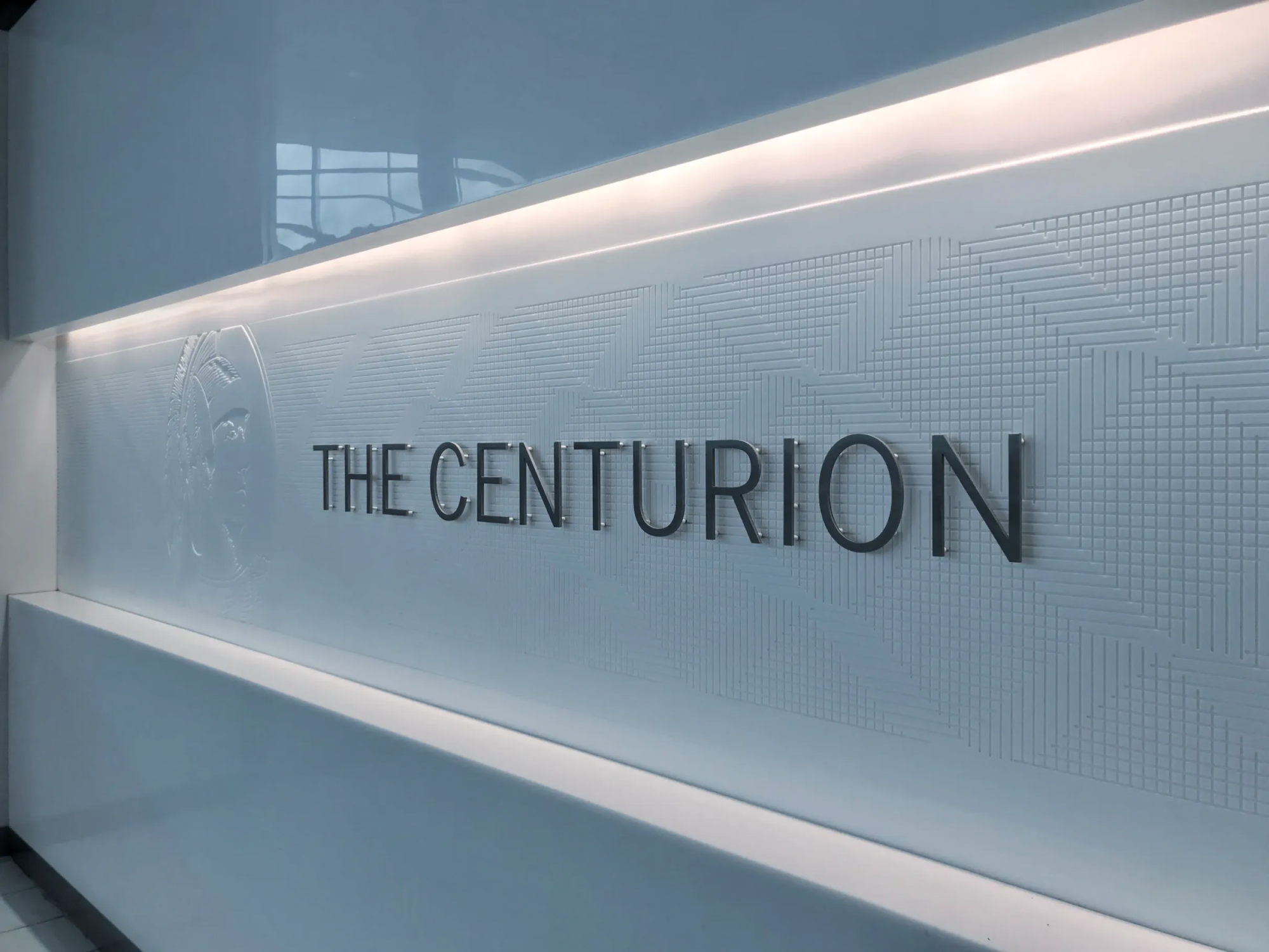
Amex Centurion Lounges used to be the trump card of the premium credit card world. Pre-2023, you flashed a Platinum card and walked into a 25,000-square-foot temple of free wine and chef-prepared food whenever you felt like it. Then Amex changed the rules. Twice. And the math on whether the Platinum's $695 annual fee is worth it for lounge access alone got a lot more interesting.
Here's the honest take from someone who's been chasing this access for years: Centurion is still the best US-based lounge network for food and design. It's also no longer the only premium network worth caring about. If you're trying to decide whether Amex Platinum, Chase Sapphire Reserve, or Capital One Venture X is the right home for your travel spend, the lounge calculation matters, and the answer depends on which airports you actually fly through. Let me walk you through what the network looks like in 2026, what the access rules really are, and where Centurion still wins versus where Chase Sapphire Lounges have quietly taken the lead.
The 2026 Centurion Lounge network
Amex has been opening lounges at a steady clip. The current footprint, as of mid-2026, looks like this.
United States. Atlanta (ATL), Charlotte (CLT), Dallas-Fort Worth (DFW), Denver (DEN), Houston (IAH), Las Vegas (LAS), Los Angeles (LAX), Miami (MIA), New York JFK, New York LGA, Philadelphia (PHL), Phoenix (PHX), San Francisco (SFO, temporary Terminal 2 location while T3 is rebuilt through 2027), Seattle (SEA), Washington DCA, and Salt Lake City (SLC, opened in 2025). Newark (EWR) and Boston (BOS) are still on the published roadmap.
International. Buenos Aires (EZE), Delhi (DEL), Hong Kong (HKG), London Heathrow (LHR), Melbourne (MEL), Mexico City (MEX, three terminals), Monterrey (MTY), Mumbai (BOM), Stockholm (ARN), Sydney (SYD), and Tokyo Haneda (HND, opened in 2025). Sao Paulo (GRU) closed permanently in 2025, which is still the biggest international loss for the network.
Lounges occasionally close for renovation, so check the Amex app before you bank on access at a specific terminal. The temporary SFO setup in Terminal 2 is a good example of why this matters: if you assume your usual T3 spot is open, you'll waste 20 minutes walking to the wrong terminal.
The Atlanta lounge that opened in 2024 is the current flagship at nearly 26,000 square feet with two outdoor patios. DFW Terminal D remains the food destination of the network (the chef partner program there punches above the rest). LAX in the Tom Bradley International Terminal is the best for premium international departures. JFK Terminal 4 is the most crowded. If you're connecting through LHR Terminal 3 on a non-British-Airways ticket, the London lounge is one of the few decent options outside of paid day passes.
The access rules that actually matter (and the 2023 changes)
This is where most articles bury the lede. Here's the short version of what the rules look like in 2026.
Who gets in. The Platinum Card from American Express, the Business Platinum Card from American Express, and the Centurion (Black) Card all get complimentary access to the cardholder. The Delta SkyMiles Reserve and Delta SkyMiles Reserve Business cards also get access, but only when you're flying Delta and you booked the ticket on the card. Every visit requires a same-day boarding pass on any airline, plus government photo ID.
The three-hour rule. As of 2023, you can only enter a Centurion Lounge within three hours of your scheduled departure time. The exception is connecting flights, where the timing window is more flexible. Before this change, you could camp out for six or seven hours, which was killing the lounge experience at JFK, LAX, and MIA. The rule worked. Lounges are still busy at peak hours, but the all-day-squatter problem is mostly gone.
The $75,000 guest rule. This is the one that gets people upset. Platinum cardholders used to get two complimentary guests, no questions asked. As of February 2023, you only get free guests if you spend $75,000 on the Platinum card in a calendar year. Below that threshold, guests cost $50 per adult and $30 per child (ages 2-17) per visit. Centurion cardholders still get two free guests with no spend threshold.
The family workaround. If you're a family of four with one Platinum holder, you're paying $110 in guest fees per lounge visit unless you hit the spend threshold or add authorized user Platinum cards (which run $175 a year for up to three users). For families that fly four to six times a year, the authorized user route usually wins on the math.
What each major lounge actually delivers
The Centurion network isn't uniform. Some lounges are destinations. Some are just better than the food court. Knowing which is which changes how much value you should assign to access at any given airport.
JFK Terminal 4 is the flagship in the Northeast. Big space, full bar, dining room, spa services, and it's still the most crowded lounge in the network at peak hours. If you can get in before 4pm or after 9pm, the experience is genuinely great. Friday evenings, you might wait 30-45 minutes at the door even with the three-hour rule in place.
LAX Tom Bradley International Terminal is the network's best lounge for premium international departures. Runway-view windows, a strong bar, and the location matters because most non-US carriers depart from TBIT. If you're flying ANA, Qantas, Singapore, or any of the Asia-Pacific premium cabins out of LA, this is your pre-flight spot.
DFW Terminal D is the food lounge. The chef partner program brings in regional Texas talent and the rotating menu is the strongest in the network. The space is enormous, which means even peak hours don't feel claustrophobic.
ATL is the new flagship. 26,000 square feet, two outdoor patios, multiple dining areas, and decent capacity given how busy ATL gets. The patios are the differentiator. Almost no US lounge has outdoor space, and this one has two.
LGA Terminal B is the surprise hit. Smaller than JFK but better-designed and far less crowded, since Terminal B handles mostly domestic Delta and American flights. If you're choosing between LGA and JFK for a flight to anywhere domestic, LGA's lounge alone is worth the routing preference.
LHR Terminal 3 is the only Centurion Lounge in the UK and it covers non-British-Airways carriers, which is why it matters. If you're flying Virgin Atlantic, Delta, or any oneworld carrier outside of BA, this is one of the few premium pre-flight options you don't have to pay separately for.
The newer international locations (Tokyo Haneda, Hong Kong, Delhi, Mexico City) are smaller and more boutique than the US flagships. They're worth using when you're already in those terminals, but I wouldn't structure a connection around them the way you might at LAX or DFW.
Centurion versus the competition
The Centurion network isn't the only game in town anymore, and the lounge-network competition is the real story of the past three years.
Chase Sapphire Lounges (Chase Sapphire Reserve cardholders) opened in LGA, BOS, JFK, IAD, PHL, AUS, SAT, and ORD between 2022 and 2025. They're newer, less crowded, and the food and design quality is genuinely competitive with Centurion. At JFK and LGA in particular, I'd often rather use the Sapphire Lounge than the Centurion, just because the wait is shorter. Chase Sapphire Reserve has a $550 annual fee versus Platinum's $695.
Capital One Lounges (Venture X cardholders) operate in IAD, DFW, DEN, LAS, BWI, and Tokyo Narita. The network is growing but still small. The Venture X annual fee is $395 and the lounge access is on top of Priority Pass access, which makes the math easy if you fly through one of their hubs.
Delta SkyClub is its own ecosystem. With the Delta Reserve or Amex Delta Platinum, you get access when you're flying Delta. No spend threshold, more US locations than Centurion, and the renovated flagship SkyClubs (JFK T4, ATL, LAX) are now competitive with Centurion on food and design. The catch: it's a Delta-only network, so you need to actually fly Delta to use it.
United Polaris Lounges are the highest-end of the bunch, but they're locked to United international business class passengers only. You can't buy in. If you fly United Polaris regularly, the Polaris Lounge in EWR, SFO, IAD, ORD, or LAX is the best US lounge experience, period. It's just not a credit-card access network.
Priority Pass is the bottom of the premium-lounge pyramid. Every major premium card includes some version of it, and the quality varies wildly by location. Some Priority Pass lounges in international airports are excellent. Most US-based Priority Pass lounges are mediocre at best.
The lounge-stacking strategy
If you're traveling 10 or more trips a year through major US hubs, you don't pick one network. You stack them. Here's how it usually plays out.
Amex Platinum gives you Centurion plus Priority Pass plus Delta SkyClub access on Delta flights. Chase Sapphire Reserve gives you Sapphire Lounges plus Priority Pass plus Polaris on United international business. Capital One Venture X gives you Capital One Lounges plus Priority Pass. Holding two of those three (typically Platinum plus Reserve, or Platinum plus Venture X) covers nearly every major US hub with at least two lounge options.
The combined annual fees feel painful on paper. Platinum at $695 plus Reserve at $550 is $1,245 a year. But the credits stack: Platinum has $200 hotel credit, $200 airline incidentals, $300 Equinox, $189 Clear, $240 digital entertainment, and on and on. Reserve has $300 travel credit and a points multiplier on travel and dining. If you actually use the credits, the effective cost of holding both cards drops to $400 or so, which is reasonable for the lounge access plus everything else.
The Platinum-for-Centurion math
Here's the question I get most: is the Amex Platinum worth $695 a year if you mostly care about Centurion access?
Conservative valuation puts a Centurion Lounge visit at $75 (a comparable lounge day pass at one of the better third-party networks). At eight visits a year, you're at $600 in lounge value. Pair that with the easy Platinum credits ($200 hotel, $200 airline, $189 Clear, conservatively $400 of usable credit) and you're already at $1,000 in offset value for a $695 fee.
For travelers doing 8-plus visits a year, this is a no-brainer. For travelers doing 2-3 visits a year, the math gets harder, and you're probably better off with the Capital One Venture X at $395 (which includes Capital One Lounge access plus Priority Pass) or the Chase Sapphire Reserve at $550 (which includes Sapphire Lounges).
For the high-spender who's already hitting the $75,000 Platinum spend threshold, the unlimited guest access changes the calculation again, because you're now bringing a partner or kids in for free, which doubles the per-visit value.
What I'd actually do
If you're a frequent traveler picking your first premium card, start with the Chase Sapphire Reserve. The Sapphire Lounge network is growing fast, the $550 fee is more digestible than Platinum's, and the Reserve's points are more flexible for transfer partner redemptions.
If you're already a Reserve holder and you want to add a second premium card, the Amex Platinum is the right next move specifically because of the Centurion network at the hubs where Chase Sapphire Lounges don't exist yet (LAX, MIA, DFW, ATL).
If you're a Delta loyalist, the Delta SkyMiles Reserve plus a regular Amex Gold is probably better than the Platinum for your usage pattern. You get Centurion access on Delta flights, SkyClub access, and you avoid the $695 fee.
If you fly out of IAD, DFW, DEN, or LAS regularly, the Capital One Venture X is the highest-value premium card on the market right now at $395. The Capital One Lounges there are excellent and the Priority Pass access is the wide net underneath.
Centurion is still the best US lounge brand for food and design. It's just not the only one that matters anymore, and the 2023 rule changes pushed enough frequent travelers toward Chase and Capital One that the competition is now real. Pick the network that matches the airports you actually fly through, and don't pay $695 for Centurion access if you're going to use it twice a year.
This article contains affiliate links. If you apply through our links, we may earn a commission at no cost to you, which helps us continue sharing points and miles strategies with the community.
Some of the links in this article are affiliate links. We may receive a small commission at no extra cost to you if you apply through these links. This helps us keep the site running and continue creating free content.