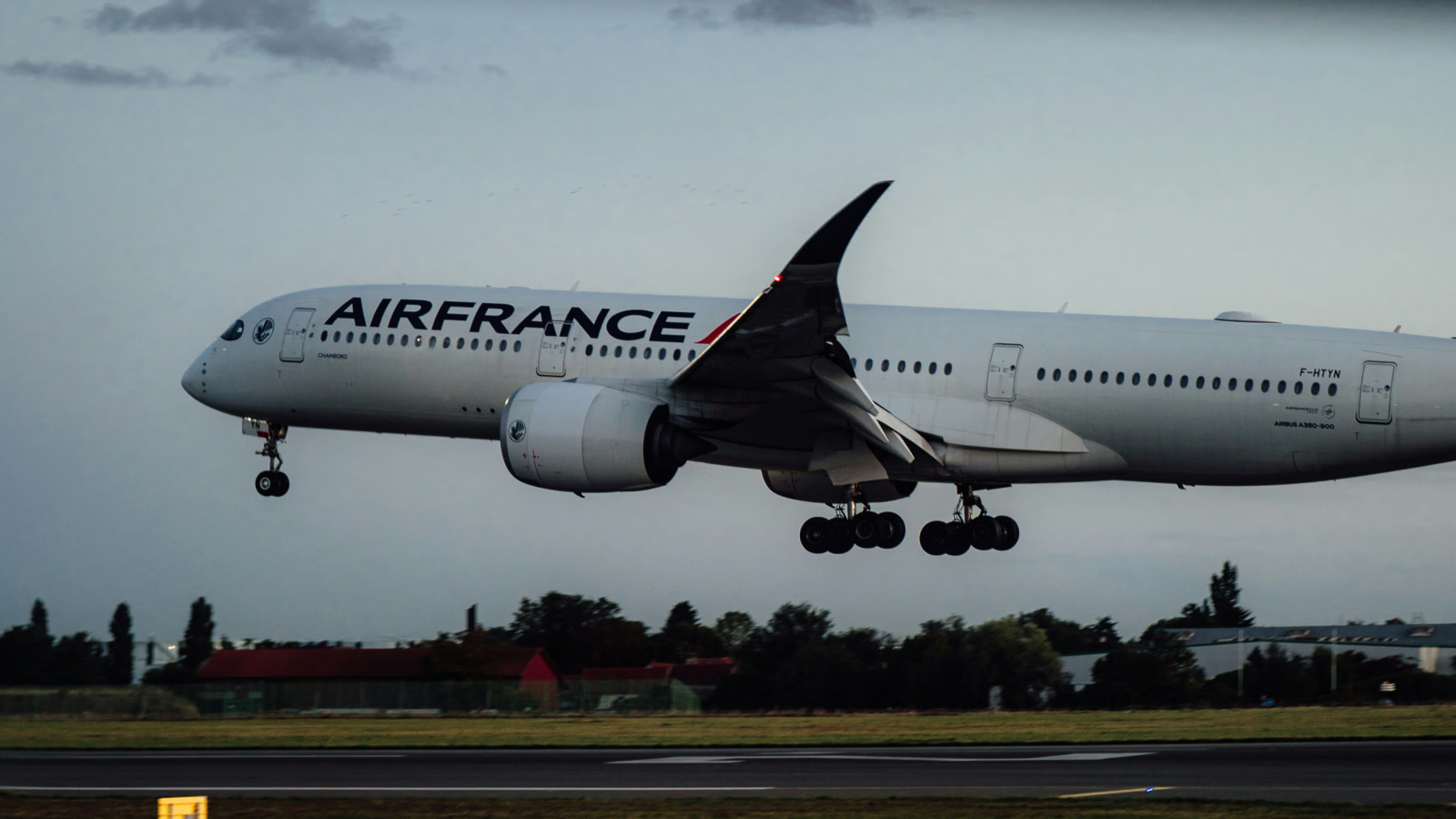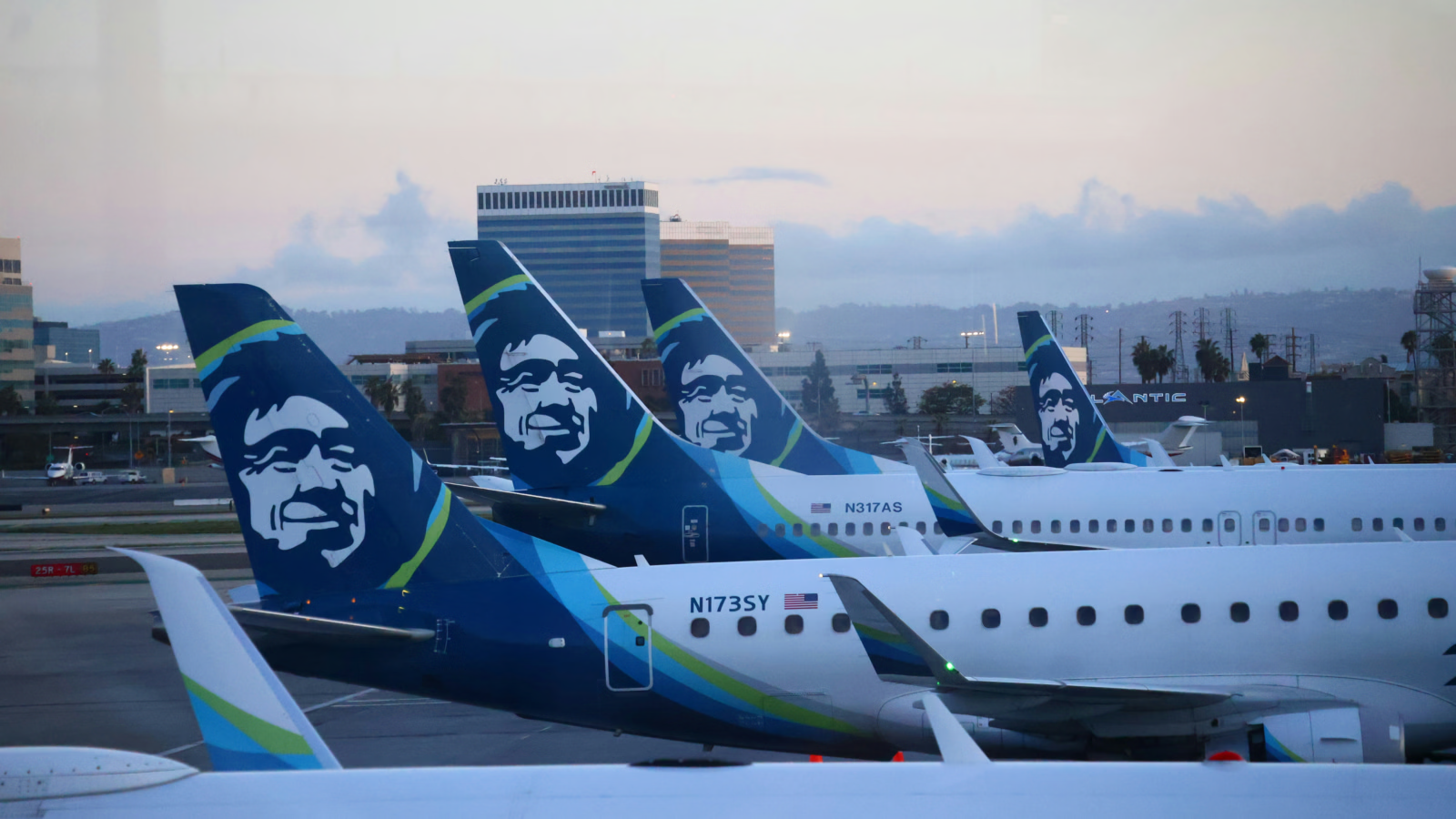
The Alaska Airlines and Hawaiian Airlines merger completed in September 2025, and since then Mileage Plan members have had access to a combined route map of roughly 138 destinations across the two carriers. The headline gains for points and miles travelers are real but specific: deeper inter-island earning in Hawaii, more West Coast to Hawaii capacity under a single program, and a set of Asia-Pacific destinations that previously sat behind Hawaiian Airlines' separate HawaiianMiles program.
The integration work that unfolded through 2026 has been gradual. Both brands kept separate operations, separate fleets, and separate frequent flyer accounting in many respects, with codeshare and reciprocal benefits coming online in phases. For Mileage Plan loyalists, this has meant a longer adjustment period than the marketing language suggested, but the underlying award value has held up well.
So the question worth sitting with is the one that matters for points strategy: did the merger make Alaska miles materially more valuable, or did it mostly just expand the map? The honest answer is somewhere in between, and the difference shows up in three or four specific redemption corridors rather than across the entire combined network. Below is what to know, where the value actually lives, and which credit cards do the most work for this program in 2026.
Where the combined network actually goes
The pre-merger Alaska network covered roughly 120 destinations, concentrated on the West Coast, Pacific Northwest, and Alaska itself, with selective long-haul international service through partners. Hawaiian added a different footprint: dense inter-island Hawaii service, several mainland-to-Hawaii routes, and a small but valuable Asia-Pacific list including Tokyo (HND and NRT), Osaka (KIX), Seoul (ICN), Sydney (SYD), Auckland (AKL), and Pago Pago (PPG).
Combined, the carriers have served about 138 destinations as of mid-2026. The interesting addition for mainland points collectors is not the count but the geography. Alaska now reaches Asia-Pacific on its own metal through Hawaiian-operated flights, which means Mileage Plan members can earn and redeem on routes that previously required transferring to a partner program. The redemption pricing anchors to Alaska's award chart rather than Hawaiian's older HawaiianMiles structure, which generally favors Mileage Plan holders.
Alaska Mileage Plan after the merger
The earning structure stayed familiar. Mileage Plan continued to award miles based on flight distance and fare class rather than dollar spend, which has long been one of the program's quiet advantages over United, Delta, and American. A discounted economy ticket from Seattle to Tokyo still earned the same mileage on Hawaiian-operated metal as it would have on an Alaska partner like JAL.
The bigger change was inter-island earning. Hawaiian's short-hop flights between Honolulu, Kahului, Lihue, and Kona now credit to Mileage Plan, and the cumulative mileage on a family trip with multiple inter-island segments adds up faster than people expect. Status qualification through MVP, MVP Gold, MVP Gold 75K, and MVP Gold 100K continued on the same distance-based criteria, and Hawaiian-operated flights counted toward elite qualifying miles starting in early 2026.
What did not get better is the dynamic-pricing creep on partner award charts. Alaska held its own chart firm on its own flights, but partner redemption sweet spots have been quietly trimmed in recent years, and a few of the genuinely cheap fares have moved up a bracket. The merger did not reverse this. It just added partner-adjacent options through the Hawaiian inventory.
Sweet spot redemptions worth knowing
West Coast to Hawaii in economy stayed priced at 15,000 Alaska miles each way as of mid-2026, which is one of the best fixed-price mainland-Hawaii redemptions in any major program. East Coast to Hawaii ran 20,000 miles each way on Alaska's own metal, with select dates higher. The fixed-pricing structure mattered because cash fares to Hawaii spike during holidays and school breaks, but the mile cost did not.
Mainland to Hawaii in first class ran 40,000 miles each way on Alaska metal where availability existed, with Hawaiian's lie-flat-equipped widebodies (on certain mainland routes) costing a similar or slightly higher amount through Mileage Plan. The premium-cabin redemptions made the most sense out of peak season when cash prices for first class to Honolulu pushed past $1,500 one way.
Inter-island awards started at 7,500 miles one way for short hops between the main Hawaiian Islands, which is a cleaner way to handle Maui-to-Big-Island or Honolulu-to-Kauai than the cash fare, particularly for families combining multiple islands into one trip. Stacking inter-island awards with a mainland-Hawaii award on Mileage Plan let travelers build a full island-hopping itinerary without paying cash for the connecting flights.
Hawaii to Asia became the most interesting new redemption lane. Honolulu to Tokyo on Hawaiian-operated flights priced at 40,000 Alaska miles one way in economy, with business class running 60,000 to 70,000 miles depending on the route and season. Comparable redemptions on JAL or ANA through partner programs often cost more miles or required harder-to-find space, which made the in-house Hawaiian routing a useful fallback.
Credit card strategy for the combined network
The Bank of America Alaska Airlines Visa Signature stayed the most direct earning card for the program. The headline benefit was the annual companion fare, which let cardholders bring a second passenger on a paid Alaska flight for $99 plus taxes and fees after meeting a $6,000 spending threshold in the cardmember year. The card earned 3x on Alaska purchases and 1x on everything else, with a $95 annual fee. For a Hawaii traveler flying Alaska or Hawaiian metal twice a year with a partner, the companion fare alone typically covered the annual fee several times over.
The earning rate outside of Alaska purchases was not competitive with category bonuses on transferable points cards. That is why most readers are better served by carrying the Alaska Visa for the companion fare and status qualifying perks, then putting day-to-day spend on a transferable points card.
The Chase Sapphire Preferred earned 5x on travel booked through Chase Travel, 3x on dining and online groceries, and 2x on other travel for a $95 annual fee. Ultimate Rewards do not transfer to Alaska Mileage Plan directly, but they do transfer to Hyatt, British Airways, Air France, and several partners that overlap with Hawaii travel planning.
The Chase Sapphire Reserve sat at a $550 annual fee with stronger earning on travel and dining, a $300 annual travel credit, and Priority Pass lounge access. The break-even math is tighter on a higher fee, but the lounge access pays off for travelers passing through SEA, LAX, SFO, or HNL more than four or five times a year.
The Capital One Venture X earned 2x on every purchase, 10x on hotels and 5x on flights booked through the Capital One portal, with a $395 annual fee offset by a $300 annual travel credit and 10,000 anniversary miles. Capital One miles transfer to Air France, Turkish, British Airways, and Avianca among others, though not to Alaska directly.
None of the major transferable currencies transfer to Alaska Mileage Plan, which is the structural limit of using them to feed an Alaska balance. The play is to use Alaska miles for Alaska metal redemptions (Hawaii, West Coast, Asia via Hawaiian), and use transferable points for partner programs that cover gaps the Alaska chart did not handle well.
What hasn't changed
The two airlines kept separate operational identities through 2026. Hawaiian-branded planes still flew under the Hawaiian callsign, Alaska-branded planes still flew under Alaska's, and the fleets remained structured for different missions. Alaska continued operating 737s and Embraer 175 regional jets through Horizon Air, while Hawaiian retained its A330 and A321neo mix for inter-island and longer routes.
Crew, scheduling, and IT systems stayed largely separate through most of 2026, which mattered most during irregular operations. A cancelled Hawaiian flight did not automatically rebook onto Alaska metal in every case, and reciprocal handling at airports rolled out city by city rather than all at once.
Integration milestones to track
A few moving pieces are worth checking before booking. First, IT consolidation: the merged reservation system has historically been the slowest part of every U.S. airline merger, and Alaska-Hawaiian was no exception. Codeshare flights showed up cleanly in Alaska's search through 2026, but combined operations control remained a work in progress.
Second, IROPS handling. The standard for a healthy merger is that a cancellation on one carrier rebooks onto the other carrier's flights without elite status loss or fee. That standard was met on some routes by mid-2026 and not yet on others.
Third, status reciprocity. Mileage Plan elites received reciprocal benefits on Hawaiian-operated flights starting in early 2026, including priority boarding, free checked bags, and same-day standby. Reciprocal lounge access at Hawaiian's Premier Club lounges came online for Mileage Plan Gold and above through the year.
Fourth, codeshare and partner alignment. Alaska's partner network of JAL, Qantas, Cathay Pacific, Singapore Airlines, and others continued unchanged, with Hawaiian's narrower partner list being absorbed or retired where redundant.
Companion fare maximization
The Bank of America Alaska Visa Signature's annual companion fare became materially more useful after the merger because the network of eligible routes expanded. Through 2026, the fare was usable on Alaska-marketed flights operated by either Alaska or Hawaiian, which meant a cardholder could book the companion on Hawaiian-operated mainland-to-Hawaii or inter-island flights as well as on Alaska's own metal.
The math stayed identical: a paid fare for the first passenger, $99 plus taxes and fees for the companion, with no minimum or maximum cash price requirement beyond what the booking class allowed. For a family flying Seattle to Honolulu in May at roughly $700 per person round-trip in peak economy, the certificate cut the second ticket from $700 to about $145 all-in. That is a $555 saving against a $95 annual fee, earned back several times over on a single trip.
Hawaii to Asia routes specifically
The Hawaii to Asia routes are the part of the merger that most expanded Mileage Plan's redemption value. Honolulu to Tokyo (HND or NRT) priced at 40,000 Alaska miles one way in economy on Hawaiian metal, with business class at 60,000 to 70,000 depending on date and routing. Honolulu to Seoul (ICN) ran similarly priced, and Honolulu to Sydney (SYD) typically sat at 50,000 miles one way in economy and 80,000 to 90,000 in business.
The strategic point: travelers based in the western United States who would have needed to position to LAX, SFO, or SEA for a transpacific award can now route through Honolulu, often with a lower combined mile cost. The connection adds time but can save miles, particularly during peak periods when nonstop transpacific business class space disappeared early.
The space itself was tighter than the price suggested. Hawaiian's widebody capacity was finite, and award inventory on the strongest dates released slowly. Booking 10 to 11 months out, or being flexible on dates by a week or two, made a meaningful difference in what was available.
Three realistic redemptions
A mainland to Hawaii couple's trip. Seattle to Honolulu round-trip in economy at 15,000 miles each way, or 30,000 round-trip per person, 60,000 total for two. With the companion fare applied to one direction, the cost could drop to 30,000 miles for the first passenger plus $99 plus taxes for the second, depending on date eligibility. Cash equivalent for the same flights in peak season ran about $1,400 for two. That is roughly 2.3 cents per mile of value on the straight redemption, and substantially better with the companion fare layered on.
An inter-island family trip. A family of four flying Honolulu to Kahului, four days later to Kona, then back to Honolulu, at 7,500 miles per person per segment. Total mileage cost: 90,000 miles. Cash cost for the same itinerary in peak summer ran roughly $1,100 across the four travelers, putting the redemption at about 1.2 cents per mile. Below sweet spot, but the value of avoiding the cash outlay matters for families running multiple Hawaii trips per year.
A Hawaii to Tokyo business class redemption. Honolulu to Haneda one way in business class on Hawaiian-operated metal at 60,000 miles. Cash fares in the same cabin during peak season ran $2,400 to $3,200 one way. At a $2,800 reference price, the redemption returned about 4.7 cents per mile of value, which is well into sweet-spot territory for Mileage Plan and arguably the single best Hawaii-area redemption available through the program.
What to do this quarter
For Mileage Plan members who already had the Alaska Visa Signature, the priority is checking whether the companion fare is in the account and identifying one trip in the next 12 months where it can be applied. The certificate's date eligibility tightens around holidays, which is the main constraint.
For those without the Alaska Visa, the decision is whether a $95 annual fee with a 3x category requiring Alaska-specific spend makes sense alongside whatever transferable-points card already lives in the wallet. The answer is yes for most readers who fly Alaska or Hawaiian at least twice a year.
For travelers planning Asia trips out of the western United States, the Hawaii routing on Hawaiian-operated flights is worth pricing against the direct transpacific options. The combined cost in miles and cash sometimes favored the connection through Honolulu, particularly in business class during peak season.
The Mileage Plan award chart remained one of the more honest fixed-price charts in the U.S. market, and the merger broadened its useful redemption surface without diluting the existing sweet spots. That is the steady-state win, and it is enough to keep this program in the rotation for anyone with regular West Coast or Hawaii travel patterns.
This article contains affiliate links. If you apply through our links, we may earn a commission at no cost to you, which helps us continue sharing points and miles strategies with the community.
Some of the links in this article are affiliate links. We may receive a small commission at no extra cost to you if you apply through these links. This helps us keep the site running and continue creating free content.