The Alaska-Hawaiian merger closed on September 18, 2024, at $1.9 billion in cash. That was almost two years ago. In May 2026, the conversation has shifted from "will the regulators approve it" to a much more practical question for points-and-miles readers: where is the integration, what should HawaiianMiles members do with their balances, and how does Mileage Plan look now that it's the surviving currency on a Pacific-spanning route map? This guide walks through what's actually happened, what's still in progress, and the moves worth making before the final integration milestones land in 2026 and 2027. If you're sitting on HawaiianMiles, holding the Hawaiian Barclays card, or just trying to understand why Alaska Airlines is suddenly flying Airbus A330s to Tokyo, this is the one to read.
What actually happened: the deal, dated
Alaska Air Group announced the acquisition of Hawaiian Holdings on December 3, 2023, at $18 per share, an all-cash $1.9 billion transaction including roughly $900 million of Hawaiian debt assumed. The Department of Justice declined to challenge the deal in August 2024, the Department of Transportation issued its tentative approval in September 2024 with carrier-level commitments around Hawaii service levels, and the deal closed on September 18, 2024. Hawaiian Holdings stopped trading on Nasdaq the same week. Alaska Air Group is now the parent of both Alaska Airlines and Hawaiian Airlines, and both carriers continue operating under their existing brands.
Brand separation is the part that surprises people. The plan from day one was to keep Hawaiian flying as Hawaiian, with the lei greeting, the Hawaii-themed onboard service, and the inter-island shorthop network preserved. Alaska kept Alaska. What changes is the back end: the operating certificate, the loyalty program, the reservation system, the elite tiers, and eventually the corporate sales and revenue management teams. The integration is being run in phases. As of mid-2026, the loyalty side is the furthest along. The single-operating-certificate filing with the FAA was submitted in 2025 and is the milestone the rest of the timeline hangs on.
For anyone who held Hawaiian stock, the cash settlement closed in September 2024 and is documented in the SEC transaction filings. For anyone who held HawaiianMiles, the program is being wound down into Mileage Plan, which is where the practical work for readers begins.
HawaiianMiles into Mileage Plan: the integration timeline
The combined company committed at deal close to a single loyalty program, with Mileage Plan as the surviving currency. The conversion ratio is one HawaiianMiles to one Mileage Plan mile. There is no devaluation built into the conversion math itself, which was the first concrete commitment the merged entity made to Hawaiian members and is the reason the hobby reaction has been mostly neutral rather than hostile.
The phased timeline as of May 2026 looks like this. Reciprocal earning and redemption between the two programs went live in 2024 shortly after close, which means a HawaiianMiles member could already earn miles on Alaska metal and an Alaska Mileage Plan member could already earn on Hawaiian. Reciprocal elite status mapping followed: Hawaiian Pualani Gold maps to Alaska MVP, and Hawaiian Pualani Platinum maps to Alaska MVP Gold, with cross-airline benefits like priority boarding and free bags honored on both carriers' metal. The full conversion to a single account, single PIN, single app experience is the milestone still rolling out, and the public roadmap from Alaska puts the final cutover in the 2026-to-2027 window. The exact date has slipped before, so anyone with a meaningful balance should plan for "sometime in the next eighteen months" rather than a fixed deadline.
The takeaway for HawaiianMiles holders is straightforward. The miles are safe in the conversion, but the program rules they'll live under are Mileage Plan's, not Hawaiian's. That matters because Mileage Plan's redemption logic is structurally different from the dynamic pricing the Hawaiian program drifted toward in its last few years, and the value of the balance depends on how you use it.
The Oneworld extension that travelers should care about
Alaska joined Oneworld on March 31, 2021. Hawaiian was not a Oneworld member, but the merger effectively extends Alaska's Oneworld membership to Hawaiian's routes during integration. The practical result is that a Hawaiian Airlines A330 from Honolulu to Tokyo Haneda now earns Mileage Plan miles, qualifies for Mileage Plan elite credit, and counts toward Oneworld tier status. The same flight is bookable on partner awards through other Oneworld programs, including American AAdvantage and British Airways Executive Club, at their respective partner-award rates.
The reverse is more interesting for the Mileage Plan crowd. Hawaiian's widebody fleet, primarily A330-200s configured with lie-flat business class on long-haul Pacific routes, is now in the Mileage Plan partner search through alaskaair.com. That's a structural addition to the program. Pre-merger, Mileage Plan was a narrowbody-heavy program domestically, with international widebody redemption value living almost entirely in the partner chart, on Cathay Pacific, Japan Airlines, Qantas, and Finnair. Post-merger, the program inherits widebody redemption on its own metal across the Pacific. The award rates for Hawaiian metal redemptions through Mileage Plan follow the published distance-based partner-style chart rather than dynamic pricing, which is the structural reason this matters.
Honolulu as Alaska's Pacific gateway
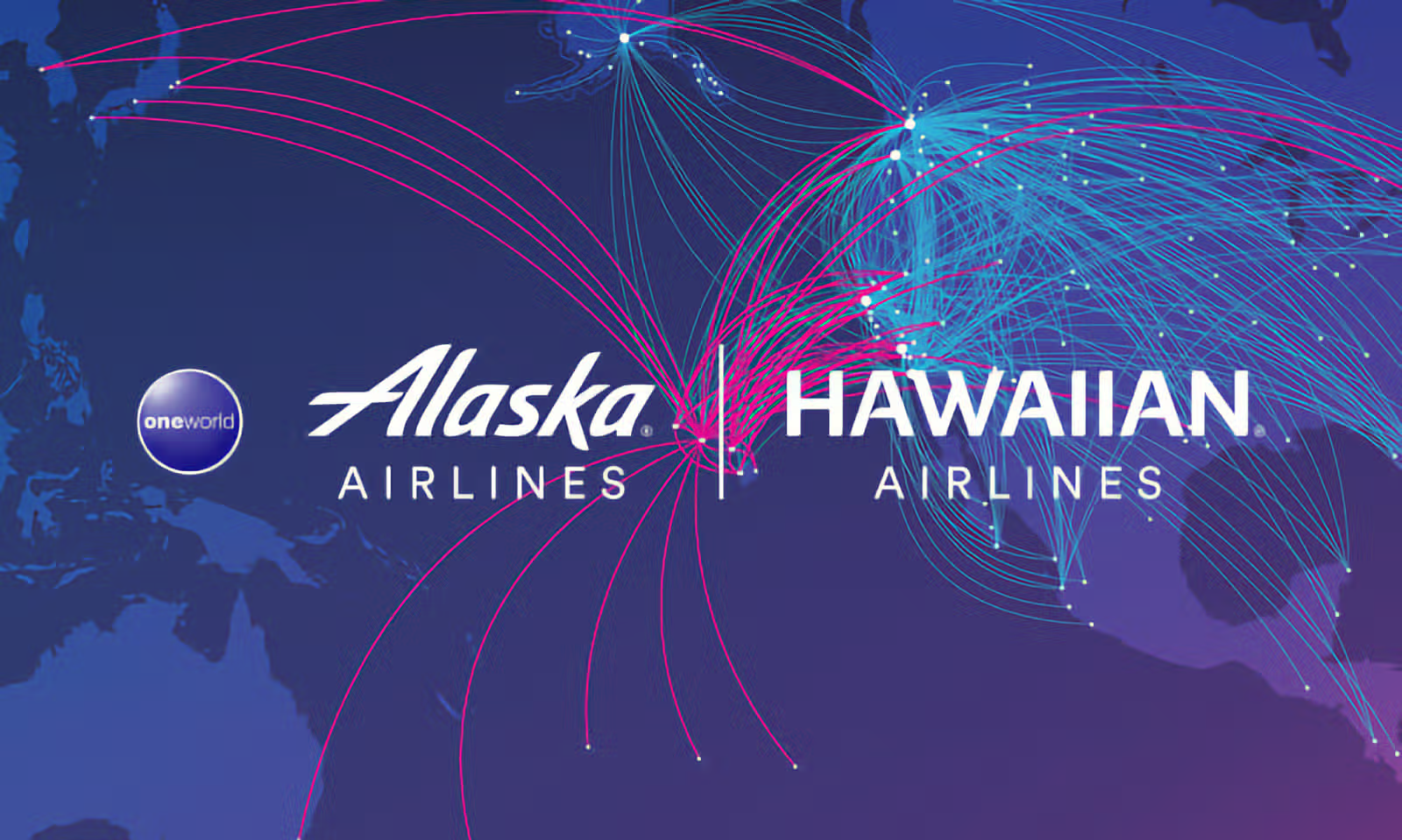
Alaska Airlines had a West Coast hub structure built around Seattle, Portland, Los Angeles, San Francisco, and Anchorage. Honolulu has now joined that list as the long-haul Pacific gateway. The route map flowing out of Honolulu under the combined operation includes Tokyo Haneda, Tokyo Narita, Sydney, Auckland, Pago Pago, Papeete, and the inter-island Hawaii network, all on Hawaiian metal. Alaska has also publicly discussed adding Asia routes from Honolulu under its own livery using widebody equipment as the fleet integration progresses. The Boeing 787-9 has come up in filings as the long-haul aircraft Alaska is positioning for new routes beyond the Hawaiian network.
For Mileage Plan members on the West Coast, the operational change is that Honolulu becomes a viable second connecting point for Pacific travel. Before the merger, Pacific redemptions out of Mileage Plan typically routed through partner carriers via Hong Kong or Tokyo Narita. After the merger, the program can build Pacific itineraries via Honolulu on its own metal, often at lower mileage costs than the equivalent partner award. The combined route network covers more of the Pacific than any other US frequent-flyer program, which is the structural advantage Mileage Plan members didn't have before September 2024.
What HawaiianMiles members should do now
The first move for anyone with a meaningful HawaiianMiles balance is to status-match into Mileage Plan if it hasn't already happened automatically. The reciprocity mapping is in place, but the cleaner experience is to have a single Mileage Plan account with the correct elite tier rather than relying on the cross-program recognition during the transition. Alaska has run match windows since 2024, and the request can be made through the Mileage Plan website.
The second move is to think carefully about whether to burn HawaiianMiles now or hold for the conversion. Because the conversion is one-to-one, there is no built-in devaluation to outrun, which removes the usual "burn before they cut" panic. The argument for burning now is operational: some Hawaiian-only redemptions, especially inter-island award seats and Hawaii-to-mainland coach, are easier to book today through the legacy Hawaiian search than they will be once the systems unify. The argument for holding is that Mileage Plan's partner chart is more valuable per mile than HawaiianMiles' dynamic redemption rates ever were. For most readers, the practical answer is to use stored balances on Hawaii-to-mainland trips already planned in 2026, then let the rest convert.
The third move is to make sure both programs have current contact information and that the linked accounts (Apple Pay, miles purchases, cobrand card connections) are clean before the cutover. The integration phase is when account-merge errors happen, and the cleanest accounts are the ones that go through without manual intervention. If you have HawaiianMiles tied to a closed email address, an old phone number, or a name that doesn't match your government ID, fix it now. Recovery requests after a system migration are slower, less consistent, and more likely to require a phone call than the same fix made today.
The fourth move, for the smaller subset of readers with serious balances on both sides, is to think through whether to keep them separate during the transition or combine them early. The combined-account experience hasn't fully launched as of May 2026, which means there is no penalty to holding two balances. Once the unified account goes live, balances merge automatically. Holding separate accounts a few months longer is not a problem; rushing the merge before the systems are ready can be.
The cobrand cards during integration
Both cobrand credit cards are still being issued as of May 2026, which surprises people. Bank of America continues to issue the Alaska Airlines Visa Signature card at a $95 annual fee, and Barclays continues to issue the Hawaiian Airlines World Elite Mastercard at a $99 annual fee. The combined company has publicly signaled that a single Mileage Plan cobrand structure will eventually consolidate the offering, but the timeline for that decision has not been publicly committed, and the existing cards remain in market. Anyone shopping for the cobrand should confirm the current welcome offer and terms at apply time, because both products have run higher-than-baseline bonuses during the integration period and the offers move.
The Alaska Visa's annual benefits, particularly the Famous Companion Fare and the free checked bag on Alaska, transfer cleanly to the merged route map for cardholders flying either airline. The Hawaiian Barclays card's annual benefits skew more toward Hawaii-specific perks like the inter-island free checked bag, which is still useful but progressively less differentiated as the programs unify. For most readers, the Alaska Visa is the safer long-horizon hold of the two. The Hawaiian Barclays card makes sense for households with a heavy Hawaii inter-island flight pattern who want the Hawaiian-specific benefits while they're still being honored.
Where Mileage Plan still pays off post-merger
The headline value of Mileage Plan, the partner-award chart, is unchanged by the merger and is the reason the program still rewards holding miles. Cathay Pacific business class to Hong Kong remains 50,000 miles one-way. JAL first class from Tokyo to the US East Coast remains bookable on the distance-based chart. Qantas business class to Sydney from the West Coast continues to deliver one of the cleanest long-haul redemptions among US airline programs.
What the merger adds is the widebody Pacific layer on Hawaiian metal, plus deeper Oneworld access through the alliance integration. The mileage-per-dollar earning rates on the cobrand cards held steady through the merger close, and the elite ladder is now wider with the Hawaiian flyer base absorbed into the Mileage Plan tiers. The program is more useful now than it was in 2023, with the caveat that the integration is not done and the experience at the gate, in the app, and through the reservation system will continue to be bumpy through 2026.
The redemption sweet spots worth memorizing as of May 2026 are: Cathay Pacific business at 50,000 miles one-way to Hong Kong, JAL business at 60,000 to 65,000 miles one-way to Tokyo, Qantas business at 55,000 to 70,000 miles one-way to Sydney, and Finnair business via Helsinki at 70,000 miles one-way to most of Europe. Add the new layer: Hawaiian-operated A330 business class between Honolulu and Tokyo or Sydney at distance-based rates that beat the dynamic pricing of every other US program flying the same routes. The combined chart, partner plus Hawaiian metal, is the deepest Pacific business-class redemption set any US carrier program offers in 2026, and it's the structural reason serious Pacific travelers should keep Mileage Plan in their portfolio rather than chasing whichever program is paying the highest sign-up bonus this quarter.
The Mileage Plan program remains one of the last US airline currencies where the published award chart still rewards reading the fine print. Anyone holding miles should keep them. Anyone with HawaiianMiles should plan the conversion. Anyone deciding whether the merged airline deserves a wallet slot should look at the Pacific route map and the Companion Fare math and make the call from there.
This article contains affiliate links. If you apply through our links, we may earn a commission at no cost to you, which helps us continue sharing points and miles strategies with the community.
Some of the links in this article are affiliate links. We may receive a small commission at no extra cost to you if you apply through these links. This helps us keep the site running and continue creating free content.