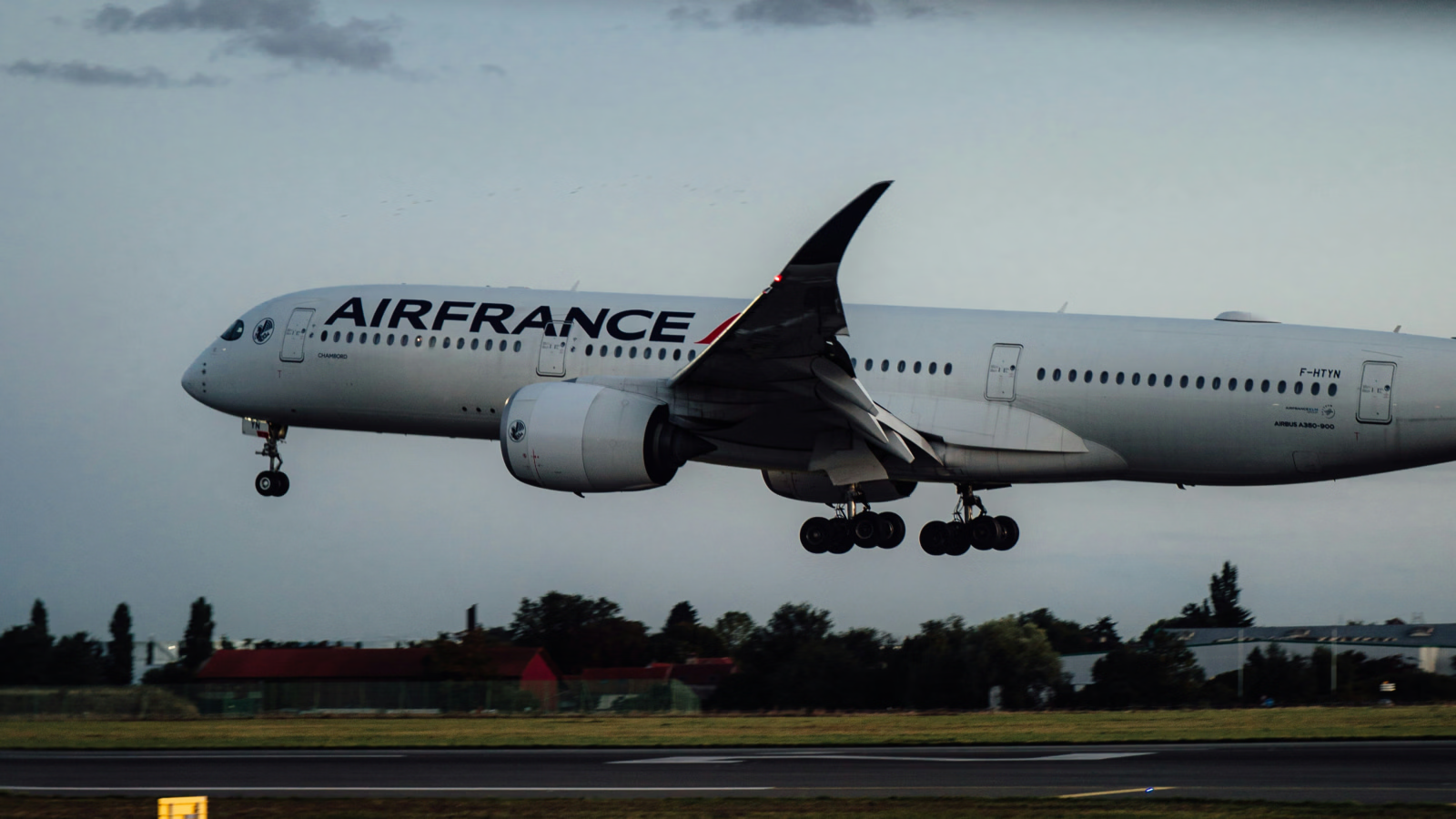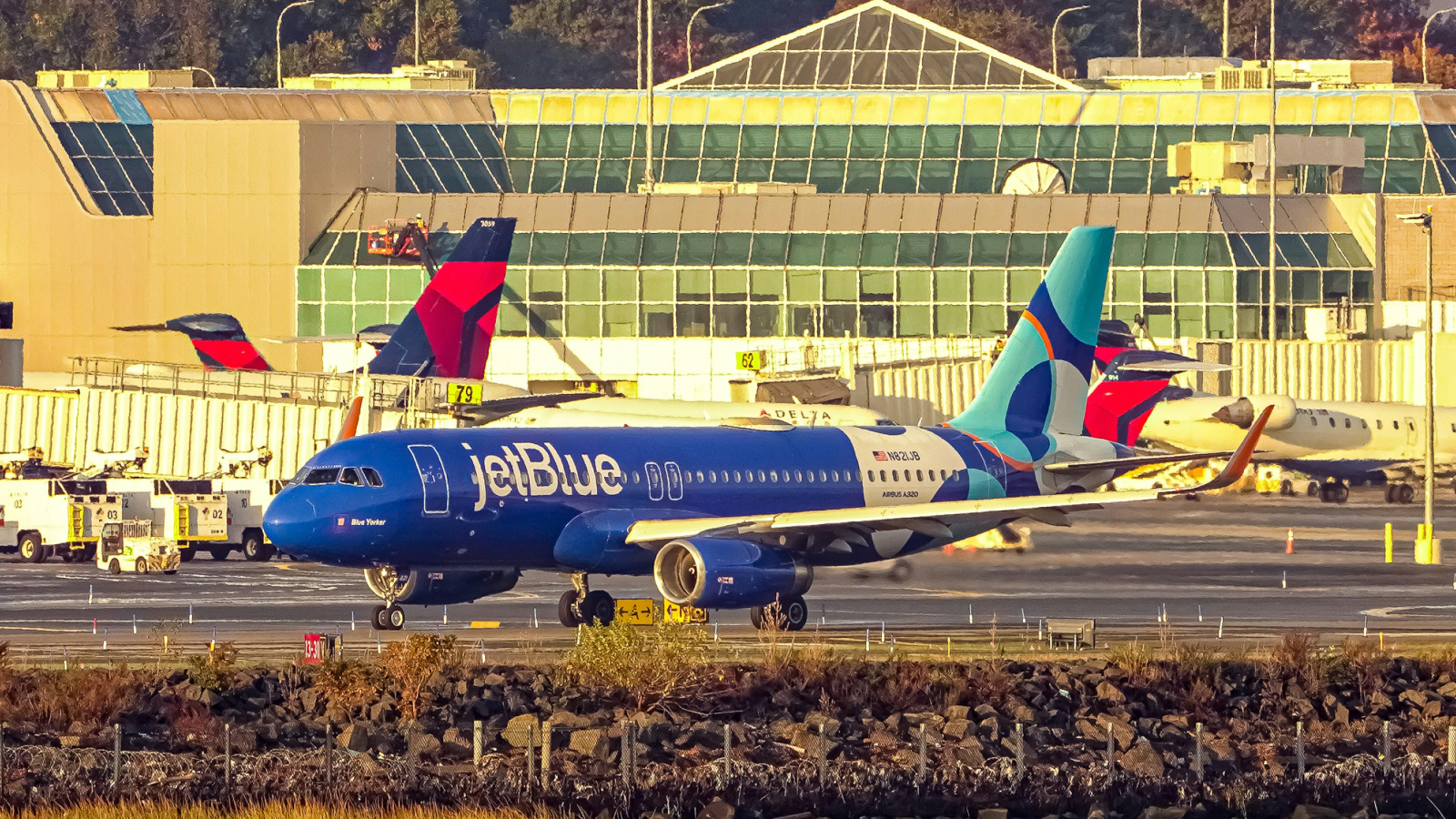
US airlines aren't really flight businesses anymore. They're financial services companies that happen to own planes.
I'm not being cute. The numbers say it plainly. The major US carriers earned roughly $5.51 in profit per passenger between 2021 and 2024, according to a Sherwood News analysis of company reports and Bureau of Transportation Statistics data. The average domestic fare in 2024 was $383. Do the arithmetic: somewhere around 1.4% of what you paid for that ticket actually became profit for the airline. The rest went to jet fuel, labor, aircraft leases, gate fees, taxes, and the long list of costs it takes to move 180 strangers from one city to another at 35,000 feet.
That's the headline. Here's the part that matters for anyone who collects points: while the flying business has been earning pennies, the credit-card business attached to those same airlines has been printing money. Delta's co-branded partnership with American Express delivered the airline roughly $2 billion in a single quarter of 2024, at a profit margin that runs closer to 50%. The flying half of Delta could lose a war and the financial services half would still hand the company a healthy year.
This isn't a complaint. For people who play the points game, it's actually good news, and it changes how I think about which cards to apply for and when. Let me walk through what the numbers say, why they're shaped this way, and what I'd actually do with that information.
Quick Answer
Major US airlines made about $5.51 profit per passenger from 2021 through 2024. Their credit-card partnerships, especially Delta-Amex, generated billions in high-margin revenue over the same window. The flying business runs thin. The financial services business is where the actual money lives. That shifts the math on how aggressively you should chase airline-card sign-up bonuses.
The Sherwood Numbers, In Context
Sherwood News published the cleanest public breakdown of airline unit economics I've seen, and the comparison they ran is worth pausing on. From 2016 through 2019, the last stretch of pre-pandemic normal, the majors averaged about $19.26 in profit per passenger. From 2021 through 2024, that fell to $5.51. In the first quarter of 2024 specifically, the figure bottomed out at $0.55 per passenger. Fifty-five cents.
That's per passenger, not per flight. A 180-seat 737 carrying a full load in Q1 2024 generated, on average, $99 in profit. After everything. After the ticket revenue, the loyalty revenue, the baggage fees, the Wi-Fi upcharges, the canceled seat selections, the change fees, the cargo. Ninety-nine dollars for moving 180 humans across the country.
It's now 2026. The industry recovered through 2024 and 2025; full-year results for the majors looked stronger than that Q1 trough. But the trend Sherwood identified hasn't reversed. The structural shift it points at, that ticket margins compress while partnership revenue keeps growing as a share of profit, has continued. The Q1 2024 numbers were a low point, not the new floor. They still illustrate the shape of the business.
Bill McGee, an analyst at the American Economic Liberties Project, told Sherwood the industry "over time, looks like the Alps." Meaning the profit curve has dramatic peaks (good years) and deep valleys (recessions, fuel spikes, pandemics), with not much flat ground in between. That's true of the flying business. What's been quietly reshaping the industry is the addition of a second business, loyalty and co-brand credit cards, that doesn't move with that curve at all.
Where The Money Actually Is
Three buckets, all attached to the same airline brand, all dramatically more profitable than the seats themselves.
Co-branded credit cards. Delta's partnership with American Express is the clearest example because Delta breaks the numbers out. Amex contributes roughly 7% of Delta's revenue but a far larger share of its profit. The partnership earns Delta around $2 billion per quarter, and management has been on the record about pushing it toward $10 billion annually. The margin runs near 50%. That's a software-company margin. On an airline.
Why does it work? Amex pays Delta cash for the SkyMiles it hands out as sign-up bonuses, ongoing spend earnings, and category multipliers. That cash arrives whether or not the cardholder ever boards a Delta flight. The miles sit on the balance sheet as a deferred obligation, but airlines have decades of data on redemption behavior. They know roughly what percentage will be redeemed, how, and when, and they're allowed to recognize the rest as revenue over time. Award seats themselves have a marginal cost close to zero on a flight that was going to operate anyway. The economics on this side of the business look nothing like the economics on the flying side.
Ancillary fees. US major carriers collected roughly $7.27 billion in baggage fees alone in 2024, up about 26% from 2019. Add seat selection fees, change fees, priority boarding, in-flight purchases, and the rest, and the total ancillary line item runs significantly higher. Ancillaries don't have the same fixed-cost structure as flying. Once you've built the systems to charge for a checked bag, charging for the second one costs you almost nothing.
Cargo and partnerships. Smaller than the first two, but worth mentioning. Cargo runs at higher margins than passenger revenue, and partnership deals with hotels, car rentals, and other affinity programs add to the loyalty-revenue line without adding cost.
The pattern across all three: the airline collects revenue that doesn't require flying a specific passenger to a specific destination at a specific time. That's what makes the financial-services side of the business so much more resilient than the flying side. Fuel prices spike, demand softens, weather costs you operational dollars. None of that meaningfully changes how many people sign up for the Delta Reserve.
Why This Is Good News If You Collect Points
If you're reading this site, you already know the punchline: airlines need credit-card customers more than credit-card customers need airlines. But it's worth being explicit about what that asymmetry buys you.
Sign-up bonuses are funded by Amex, not by Delta. When the Delta SkyMiles Reserve runs a 100,000-mile sign-up bonus, that bonus isn't a generous gift from the airline. It's a marketing expense that Amex is paying Delta for, because Amex needs the new cardholder and Delta needs the deferred revenue. Two parties with aligned incentives are competing to put miles in your account.
Big bonuses keep coming. As long as the partnership revenue line is the part of the airline's P&L that's actually growing, the airlines have every reason to keep signing co-brand customers. That's why the welcome offers in 2025 trended higher across the major US programs, not lower, and why the boosted offers like the periodic Delta Reserve and Amex Platinum spikes have shown up more frequently in recent years. (See our review of the Delta SkyMiles Reserve American Express card for the current state of that specific offer.)
Award space follows the same logic. Airlines that lean on loyalty revenue have a reason to keep at least some award space available, because if their members can never redeem, the program loses value and Amex's argument for paying $2 billion a quarter weakens. This doesn't mean award space is generous (it isn't, especially in premium cabins), but the structural incentive to keep some doors open is stronger than people give credit for.
Strategic Implication 1: Prioritize Airline-Card Welcome Bonuses
This is the part where I'd push back on the conventional advice. The dominant playbook for the last several years has been "build your transferable-currency stack first, then pick the airline cards only when you need them." That's still good advice for someone with zero points who's just getting started.
But if you're past that beginner stage and you have a clear target, a specific carrier whose award space you actually want, the math has tilted further toward going direct on the airline card. The welcome bonuses are bigger and more frequent than they used to be, the issuer-side competition is real, and waiting for the perfect transferable-currency moment can cost you the bonus window. (Our guide on decoding sign-up bonuses walks through what to look for in an offer worth chasing.)
If you fly Delta enough to care about Medallion status, the Delta cards are the right first move. If you fly United enough to want Star Alliance access, the United-Chase cards stack with your Ultimate Rewards balance. If you fly American, the Citi and Barclays cards have their own bonus rhythm. Don't twist yourself into a transferable-currency strategy if your actual flying patterns point at one carrier.
Strategic Implication 2: Pair With Transferable Currencies, Don't Replace Them
That said, and this is where I disagree with the most aggressive "go direct on airline cards" advice, you still want transferable currencies in the mix. Not as your only stack, but as your flexibility layer.
Three reasons. First, partner award charts shift, and a transferable balance lets you move miles to wherever the value sits this quarter rather than the program you committed to two years ago. (We track this across the big three: Chase Ultimate Rewards transfer partners, American Express transfer partners, and Capital One transfer partners.)
Second, transfer bonuses periodically punch above the standard 1:1 rate. Amex regularly runs 25-40% transfer bonuses to specific partners, and if your miles are already with the airline, you can't take advantage. The currency-first approach catches those bonuses; the airline-direct approach doesn't.
Third, transferable currencies hedge against single-program devaluation. When a program raises award prices overnight (which they all do, periodically), having your balance one step removed gives you more options. (Our credit-card pairings guide covers the most common stacks, and the business-card-for-travel guide covers the equivalent on the business side.)
The right structure for most people isn't airline-only or transferable-only. It's a transferable engine plus a co-brand card for the carrier you actually fly.
Strategic Implication 3: Time Applications Around The Partnership Revenue Cycle
This is more speculative but it tracks with the public quarterly results: the biggest co-brand welcome offers tend to cluster in periods when carriers are pushing partnership revenue targets. Q4 is historically heavy. So is the period around new route launches and major aircraft deliveries, when carriers want to flood new flyers into the membership pool.
Practical version: when you see a Delta or United or American card offer that's 20-30% higher than the last few months, don't assume it's a fluke. Assume the airline is leaning into the partnership-revenue lever. Apply within the window.
If you already hold the card and a higher-than-usual offer drops for new applicants, the retention-offer route is the right play. Our guide to retention offers for more miles and points covers the script. The credit-card retention offers guide goes deeper on the broader strategy.
The Competition Question
One reason the financial-services half of the airline business has stayed so profitable: there isn't much new airline competition keeping the flying side honest. Only two new US scheduled passenger airlines have launched since 2007, Avelo and Breeze. That's it. Eighteen years, two entrants.
The barriers to entry are brutal. You need aircraft, certifications, gate slots at constrained airports, pilots in a market that's been short on pilots for most of a decade, and enough capital to lose money for several years while you build a brand. Most attempts don't survive. Meanwhile the four majors (American, Delta, United, Southwest) and their consolidated networks (American absorbed US Airways, Delta absorbed Northwest, United absorbed Continental) control most of the domestic seat capacity.
What that means in practice: the carriers don't have to compete hard on ticket price, because the alternatives are limited. They don't have to compete hard on co-brand economics either, because the cardholder isn't shopping between American Eagle and Lufthansa for their primary card. The financial-services moat is wider than the flying moat.
The 2026 Reader Caveat
If you're reading this after the Sherwood analysis, a fair question is whether the numbers are still right. Short answer: the specific 2024 figures are what they are, but the underlying shape of the business has continued in the same direction through 2025. Co-brand partnerships have grown as a share of major-carrier profit, not shrunk. Ancillary fees keep climbing. Ticket margins remain thinner than they were pre-pandemic.
The trend hasn't reversed. If anything, the gap between the flying business and the financial-services business is wider in 2026 than it was when Sherwood ran the analysis.
What I'd Actually Do
If you offered me the next aggressive airline-card welcome bonus, say, a Delta Reserve at 100,000 SkyMiles or a United Club Card at 95,000 miles, and I had a clean credit profile and a use case for the carrier, I'd take it. Without hesitation. The bonus is funded by a financial-services partnership that the airline has every incentive to keep growing. The card is profitable enough to the issuer that the welcome math is generous. The miles sit on a program that has structural reasons to keep at least some award space honest.
Pair the card with whichever transferable-currency engine you already have, lean on transfer bonuses when they appear, and use sign-up bonuses to absorb a meaningful chunk of your annual mile-earning. (Our ultimate guide to free travel walks through the broader strategy.) If you need help finding the actual award space, search tools like PointMe and Going cover most of the gaps the airlines won't show you in their own search engines.
The airlines aren't flight businesses anymore. They're financial services companies with planes. That doesn't have to be a problem for you. It can be the most profitable thing you exploit, as long as you remember which side of the business is actually paying the bills.
This article contains affiliate links. If you apply through our links, we may earn a commission at no cost to you, which helps us continue sharing points and miles strategies with the community.
Some of the links in this article are affiliate links. We may receive a small commission at no extra cost to you if you apply through these links. This helps us keep the site running and continue creating free content.