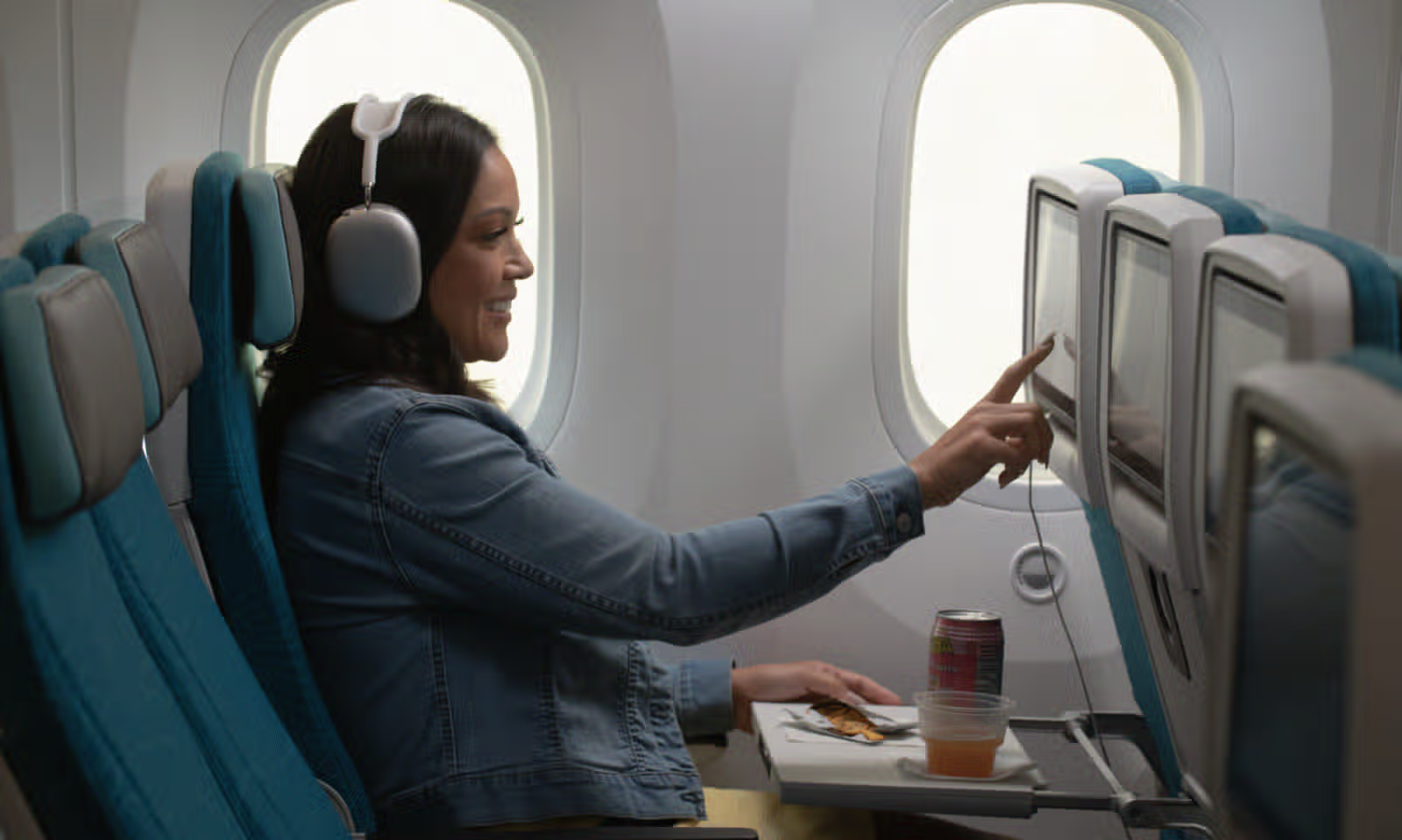
HawaiianMiles is winding down. As of October 2025, Hawaiian Airlines and Alaska Airlines combined their loyalty programs into Atmos Rewards, the rebranded successor to Alaska Mileage Plan. If you have a HawaiianMiles balance in April 2026, the program you signed up for is no longer the program your miles live in. They've moved.
That sentence covers most of what readers landing on this page need to know. The rest of this review covers the specifics: when the migration happened, what your balance is worth now, what to do with it, how Atmos compares to what HawaiianMiles used to offer, and the small handful of cases where you should still care about the old program's quirks.
This is not an obituary. HawaiianMiles served Hawaii travelers well for four decades, and the value didn't disappear. It transferred into a stronger, broader program with more partners and a real domestic and international footprint. If you held HawaiianMiles for inter-island flights or Hawaii-to-mainland awards, the news is mostly good. If you held them for Pacific business class sweet spots, the news is more mixed.
Here's the full picture as of April 2026.
Quick summary
Best for: Existing balance-holders who need a clear migration path, and Hawaii-bound travelers comparing co-brand cards. Standout benefit: Miles transferred at the announced 1:1 ratio with no fee, preserving balance value into Atmos Rewards. Biggest drawback: The HawaiianMiles brand and standalone redemption tools are gone; all forward booking happens inside Atmos. Migration status: Combined program live since October 2025; HawaiianMiles accounts and balances now sit inside Atmos.
What happened to HawaiianMiles
Alaska Airlines closed its acquisition of Hawaiian Airlines in September 2024. The two airlines kept their loyalty programs running in parallel through most of 2025 while the combined entity finalized the program design. In October 2025, Mileage Plan rebranded as Atmos Rewards, and HawaiianMiles balances were folded into the combined program at the announced 1:1 ratio.
If you had a HawaiianMiles account, the migration was automatic for most members. Balances moved over. Activity history moved over. Pualani elite status converted to the equivalent Atmos tier (Pualani Gold to MVP Gold, Pualani Platinum to MVP Gold 75K), and that mapping has held through April 2026. The old hawaiianairlines.com login still resolves, but redemptions, account management, and credit card earning all flow through Atmos now.
A few things didn't survive the transition cleanly. The HawaiianMiles partner list shrank to whatever overlapped with Mileage Plan's existing partners. Phone-only partner award booking, which was a HawaiianMiles quirk, is now Atmos's standard online booking on Alaska's site. The fixed HawaiianMiles award chart was replaced with the Atmos award structure, which is slightly more dynamic on long-haul international but kept fixed pricing on inter-island and short-haul West Coast routes, which were the redemptions HawaiianMiles members used most.
What your balance is worth now
If you logged in today and saw your HawaiianMiles balance reappear inside Atmos at a 1:1 conversion, that balance is worth roughly what Alaska Mileage Plan miles have always been worth: 1.4 cents per mile on average across redemptions, with sweet spots at 2 cents or higher and weaker redemptions closer to 1 cent.
The headline numbers held up well:
- Inter-island Hawaii: Still bookable, still 7,500 to 15,000 miles one-way. This was HawaiianMiles' single best redemption and Atmos preserved it.
- Hawaii to West Coast: Starts at 20,000 miles one-way in economy. Peak dates run higher, same as the legacy HawaiianMiles chart.
- Honolulu to Tahiti business: The 47,500-mile Pacific sweet spot transferred over but availability has tightened. If you saw this on a HawaiianMiles bookmark, search Atmos availability before assuming the seat is there.
- Mainland and international: Atmos opened up oneworld routings via Alaska's existing partners (American, British Airways, Qatar, Cathay Pacific, Japan Airlines), plus the Hawaiian-side partners that survived (Korean Air, Virgin Atlantic). The combined network is meaningfully broader than HawaiianMiles offered.
If your balance is sitting in Atmos and you're wondering whether to use it: the answer is the same advice we'd give any Atmos member. Use it for inter-island, for Hawaii-to-West-Coast, for the Pacific business class sweet spots when they open up, and for oneworld redemptions you couldn't access before.
What to do with a HawaiianMiles balance now
The action items are simple. None of them are urgent in the way the original "ends in August 2025" headline suggested, because the migration already happened and your miles are already in Atmos. But there's still useful housekeeping.
Confirm your balance migrated. Log into your Alaska Mileage Plan account (now branded Atmos). If you previously had a HawaiianMiles account but no Mileage Plan account, the merger created one for you using your HawaiianMiles email. The combined balance should reflect both sides as of October 2025. If something looks off, the Atmos member services line can pull up the migration record.
Check your status mapping. Pualani Gold should show as Atmos MVP Gold; Pualani Platinum should show as MVP Gold 75K. Status earned in 2025 carries through 2026 under Atmos's tier rules. If you were close to a tier under the old HawaiianMiles thresholds, the conversion may have nudged you up or held you steady. Worth verifying before booking flights you'd want elite benefits on.
Use miles on what HawaiianMiles was best at. Inter-island awards from 7,500 miles, Hawaii-to-mainland awards from 20,000 miles, and the Pacific business class redemptions are still the highest-value places to spend a converted HawaiianMiles balance. None of those got worse in the transition.
Consider the co-brand card decision. The Hawaiian Airlines World Elite Mastercard is still issued by Barclays in 2026, now earning Atmos points instead of HawaiianMiles. Bank of America also launched an Atmos Ascent personal card and an Atmos Rewards Business Card, with sign-up bonuses competitive with other airline co-brands. If you held the legacy Hawaiian Airlines card primarily for the inter-island value, the math hasn't changed; it's just denominated in Atmos points now.
Was HawaiianMiles a good program?
For its niche, yes. If you're a reader who's just discovering they have a balance and wants to understand what it represented, the short version: HawaiianMiles was a focused program that did inter-island Hawaii travel better than any other loyalty currency. Its weaknesses were partner award booking (phone-only, hard to find availability) and limited global reach. Its strengths were fixed award pricing on Hawaii-related routes and a co-brand card that earned reasonable bonuses for Hawaii-bound spenders.
The program ranked in the top five U.S. frequent flyer programs in independent surveys through 2024 and 2025, primarily because the redemption sweet spots were genuinely good. What HawaiianMiles couldn't offer (broad domestic coverage, deep oneworld access, transferable-points flexibility) Atmos now offers as the default. That's the upside of the merger for most former HawaiianMiles members.
How HawaiianMiles compared to other Pacific carrier programs
For readers researching Pacific carrier loyalty, the comparison set in 2026 looks different than it did two years ago.
Atmos Rewards (formerly Mileage Plan plus HawaiianMiles). The combined program is the strongest U.S.-based option for Pacific travel. Direct service to Hawaii, oneworld access for onward Asia routings, and the inherited Korean Air and Virgin Atlantic partnerships from the Hawaiian side. If you used to weigh HawaiianMiles against Mileage Plan, that decision is now moot. They're the same program.
United MileagePlus. Stronger for Asia-Pacific via Star Alliance partners (ANA, Singapore, EVA), particularly for Tokyo, Seoul, and Singapore in business class. United is the better answer if your Pacific travel is primarily East Asia rather than Hawaii.
ANA Mileage Club and Singapore KrisFlyer. Best in class for premium-cabin Pacific redemptions when you can find availability, but neither rewards U.S.-domiciled spending the way Atmos or United do. Useful as transfer destinations from Amex Membership Rewards rather than as primary programs.
Air New Zealand Airpoints. A separate currency without U.S. transfer partner depth. Useful only if you're flying Air New Zealand directly.
The practical takeaway: if Hawaii is your primary Pacific destination, Atmos is the answer. If you're flying past Hawaii to Asia, United is usually the better fit, with ANA or KrisFlyer as transfer destinations for premium cabins.
Pros and cons of the transition (for former HawaiianMiles members)
Pros
- One-to-one balance conversion preserved every mile at no cost.
- Atmos Rewards gives former HawaiianMiles members access to oneworld routings they couldn't book before.
- Inter-island and Hawaii-to-West-Coast award pricing held steady through the merger.
- Status conversion was clean; Pualani tiers mapped cleanly to MVP Gold and MVP Gold 75K.
- The Hawaiian Airlines co-brand card still exists, now earning a more useful currency.
Cons
- The HawaiianMiles brand and standalone account experience are gone; some long-time members miss the simpler interface.
- Partner award availability for the legacy Hawaiian-side partners (Korean Air, Virgin Atlantic via Hawaiian) tightened during the integration.
- Atmos uses slightly more dynamic pricing on long-haul international than the old HawaiianMiles fixed chart.
- Members who only ever flew Hawaiian Airlines now need to learn Alaska's tools and route network.
Final verdict
HawaiianMiles, as a standalone program, is gone. The miles aren't. If you logged in expecting to see a balance you forgot about, that balance is now sitting in Atmos Rewards at the same nominal count, ready to spend on the same Hawaii-related redemptions that made HawaiianMiles worth holding in the first place, plus a much wider international network you didn't have access to before.
The action for most readers is small. Verify the migration. Confirm your status mapping. Spend the miles on inter-island, Hawaii-mainland, or Pacific business class when availability opens up. If you were planning to chase HawaiianMiles for new earning, your earning now flows into Atmos through the same Hawaiian Airlines co-brand card, plus the new Bank of America Atmos personal and business cards.
The combined program is stronger than either parent program was alone. That's the rare merger outcome where loyalty members come out ahead.
This article contains affiliate links. If you apply through our links, we may earn a commission at no cost to you, which helps us continue sharing points and miles strategies with the community.
Some of the links in this article are affiliate links. We may receive a small commission at no extra cost to you if you apply through these links. This helps us keep the site running and continue creating free content.