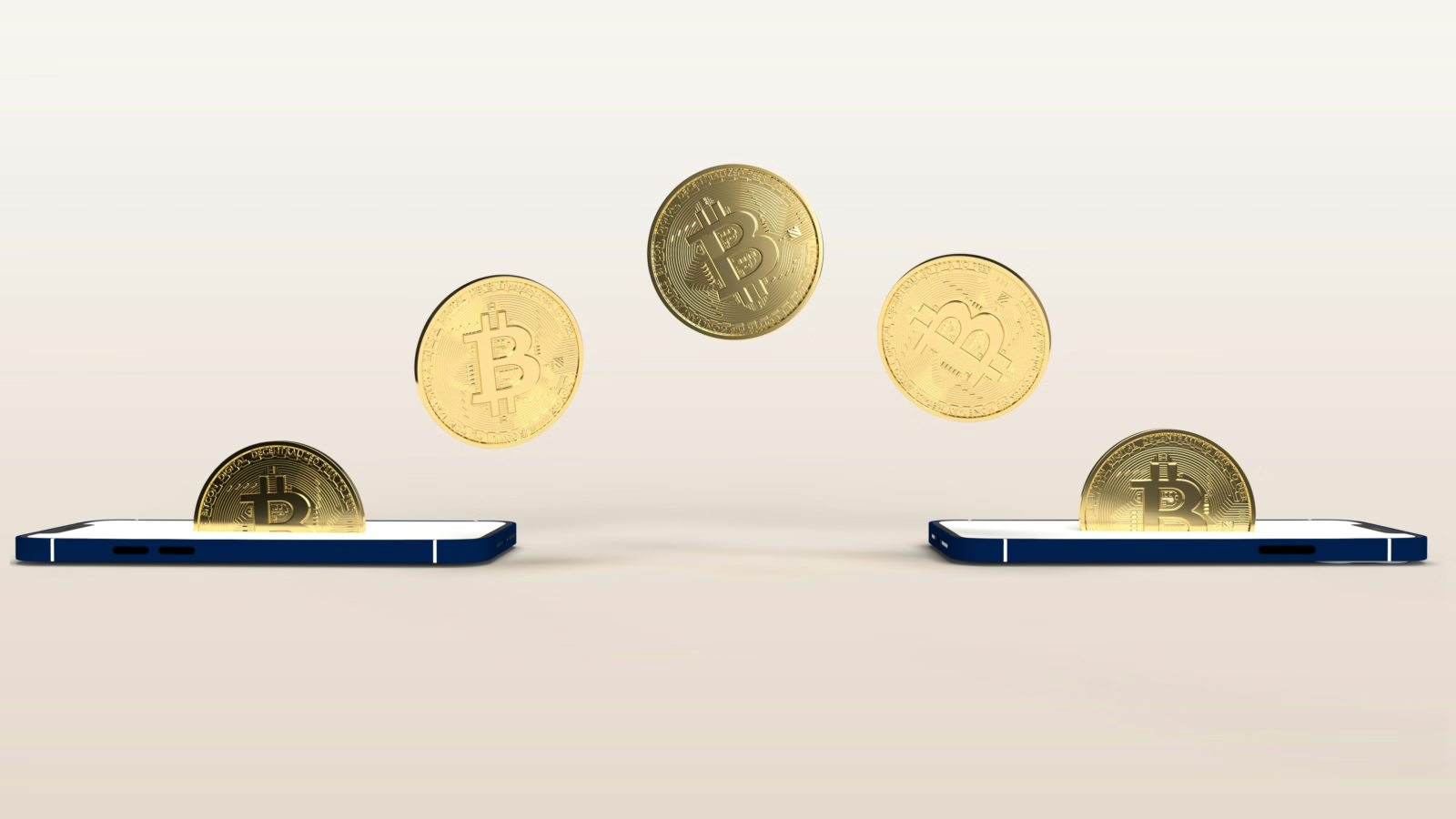
The Fold Bitcoin Rewards Visa is a no-annual-fee credit card that pays rewards in Bitcoin instead of cash or points. Every purchase earns sats, which post to a Fold account you can hold, sell back to dollars, or withdraw to an outside wallet. As of April 2026, Fold offers two consumer card tiers, a base rewards rate of 1% back in BTC (with promotional categories that lift the rate), and a "Bitrise" pool model that occasionally sweeps bonus sats to active cardholders.
The pitch is that you accumulate Bitcoin passively through everyday spending. The math has to clear two hurdles before it works for most readers: the base earn rate has to compete with a flat-rate cash-back card, and Bitcoin's price has to behave well enough after you receive the rewards. Below is a clear walk-through of how the card actually pays, what the tiers cost, the tax friction nobody enjoys, and where this card fits versus the Amex Blue Business Plus and Citi Double Cash.
How Fold Pays Out (Bitrise And All)
Fold's headline rate is 1% back in Bitcoin on every purchase, denominated in sats (one Bitcoin equals 100 million sats). Sats accrue per transaction and post to your Fold account, generally within a few days of the charge clearing.
On top of the base rate, Fold runs a "Bitrise" mechanic. The way it works: a portion of total cardholder spend across the network feeds a shared sats pool, and active cardholders receive periodic distributions from that pool on top of their base earnings. The exact distribution math is opaque from the outside; Fold publishes earned-sats totals in the app but does not give you a transparent multiplier you can model in advance. Effective realized rates I've seen reported by users for 2025 spending land in the 1.0% to 1.5% range once Bitrise is included, valued at the BTC price on the earn date.
There are also rotating promotional categories (gas, groceries, takeout) where the earn rate temporarily steps up to 2% or more, and a "spin" mechanic in the app that gives a small randomized bonus on each purchase. The spin pays small amounts of sats most of the time, with rare larger hits. Treat it as a marketing flourish rather than a meaningful chunk of your earn.
Two important footnotes on the rewards mechanics:
- You earn sats, not dollars. The dollar value of your rewards moves with Bitcoin's price between when you earn them and when you sell or spend them.
- Withdrawal limits and conversion friction apply. Moving sats off Fold to an outside wallet is allowed but subject to network fees and Fold's own minimums. Selling back to USD inside the app is cleaner but locks in whatever the BTC price is on that day.
The Tier Structure And What You Actually Pay
As of April 2026, Fold sells two cards aimed at consumers:
Fold Card (no annual fee). Base 1% back in BTC. Bitrise pool participation. Spin bonuses. Rotating promo categories. This is the on-ramp tier most readers should evaluate first because the cost of being wrong is zero dollars per year.
Fold Card Premium ($150 annual fee, advertised on Fold's site). Higher base earn (Fold cites up to 2.5% in BTC on premium-tier categories at launch in 2024, with category mixes that have shifted in 2025), priority Bitrise pool weight, and a few perks like enhanced spin odds. The premium tier is meaningful only if you spend enough to clear the $150 fee in incremental BTC versus the no-fee tier.
The premium tier breakeven is the question to answer before paying. Roughly, you need to net at least $150 of additional BTC per year to be ahead of the free card, which depending on your category mix and Bitrise distributions takes roughly $15,000 to $25,000 in annual spend. Below that, the no-fee Fold Card is the right starting point.
Both tiers carry no foreign transaction fees. The card runs on Visa, with the standard Visa-tier protections.
The Volatility Problem
This is the part that makes Fold structurally different from a cash-back card. When Wells Fargo Active Cash credits you 2% on a $100 purchase, you receive $2.00. That two dollars is two dollars next month and next year.
When Fold credits you 1% on a $100 purchase and BTC trades at $70,000, you receive about 1,428 sats (roughly $1.00 in value at that moment). Six months later, those sats might be worth $1.40 if BTC has run up to $98,000, or $0.70 if BTC has dropped to $49,000. The realized rate of return on your spend is unknown until you actually convert or spend the sats.
This cuts both ways:
- If you believe BTC trends up over your holding period, the dollar-equivalent return on spending can exceed what a 2% cash-back card produces. A long Bitcoin run between earn date and sale date is the bull case for the card.
- If BTC is flat or down over your holding period, your realized return falls below the headline 1% rate, sometimes well below.
This is not a card I'd recommend to anyone who would not, separately, choose to buy Bitcoin with cash. The card layers a small Bitcoin position on top of your regular spending. If you don't want Bitcoin exposure to begin with, you don't want this card.
The Tax Side Nobody Enjoys
Receiving rewards in Bitcoin is more complicated than receiving cash back, and the IRS has been clear that crypto rewards are generally treated as property, not as a non-taxable rebate.
The current US treatment, as of April 2026, breaks roughly into two events:
- Earning sats. The IRS has historically treated traditional credit card cash back as a price rebate, not income. Crypto rewards earned through purchase activity are commonly treated the same way (a rebate, not income at the moment earned), and most crypto tax practitioners apply that approach to card rewards. This is not settled with formal guidance, so consult your CPA. The conservative read: track the fair market value of sats at the moment they post to your account because that becomes your cost basis.
- Spending or selling sats. When you sell sats for USD or spend them to buy something, you trigger a capital gain or loss equal to the difference between your cost basis (the BTC price when the sats posted) and the proceeds (the BTC price when you sold or spent). Held under a year, that gain is taxed at ordinary income rates. Held over a year, long-term capital gains rates apply.
Practical effect: every time you sell or spend Fold rewards, you create a taxable event with paperwork. Cash back doesn't do that. If you intend to sell often, the friction is real. If you plan to hold long-term, the friction is back-loaded but doesn't go away.
Two operational suggestions if you go this route. Keep a running record of cost basis at the moment sats post (Fold's transaction history will show date and BTC price). And if you stack a year of rewards, expect to file IRS Form 8949 entries for any sales, which most tax software handles cleanly if you import from a service like CoinTracker or Koinly.
How Fold Compares To Amex Blue Business Plus And Citi Double Cash
These are the two cards I'd actually weigh against Fold for someone who wants stable, predictable rewards on general spending.
Citi Double Cash. No annual fee. 2% on every purchase (1% when you buy, 1% when you pay). Cash redeemable as a statement credit, check, or ThankYou points (which is the lever that turns this into a points card if paired with a Strata Premier or Strata Elite). The base case is that if Bitcoin underperforms a 2% return between when you earn and when you cash out, the Double Cash beats Fold's no-fee tier on raw return, with no tax filing complication. As of April 2026, the Double Cash is the dominant flat-rate cash-back card for most readers.
Amex Blue Business Plus. No annual fee for sole proprietors or business owners. 2X Membership Rewards points on the first $50,000 in purchases per calendar year, then 1X. Membership Rewards transfer to Delta, Hilton, Marriott, ANA, Air Canada, and another 15+ partners, which gives you a path to outsized value if you actually book award travel. The 2X cap on $50,000 of spend is meaningful for small businesses; pair it with Fold for personal spend if you want both buckets covered.
The honest comparison. If your goal is the highest expected dollar return on spending with no surprises, the Citi Double Cash beats Fold's no-fee tier in every period where BTC underperforms a 2% return after taxes and conversion. If your goal is to acquire Bitcoin and you'd be buying some anyway, Fold's no-fee tier replaces that buying with passive accumulation, which has real behavioral value. Both can be true, and the right move for a lot of people is to put primary spend on a Double Cash or Active Cash and use Fold for a slice of monthly spend you'd otherwise convert into BTC at an exchange.
Who The Fold Card Actually Fits
The card makes sense for three reader profiles:
- Active BTC accumulators. You're already buying Bitcoin monthly. Routing a portion of spend through Fold replaces some of that buying with passive earn, and the no-fee tier costs nothing to test.
- Travelers with no foreign transaction fees as a hard requirement. Fold has them. This is one of the few BTC-rewards cards that does.
- Readers who want exposure but not commitment. The no-fee tier lets you accumulate a small position over a year of spending without ever transferring USD to an exchange.
The card does not fit for readers who want predictable cash back, readers who don't want crypto exposure, or readers who don't want to deal with tax filing on small sales of rewards. For those readers, the Citi Double Cash is the cleaner answer.
The Verdict
The Fold Bitcoin Rewards Visa, no-fee tier, is a reasonable supplement card if Bitcoin accumulation is already part of your plan. The premium tier requires high enough spend to clear the $150 fee in incremental BTC, and most readers don't hit that threshold. As a sole rewards card, it loses to the Citi Double Cash on raw return in any period where Bitcoin underperforms 2%, and it adds tax filing friction the Double Cash doesn't.
The cleanest play for most: Double Cash or Wells Fargo Active Cash on primary spend, Fold on a slice of monthly spend if you want passive BTC accumulation, and a clear plan for how you'll handle the tax record-keeping before you swipe.
This article contains affiliate links. If you apply through our links, we may earn a commission at no cost to you, which helps us continue sharing points and miles strategies with the community.
Some of the links in this article are affiliate links. We may receive a small commission at no extra cost to you if you apply through these links. This helps us keep the site running and continue creating free content.