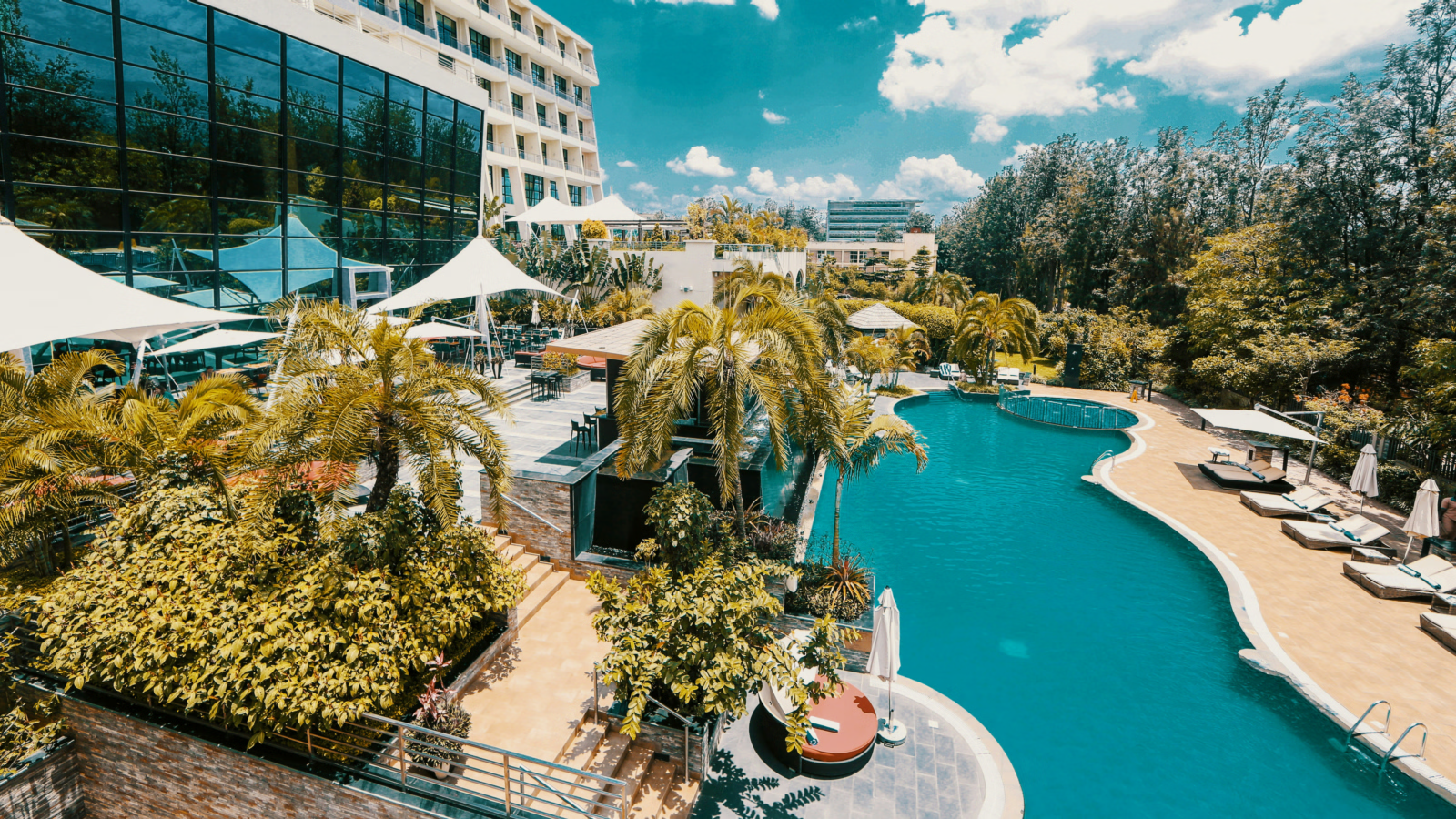


Hawaii is where hotel points either earn their keep or expose how thin the cents-per-point math actually is. Cash rates at the Andaz Maui at Wailea ran past $1,400 a night during the 2026 winter window. The Grand Wailea, Hilton Hawaiian Village, Ritz-Carlton Kapalua, and Westin Maui all sat in the $700-1,200 range. When the points community talks about Hawaii redemptions clearing 3 to 4 cents per point, that's not hype. It's the cash math doing what it does when an island chain has finite hotel supply and nine months of reliable demand.
The question is which currency to earn to redeem against those rates, which properties actually clear the math, and how to handle the award-space problem that turns most "great Hawaii redemption" articles into theoretical exercises. This guide covers all three. As of April 2026.
Quick Answer
Hyatt is the best Hawaii currency by a wide margin, anchored by the Andaz Maui at Wailea (Category 7, 25,000-35,000 points) and the Hyatt Regency Maui (Category 4, 12,000-18,000). Hilton Honors and Marriott Bonvoy work but require 70,000-150,000 points per night for properties that often clear 1 cent per point or less. Chase Ultimate Rewards transfers 1:1 to Hyatt, Marriott, and Hilton, which is the central reason Chase is the Hawaii points engine. Award availability is the binding constraint, not the chart math.
Why Hawaii Redemption Math Is Different
The reason Hawaii is a points story is that the cash side keeps moving. Maui's Wailea row, Kauai's south shore, the Big Island's Kohala Coast, and Oahu's Ko Olina corridor all have a fixed number of luxury rooms and year-round demand. When Hawaii cash rates moved up 30-plus percent post-2021 and then stuck there, the points charts didn't keep pace. That's where the per-point return comes from.
The catch is that Hawaii award space is the tightest among major U.S. leisure destinations. The 11-month booking window matters here in a way it doesn't at most chain hotels. The strategic question is two-part: which properties have the cleanest points-to-cash math, and how do you actually get the night confirmed at that rate. The second part is where most people fall down, so I'm covering that first.
Hawaii Award Space: How to Actually Get the Night
Three rules before you start running point costs.
The 11-month rule is real. Hyatt opens award space 11 months out at most properties. Andaz Maui standard Cat 7 nights for January and February typically vanish within 24 to 48 hours of release. If you want winter standard pricing, you're calling at exactly 11 months out, not approximately.
Last-minute releases are the second window. Properties that didn't sell out cash rooms sometimes release additional award inventory inside the 14-day window before arrival. The strategy if you're flexible on dates. Hyatt's mobile app refreshes faster than desktop, and award calendars update at midnight property local time.
Peak pricing matters. Hyatt's Cat 7 chart is 25,000 off-peak, 30,000 standard, 35,000 peak. Marriott uses a dynamic chart but the floor and ceiling still move with demand. Verify date-specific rates before assuming chart math.
Hyatt: The Hawaii Hotel Currency
Hyatt is the headline because the Hawaii portfolio includes Cat 4 and Cat 7 properties where the cents-per-point math is the cleanest. As of April 2026, here are the properties worth chasing. (Hyatt re-categorizes annually, so verify the live chart category at the property page before you transfer or book.)
Andaz Maui at Wailea Resort (Category 7)
Standard 30,000 points, off-peak 25,000, peak 35,000. Cash rates $800-1,400 winter and shoulder, $600-900 deep summer. A 35,000-point peak redemption against $1,200 cash is 3.4 cents per point. This is the Hawaii Hyatt headline redemption that gets the points-media coverage, and it deserves the airtime. The property sits on Mokapu Beach in Wailea with multiple infinity pools, a Morimoto restaurant, and no resort fee on award stays. That last point matters: most Hawaii award stays carry $40-50 nightly resort fees that Hyatt doesn't waive. The Andaz waives them.
Hyatt Regency Maui Resort and Spa (Category 4)
Standard 15,000, off-peak 12,000, peak 18,000. Cash rates $400-700, climbing to $800-plus winter. An 18,000-point peak night against $700 cash is 3.9 cents per point. The property is on Ka'anapali Beach with walking access to Whalers Village. The World of Hyatt Credit Card's Cat 1-4 anniversary Free Night Award lands here cleanly: at $0 points cost, the cert's peak-rate value clears $700.
Grand Hyatt Kauai Resort and Spa (Category 7)
Kauai is where the points story gets under-covered. Most Hawaii redemption articles spend 80 percent of their oxygen on Maui, but the Grand Hyatt Kauai is one of the cleanest Hawaii redemptions in the Hyatt system. Standard 30,000, off-peak 25,000, peak 35,000. Cash rates $700-1,100 standard, $1,200-plus peak. Math runs 2.8 to 3.4 cents per point, the same band as the Andaz Maui. The property sits on Poipu's south shore with the Anara Spa and direct access to Shipwreck Beach. Kauai's south-shore alternatives (Sheraton Kauai, Koloa Landing) have weaker per-point math, so this is the Kauai play if you're chasing Hyatt's chart.
Hyatt Regency Waikiki Beach Resort and Spa (Category 4) and Hyatt Place Waikiki Beach (Category 4)
The two Waikiki Cat 4 options. The Regency runs 12,000-18,000 points against $300-600 cash (around 2.8 cents per point at peak), the Hyatt Place runs 15,000 against $250-400 cash. Math is fine but not the headline. Both are reliable Cat 1-4 Free Night Award destinations and consistently more available than the Maui properties.
Marriott Bonvoy: Volume, Not Math
Marriott's Hawaii portfolio is broad, but the dynamic award chart means the point costs at trophy properties are high. The Grand Wailea (sits in Marriott's chart through the Hilton-Marriott split portfolio) runs 80,000-110,000 points standard against $900-1,500 cash, which lands around 1.2 cents per point. The Ritz-Carlton Maui at Kapalua and the Wailea Beach Resort both run 70,000-110,000 points against $500-1,200 cash, clearing 0.7 to 1.1 cents per point. The Westin Maui Ka'anapali sits in the same band.
On Oahu, the Sheraton Waikiki and the Royal Hawaiian (the pink hotel on Waikiki Beach) are the Marriott workhorses. Cash rates $400-900, points 60,000-95,000, math around 0.7 to 1.0 cents per point. Useful for Bonvoy native earners, weak for transfers.
The Marriott pattern in Hawaii: points are useful if you're earning natively (Brilliant card spending, Bonvoy elite stays, the 85K free night cert), not if you're transferring from Chase or Amex. Marriott's transfer-in math doesn't clear at Hawaii prices. The 85K certificate from the Bonvoy Brilliant Amex extracts $700-1,000 in value at the Ritz-Carlton Kapalua or Grand Wailea cleanly. That's the Marriott Hawaii play.
Hilton Honors: Volume Earning, Modest Per-Point Math
Hilton's Hawaii redemption story is similar to Marriott's: large portfolio, dynamic pricing, modest cents-per-point. The Hilton Hawaiian Village Waikiki is the headline property by volume, with cash rates $400-700 and point costs 70,000-95,000 standard. An 80,000-point redemption against $450 cash is 0.56 cents per point. The math is weak, but Aspire cardholders use it constantly because of the brand's Honors-side accessibility.
The Big Island is where points-eligible inventory thins out fastest. The Kohala Coast has the Mauna Lani, Mauna Kea, Four Seasons Hualalai, and Fairmont Orchid, but only the Fairmont Orchid (Marriott Luxury Collection) and the Hilton Waikoloa Village reliably accept points. Hilton Waikoloa runs 60,000-95,000 points against $300-600 cash, around 0.5 to 0.8 cents per point. Modest math, but the property's lagoon, dolphin program, and 1,200 rooms make it the most reliable Big Island points stay.
The Hilton play in Hawaii is the Aspire card's Free Weekend Night Reward. The Aspire's free night certificate has no category restriction (any standard room at any property), so dropping it on a Hilton Hawaiian Village peak night extracts $700-plus value at zero points cost. That's the Hilton Hawaii play. Don't transfer Amex Membership Rewards to Hilton for Hawaii redemptions; the math doesn't work.
Stacking Flights with Hotels: The Currency That Gets Skipped
Most Hawaii redemption guides stop at hotels, which is where they leave the highest-leverage points play on the table. HNL and OGG are flight redemption sweet spots if you know the partners.
Hawaiian Airlines miles have always been the local currency, but the program's HawaiianMiles redemptions on Hawaiian metal from the West Coast (LAX, SFO, SEA, PDX, LAS) start at 20,000 points one-way in coach off-peak. Cash on those routes runs $300-600 most months, so a 20K redemption is 1.5 to 3 cents per point. Hawaiian transfers in from Bilt and AAdvantage, which makes it accessible without holding a Hawaiian co-branded card.
Air Canada Aeroplan is the under-covered HNL play. Aeroplan's distance-based award chart prices a one-way flight from the U.S. mainland to Hawaii at 12,500 points off-peak (LAX-HNL falls in the 0-2,750-mile band when Aeroplan applies it, though the actual sweet spot lives in the 6K-25K range depending on partner availability). United is a Star Alliance partner that flies HNL constantly from LAX, SFO, ORD, EWR, IAH, and DEN. Booking United metal through Aeroplan can run roughly half what United charges through MileagePlus on the same route, especially in off-peak months. Aeroplan transfers 1:1 from Amex, Capital One, and Bilt, plus 2:1.5 from Marriott, which is one of the few good outbound uses for Bonvoy.
The stack: 20,000-25,000 Aeroplan or HawaiianMiles for a one-way West Coast to HNL flight in coach, plus 25,000-35,000 Hyatt for the resort. That's a one-way premium-resort Hawaii trip at 50,000-60,000 total points. Compare to the equivalent cash trip at $700-1,200 for the room and $400-600 for the flight, and the per-point math is closer to 4 cents on the combined stack than on either piece alone.
How Chase Ultimate Rewards Powers Hawaii Hyatt Redemptions
Chase Ultimate Rewards is the Hawaii points engine because Chase transfers 1:1 to Hyatt, instantly. Most points-currencies require 24 to 48-hour transfer windows. Chase to Hyatt is real-time, which means you can transfer the exact point count for a redemption you've already identified, then book.
The Chase Sapphire Preferred, Sapphire Reserve, and Ink Preferred all transfer 1:1 to Hyatt. The high-value play is to earn Ultimate Rewards from a Sapphire card's category multipliers (3X dining and travel on Reserve, 2X-3X on Preferred), then transfer them to Hyatt for Hawaii redemptions at 4-plus cents per point. That's a 12-15 cents-per-dollar return on dining spend, well past the average rewards-card category return.
The World of Hyatt Credit Card is the second piece. The card earns 4X at Hyatt and 2X at restaurants and gas, plus the Cat 1-4 Free Night Award at every cardmember anniversary and a second cert at $15K calendar-year spend. That cert lands cleanly at the Hyatt Regency Maui or Hyatt Regency Waikiki, both Cat 4 with peak cash rates north of $500.
Sweet Spots Worth Chasing
Five Hawaii redemptions that consistently clear the math:
Andaz Maui at Wailea, off-peak Cat 7 (25,000 points). Off-peak windows are late spring and deep fall. Cash rates run $700-900 in those windows: 2.8 to 3.6 cents per point. Award space is tighter than peak because savvy redeemers target it.
Hyatt Regency Maui, peak Cat 4 (18,000 points). Holiday weeks and February. Cash rates $700-900. Roughly 4 cents per point, and Cat 4 has more inventory than Cat 7 so the space holds longer.
Grand Hyatt Kauai, off-peak Cat 7 (25,000 points). Late spring before summer family travel. The under-covered redemption: Kauai has fewer alternative points hotels, so when the Grand Hyatt Kauai opens up, it's the easiest path to the south shore.
Two-resort Maui stack. The Andaz Maui isn't on the Cat 1-4 cert list (it's Cat 7), but the Hyatt Regency Maui is, and the two properties are 8 miles apart. Stack a Free Night Award at the Regency for arrival day and a transfer-points night at the Andaz for the bulk of the stay.
Ritz-Carlton Kapalua, Marriott 85K free night cert. The Bonvoy Brilliant Amex's 85K cert extracts $700-1,000 in value cleanly. Don't transfer Marriott points here; use the cert.
Peak-Season Caveats
Hawaii's peak windows are predictable: Christmas through New Year's, Presidents Day weekend, Spring Break, and Thanksgiving week. Hyatt prices these as peak (35,000 for Cat 7, 18,000 for Cat 4) and Marriott's dynamic chart spikes further. Trophy-property award space in these windows is essentially gone the day it opens 11 months out.
The workaround: shoulder season. Mid-September through mid-November is the cleanest Hawaii window. Cash rates dip to off-peak ($600-900 at the Andaz), award space loosens, and the weather still beats anywhere on the U.S. mainland in November.
What I'd Actually Do
Planning a Hawaii redemption from scratch with no balances: open the Chase Sapphire Preferred or Reserve. Hit the welcome bonus (60,000-100,000 Ultimate Rewards depending on the cycle). Open the World of Hyatt Credit Card. Hit its bonus (30,000-60,000 points plus a Cat 1-4 cert). Run normal spend through both. Inside 12-18 months you have enough Hyatt for a 5-night Andaz Maui (around 150,000 points at standard) plus a Cat 1-4 cert for a Hyatt Regency Maui or Waikiki night.
Holding Marriott or Hilton from prior cycles: target the free-night certificate plays first, trophy redemptions second. Don't transfer fresh points into either for Hawaii.
Flexible on dates: watch the 14-day window for last-minute releases. Rigid: call Hyatt at 11 months out on the morning of the calendar opening. Always price the flight stack alongside the hotel; Aeroplan or HawaiianMiles plus Hyatt is the cheapest combined Hawaii trip the points game offers.
Conclusion
Hawaii is the points-redemption story where the cash side does the heavy lifting. Hyatt's Cat 4 and Cat 7 properties clear 3 to 4 cents per point against the islands' $500-1,400 cash range, which is why World of Hyatt plus Chase Ultimate Rewards remains the cleanest Hawaii hotel-points play in 2026. Marriott and Hilton work for free-night certificates, not for transferred points. Flight stacking through Aeroplan or HawaiianMiles is the under-covered move that doubles the leverage on a Hawaii trip. The binding constraint is award space; book at 11 months for winter peak, watch the 14-day window for last-minute releases, target shoulder season when you can. Start with the Sapphire and World of Hyatt cards if you're building from scratch. The rest is timing.
This article contains affiliate links. If you apply through our links, we may earn a commission at no cost to you, which helps us continue sharing points and miles strategies with the community.
Some of the links in this article are affiliate links. We may receive a small commission at no extra cost to you if you apply through these links. This helps us keep the site running and continue creating free content.