If you spend a lot inside the Apple ecosystem (devices, App Store, AppleCare, Apple One) and you also care about travel rewards, the question isn't "what's the best Apple card." It's "how do I keep the Apple ecosystem from being a points dead zone?" The honest answer is that Apple Card is a fine convenience product and a poor rewards card, that Apple Pay is more useful for points than the Apple Card itself, and that buying Apple gift cards through a category-bonus card is the single biggest lever most readers haven't pulled. Card terms below reflect published offers as of April 2026; issuers update earn rates and credits regularly, so confirm on the application page before applying.
This article is also about the other half of the Apple ecosystem: the part that travels with you. Find My, AirTag, iCloud, Apple Maps offline, and trip-protection coverage that triggers when you tap Apple Pay at checkout. None of those earn points, but they're load-bearing infrastructure on a points-funded trip, and they belong in the same conversation.
Apple Card: convenient, integrated, and a weak rewards card
Apple Card pays 3% Daily Cash on purchases at Apple, 2% on anything else paid with Apple Pay, and 1% on the physical titanium card. Daily Cash is exactly what it sounds like: cash that lands in your Apple Cash balance, redeemable as a statement credit or sent through Apple Pay. There are no transfer partners. There is no welcome bonus. There is no annual fee. That last part is genuinely the strongest thing about the card.
The 3% earn at Apple is fine. It's not great. The same dollar spent at apple.com routed through a 2x flat-earn travel card and a 3-5x airline shopping portal earns 5-7x, and those are transferable miles, not cash, which means real value north of 1.5 cents each on the right redemption. Apple Card's 3% caps out as a 3% return. The Plat or Sapphire Reserve, layered with a portal, can return 7-10% in points value on the same purchase.
The 2% via Apple Pay is the more interesting earn rate, but it's still beaten by any flat-2x travel card (Venture, Venture X, Citi Double Cash) that earns transferable miles or has a stronger redemption ceiling. Apple Cash redeemed at one cent per point is the floor of credit card rewards, not the ceiling.
Where the Apple Card is the right answer: financing big-ticket Apple hardware at 0% APR through Apple Card Monthly Installments, household members who want a no-fee card with transparent statements and no foreign transaction fees, and small Apple purchases under $50 where the friction of switching cards isn't worth the marginal points. Outside those use cases, there's almost always a better card in your wallet.
Apple Pay is the real points story
The thing most people miss about Apple Pay is that it doesn't change the merchant category code. When you tap Apple Pay at a supermarket, the transaction still runs as a supermarket purchase. Your Amex Gold still earns 4x, your Amex Blue Cash Preferred still earns 6%, your Sapphire Reserve still earns its category multiplier. Apple Pay tokenizes the card number for security; it doesn't downgrade the earn rate.
This matters for travel. Use the Amex Platinum to book a Delta flight through Apple Pay on delta.com or in the Delta app, and the transaction still codes as airfare with Delta. The Plat's 5x on flights booked direct still applies. Same for Sapphire Reserve's 4x on flights and hotels booked direct. Same for any card's airline category bonus.
Three places this becomes load-bearing on a trip:
Airline check-in counters and ticket counters. Many domestic and international carriers now accept Apple Pay at the gate or counter for upgrades, baggage fees, and last-minute fare changes. The Plat still earns 5x. Your physical card stays in your wallet.
Hotel check-in. A growing number of major chains accept Apple Pay for incidentals and room charges at the front desk. Your hotel-bonus card (Amex Gold 3x on direct hotel bookings, or any 2x travel card) earns its full rate.
Foreign transactions. Apple Pay works everywhere contactless does, which in 2026 is most of Europe, Japan, much of Latin America, and Australia. Load your no-foreign-transaction-fee card (Sapphire Preferred, Venture X, Capital One Savor) into Apple Pay and use it as your primary payment abroad. You earn the card's category bonus and avoid the 3% foreign transaction fee that a default U.S. card would charge.
The pattern: Apple Pay is a delivery mechanism, not a card. The card behind it determines the earn rate, the protections, and the foreign fee policy. Pick the right card; the points follow.
Buying Apple gift cards through a category-bonus card
This is the lever almost no one pulls and the one that produces the highest effective earn rate on Apple ecosystem spending. The mechanic is simple: most large U.S. supermarket chains, including Whole Foods, Kroger, Safeway, Publix, and Wegmans, stock physical Apple gift cards in denominations from $25 to $500 in the gift-card aisle. Pay for them with a supermarket-bonus credit card and you've effectively converted Apple spending into supermarket-category spending.
The two cards this works best with as of April 2026:
American Express Blue Cash Preferred earns 6% cash back at U.S. supermarkets on the first $6,000 in purchases per year, then 1%. A $500 Apple gift card bought at Whole Foods or Kroger earns $30 in cash back. Repeat through the year up to the $6,000 cap and you're earning 6% on Apple App Store, AppleCare, Apple One, and any apple.com purchases that the gift card balance can fund.
American Express Gold earns 4x Membership Rewards points at U.S. supermarkets on the first $25,000 per year. A $500 Apple gift card earns 2,000 points, worth $30-$50 depending on transfer partner, closer to $50 if you transfer to ANA or Air Canada Aeroplan for premium-cabin redemptions.
Stack the gift-card mechanic with regular Apple ecosystem spend: load $500 at a time onto your Apple ID balance, let it draw down through your monthly Apple One ($22.95), iCloud upgrade, App Store purchases, and AppleCare+ payments. You've replaced a 1-3% earn rate (Apple Card or a default credit card) with 4-6x in supermarket-category points or cash. Over a year of $1,500-$2,500 in Apple ecosystem spend, that's $30-$120 in additional value with no behavior change beyond which card you swipe in the gift-card aisle.
Two caveats: not all supermarkets carry Apple gift cards (call ahead or check the gift-card endcap before assuming), and some warehouse stores like Costco code as "Costco" rather than "supermarket" for credit card category purposes. Stick to traditional supermarkets where the bonus actually applies.
The variable-load Visa or Mastercard gift card buys at supermarkets (sometimes called "manufactured spending") are a separate, more complicated technique with risks around card acceptance and bank account scrutiny. Apple gift cards are simple: buy them, use them on apple.com or in the App Store, no liquidation step required.
The travel toolkit: Find My, AirTag, iCloud, Apple Maps offline
The other half of the Apple ecosystem on a trip is the device-side toolkit. None of these earn points. All of them prevent or recover from the kind of trip-killing problems that points-funded travel can't fix.
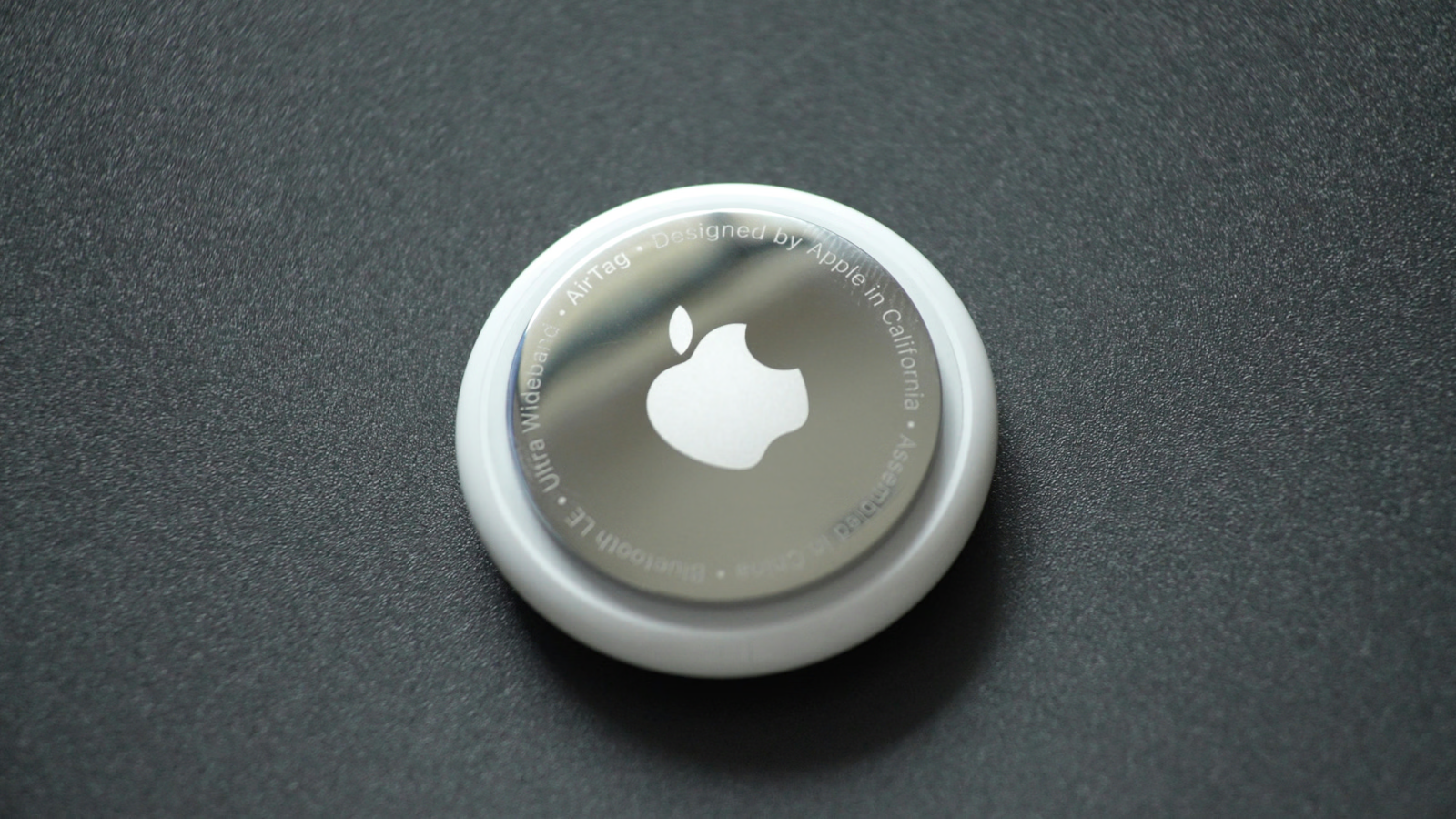
AirTag in checked luggage. The single best $29 you can spend before any international trip is an AirTag dropped in your checked bag. The Find My network (every iPhone in the world that's running Find My, anonymously) relays AirTag location to your phone. When the airline says "your bag is lost," you can pull up Find My and say "actually, it's at the connection airport on a baggage cart," and that conversation goes very differently. Travel writers and frequent flyers have been documenting AirTag-vs-airline stories for years. The mechanic works.
Find My iPhone for stolen-phone recovery. If your phone is taken in a market, on a beach, or out of your hotel room, Find My lets you remote-lock it, display a contact message on the lock screen, and (with location services on) see where it is in real time. The point isn't necessarily recovering the phone. It's protecting the data and not handing a thief open access to your iCloud, banking apps, and photos.
iCloud for travel documents. Save passport scans, vaccination records, hotel confirmations, rental car reservations, and any visa or entry documentation to a single iCloud folder before you leave. The Files app on iPhone lets you mark folders as "Make Available Offline" so they work without service. If your physical passport is stolen, the embassy appointment goes much faster when you have a digital scan ready. If your hotel reservation evaporates from the booking platform, the PDF in your iCloud folder is still there.
Apple Maps offline. Apple Maps added downloadable offline regions in iOS 17. Before flying, download maps for your destination city and any cities you'll transit. Turn-by-turn navigation, search for places, and saved Guides all work offline. The rental-car tutorial that ends with "and don't forget to download the maps before you leave Wi-Fi" exists for a reason; it has saved more traveler hours than any points strategy.
Apple Wallet for boarding passes. Most major airlines push boarding passes directly to Apple Wallet from their app. The Wallet pass auto-updates with gate changes and delays, displays on the lock screen at the right time, and works through the iPhone screen lock without requiring you to dig the app out at the gate. Three seconds of saved fumbling at the boarding scanner, multiplied across a trip's worth of segments, is real time saved.
Trip protection coverage when you tap Apple Pay
This is the under-discussed part of the Apple Pay story for points-card holders. The trip protection benefits (trip cancellation, trip interruption, trip delay, lost-bag, rental-car CDW) that come with premium travel cards (Sapphire Reserve, Sapphire Preferred, Amex Platinum, Venture X) trigger when the trip is paid for with the card. They trigger whether the card was swiped, dipped, keyed in, or tapped via Apple Pay. The token is tied to the underlying card; the protections follow the card.
What this means in practice: if you book a flight on a third-party site that doesn't store your card on file but does accept Apple Pay, the trip protection still applies. If you book a hotel with Apple Pay at a property that doesn't take Sapphire Reserve directly, the Reserve's protections still apply. If you rent a car with Apple Pay at a counter where you'd normally hand over the physical card, the rental car CDW (primary on the Reserve, primary on Venture X for international rentals) still applies.
The same logic extends to extended-warranty coverage on Apple devices themselves. Buy an iPhone or MacBook with the Sapphire Reserve via Apple Pay or otherwise, and the card's extended warranty extends the manufacturer warranty by an additional year. AppleCare+ is still worth considering for accidental damage coverage that no credit card matches, but the manufacturer warranty extension is free with the right card.
The general rule: Apple Pay does not break credit card protections. It changes how the transaction is presented at checkout; it does not change which card is paying or what comes with that card.
Putting it together: the Apple ecosystem points stack
The boring practical version of all of this is a simple four-card stack for an Apple-heavy household. As of April 2026:
The Sapphire Reserve or Sapphire Preferred sits in Apple Pay as the default for travel, dining out, and hotel bookings. That card earns the trip protections and the category multipliers. The Amex Gold (or Blue Cash Preferred for cash-back households) sits in physical wallet for supermarket runs, including the regular pass through the gift-card aisle for $300-500 in Apple gift card loads. The Apple Card stays in Apple Pay as the catch-all for small Apple purchases, household authorized-user cards, and zero-percent financing on big Apple hardware buys. A no-foreign-transaction-fee card (Sapphire Preferred, Venture X) sits in Apple Pay for international travel.
The annualized math for a household spending $2,000 across Apple's ecosystem and routing it through this stack rather than defaulting to the Apple Card: roughly 8,000-12,000 transferable points per year on the gift-card mechanic alone, plus the trip-protection backstop on every Apple Pay travel transaction, plus the device toolkit that keeps the trip itself working when something goes wrong. The Apple Card alone, on the same $2,000 in spend, returns $60 in Daily Cash. The stacked approach returns $120-180 in transferable-point value plus the protections plus the convenience.
Apple's ecosystem is genuinely good at being an ecosystem. It's just not designed to be a rewards engine. Build the rewards engine yourself, plug it into Apple Pay, and let Apple be Apple.
This article contains affiliate links. If you apply through our links, we may earn a commission at no cost to you, which helps us continue sharing points and miles strategies with the community.
Some of the links in this article are affiliate links. We may receive a small commission at no extra cost to you if you apply through these links. This helps us keep the site running and continue creating free content.