The news
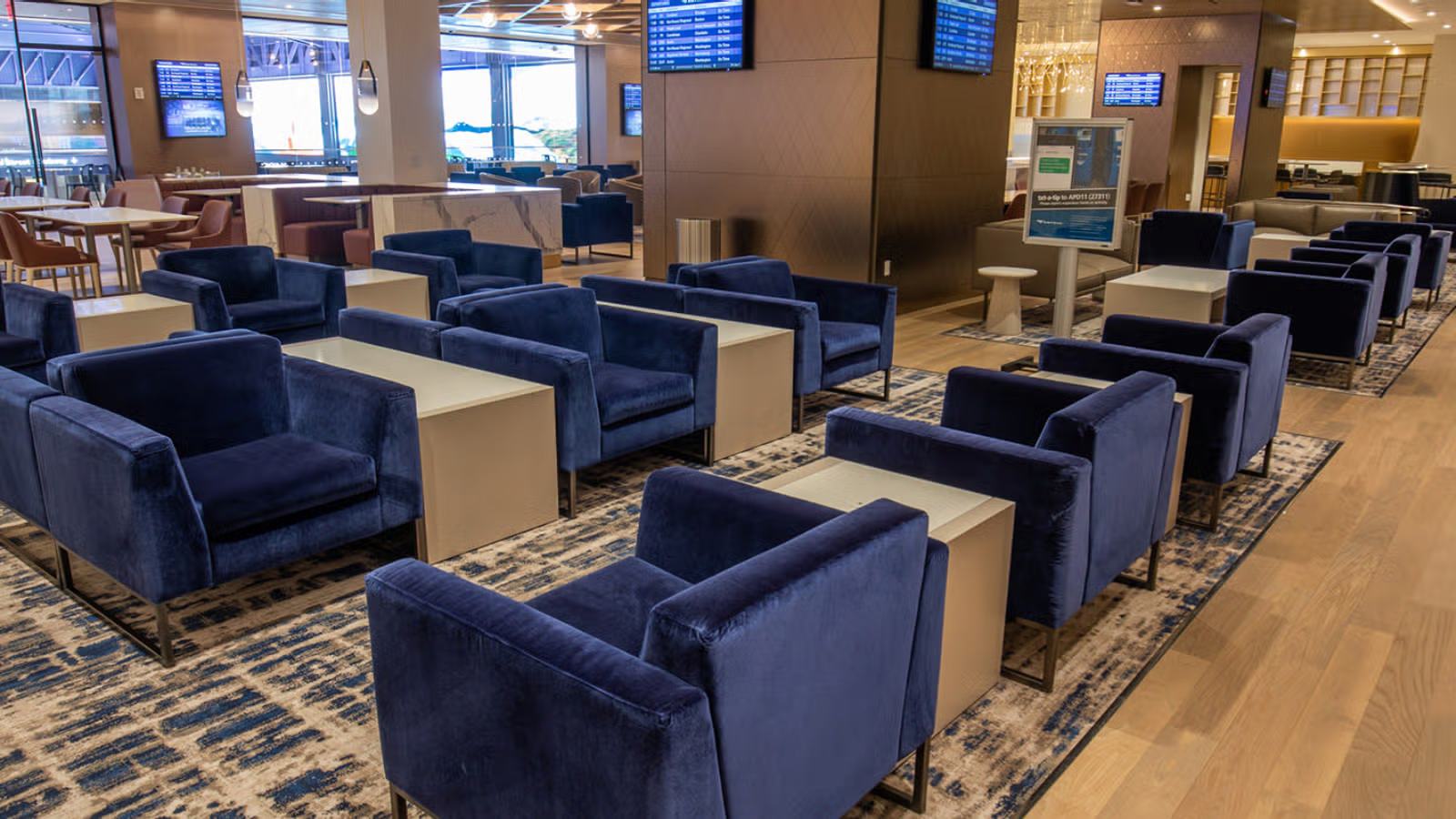
Ten months after launch, Amtrak's $35 Single Visit Pass has settled in as a fixture of the rail operator's premium-on-demand strategy. Introduced in mid-2025, the pass opened Metropolitan Lounge access to passengers on any class of service, including standard Coach, at ten flagship stations: New York Penn, Washington Union, Philadelphia 30th Street, Chicago Union, Boston South, Los Angeles Union, Portland, Seattle King Street, Pittsburgh, and St. Paul.
The structure has held steady. A $35 pass covers one visit for one passenger on the day of travel, with same-day ticket validation required at the door. Current stations and hours are listed on the official station lounges page.
What was pitched as a soft launch has become Amtrak's clearest signal that ancillary revenue, long an airline staple, now sits at the center of rail's profitability model.
What's changing
Two passenger groups feel the shift most directly.
Coach passengers. Before 2025, Metropolitan Lounge access required a Business Class ticket on Acela, a sleeper booking, Select Plus or Select Executive status, or an eligible Amtrak Guest Rewards Preferred Mastercard. Standard Coach travelers were locked out regardless of fare paid. The Single Visit Pass removed that wall for $35 per trip.
Points enthusiasts and casual travelers. The pass made lounge access transactional rather than status-based. A traveler with a four-hour layover at Chicago Union can now bypass the loyalty ladder. For the points community, that mirrors airline day passes and brings rail amenities into the same framework readers use for airport lounge etiquette and access programs like Priority Pass.
Background and context
Metropolitan Lounges have historically been Amtrak's quiet premium product. Originating as ClubAcela in the early 2000s and rebranded after 2018, they were gated to roughly the top 10% to 15% of Northeast Corridor passengers by ticket class or loyalty tier. The original purpose was retention for Acela commuters, not revenue.
Three structural pressures changed that calculus. Post-pandemic ridership recovery skewed toward leisure travelers who lacked the corporate patterns that built Select status. Amtrak's FY2024 disclosures showed ancillary revenue growing faster than ticket revenue across most product lines. And the airline industry's success monetizing lounge access through paid day passes (Delta's Sky Club guest pass, United Club one-time passes, the broader Priority Pass ecosystem) provided a tested playbook.
Applied to a captive station footprint with limited substitutes, that playbook has real pricing power. Unlike at an airport, an Amtrak station typically offers one lounge and a row of standard seating.
Expert analysis
The $35 price point is the most analytically interesting choice. It sits above an impulse buy and below a typical Coach-to-Business upgrade on the Northeast Corridor, which runs $30 to $80.
Three pricing observations from the first ten months:
The pass is anchored to upgrade economics, not amenity value. If Coach to Business on a Washington-to-New York Acela costs $50, a $35 lounge pass lets a passenger capture most of the Business Class ground experience (lounge, complimentary snacks, Wi-Fi, quiet seating) without the onboard upgrade. That deliberate gap pulls revenue from passengers who would not have upgraded at all, while keeping Business Class attractive to time-sensitive travelers.
Capacity controls remain unpublished. Amtrak has not disclosed daily caps, but staff at New York Penn and Chicago Union have reported that pass sales pause on peak holiday travel days. Standard yield management, and it preserves the experience for status holders.
Loyalty value has compressed, not collapsed. Select Plus and Select Executive members still get complimentary access, and the Amtrak Guest Rewards Preferred Mastercard's lounge benefit retains real value at roughly $1,800 per year for a frequent traveler. But the gap between a paid pass and a status visit is now mostly about predictability, not exclusivity.
What this means
Winners. Occasional Acela and long-distance travelers who hit one or two big-station lounges per year now have a clear price for a clear amenity. Layover passengers in Chicago, Washington, and New York gained the most, since those stations have the largest lounges and longest typical dwell times. Travelers using Amtrak's USA Rail Pass for multi-city itineraries can now build lounge access into their planning at predictable cost.
Losers. Select status holders lost the implicit scarcity that made the tier feel premium. The math still works for high-frequency commuters, but the perceived gap between status visits and a $35 monthly pass has narrowed. The Amtrak Guest Rewards Preferred Mastercard's lounge benefit took a small hit on positioning, though not on dollar value.
How to adapt your strategy
A practical framework after ten months of program data:
Under five lounge visits per year. Buy the pass as needed. The math doesn't support pursuing status or a co-brand card purely for lounge access at this volume.
Five to twenty visits per year. Run the comparison both ways. The Amtrak Guest Rewards Preferred Mastercard's annual fee plus its lounge benefit may still beat 20 paid passes once you factor in points earnings. Review Amtrak Guest Rewards redemption options before committing.
Twenty-plus visits per year. Status remains the strongest play, particularly Select Plus, which adds companion access and waitlist priority the pass doesn't replicate.
Layover-driven travelers. A three-plus-hour gap at New York Penn or Chicago Union is the clearest ROI case: workspace, food, quiet, and Wi-Fi for less than a sit-down restaurant meal nearby.
Related developments
The lounge program isn't operating in isolation. Amtrak's 2025-2026 commercial strategy includes the next-generation Acela high-speed trainsets, which entered full service rotation in late 2025 with expanded Business and First Class capacity. Lounge economics scale with Business Class fare adoption: every onboard upgrade is one less $35 pass sold, which is exactly the substitution Amtrak's pricing team modeled. The Borealis expansion between Chicago and St. Paul has also reshaped the lounge footprint, with St. Paul's facility seeing higher pass utilization than projected at launch.
Looking ahead
Three things to watch over the next twelve months:
Price increases. Airline day passes have crept from $50 to $79 over the past five years. A move to $39 or $45 by late 2026 would not be surprising and would still sit below most airline equivalents.
Network expansion. Amtrak operates additional lounges at smaller stations outside the Single Visit Pass program. Adding Baltimore, Sacramento, or Albany would extend the revenue model without major capital expense.
Subscription packaging. A multi-pass bundle (five visits for $150, ten for $275) has been signaled in investor presentations but not announced. That would reposition the co-brand card as a points-earning product rather than a lounge product.
Bottom line
Ten months in, the $35 Single Visit Pass looks less like an experiment and more like the first installment in Amtrak's shift to an airline-style ancillary revenue model. It added a clean option for Coach travelers, compressed mid-tier status value, and gave the points community a new line item to optimize. For most readers, the move is simple: buy the pass when the trip warrants it, run the status math honestly above twenty visits a year, and watch the next price update closely.
The Points Party may earn a commission when you apply for cards or book travel through our links, at no additional cost to you. Our editorial opinions are our own.
Some of the links in this article are affiliate links. We may receive a small commission at no extra cost to you if you apply through these links. This helps us keep the site running and continue creating free content.