
Key Points
- Apple AirTags remain the best luggage tracker for iPhone users in 2026, thanks to the Find My network's billion-plus device coverage.
- Best for Apple-ecosystem travelers who check bags on long-haul or connecting flights and want real-time location data the airline can also see.
- The biggest catch: setup and full functionality require an iPhone, and Android users should look at Galaxy SmartTag or Chipolo One Point instead.
TL;DR
As of April 2026, AirTags remain the default luggage tracker for iPhone users. $29 each, $99 for a 4-pack, accepted by most major airlines via Share Item Location. Skip if you're on Android.
Verdict
If you carry an iPhone and check bags more than twice a year, an AirTag is a $29 purchase that pays for itself the first time it tells you your suitcase is in Frankfurt while you're standing in Rome. The hardware hasn't changed since launch, but the ecosystem has. Share Item Location is now accepted by most major carriers, and the Find My network has scaled to over a billion devices. The verdict: buy. Apple-only is the main asterisk, and it's the only meaningful one.
What AirTags Are
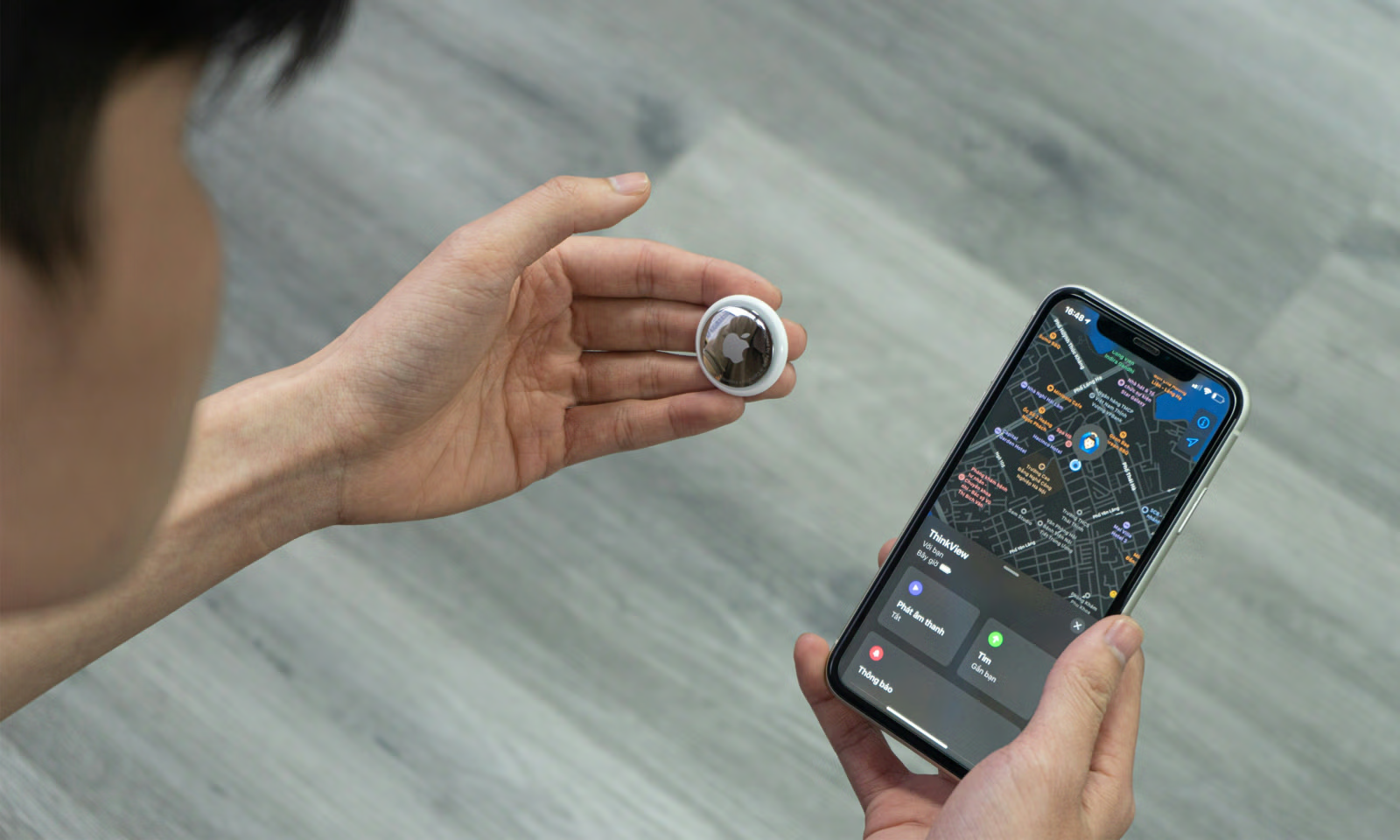
An AirTag is a coin-sized Bluetooth tracker that piggybacks on Apple's Find My network. You drop one in your suitcase, pair it with your iPhone, and any nearby Apple device (a phone, iPad, or Mac belonging to a stranger) anonymously relays its location back to you. You see the result on a map in the Find My app.
The network is the entire point. Apple says Find My now covers more than a billion active devices worldwide, which means in any major airport, hotel, or city, your bag is almost certainly within Bluetooth range of someone's iPhone every few minutes. That's why a tracker that has no GPS, no SIM card, and no monthly fee can still tell you, with surprising precision, that your luggage is sitting at gate B17 in Heathrow.
AirTags pair only with Apple IDs. There's no Android app, no web dashboard, no workaround. If you live in the iPhone ecosystem, this is mostly invisible. If you don't, it's a hard stop.
How They Work for Travel
The real-world use case is checked baggage. You drop your bag at the counter, watch it disappear down the belt, and from that moment until baggage claim, the AirTag updates whenever it pings a nearby iPhone. In airports, that's constant.
The 2024-2025 wave of "AirTag-found-my-bag" stories pushed airlines to formalize what travelers were already doing. Apple launched Share Item Location in December 2024, and the airline list grew through 2025. As of April 2026, Aer Lingus, Air Canada, Air New Zealand, Austrian, British Airways, Brussels Airlines, Delta, Eurowings, Iberia, KLM, Lufthansa, Qantas, Singapore, SWISS, Turkish, United, Virgin Atlantic, and Vueling all accept Share Item Location links as part of their delayed-baggage workflow. American is the notable holdout among the big U.S. carriers, though agents will often act on screenshots.
The mechanic is straightforward: file the delayed baggage report through the airline's app or website, generate a Share Item Location link in Find My, and paste it into the report. The airline agent sees the same map you do. Links expire after seven days and can be revoked at any time.
What this changes in practice: when a bag is delayed, you usually know where it is before the airline does. That shifts the conversation from "we'll investigate" to "it's at the carousel in your connecting airport, can you route it on the next flight?" Recovery times drop from days to hours.
The most common real-world scenario is the missed-connection bag. You make your tight transfer, your suitcase doesn't, and you land in your final city without it. Without an AirTag, you wait for the airline's tracing system to catch up, often 24 to 48 hours. With an AirTag, you can tell the agent the exact terminal and gate where the bag is sitting, which usually puts it on the next flight to you. The second-most common case is the misrouted bag that ends up in another city entirely. Same fix, faster path.
The Pros
Precision Finding. On any iPhone with a U1 or U2 chip (iPhone 11 and later), AirTags use ultra-wideband to give you directional arrows and distance to the bag once you're within Bluetooth range. This matters in baggage claim halls full of identical black roller bags.
Ecosystem coverage. No subscription, no extra app, no separate account. Find My is already on every iPhone, and the network effect is impossible for competitors to match.
Weatherproofing. IP67 means the AirTag survives rain, snow, and brief submersion. Cargo holds aren't friendly environments, and the AirTag is rated for them.
Pricing. $29 for a single AirTag, $99 for the 4-pack, no recurring cost. The CR2032 battery is replaceable and lasts about a year. Apple sells them, but so does every drugstore.
Airline integration. Share Item Location is a real workflow change. Most major airlines now treat the link as a legitimate input to their baggage tracing system.
The Cons
Apple-only setup. Pairing requires an iPhone. There's no Android equivalent, and there isn't going to be one. If your household is split, the iPhone user has to do the setup and own the tracking.
Battery is replaceable but not rechargeable. The CR2032 lasts roughly 12 months under normal use, less under heavy travel with frequent location updates. Find My warns you when it's low. Carry a spare battery if you're on a long trip somewhere remote.
Anti-stalking alerts cut both ways. AirTags will beep and notify nearby iPhones if they've been separated from their owner for an extended period. That's a useful privacy feature, and it's also why an AirTag isn't a great choice for tracking a rental car, a child's backpack on a school trip, or anything that travels without you for weeks at a time.
Bluetooth-and-relay, not GPS. When the bag is in a cargo hold mid-flight, in a remote rural area, or anywhere without a passing iPhone, you'll see "No location found." Updates resume once an Apple device comes within range. For most travel routes that's fine. For overlanding in Patagonia, it isn't.
Pricing and Where to Buy
As of April 2026, Apple's pricing is $29 for a single AirTag and $99 for a 4-pack, unchanged since launch. Confirm current pricing on apple.com before you buy, since this is a long-running product and Apple occasionally adjusts. Best Buy, Amazon, and Target carry them at the same MSRP, and aftermarket cases from Belkin, Spigen, and Catalyst run $10-20 if you want extra durability or a luggage-tag form factor.
The 4-pack is the obvious value play. One per checked bag, one for a carry-on, one for a wallet or camera bag. At $24.75 per AirTag, you've got a household tracking system for less than a single checked-bag fee on most international flights.
Alternatives
For Android users, the closest equivalent is the Samsung Galaxy SmartTag2, which uses Samsung's SmartThings Find network. The network is smaller than Find My but has grown meaningfully through 2025. Best for Galaxy phone owners.
Chipolo One Point and Pebblebee Tag both work with Google's Find My Device network, which Google launched in April 2024 and now covers Android devices broadly. Cross-platform, but the network is still less dense than Apple's.
Tile trackers were the original category leader. They still work, still require their own app, and now also relay through Amazon Sidewalk in some regions. Reasonable for households on mixed devices, but the network coverage gap versus Find My is real.
For travelers who genuinely need GPS rather than Bluetooth relay, products like the Knog Scout or cellular-based trackers from LandAirSea exist, but they require subscriptions and are overkill for luggage.
Who Should Buy
- iPhone users who check bags more than a couple of times a year
- Connecting-flight travelers, especially on transatlantic or transpacific routes where mishandled bags are most likely to go astray
- Frequent business travelers carrying gear they can't easily replace
- Anyone who's already had a bag delayed once and never wants to repeat the experience
Who Should Skip
- Android-only households, where the Galaxy SmartTag2 or a Chipolo One Point will serve you better
- Carry-on-only travelers who never let the bag out of sight
- Travelers who only need a key finder and already have a Tile they're happy with
Final Verdict
The AirTag is one of those rare Apple products where the answer is unambiguous: if you're already in the ecosystem, buy one (or four) before your next trip. The Share Item Location rollout has turned what used to be a peace-of-mind purchase into something that materially changes how airlines handle delayed bags. The hardware is durable, the price is low, and the network is uncatchable. The only honest reason to skip is if you're not on iPhone, in which case a Galaxy SmartTag2 or Chipolo One Point is the right answer instead.
This article contains affiliate links. If you apply through our links, we may earn a commission at no cost to you, which helps us continue sharing points and miles strategies with the community.
Some of the links in this article are affiliate links. We may receive a small commission at no extra cost to you if you apply through these links. This helps us keep the site running and continue creating free content.