A bottle of water for $6. A beer for $27. A wilted sandwich for $15. The pricing inside any major US terminal in April 2026 looks indefensible until you read the lease agreement, and then it starts to make a different kind of sense.
US travelers spent more than $1 billion on airport food and beverage in 2024, according to industry trade reports. The reason that number keeps climbing is not greed at the cash register. It is the rent structure on the storefront, the labor cost of the employee behind it, and the fact that every customer has already cleared TSA and cannot easily walk away.
How airport rent actually works
Airport concessions do not rent space the way a strip mall does. Vendors win locations through a Request for Proposal process, and the winning bid almost always commits to a Minimum Annual Guarantee plus a percentage of gross sales, whichever is higher. The percentage rent typically lands between 10 and 18 percent of revenue.
Portland International Airport's published concession terms call for a minimum of $80 per square foot a year or 10 to 18 percent of sales. Class A commercial space in downtown Portland averages closer to $30 per square foot. The airport tenant is paying more than double the going rate before turning on the espresso machine.
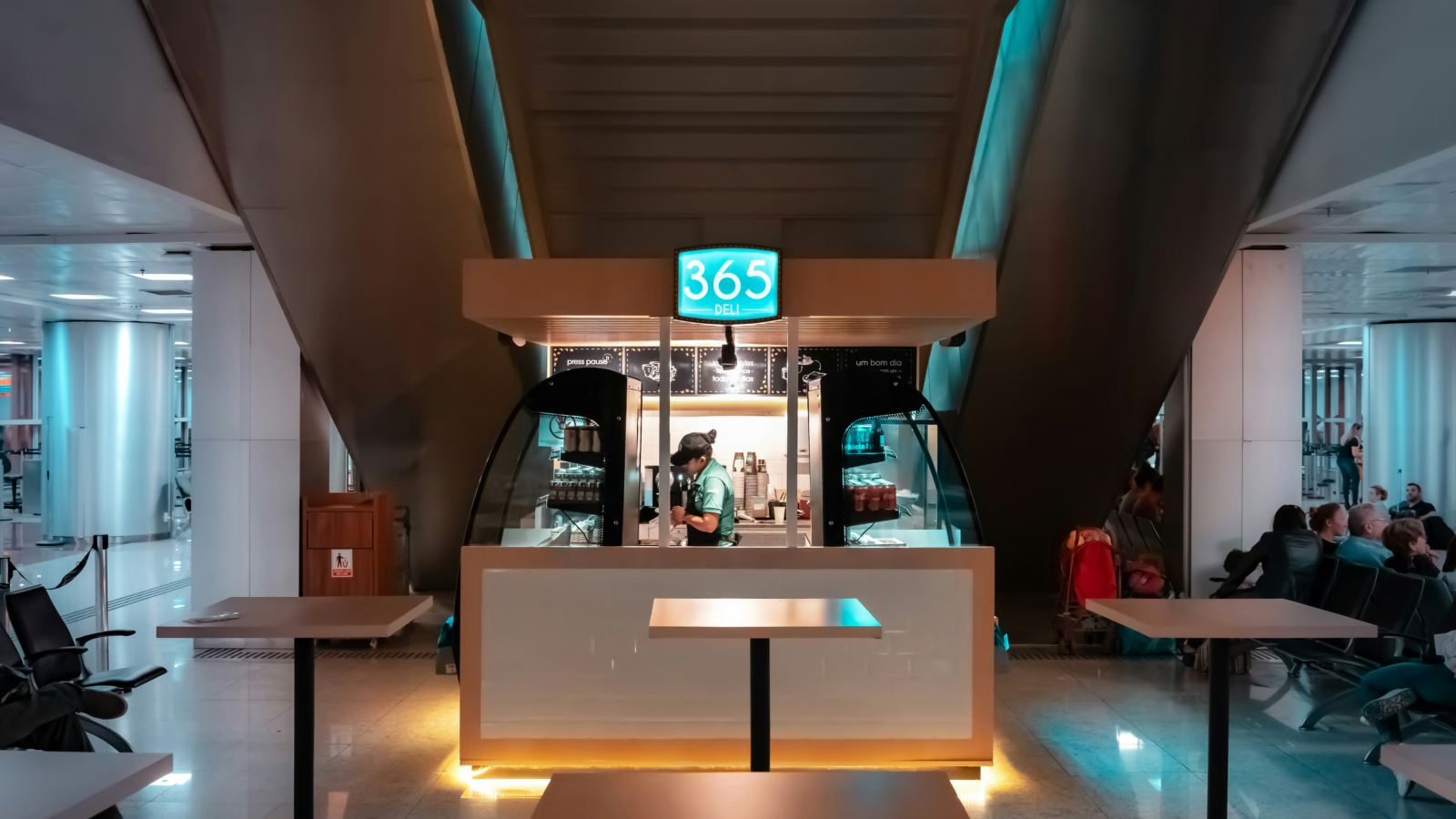
At JFK, a 175-square-foot kiosk runs around $2,700 a month at the floor. Scale that to a 1,000-square-foot sit-down restaurant and the rent line is roughly $15,000 a month, and that is before the percentage kicker. If the restaurant performs, the percentage rent overtakes the floor and the operator pays more.
Airports defend this structure because concession revenue funds terminal operations and capital projects. The Port Authority, the GSP, and every regional airport authority I have looked at treat food and beverage as a financing tool, not a service to passengers.
The costs you do not see on the receipt
Three operational lines push airport menus higher than street prices, even before margin.
Deliveries. Suppliers cannot pull up to a loading dock the way they would at a downtown cafe. Trucks need badged drivers, scheduled windows, and security screening on every pallet. Industry estimates put airport delivery surcharges at 15 to 20 percent above off-airport equivalents. The eggs in the breakfast sandwich cost the operator more before they hit the grill.
Storage. Back-of-house space at airports is rationed. Operators receive smaller, more frequent deliveries, which means smaller bulk discounts and higher per-unit cost.
Labor. Every employee needs a SIDA badge, recurring background checks, and daily security screening. Many airports charge employees $75 to $150 a month for staff parking. Turnover is high, training is constant, and a 2024 Airports Council International benchmarking report cited airport restaurant labor running 10 to 15 percent above comparable off-airport positions. SFO and a handful of other West Coast airports also mandate above-minimum living wages, which the operator passes through to the menu.
Street pricing rules exist, but with caveats
Several airports, including Dallas-Fort Worth, Chicago O'Hare, and Portland, require concessionaires to keep prices within a defined band of street pricing, typically 10 to 20 percent above what the same operator charges off-airport. The detail that gets lost is which street the comparison uses. A burger benchmarked against a Manhattan flagship is going to read very differently than the same burger benchmarked against a suburban location.
Some airports have rolled back their caps entirely in the past three years, arguing that without flexibility, quality operators bid elsewhere. Travelers feel the difference at the register.
What the numbers look like by airport
LaGuardia food and beverage runs roughly 30 percent above national averages, per industry trade pricing surveys. SFO regularly tops $20 a person for a sit-down meal, partly because of the airport's worker-protection rules. Indianapolis sits near the bottom of the major-airport range; lower regional rents and lower labor costs flow through to the menu.
The captive audience explains why competition does not close the gap. Each terminal hosts a deliberately limited number of operators. Once you are past security, the alternative to the $15 sandwich is no sandwich.
What this means for the traveler
The economics are not changing. The practical response is to plan around them.
Bring solid food through security. TSA permits it. Fill an empty bottle at a refill station after the checkpoint. Eat before driving to the airport when the timing works.
The bigger lever is lounge access. Premium travel cards bundle it as a benefit, and the food and drinks inside are part of the value, not an extra. The Chase Sapphire Reserve carries a $795 annual fee against a $300 travel credit and Priority Pass membership. The Capital One Venture X sits at $395 with a $300 travel credit and Capital One Lounge access plus Priority Pass. The American Express Platinum opens the Centurion network on top of Priority Pass.
For a family of four flying twice a year, a $100 terminal lunch run twice over wipes out a meaningful share of either Venture X or Platinum's effective annual cost. For a traveler flying monthly, lounge access is closer to a baseline than a luxury.
Airline status is the other path in. Delta Medallion, American AAdvantage elite, and United Premier tiers grant lounge entry under various rules. If a single carrier dominates your flying, status can carry the same load as a card.
The $27 beer at Newark in 2016 looked like price gouging. It was, more accurately, a lease line, a delivery surcharge, a labor premium, and a captive customer expressed in dollars. Knowing that does not make the beer cheaper. It does help decide whether to drink it, pack one, or step into a lounge instead.
This article contains affiliate links. If you apply through our links, we may earn a commission at no cost to you, which helps us continue sharing points and miles strategies with the community.
Some of the links in this article are affiliate links. We may receive a small commission at no extra cost to you if you apply through these links. This helps us keep the site running and continue creating free content.