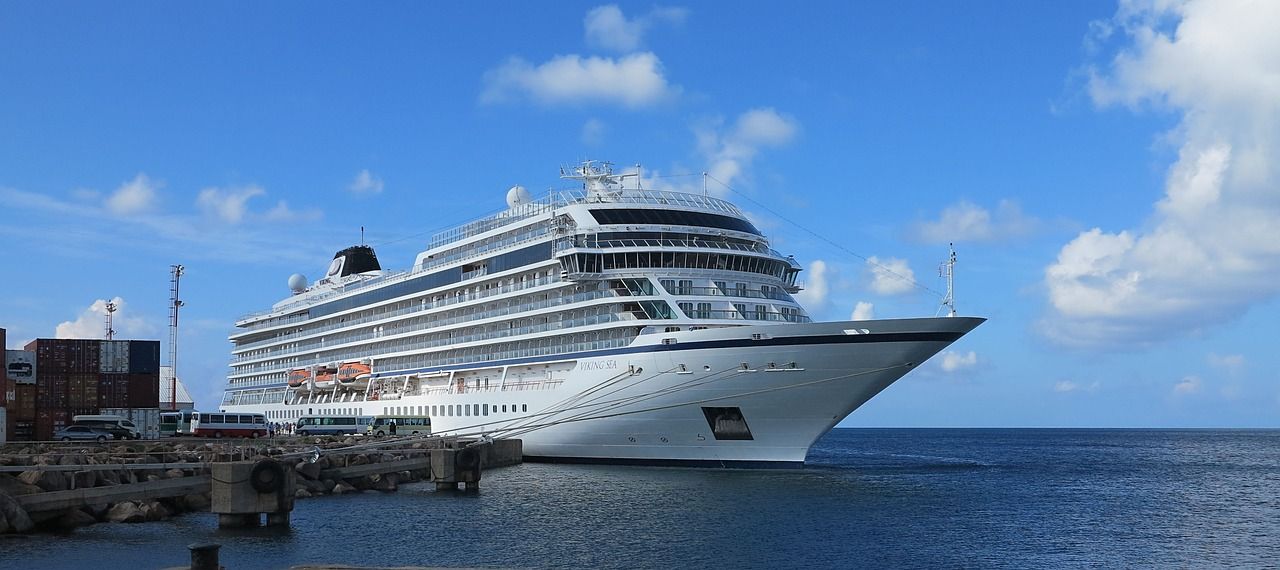
I'll say upfront what most cruise content won't: Viking is the best at what it does, but what it does isn't for most people. If you're 60+, educated, no kids in tow, and you want river or ocean cruising built around culture rather than waterslides, Viking is probably the best choice on the water in 2026. If you're anyone else (a family, a couple under 50, a Caribbean-and-rum-runner crowd, or someone hunting points-and-miles value), Viking is the wrong cruise line and you'll be unhappy on it.
This is also a cash-pay product, which trips up the points crowd. Viking isn't in Bonvoy, Hilton Honors, Hyatt, or any airline program. There's no Viking cobrand credit card. You can't transfer Chase or Amex points to Viking. The whole loyalty-and-transfer-partners playbook that works for hotels and flights doesn't apply here.
What does work: paying for Viking through Chase Travel, Amex Travel, or Capital One Travel and earning the portal multipliers. That's the only points play, and I'll show you the math on it below.
Let me walk through who Viking is for, what 2026 actually looks like on the ships, and how I'd approach a booking if I were doing one this year.
Quick answer
Viking is a premium, adults-only (18+), culture-focused cruise line with three product lines in 2026: ocean (26+ ships, ~930 passengers each), river (70+ ships across Europe, Egypt, Southeast Asia, and the Mississippi), and expedition (two ships, under 400 passengers, primarily Antarctica and the Great Lakes). Pricing runs roughly $3,000-$7,000 per person for an 8-12 day river cruise and $4,000-$10,000 per person for an 8-14 day ocean cruise, all-inclusive in the Viking sense (shore excursions, beer and wine at meals, WiFi, gratuities). It's the right call for older couples who want substance over spectacle. It's the wrong call for almost everyone else. There's no points transfer partner, so the only optimization is booking through a card portal: Chase Sapphire Reserve via Chase Travel earns 8x on the spend, which is the strongest play.
The brand positioning, honestly
Viking's tagline is "the thinking person's cruise." That's marketing, but it's also accurate. The brand was built by Torstein Hagen starting in 1997 and stayed privately held until the May 2024 IPO on the NYSE. Hagen made several decisions early that defined the product: no kids, no casinos on ocean ships, no charge-for-everything pricing model, and a deliberate cultural focus with lecturers, included excursions, and port-aligned dining.
The "no kids" thing is the most important filter. Viking enforces 18+ across the entire fleet. Not "we have an adult area." Not "kids welcome but it skews older." Eighteen and up, full stop. This single rule is what makes the demographic skew the way it does, and it's why the on-board atmosphere is what it is: quiet, conversational, no kids' clubs, no character breakfasts, no slide towers.
The cultural programming is real, not lip service. You get lectures from credentialed experts (historians, naturalists, regional specialists depending on the itinerary), classical performances, regionally aligned dining, and one included shore excursion per port. The included excursion is usually a guided walking tour or panoramic bus tour: solid, not bespoke, and good enough that you don't feel forced to upgrade.
Who should book Viking, and who shouldn't
Viking is the right line for you if:
- You're 55+ and your travel companions are too
- You want culture, history, and quiet evenings over deck parties and shows
- You're willing to spend $4,000-$10,000 per person for a high-quality, low-friction experience
- You like the idea of an included shore excursion at every port without negotiating for it
- You don't have kids with you, and you don't want other people's kids around
Viking is wrong for you if:
- You're cruising with kids (you literally can't; they're not allowed)
- You're under 50 and want any social energy on board past 10pm
- You want Caribbean beach-and-pool relaxation as the main event
- You want a giant ship with shows, casinos, and waterparks (Royal Caribbean, NCL, Carnival are your lines)
- You're trying to optimize for points-and-miles redemption (there's nothing to redeem against here)
I get asked frequently whether a 40-something couple "would have fun on Viking." Honest answer: probably not. The on-board energy is calibrated for the 60+ demographic, and you'll feel it. Not in a hostile way (Viking is one of the most uniformly polite cruise environments I've been on), but you'll be the youngest people in the dining room every night, and the social rhythm is built for an earlier bedtime.
River vs. ocean: the river product is the stronger value
If you take one thing from this article: Viking's river product is its strongest. The ocean ships are excellent, but at a $4,000-$10,000 per-person price point you're competing against Regent, Silversea, and a relaunched Crystal, all of which include more and feel more luxurious.
River cruising is different. The European river market is dominated by Viking, and they've optimized the product more than any competitor. You're sailing through Germany, Austria, France, Portugal, or Hungary on a vessel about 443 feet long, docking in town centers (not industrial ports), getting an included walking tour every morning, and back on board for dinner. The included shore excursions matter more here because the ports are the point.
Eight to twelve days, $3,000-$7,000 per person depending on season and itinerary, and the cost-per-port-experienced is significantly better than ocean. I'd put Viking's Rhine and Danube itineraries on a shortlist for anyone in the demographic.
The expedition product (two ships, Polaris and Octantis, both under 400 passengers) is genuinely interesting for Antarctica and the Great Lakes. It's a different value proposition: these are smaller, science-equipped ships with submarines and onboard labs, and the pricing reflects it. Worth a separate article.
The 2026 fleet
As of 2026, Viking operates:
- Ocean: 26+ ships in active service, all around 930 passengers, all with balcony cabins. Scandinavian neutral interiors, infinity pool aft, snow grotto and spa, no fitness center to speak of (the spa is the wellness focus).
- River: 70+ ships across the Danube, Rhine, Main, Seine, Dordogne, Rhône, Garonne, Douro, Elbe, Moselle, Nile, Mekong, and Mississippi. Smaller vessels, more intimate, closer to the destinations.
- Expedition: 2 ships (Polaris and Octantis), under 400 passengers, primarily Antarctica and Great Lakes routes.
Viking is no longer sailing Ukraine or Russia itineraries and hasn't since 2022. That removes some classic Volga and Dnieper routes from the catalog, possibly permanently.
What "all-inclusive" actually means at Viking
This is where Viking gets compared to Regent Seven Seas and loses on a literal reading. Viking's inclusions are real but bounded:
Included in your fare:
- One shore excursion per port (typically a guided walking or bus tour)
- Beer and wine at lunch and dinner
- WiFi
- Gratuities for shipboard staff
- All onboard dining (no per-restaurant upcharges at most venues)
- Port charges and government fees
Not included:
- Premium drinks package (Silver Spirits, around $25-30 per person per day)
- Specialty dining surcharges on certain ocean restaurants
- Spa treatments
- Optional/upgraded shore excursions (the bespoke or small-group versions)
- Air travel to/from the embarkation port (unless you book Viking Air)
- Pre/post-cruise hotels
Regent includes effectively all of the above (premium drinks, all excursions, air, hotel). That's why Regent costs roughly 1.5-2x what Viking does for a comparable itinerary. Whether that's worth it depends on how much the "extras" matter to you. For most travelers Viking's middle ground is the right tradeoff.
Pricing bands in 2026
Rough ranges, per person, double occupancy, before any returning-cruiser credits or promotions:
- River cruise, 8-12 days: $3,000-$7,000
- Ocean cruise, 8-14 days: $4,000-$10,000
- Expedition (Antarctica, 13-15 days): $9,000-$18,000
- Penthouse and Owner's suites: 2-3x the above
Add international air, pre/post hotels, and any premium upgrades, and a couple is realistically looking at $12,000-$25,000 for an ocean cruise vacation with shoulders. The river product comes in meaningfully cheaper and is, again, the better value.
The Viking Explorer Society
Viking's loyalty program is called the Explorer Society. You're auto-enrolled after your first cruise. Benefits in 2026:
- $200 per-person travel credit if you book your next Viking cruise within 1 year of your previous sailing
- $100 per-person credit if you book within 2 years
- Priority access to new itineraries before public release
- Member-only events and pre-cruise communication
- A subscription to the Viking magazine
This is a modest but real program. The $200 credit is per person, which on a couple is $400 toward your next booking. Not life-changing, but enough that if you know you're going to sail Viking again, it's worth staying inside the 1-year window.
What it isn't: a points program. There's no earn rate, no status tier ladder, no comp upgrades the way you'd see at Bonvoy or Hyatt. Viking's view is that the inclusive product is the loyalty benefit, and the program is a returning-guest credit, not a points system. That's a defensible position but it's not what the points-and-miles crowd is used to.
How to pay for Viking with credit card points
This is the part most points content gets wrong by ignoring it. Viking has no transfer partner, no cobrand, no direct point redemption. So the optimization isn't on the redemption side. It's on the earn side, by routing the payment through a card portal that earns bonus multipliers.
Three options worth considering:
Chase Sapphire Reserve, booking through Chase Travel: 8x Chase points per dollar. This is the strongest multiplier of the three. Viking is bookable through Chase Travel for most itineraries. On a $12,000 ocean cruise, that's 96,000 Chase points back, roughly $960 to $1,920 in transferable point value depending on how you redeem them later. The Sapphire Reserve carries a $795 annual fee in 2026, so this play makes more sense if you already hold the card.
American Express Platinum, booking through Amex Travel: 5x Membership Rewards per dollar. A $12,000 cruise nets 60,000 MR. Slightly weaker multiplier than Chase but Amex Travel sometimes has Viking promotions running.
Capital One Venture X, booking through Capital One Travel: 10x miles per dollar. Highest multiplier on paper, but Capital One miles are slightly less flexible than UR or MR, and Viking availability through Capital One Travel is sometimes patchier than Chase or Amex.
For most people the right play is: hold the Sapphire Reserve, book Viking through Chase Travel, stack the 8x with Viking's returning-cruiser credit if you're a repeat sailer, and don't try to optimize beyond that.
One trap to avoid: do not "pay with points" at the portal redemption rate of 1.0-1.5 cpp. Pay with the card, earn the 8x, and keep your points for transfer partner redemptions where they're worth 2+ cpp.
How Viking compares to the rest of the premium-plus cruise market
- Regent Seven Seas: more luxurious, similar demographic, includes effectively everything (premium drinks, all excursions, air, hotel). Roughly 1.5-2x the price for a comparable itinerary. If you want truly all-inclusive, Regent is the answer.
- Silversea: similar positioning to Regent, smaller ships, often more intimate. Royal Caribbean Group owned.
- Crystal: relaunched in 2023 under new ownership. Smaller fleet, more inclusive than Viking, less than Regent. Worth watching as it stabilizes.
- Oceania: the closest direct comparable to Viking on ocean. Premium-but-not-ultra-luxury, similar pricing, but allows kids. Different demographic mix.
- Azamara: smaller-ship, port-immersive, similar in spirit to Viking but more flexible age-wise. Stronger overnight-in-port programming.
If you want Viking's vibe but allow kids in your travel party, Oceania is the closest swap. If you want Viking's vibe at a more inclusive price point, Regent. If you want the smaller-ship version of Viking ocean, Silversea or Azamara.
Common mistakes people make booking Viking
-
Booking Viking expecting the Royal Caribbean atmosphere. This is the single biggest mismatch. If you want shows, slides, kids' clubs, and casino energy, you're on the wrong line. Viking is intentionally quiet.
-
Ignoring the credit card portal play. People reflexively book on Viking's site with whatever card is in their wallet. Booking the same cruise through Chase Travel with the Sapphire Reserve gives you 8x Chase points, which is free money for the same cruise.
-
Skipping the Viking Explorer Society $200 credit. If you've sailed Viking before in the last year, that's $200 per person off your next booking and most repeat sailers either forget or don't realize the credit is auto-applied when you book direct or through a portal.
-
Overbuying Silver Spirits. The premium drinks package adds up fast ($25-$30 per person per day). Most Viking demographics drink wine at meals, which is already included. Buy the package if you're a spirits drinker; skip it otherwise.
-
Booking ocean when river is the better fit. If you've never cruised Viking before and you want to experience the brand, the river product is the stronger value and a better introduction. Ocean is excellent but more expensive and less differentiated from the competition.
-
Booking Viking Air without comparing. Viking Air can be convenient but rarely beats direct booking with miles, especially if you have flexibility on dates and routing.
What I'd actually do
If I were booking Viking in 2026, here's the order of operations:
- Pick the right product first. If this is your first Viking, do a Rhine or Danube river cruise. 8-10 days, shoulder season (April-May or September-October), one of the standard itineraries.
- Open or use a Chase Sapphire Reserve. Confirm the cruise is bookable through Chase Travel before pulling the trigger.
- Book through Chase Travel. Pay with the Sapphire Reserve. Earn 8x UR on the full cruise spend.
- Stack the returning-cruiser credit if you've sailed Viking before in the last 12-24 months.
- Skip Silver Spirits unless you're a cocktail drinker. The included wine is fine.
- Take the included excursions and only upgrade if the small-group version is genuinely better. They usually aren't.
- Book your own air with miles. Viking Air is convenient but rarely the best use of your transferable points portfolio.
For most readers, that path captures essentially all the value Viking offers, with the maximum points-side optimization on top. The whole thing is a cash-pay product, but routing $12,000 of cash spend through 8x Chase Travel earnings turns into 96,000 Chase points back, and that's a legitimate play.
Viking does one thing extremely well. Just be sure you actually want that thing.
This article contains affiliate links. If you apply through our links, we may earn a commission at no cost to you, which helps us continue sharing points and miles strategies with the community.
Some of the links in this article are affiliate links. We may receive a small commission at no extra cost to you if you apply through these links. This helps us keep the site running and continue creating free content.