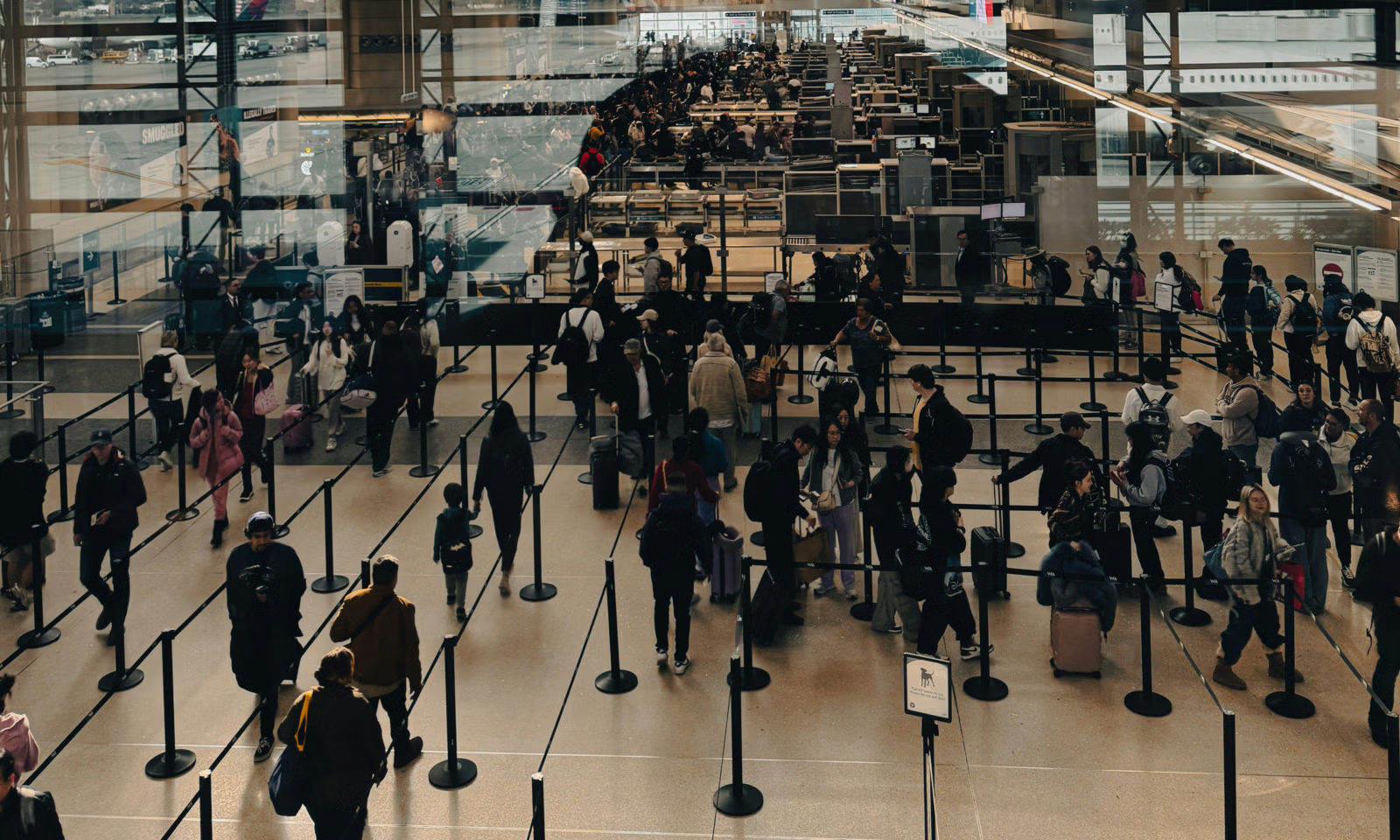
It has been about ten months since the Transportation Security Administration stopped asking most travelers to take their shoes off at the checkpoint, and the change has held up. As of mid-July 2025, standard screening lanes at U.S. airports operate the same way TSA PreCheck has for years: shoes stay on for the great majority of passengers. The shoe-bomber-era rule from 2006, which became one of the most-resented parts of domestic air travel, is effectively retired.
If you have flown anywhere in the U.S. since last summer, you have probably already experienced it. If you haven't flown in a while, here is what actually changed, what didn't, and what to expect the next time you queue up for security.
What TSA Actually Changed in July 2025
In early July 2025, TSA confirmed that travelers with REAL ID-compliant identification no longer need to remove their shoes during standard screening at U.S. airports. The agency framed it as a modernization step, citing newer scanning technology that can detect threats without making everyone walk barefoot across a checkpoint floor.
The change was originally surfaced by industry outlets, including One Mile At A Time, and was effectively confirmed when White House press secretary Karoline Leavitt amplified it in a post on X, tagging @DHSgov. In the weeks that followed, TSA updated screening procedures across the country, and the new approach has been the consistent on-the-ground experience for most travelers since.
In practical terms: if you have a REAL ID, an enhanced driver's license, or a U.S. passport book or card, you keep your shoes on in the standard lane.
Who Still Has to Take Their Shoes Off
The rule change is broad, but it is not universal. You should still expect to remove your shoes if any of the following applies:
- You do not have a REAL ID-compliant ID or other acceptable identification (an unmarked, non-compliant driver's license is the most common case).
- A TSA officer flags you for additional screening based on the scanner reading.
- You set off a secondary alarm at the body scanner or metal detector.
- The airport you are flying from has not fully rolled out the newer scanning equipment at every lane (this is rare in 2026 but does still happen at smaller airports).
- You are wearing footwear that obstructs the scanner, such as tall boots with metal shanks or heavy work boots.
If you are still using a non-compliant ID, the May 2025 REAL ID enforcement deadline has already passed. You will have a harder time at the checkpoint generally, not just on the shoe question, so updating your ID should be near the top of your to-do list.
Is TSA PreCheck Still Worth It in 2026?
This is the question that comes up most often now that shoes-on is the default. The short answer is yes, especially if you fly more than a couple of times a year.
PreCheck still gives you:
- A dedicated, typically much shorter line. Wait times in the PreCheck lane are usually under five minutes, even at busy hubs.
- Laptops and compliant liquids stay in your bag.
- No belt removal and no light-jacket removal.
- A more predictable experience across airports, which matters when you are running tight on a connection.
The application fee runs $78 for five years, which works out to about $15.60 a year. Many travel credit cards reimburse the PreCheck or Global Entry fee as a built-in benefit, so frequent travelers often end up paying nothing out of pocket. If you are weighing it for the first time, a premium travel rewards credit card will usually cover the cost.
For a more detailed comparison with the private-sector identity-verification service, our take on whether CLEAR membership is worth it walks through how the two stack up for different traveler profiles.
What You Can Still Expect at the Checkpoint
Shoes-on does not mean a free pass. Standard screening in 2026 still includes:
- An ID and boarding-pass check at the document podium.
- A walk through a body scanner (most airports) or metal detector (some smaller facilities).
- An X-ray check of your carry-on bag.
- Removing laptops and large electronics from your bag unless you are in a PreCheck lane or a lane with newer 3D CT scanners.
- Removing liquids in the standard lane if the airport has not yet upgraded to the newer scanners that let you leave them in your bag.
- A possible pat-down or bag search if anything flags during screening.
The checkpoint floor is also still the checkpoint floor. Even though you do not have to remove your shoes, you might want to wear something easy to slip off in case you draw a secondary screening, and socks remain a good idea.
How the Rollout Has Gone So Far
Ten months in, the change has been less chaotic than some travelers expected. A few patterns have emerged:
- Throughput in standard lanes has improved noticeably, especially during morning rush at major hubs.
- The gap between PreCheck and standard lanes has narrowed, but PreCheck still wins on the laptops-and-liquids piece and on line length.
- Enforcement has been consistent across major airports. Smaller regional airports occasionally lag on equipment upgrades, but the policy itself applies nationwide.
- Confusion has mostly been on the traveler side, not the TSA side. Some passengers still automatically start untying their shoes out of habit and have to be waved through.
Why This Matters Beyond the Shoes
The shoe rule existed because of a single 2001 incident, the failed attempt by Richard Reid to detonate explosives concealed in his footwear. Like the 3.4-ounce liquid limit and the laptop-out rule, it was a piece of post-9/11 security theater that long outlived its usefulness. The 2025 reversal is part of a slower, broader recalibration: TSA is moving toward screening that catches actual threats with better technology, rather than catching everyone with blanket inconvenience.
For travelers, the upshot is straightforward. Checkpoints in 2026 are faster than they were even a couple of years ago, especially for anyone with a REAL ID. Combined with PreCheck and, for some routes, CLEAR, the airport-arrival math has shifted. You do not need to pad your schedule the way you did in 2018.
Practical Checklist Before Your Next Flight
A quick run-through for your next trip:
- Confirm your ID is REAL ID-compliant. Look for the star in the upper corner of your driver's license, or use your U.S. passport.
- If you fly more than two or three times a year and don't already have PreCheck, apply. Check whether one of your existing credit cards covers the fee, including the Chase Ink business cards if you are a small business owner.
- Check live wait times at your airport before you leave. The TSA customer service page and the MyTSA app both work for this.
- Pack your liquids in a way that lets you pull them out quickly if your airport still uses the older scanners.
- Wear comfortable shoes you can still slip off easily if you get pulled for secondary screening.
Bottom Line
The shoe rule is gone for the great majority of U.S. travelers, and it has been gone long enough now to treat it as the new normal. Keep your REAL ID handy, hold on to PreCheck if you have it, and don't reflexively reach for your laces the next time you hit the checkpoint. The change is one of the most meaningful quality-of-life improvements domestic air travel has gotten in years, and it is finally something you can plan around with confidence.
The Points Party may earn a commission from affiliate links in this article. This does not affect our editorial recommendations.
Some of the links in this article are affiliate links. We may receive a small commission at no extra cost to you if you apply through these links. This helps us keep the site running and continue creating free content.