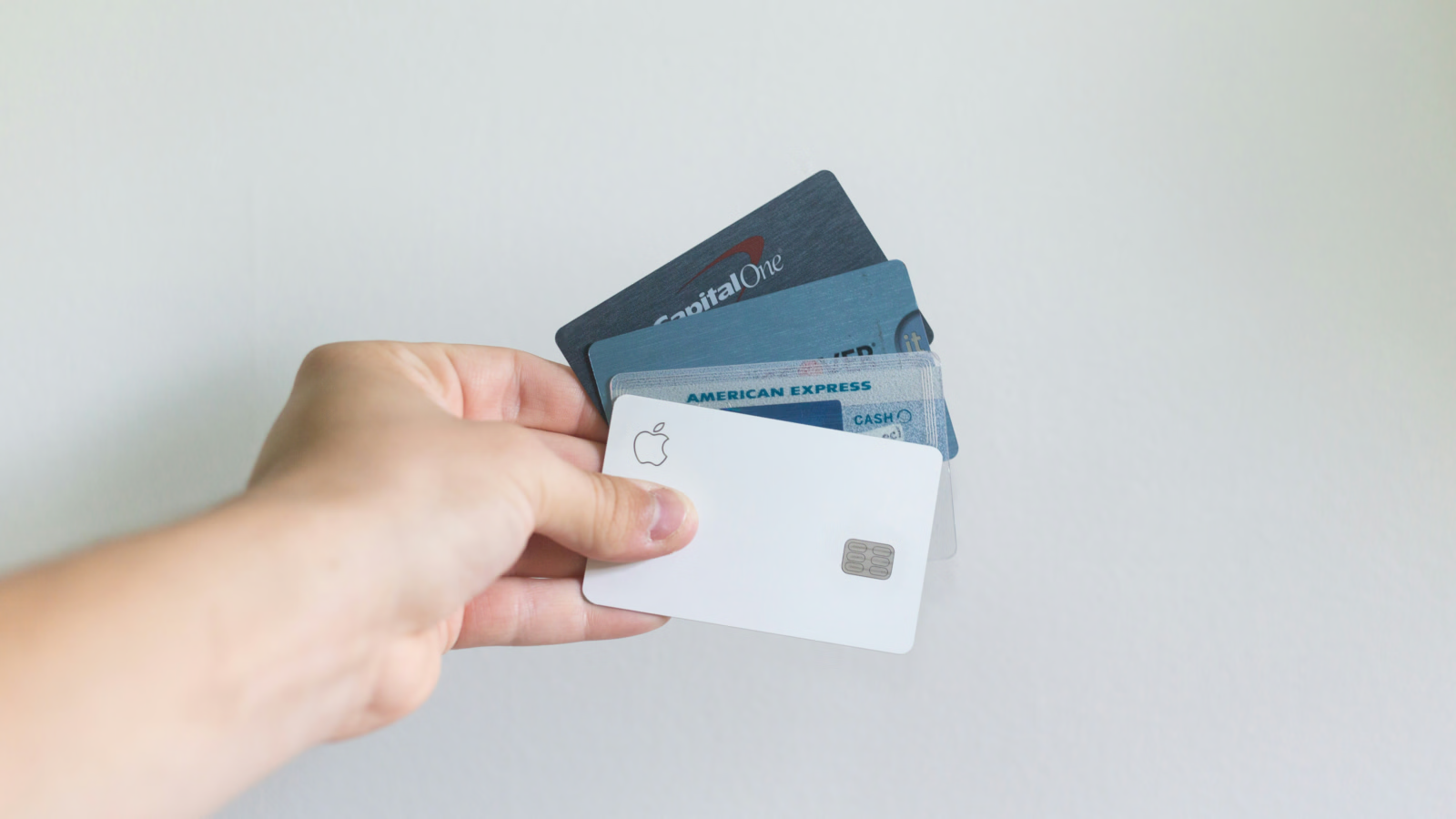
The premium credit card industry runs on a number nobody puts in the marketing. Not the annual fee. Not the welcome bonus. The hours.
I've spent a decade in the points game and I still sit down every January to figure out how much of last year's "$1,200 in credits" I actually used and how much I left on the table. The honest answer is always less than I thought. The reason is always the same: every credit on a premium card has a calendar attached to it, and every calendar costs you time. The big issuers know this. They price their benefits assuming you won't use most of them, and the math only works for them because we don't track what we're paying in attention.
Here is what the Time Tax actually looks like in April 2026, who's paying the most, and how to keep 80 percent of the value at 20 percent of the hours.
The quick verdict
The Amex Platinum at $895 demands the most management of any consumer card on the U.S. market. Realistically: 10 to 15 hours a year if you want to extract the credit stack Amex built into the refresh.
The Chase Sapphire Reserve at $795 is a step easier (8 to 10 hours a year) because more credits trigger automatically.
Below that tier, the Capital One Venture X at $395, the Chase Sapphire Preferred at $95, and the Citi Double Cash at $0 fall into 0.5 to 4 hours a year of total management. The drop-off is sharp, and the reason is structural: low-fee cards don't bury value in monthly micro-credits because they don't have to.
What the Time Tax actually is
The Time Tax is the cumulative hours you spend keeping a premium card profitable. It's not a metaphor. It's a real ledger you can write down.
The line items are familiar to anyone who carries a stack:
- Logging into card portals to enroll quarterly credits
- Remembering which card to use at which merchant for which credit
- Tracking expiration dates on credits that don't roll over
- Verifying credits posted correctly (and chasing the ones that didn't)
- Researching transfer-partner sweet spots before booking awards
- Re-reading benefit terms when the issuer "refreshes" the card mid-year
Each of those tasks is small. Five minutes here, fifteen minutes there. The damage compounds because most premium cards now run six to eight separate calendars in parallel. Miss the calendar and the credit zeros out. Issuers call this "breakage" in their investor decks. They build it into the unit economics.
What your time is actually worth
Before you can decide if a card pencils out, you need a defensible number for an hour of your time. The shortcut most people use is the income shortcut: annual income divided by 2,000 working hours.
If you earn $75,000, your time is worth $37.50 an hour. If you earn $150,000, it's $75 an hour. If you're self-employed and your billable rate is $200 an hour, the math gets ugly fast.
Run it on a card you already hold:
- Take your hourly rate from the income calculation.
- Track every hour you spend on credit-card management for one full month. Be honest. Include the time you spend reading r/CreditCards.
- Multiply by 12 to get an annual hours figure.
- Multiply your hourly rate by your annual hours.
- Subtract that number from the net benefits you actually used last year (not the marketing claim — the credits and points value you really extracted).
A $75-an-hour earner who spends 12 hours a year on the Platinum is paying $900 in time on top of the $895 fee. They need $1,795 in extracted value before the card breaks even. Anything less and they're funding Amex's marketing department for the privilege of keeping the card in their wallet.
The number that comes out of this exercise is almost always lower than the spreadsheet you ran when you applied. That's not because the cards are scams. It's because the spreadsheet assumed you'd use everything, and you don't.
The cards with the highest Time Tax
Three cards account for most of the time bleed in a typical premium stack.
American Express Platinum ($895 annual fee)
The 2026 refresh added five new credits and three enhancements, and it pushed the Platinum past every other consumer card in management complexity. To extract the headline value of roughly $3,500 in benefits, you have to track:
- A $300 monthly hotel credit that requires Amex Travel bookings (Fine Hotels & Resorts or The Hotel Collection)
- A $25 monthly Resy dining credit at participating U.S. restaurants
- A $75 quarterly Lululemon credit that doesn't roll over
- A $25 monthly digital entertainment credit across nine eligible services
- A $120 annual Uber One credit
- A $209 annual CLEAR Plus credit
- A $60 annual Oura membership credit
- Centurion lounge planning, Saks credits, and a Walmart+ subscription on top
Realistic time investment: 10 to 15 hours a year. The killers are the quarterly Lululemon credit (four reminders per year that you have to spend $75 in a category you may not normally shop) and the monthly Resy credit (zero forgiveness if you skip a month).
If your actual life involves a luxury hotel a quarter and Resy restaurants without thinking about it, this card returns the time. If it doesn't, you're funding the breakage line in Amex's earnings call.
Chase Sapphire Reserve ($795 annual fee)
Less management than the Platinum, but only because Chase made some credits automatic. The $300 travel credit applies against any travel charge until it's exhausted. That's the gold standard for a low-time-tax credit.
The complexity comes from the rest of the stack:
- Biannual Edit credits (six-month windows, hotel-portal-restricted)
- Monthly DoorDash credits if you've activated DashPass
- Priority Pass plus Chase's own Sapphire Lounge network, which means navigating two lounge programs
- Lyft credits and StubHub credits that come and go with each refresh
Realistic time investment: 8 to 10 hours a year. The Reserve gets credit for being more honest than the Platinum about how much management it asks for, and the automatic travel credit alone saves several hours a year compared to a portal-restricted equivalent.
Capital One Venture X ($395 annual fee)
The simplest of the premium tier. The $300 travel credit applies against Capital One Travel, the 10,000 anniversary miles drop in automatically, and the lounge access is generous without the multi-network complexity of Chase or Amex.
Realistic time investment: 4 to 6 hours a year, almost all of it spent figuring out whether to redeem miles through Capital One Travel at one cent each or transfer them to one of the airline partners for higher value. If you skip the transfer-partner research, you're at 2 hours a year flat.
This is the card that most premium-card shoppers should benchmark every other card against on the time-cost dimension.
The cards that barely cost an hour
You can run a respectable rewards stack on three cards that demand almost nothing.
Chase Sapphire Preferred ($95 annual fee)
The card I keep recommending for the same reason every quarter: it gets out of your way. 5x on Chase Travel, 3x on dining and select streaming, 2x on other travel, a $50 annual hotel credit through the portal, and access to the same Ultimate Rewards transfer partners as the Reserve. No quarterly activations, no monthly credits, no complicated calendars.
Realistic time investment: 2 to 3 hours a year, mostly when you decide to actually book an award redemption.
Citi Double Cash ($0 annual fee)
The set-and-forget card. 2 percent cash back on everything, no categories, no activation. If you want a card that delivers value while you sleep, this is the one.
Realistic time investment: 30 minutes a year. Maybe.
Bank of America Premium Rewards ($95 annual fee)
A $100 annual airline incidental credit, an annual TSA PreCheck/Global Entry credit, 2x on travel and dining, and the Preferred Rewards multiplier if you bank with BofA. Once you enroll once, the system runs.
Realistic time investment: 2 to 3 hours a year.
The pattern is obvious once you line them up: low-fee cards don't bury value in micro-credits because they don't need to. The breakage model only works at the premium tier.
How to cut management to 2-4 hours a year
If you carry premium cards and want most of the value without the time bleed, the structural fixes matter more than any individual hack.
Cap your stack at three cards. I've held four-card and five-card stacks. The marginal hour spent on the fourth and fifth card almost never returns the marginal credit value, especially after you account for overlap. If two of your cards both come with Priority Pass, one of them is doing nothing for you on lounges. Drop it or downgrade it.
Bias toward automatic credits. A $300 annual travel credit that triggers on any travel purchase (Sapphire Reserve, Venture X, BofA Premium Rewards) is worth more in real life than a $600 hotel credit that requires a portal booking, a six-month window, and a memory you don't have. When two cards offer similar headline value, pick the one with fewer activation steps.
Use one app to track everything. CardPointers (~$5/month) and MaxRewards (free with paid tier) are the two tools I've used. Both pull your active credits, remind you when they're about to expire, and tell you which card to use at which merchant. The cost is negligible compared to one missed monthly credit.
Set up subscription cycling. The digital entertainment credit on the Platinum is one of the easiest to harvest because most of us already pay for streaming. Park YouTube TV, Disney+, or the Wall Street Journal on the card and the credit triggers monthly without thought. The Uber One credit works the same way. The mistake is trying to harvest credits in categories you don't normally spend in.
Skip the credits that don't fit your life. This is the hardest one. If you don't shop Lululemon, the quarterly Lulu credit is not free money. It's a $75-a-quarter coupon for clothes you wouldn't have bought, in sizes you have to figure out, returned via a process you'll have to learn. The honest accounting is that it's worth $0 to you, not $75. Plan accordingly.
Pick a single primary, then assemble around it. The cleanest stack I've seen in practice is one premium card you genuinely use plus two no-fee or low-fee cards that fill specific gaps. The Sapphire Reserve plus a Citi Double Cash plus a category card (the Amex Gold or the Blue Cash Preferred) covers most spending patterns and runs at maybe 6 hours a year total.
Run those five fixes and the Time Tax on a typical premium stack drops from 15+ hours to 4 hours, with maybe 10 to 20 percent of the credit value left on the table. That's a trade most readers will make happily once they see the math.
When the Time Tax doesn't matter
Premium cards aren't always a bad deal even after the time math. Three readers can ignore most of this guide:
The first is the traveler who's already optimizing flights and hotels for fun. If you're in award charts on Sunday morning anyway, the marginal time on credit management is near zero. You're going to be there.
The second is the high-income professional whose time is too expensive to justify the calculation in either direction. If your hourly rate is $400 and you fly fifty times a year, the Centurion lounge access on the Platinum pays for itself on the lounge food and the missed-flight protection alone. The credits are gravy.
The third is the reader who books most of their travel through a single ecosystem (Amex Travel for hotels, Chase Travel for flights). The "portal-restricted" credits that look like a tax to a flexible traveler look like a discount to a portal-loyal one.
If you fit one of those three profiles, run the Amex Platinum, the Chase Sapphire Reserve, or both. The math works.
Bottom line
The credit-card industry quietly converted the premium tier from "card you pay for" to "card you also work for." The hours are the part nobody puts on the application page, and they're the part that decides whether a card actually makes you money or just feels like it should.
Run your numbers. If a card costs you 15 hours a year and your time is worth $75 an hour, you're paying $1,125 in time on top of the fee. Either the benefits clear that bar with room to spare, or the right card is one tier down.
For most readers, the answer is the Chase Sapphire Preferred. For the smaller group whose travel and lifestyle map onto the premium portfolios, the Capital One Venture X is the lowest-effort premium option, and the Chase Sapphire Reserve is the best of the high-effort ones. Pick on the Time Tax, not the headline credits, and you'll get the right card the first time.
This article contains affiliate links. If you apply through our links, we may earn a commission at no cost to you, which helps us continue sharing points and miles strategies with the community.
Some of the links in this article are affiliate links. We may receive a small commission at no extra cost to you if you apply through these links. This helps us keep the site running and continue creating free content.