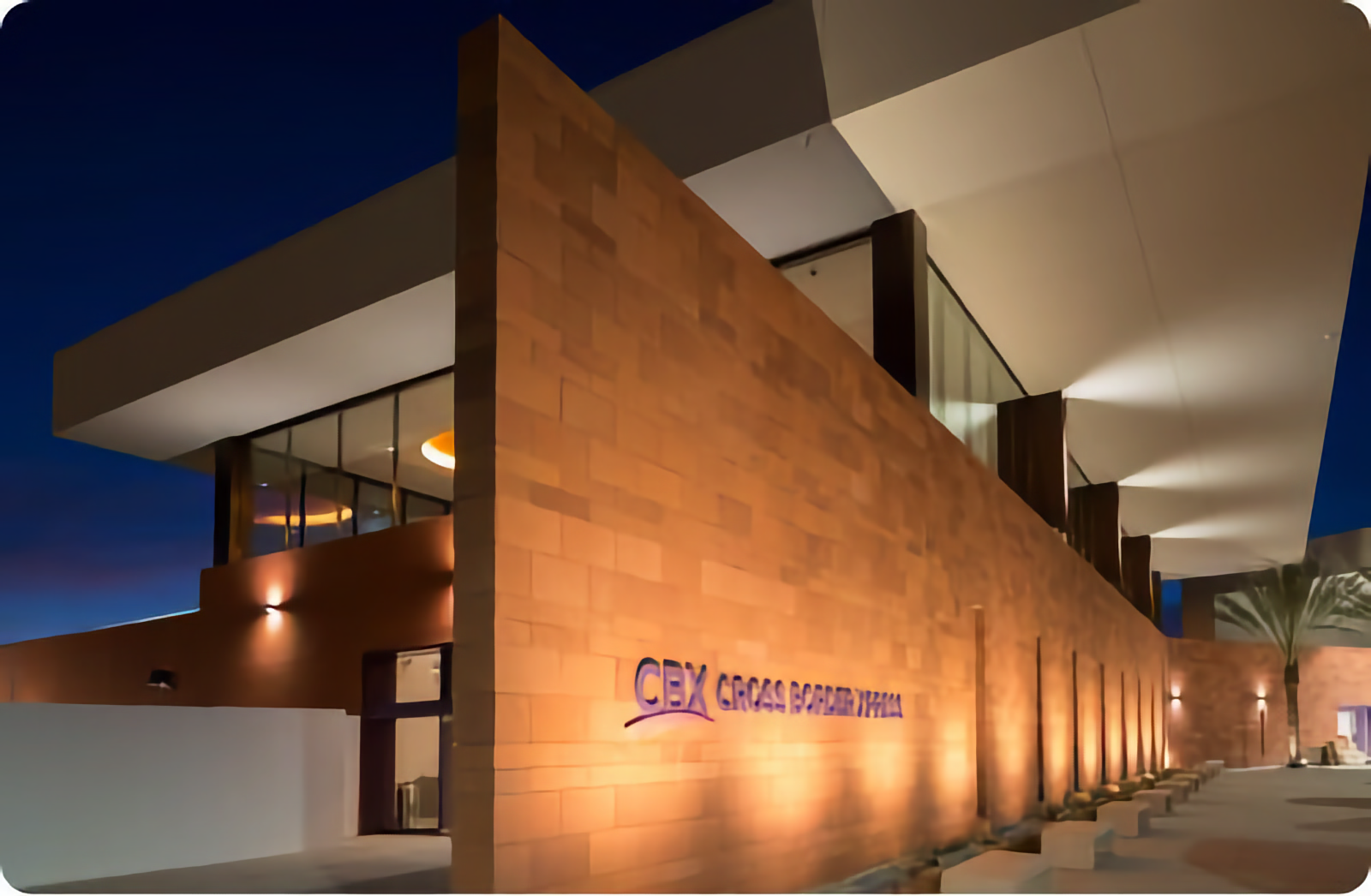
Here's a piece of Southern California travel infrastructure that most people in San Diego County still haven't used, and most people in Los Angeles County haven't even heard of. The Cross Border Xpress is a private pedestrian bridge that connects a US-side terminal in Otay Mesa directly into Tijuana International Airport. Five-to-seven-minute walk. US Customs and Mexican immigration are both housed on the bridge itself. No San Ysidro line. No three-hour wait at the Otay Mesa land crossing. You park, you walk, you're inside TIJ.
The reason this matters is that TIJ is a real hub. Volaris, Viva Aerobus, and Aeroméxico run nonstops from Tijuana to Mexico City, Cancún, Guadalajara, Monterrey, Oaxaca, Mérida, and a long list of beach destinations on both coasts. Fares from TIJ tend to run 40-70% cheaper than the same routes out of San Diego (SAN) or Los Angeles (LAX). For a San Diego County resident, CBX makes those fares accessible without the airport-grade border anxiety. For an Orange County or LA County resident willing to drive south, it can still beat the alternative on total trip cost, even after you add the gas, the parking, and the bridge ticket.
I want to walk through how the bridge actually works, what the fare math looks like on three real routes, and where the gotchas hide. By the end of this you should be able to decide whether CBX belongs in your toolkit or whether you're better off just flying out of SAN.
What CBX Actually Is
The Cross Border Xpress opened in December 2015 as a public-private project linking a parking-and-terminal complex on the Otay Mesa side of the border in San Diego with the existing TIJ terminal on the Mexican side. The bridge itself is enclosed, climate-controlled, and ticketed. You can only cross it if you're flying in or out of TIJ within a defined window: typically 24 hours before a TIJ departure, or within 2 hours of a TIJ arrival.
The structural advantage is that immigration and customs for both countries are processed on the bridge or at the terminal endpoints. Going south, you hand your CBX ticket and passport to Mexican immigration in the middle of the walk. Going north, you clear US Customs and Border Protection right after stepping off the bridge into the San Diego terminal. There's no separate land-border stop. No San Ysidro queue full of commuters.
Operating hours run roughly 4:00 a.m. to 11:00 p.m. on most days, with adjustments around major holidays. That window matters. If your flight lands at TIJ at 12:30 a.m., you cannot use CBX to get home. You'll need to clear a regular land border crossing in Tijuana, which is exactly the experience the bridge exists to avoid.
Why TIJ Is Worth Flying Out Of
Tijuana International is the third-busiest airport in Mexico by passenger traffic, behind only Mexico City and Cancún. It's the Pacific-coast hub for Volaris and Viva Aerobus, the two largest Mexican ultra-low-cost carriers, and a significant Aeroméxico station. The route map looks something like this if you're flying domestically inside Mexico:
- Mexico City (MEX), Toluca (TLC), and Querétaro (QRO) on the central plateau
- Cancún (CUN), Mérida (MID), and Cozumel (CZM) in the Yucatán
- Guadalajara (GDL), Puerto Vallarta (PVR), and Morelia (MLM) in the western states
- Monterrey (MTY), Aguascalientes (AGU), and San Luis Potosí (SLP) in the north
- Oaxaca (OAX) and Tuxtla Gutiérrez (TGZ) in the south
What you're getting is direct access to roughly thirty-plus Mexican cities from a terminal twenty minutes from downtown San Diego, on a carrier mix that competes hard on price.
Here's the fare-math part. Tulum and Cancún round-trips from TIJ in shoulder season frequently sit in the $180-$250 range on Volaris or Viva Aerobus. The same dates from SAN, usually one-stop through MEX or Guadalajara, run $450-$700. Mexico City weekend trips run $150-$200 from TIJ on Volaris versus $380-$500 from SAN on Aeroméxico or Alaska. Even Oaxaca, a notoriously expensive city to reach from the US, has been showing up around $220 round-trip from TIJ when SAN routings are landing closer to $600.
You don't get this on every search. Volaris and Viva Aerobus run flash sales and the price spread compresses on peak travel weeks. But the structural gap is wide enough that for any trip with even moderate flexibility, checking the TIJ fare alongside your SAN search is worth two extra minutes.
Booking the Bridge Ticket
CBX tickets are sold per direction. As of May 2026, the one-way base ticket runs around $25 per passenger for a same-day adult crossing, with round-trip pricing typically discounted versus two one-ways. Family packages and group rates exist for parties of three or more. Pricing fluctuates with demand and season, so confirm the current rate on the CBX site before booking.
The smarter play is to bundle the ticket with your flight. Volaris and Aeroméxico both sell CBX-inclusive fares directly through their booking flows, and those bundles often price below the sum of buying the bridge ticket and the flight separately. Viva Aerobus does the same on select itineraries. When you see a "TIJ + CBX" combo on an airline site, click through and compare. It's not always cheaper, but when it is, the discount can be meaningful.
If you're stacking points, most premium travel cards book Volaris, Viva Aerobus, and Aeroméxico through their portals at standard 1-cent-per-point redemption. Chase Sapphire Reserve, Capital One Venture X, and Amex Platinum all surface TIJ fares in their portals. The bridge ticket itself is generally a separate purchase that codes as travel and earns travel-category multipliers, which is a small but real bonus on top.
The Parking Lot Situation
CBX operates a large parking facility immediately adjacent to the US-side terminal. Rates as of mid-2026 run roughly $20 per day for standard parking, with multi-day discounts that bring longer stays down to closer to $15 per day. Valet, covered, and reserved spaces are available at higher rates. You can reserve in advance through the CBX site or app, which is genuinely worth doing during Mexican holiday periods when the lot fills up.
Major rental car returns also live at the CBX lot, which closes one of the obvious loops. Fly into SAN, pick up a rental at the airport, drive south to the CBX lot, drop the rental, walk across the bridge, fly out of TIJ. That's a routing that occasionally beats every other option for visitors who don't live in San Diego County.
The Time Math
This is the part where CBX either wins or loses, depending on where you live.
If you're in San Diego County, the drive to the CBX lot is typically 20-40 minutes. Add 5-7 minutes to walk the bridge, 5-15 minutes for Mexican immigration, and another 5-10 minutes to walk to your gate inside TIJ. Total door-to-gate: roughly 60-90 minutes. That is competitive with, and often faster than, flying out of SAN.
For Orange County, the drive is typically 90-120 minutes without traffic, 2-3 hours with. The total door-to-gate range becomes 2-4 hours. CBX still beats the regular San Ysidro or Otay Mesa land crossings (which can stack another 1-3 hours of wait on top), but you're now in the same range as a flight out of SAN or LAX after factoring in the security line and gate walk.
For LA County, you're looking at 2.5-4 hours of driving in normal traffic, longer in rush hour. CBX becomes a niche play here, viable when fare savings are large enough to justify the drive, or when you're already heading south for other reasons.
The rule of thumb that works: CBX is a slam dunk for San Diego County, a math problem for Orange County, and a special-case tool for LA County.
Real-World Use Cases
Tulum or Cancún beach trip from San Diego. Volaris flies TIJ-CUN multiple times daily. Round-trip fares in shoulder season frequently land at $200-$280 including taxes. Same trip from SAN with a one-stop routing usually starts at $500. Net savings after a $25 CBX one-way each direction: around $250 per traveler. On a family of four, that's a thousand dollars before you've booked the hotel.
Mexico City foodie weekend. TIJ-MEX nonstops on Volaris or Aeroméxico run $150-$220 round-trip. SAN-MEX through Aeroméxico or Alaska usually hits $380 and up. CBX adds $50 round-trip. Net savings around $180 per person, plus you skip the connection.
Family visit to Guadalajara, Monterrey, or Oaxaca. These are the routes where TIJ shines hardest. Secondary cities that the US carriers either don't fly or price aggressively. A round-trip to GDL from TIJ on Volaris can run $140; from SAN it's typically $350-$450. The CBX-inclusive bundle on Volaris often prices the bridge ticket in at minimal upcharge, which kills the apples-to-apples math on whether the bridge is "worth it." At that point it's just part of the fare.
The Honest Gotchas
This is where I want to be specific, because every blog post about CBX glosses over the friction.
First, the bridge is pedestrian-only. You carry your own checked bag from the US-side curb to the airline check-in counter inside TIJ. There are luggage carts, but you're moving your bags physically across the bridge. If you're traveling with three suitcases and a stroller, the experience is workable but not pleasant.
Second, the operating hours cut off your late-night and red-eye options. If your flight lands at TIJ at 11:30 p.m. or later, the bridge will likely be closed by the time you clear baggage. You'll need to take a taxi or rideshare to the regular land border crossing in central Tijuana, which is the exact friction point CBX is designed to bypass. Check the inbound flight's scheduled arrival against the bridge's posted closing time before you book.
Third, the bridge requires valid travel documentation for both countries. A US passport book or passport card works going south. Mexican citizens and dual nationals need the right combination of documents going in each direction. A regular US driver's license is not sufficient, and this catches a meaningful number of first-time users off guard.
Fourth, for foreign passport holders staying in the US for longer than 30 days or traveling more than 25 miles from the border, the provisional I-94 process applies and needs to be completed before crossing. Check CBP's current rules if this applies to you.
Fifth, the LA-to-Otay-Mesa drive in Friday-afternoon traffic can stretch to four hours. Build in real buffer if you're driving down from north of San Diego. Missing a flight because the 5 freeway parked you in San Clemente is a recoverable problem but an avoidable one.
When CBX Wins, When It Doesn't
CBX wins when you live within reasonable driving distance, you're booking secondary Mexican destinations that the US carriers price aggressively, and you have at least one checked bag's worth of patience for the walk. The bridge ticket is a small line item against the fare savings TIJ delivers on Volaris, Viva Aerobus, and Aeroméxico routes.
CBX loses when you're flying to a destination the US carriers route cheaply (Cabo from LAX, for instance, sometimes prices below the TIJ alternative once you include the bridge), when your only flight options at TIJ are late-night arrivals that hit after the bridge closes, or when you're traveling with so much luggage that the pedestrian walk becomes its own problem.
If you live in San Diego County and you've never used CBX, here's my actual recommendation. Next time you're planning a trip anywhere in Mexico, pull up the TIJ fare alongside the SAN fare. Spend two minutes on Volaris and Aeroméxico instead of jumping straight to Google Flights. The first time the gap is $200 per person, you'll get why this bridge has its own quiet cult following among Southern California travelers, and why it might be the most useful $25 you spend on your next vacation.
This article contains affiliate links. If you apply through our links, we may earn a commission at no cost to you, which helps us continue sharing points and miles strategies with the community.
Some of the links in this article are affiliate links. We may receive a small commission at no extra cost to you if you apply through these links. This helps us keep the site running and continue creating free content.