Spring break booking has a rhythm. Awards space opens in waves, school calendars cluster demand into the same three weeks every year, and the destinations that look impossible in early March are usually the same ones that had wide-open saver inventory the prior November. The hard part isn't finding award space. It's deciding where to point your points before someone else does.
This piece pulls together a destination-by-destination playbook for spring break travel using points and miles. The 2026 cycle is the most recent reference, but the booking patterns repeat. The right question isn't "where should I go for spring break?" It's "which destination matches the point currencies I'm sitting on, and what's the booking window for that specific combination?"
The answer changes the trip from a $4,000 cash expense to a 100,000-point redemption with a $200 cash co-pay for taxes and resort fees.
Understanding spring break award availability
Spring break is unusual in the award calendar because it isn't one peak — it's a rolling three-week peak that follows university and K-12 school schedules. Texas spring break clusters around the second week of March. Most public school systems on the East Coast fall the third week. Colleges spread across all three. The result: any given Caribbean property sees four or five separate demand spikes back-to-back.
Programs respond predictably. Hyatt holds award rates because the chart is published. Marriott Bonvoy reprices dynamically and shows the biggest jumps between mid-February and late March. Hilton Honors floats with cash rates and often makes spring break properties uneconomical at standard redemption values. Airlines treat the second half of March as peak for most domestic-to-Caribbean routes.
The booking window that consistently works: November through mid-January for saver flight space, and immediately when a destination announces its spring schedule for hotels. Waiting until February to start searching means working with leftovers.
Cancun and Riviera Maya: the Hyatt Ziva and Zilara sweet spots
The single best spring break redemption for families is World of Hyatt at the Inclusive Collection properties. Hyatt Ziva Cancun, Hyatt Ziva Riviera Cancun, and Hyatt Zilara Cancun all book at 25,000 points per night for two adults, with food, drinks, and most activities included. Two kids under 12 stay free with paying adults in the same room.
The math: a five-night stay runs 125,000 points. Cash rates in mid-March on those properties regularly hit $700 to $900 per night including taxes and resort fees, so the redemption returns 3.5 to 4 cents per point. That's well above the 1.7-cent baseline Hyatt typically delivers.
How to get there: Chase Ultimate Rewards transfers to Hyatt at 1:1. A Chase Sapphire Preferred welcome bonus of 60,000 points plus organic spend gets a couple most of the way to a five-night Ziva stay. Two cards across a household, plus existing balances, comfortably cover the trip.
Booking timing for the Inclusive Collection properties: rates load 13 months in advance, and Category 4 inventory for spring break sells out by mid-November the year before. If you missed the November window, Hyatt Ziva Los Cabos and Hyatt Ziva Puerto Vallarta hold availability longer because they're less searched.
Airfare in: AAdvantage classifies the second half of March as off-peak for Mexico, which keeps Cancun saver awards at 17,500 miles one-way from most East Coast and Texas hubs. Bilt transfers to AAdvantage at 1:1, the simplest path for readers without an American co-brand card.
Miami and South Beach: hotels are the bottleneck
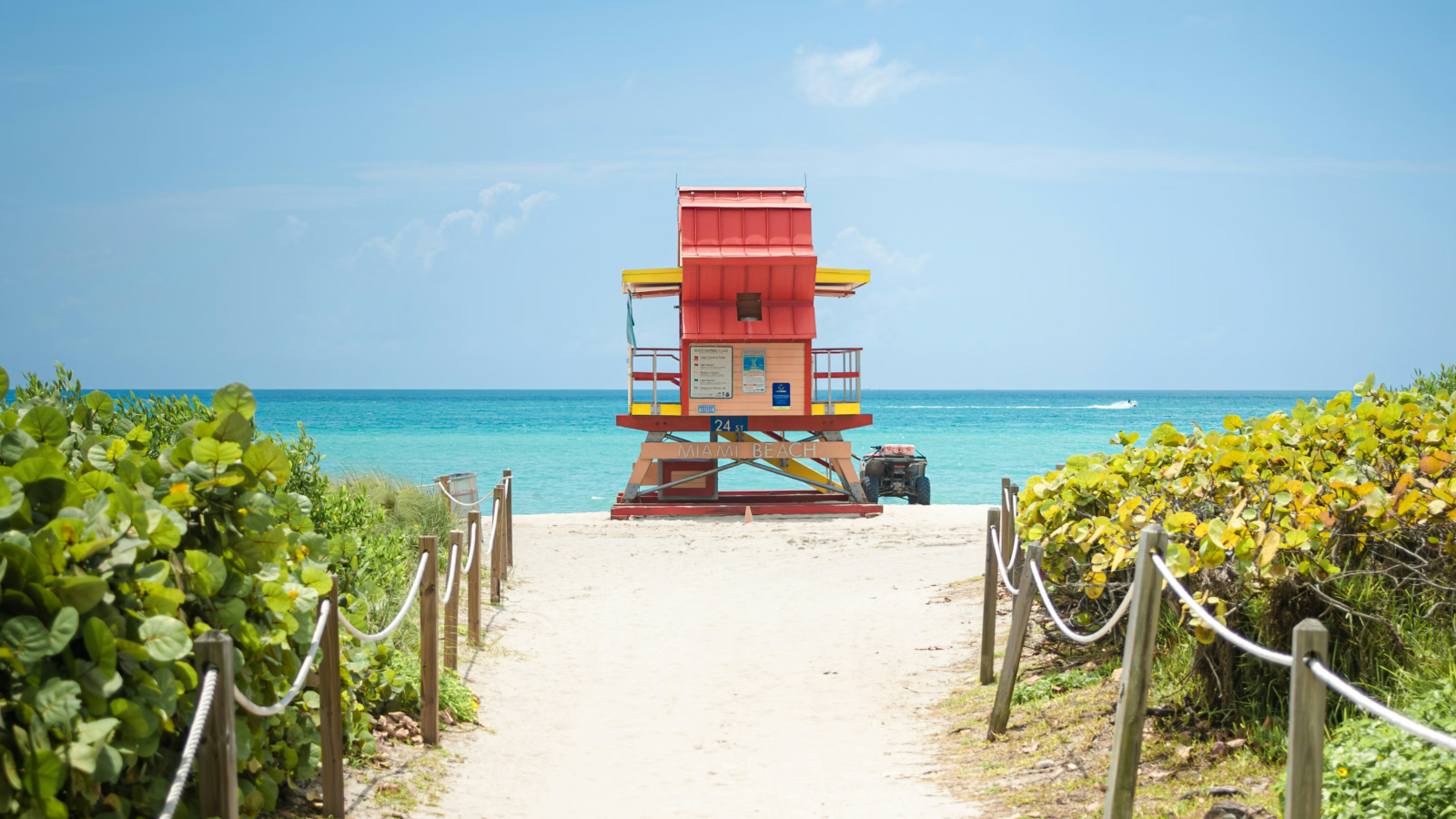
Miami is the rare spring break destination where flights are easy and hotels are the constraint. Delta, American, JetBlue, and Spirit all run heavy spring schedules into MIA and FLL, so SkyMiles, AAdvantage, and JetBlue TrueBlue saver space opens regularly in 7,500 to 12,500 mile one-way ranges from the Northeast.
The hotel side is harder. Marriott Bonvoy beachfront properties in South Beach (The Setai, W South Beach, JW Marriott Miami Turnberry) price at 80,000 to 110,000 points per night during peak weeks. The fifth night free benefit on all-points stays drops the effective rate to 64,000 to 88,000 per night across five nights, which gets the redemption value above 1.2 cents per point on most properties.
The stronger play is staying in Brickell or downtown rather than directly on South Beach. The Marriott Marquis Miami runs 50,000 to 70,000 points in peak weeks, and the rideshare to South Beach costs $20 to $30 each way. For five nights, that math beats staying on the sand by 100,000+ Marriott points.
Card pairing: the Marriott Bonvoy Brilliant earns 6x at Marriott properties and provides a 50,000-point annual award night certificate that covers off-peak Category 5 stays. The Marriott Bonvoy Boundless is the lower-fee alternative with a 35,000-point certificate that works at Category 4 properties.
Austin: shoulder dates beat South by Southwest
Austin during SXSW (the second week of March most years) prices like Manhattan during New Year's Eve. Hotels that run $200 per night in February clear $700 to $900 during the festival, and points redemptions follow.
The strategy is to skip SXSW week and book the third week of March or first week of April. The Driskill, JW Marriott Austin, and W Austin all drop back to 50,000 to 70,000 Marriott points per night once the festival ends. Cash rates fall by half. Restaurants take reservations again.
For SXSW itself, the workable plays are: 1) book a Hyatt House or Hyatt Place in the suburbs at 12,000 to 20,000 points per night and rideshare in, 2) use the fifth night free benefit on a five-night Marriott stay to absorb one expensive night, or 3) skip downtown entirely and stay near the airport at a Hampton or Hilton Garden Inn on points.
Austin-Bergstrom is well-served by Southwest Rapid Rewards. A family of four to Austin from a Southwest hub often costs 30,000 to 45,000 points round-trip per person, and two free checked bags per passenger plus no change fees make Southwest the lowest-friction option for families.
San Diego and La Jolla: the Hyatt and Marriott portfolio works
San Diego is the West Coast spring break alternate when Hawaii prices out. The weather is reliable for mid-March, the beaches don't require a passport, and both Hyatt and Marriott have strong portfolios.
Hyatt's Andaz San Diego runs 20,000 points per night, and the Manchester Grand Hyatt sits at 15,000 to 25,000 depending on dates. Park Hyatt Aviara, technically in Carlsbad, books at 30,000 points per night and is one of the strongest family resorts on the West Coast — full kids' club, large pool complex, and beach access.
Marriott's San Diego Marriott Marquis and the Marriott La Jolla both fall in the 50,000 to 70,000 range, with the fifth night free benefit dropping the effective rate. The Westin Carlsbad Resort is the value pick at around 40,000 points per night and includes a water park.
United MileagePlus and Southwest Rapid Rewards both fly heavy schedules into SAN. Saver award space holds longer to San Diego than to most Hawaii routes because the local market doesn't compete with award redemption demand the same way.
Charleston: a points play for travelers skipping the beach
Charleston has quietly become one of the strongest spring break alternatives for travelers who'd rather walk a historic downtown than sit on a beach. The weather is reliable in mid-March (lows in the 50s, highs in the 70s), the restaurant scene is genuinely strong, and points hotels are concentrated downtown.
The Restoration Hotel, Hotel Bennett, and HarbourView Inn aren't on points programs, but the Renaissance Charleston Historic District, Courtyard Charleston Historic District, and Hampton Inn Charleston-Historic District all book in the 30,000 to 50,000 Marriott points or 30,000 to 40,000 Hilton points range. The Hyatt House Charleston Historic District is the Hyatt option at around 15,000 to 20,000 points per night.
Charleston is also walkable, which means the rental car math changes. Skip the car for a four-day stay and that's $200 to $300 in savings on top of the hotel redemption.
Flights: Charleston is well-connected to East Coast hubs. Delta and American both run saver award space at 12,500 to 17,500 miles one-way from JFK, LGA, ATL, DCA, and CLT.
Phoenix and Scottsdale: the spring training and golf play
Phoenix in mid-March is spring training season, perfect weather (highs in the mid-70s to low 80s), and one of the strongest concentrations of Marriott resorts in the country. The JW Marriott Camelback Inn, JW Marriott Phoenix Desert Ridge, and The Phoenician all run 60,000 to 85,000 Marriott points per night during peak weeks.
The Hyatt play is Hyatt Regency Scottsdale Resort and Spa at Gainey Ranch, which books at 20,000 to 25,000 World of Hyatt points per night and includes a multi-pool complex with a lazy river. For families, that property delivers 3+ cents per point in value during spring break weeks.
Hilton's Pointe Hilton Squaw Peak Resort and the Hilton Phoenix Resort at the Peak both fall in the 50,000 to 70,000 Hilton Honors range, which is reasonable for Hilton's redemption economics but still well below cash equivalents.
Airfare into PHX is among the easiest spring break award routes. American operates PHX as a major hub, Southwest flies heavy schedules, and saver space at 12,500 AAdvantage miles or 14,000 Rapid Rewards points one-way holds through most of the booking window.
Maximizing point value during spring break
Three rules consistently produce the best redemption values during spring break weeks.
First, prioritize programs with published award charts over dynamically priced programs. Hyatt and the Marriott category system both reward booking in advance. Hilton and Marriott's most dynamic properties price like cash, which compresses point value when cash rates spike.
Second, lean on the fifth night free benefit. Marriott Bonvoy gives every member a fifth night free on all-points stays. For a five-night spring break trip, that's a 20% discount built into the redemption. Across a 350,000-point booking, the saving is 70,000 points.
Third, transfer when the math works, hold when it doesn't. Transferring Chase Ultimate Rewards to Hyatt for an Inclusive Collection booking returns 3+ cents per point. Transferring the same points to Marriott returns closer to 0.7 cents. Move points based on the specific redemption, not as a default behavior.
For a comprehensive view of where Chase points move best, see the Chase Ultimate Rewards transfer partners guide.
Alternative strategies when awards aren't available
When the destination you want has no saver space, the playbook isn't empty.
Shift dates by one week. The first week of March and the first week of April both have meaningfully better availability than the middle three weeks. If your family's school schedule allows flexibility, this is the highest-leverage single change you can make.
Use cash and points where Marriott offers it. The cash and points option on Marriott bookings often delivers better per-point value than straight points redemptions during peak weeks. The hybrid hides some of the dynamic-pricing penalty.
Open a new card for the welcome bonus. A Chase Sapphire Preferred or Chase Sapphire Reserve approved 60 to 90 days before the trip generates 60,000 to 75,000 transferable points after minimum spend. Those points transfer to Hyatt for the Inclusive Collection redemption, or to United for West Coast routes.
Position from a different airport. The Caribbean and Mexico have wider saver inventory from MIA, JFK, and DFW than from secondary cities. A cash positioning flight to one of those hubs often opens up a saver award that wasn't available from your home airport.
For an end-to-end look at the booking cycle, the spring break award travel deals guide walks through the four-program playbook in more detail.
Booking timeline
The timeline that consistently works across destinations:
13 months out (February of the prior year): Hyatt opens spring break dates for the following year. The strongest Inclusive Collection redemptions sell out within the first two weeks of the window.
11 months out (April-May): airlines load summer schedules and adjust spring inventory based on prior-year demand. Saver award space firms up.
6 months out (September-October): cash rates begin firming for spring break destinations. Hotel points redemptions still hold at the published rates.
3 months out (December): final saver award space for popular routes appears as airlines true up their schedules.
6-8 weeks out (mid-January): the booking crunch begins. Cash fares spike, and award space repricing accelerates.
3-4 weeks out (mid-February): the last reliable wave of saver space for the third week of March. After this point, the playbook shifts to flexible dates, premium cabins, and positioning flights.
For the best travel credit cards overview, the recommendation set is consistent: Chase Sapphire Preferred for Hyatt access, Marriott Boundless for the annual certificate, and a World of Hyatt co-brand card if you're hitting Hyatt loyalty hard.
Common mistakes
The mistakes that cost readers the most points and money are predictable.
Searching too late. Starting the search in February for late-March travel works for some routes, but the inventory is leftovers. Searching in November pulls from the full schedule.
Anchoring on one destination. Building a list of three or four target destinations doubles your odds of finding strong saver space. Cancun, San Diego, Phoenix, and Charleston cover four very different vacation styles using four different point currencies.
Booking flexible cash rates instead of points. Hyatt's Inclusive Collection rates often run $700 to $900 per night in cash for spring break. Even at 1.8 cents per point, the point redemption beats the cash booking by a wide margin once you account for resort fees.
Ignoring the fifth night free. A five-night Marriott points booking saves 20% over five separate one-night redemptions. The booking system applies it automatically when you select five consecutive nights, but only if you book all five at once.
Treating spring break like any other peak. Spring break inventory behaves differently from Christmas-New Year's or Fourth of July. The booking windows are tighter, the demand clusters are sharper, and the secondary destinations (Charleston, Phoenix, San Diego) take more pressure than they do in other seasons.
The right framing: pick the destination that matches the points you actually have, book at the right point in the cycle for that program, and keep a backup destination on the list in case the first choice prices out. The trip costs change from $4,000 cash to 100,000 to 150,000 points and a small cash co-pay, which is the version of spring break worth planning around.
This article contains affiliate links. If you apply through our links, we may earn a commission at no cost to you, which helps us continue sharing points and miles strategies with the community.
Some of the links in this article are affiliate links. We may receive a small commission at no extra cost to you if you apply through these links. This helps us keep the site running and continue creating free content.