A pre-flight checklist worth running is the one you can finish in 30 minutes the night before a trip and then forget. The list below is built around what actually goes wrong on a typical 2026 itinerary: a weather waiver you didn't see, a cancellation that empties the next rebookable flight before you reach the gate, a checked bag you don't get back for 18 hours, a 75-minute security line. Twelve items, in roughly the sequence a careful traveler would work through them.
1. Book the Earliest Reasonable Flight You'll Tolerate
This is a decision made at booking, not the night before, but it's the single highest-leverage choice on the list. U.S. Department of Transportation data shows on-time performance is consistently best for the first wave of departures and declines steadily through the day; by the late-afternoon and evening banks, cancellation cascades and accumulated delays peak.
A 7 a.m. flight that gets canceled leaves an entire operational day for rebooking. A 5 p.m. flight often means an overnight, because the remaining departures have already absorbed the previous wave of stranded passengers.
If the airline offers a schedule-change adjustment, most carriers will let you move to a different departure on the same day with no fee. Use that rule to swap into a morning flight if you didn't book one originally.
2. Set Up the Airline App Before You Leave Home
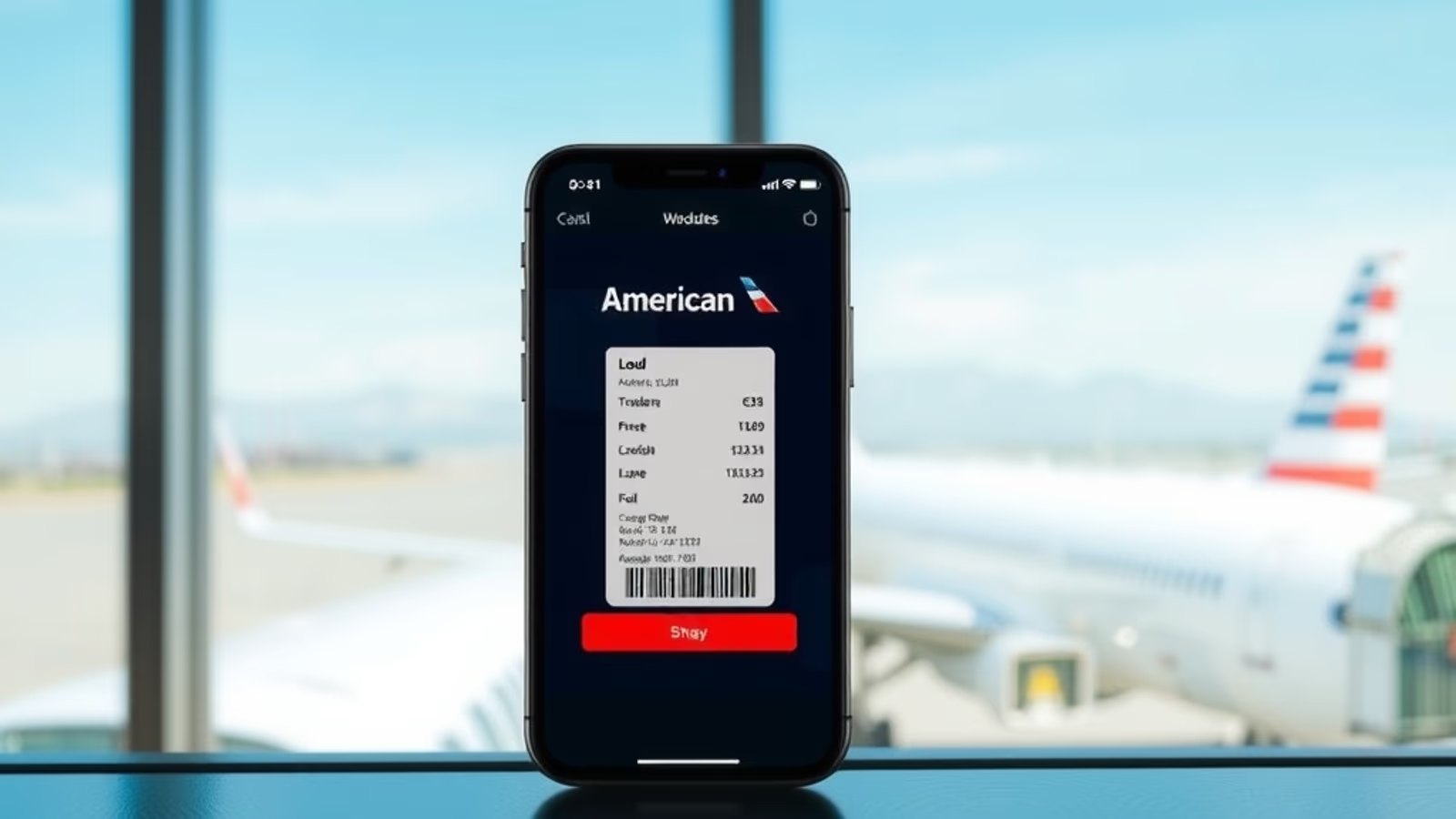
Most rebooking value sits inside the app. When a flight is canceled, the app routes you to a self-service rebooking screen within a minute. Gate agents reach the same inventory a few minutes later, and by then 50 to 200 passengers are ahead of you.
Three steps to complete the night before:
Log in and verify your reservation appears. A surprising number of travelers discover at the airport that their profile isn't linked to their booking because the email used at booking doesn't match the email on the loyalty account.
Turn on push notifications. Airlines push cancellation and gate-change alerts directly to the home screen, often before terminal screens update. Notifications are off by default for many users.
Confirm your Known Traveler Number is on the boarding pass. If you have TSA PreCheck and the boarding pass doesn't show it, the KTN is missing from this reservation. Call the airline before leaving home; fixing this at the airport is slow.
3. Get TSA PreCheck, Global Entry, or CLEAR
These aren't trip-specific, but the checklist should flag them because the marginal saving on every future trip is real. As of April 2026:
- TSA PreCheck: $77.95 for five years (renewals at $58.50). Faster lanes at participating U.S. airports; shoes and electronics stay packed.
- Global Entry: $120 for five years, includes PreCheck, and adds expedited customs re-entry.
- CLEAR Plus: $209 per year ($199 with certain elite statuses or premium credit cards). Biometric ID verification at the front of security; works in tandem with PreCheck.
Several premium credit cards reimburse the application fee every four to five years. If you already have the card, check whether the credit applied this year before paying out of pocket.
4. Check Weather Forecasts and Airline Waivers 24-48 Hours Out
A weather waiver is the most underused tool in the rebooking toolkit. When an airline expects significant disruption at a hub, it posts a travel waiver on its homepage, usually 24 to 72 hours before the storm. The waiver lets you change your flight for free, typically by one or two days in either direction, with no fee or fare difference, even on a basic economy ticket.
The critical detail: waivers expire. The earlier waivers, the better rebooking options. If you wait until the day of, the best flights are already full of passengers who acted on the waiver the day before.
Three sources to monitor for the 48-hour window:
- The airline's own travel alerts page. Every major U.S. carrier publishes one.
- FlightAware's MiseryMap and delay summary. Shows current and forecast hub delays in a single view.
- A general weather radar app. Watch for systems crossing your origin, destination, or any connecting hub.
If you see a waiver issued for your route, log into the app and review your rebooking options before doing anything else. Even if your original flight ends up operating, a free move to a calmer departure day is upside.
5. Identify Two or Three Backup Flights Before You Need Them
A 10-minute pre-trip exercise on Google Flights or your airline's app: pull up your route on your travel date and note the other departures. Same airline, different times. Different airlines, similar times. Connecting routings if your nonstop is the only option.
When a cancellation hits, the rebooking conversation goes faster when you can name the flight you want. "I see Flight 2287 at 4 p.m. has economy seats available" gets a different response than "what are my options?" Agents work faster against a specific request.
For connecting itineraries, identify which hubs the airline operates and which alternative hubs serve your destination. If your Atlanta connection collapses, knowing the same airline routes through Detroit, Minneapolis, or New York keeps the rebooking conversation moving.
6. Pack a Carry-On That Survives an Unplanned Overnight
Even if you're checking a bag, the carry-on should be functional as a standalone 24-hour kit. When bags are delayed (U.S. carriers misplace roughly six bags per 1,000 passengers, per recent DOT data), they typically arrive the next day. The hours in between are the problem.
A serviceable list:
- Prescription medication, plus a two- or three-day buffer. Never in checked luggage.
- One change of clothes, including underwear and a layer appropriate to the destination's weather.
- Basic toiletries in a quart bag: toothbrush, toothpaste, deodorant, face wash.
- A phone charger and a portable battery. Your phone is the rebooking tool; keeping it powered is load-bearing.
- Copies of your passport and travel insurance documents. A photo on the phone is fine.
- An empty water bottle and a snack. Airport food during a delay is expensive and often closed by 10 p.m.
Simplest test: if your checked bag never arrived, could you function until tomorrow afternoon? If yes, the carry-on is set.
7. Review What Your Credit Card Travel Insurance Actually Covers
Most travelers carrying a premium credit card have travel insurance benefits and never read the terms. The benefits typically activate only when the trip was paid on that specific card. Verify that first.
The benefits that matter most during disruptions:
- Trip delay reimbursement. Triggers after a delay of a set length (commonly 6 or 12 hours). Covers meals, hotel, transport, and essentials up to a per-ticket cap.
- Trip cancellation and interruption. Covers non-refundable expenses if a covered reason cancels or shortens the trip.
- Baggage delay. Reimburses essential purchases when a checked bag is delayed beyond a set window.
The Chase Sapphire Preferred review and Chase Sapphire Reserve review cover the specifics on those two cards; the credit card travel insurance guide compares trip-delay coverage across the major premium cards.
One operational point: claims need documentation. The moment a delay starts, photograph the departure board, keep every receipt, and save the boarding pass. Most denied claims are denied for incomplete documentation, not because the delay didn't qualify.
8. Check Security Wait Times for Your Specific Terminal
The standard "arrive two hours early for domestic, three for international" advice is a fine default, but it can be wrong in either direction. The free MyTSA app publishes estimated wait times by checkpoint and historical wait patterns by hour and day of week. Most major airport websites post the same data.
Two checks to run the night before and again the morning of:
- Current and forecast wait time at your specific terminal. Large hubs have multiple security checkpoints with very different lines; Terminal 1 vs. Terminal 5 at LAX routinely runs a 30+ minute gap.
- Whether PreCheck is open at your departure time. PreCheck lanes close earlier than standard lanes at many airports for early-morning or late-evening departures.
If wait times are long, buffer aggressively. Missing a flight because security took longer than expected is a non-covered, on-you problem under nearly every insurance policy.
9. Pre-Identify Hotels Near Connection Airports
For any itinerary with a connection, spend two minutes the night before identifying which hotels sit closest to the connecting airport. Save a few in the hotel app you already use most.
The rationale: when a cancellation strands you at a hub, hotel rooms within shuttle distance fill within an hour. Travelers who can book in 90 seconds from the gate get rooms. Those who start by searching get the leftovers, often 25 to 40 minutes away.
A few practical points:
- Don't book until you're certain. Last-minute airport-hotel rates are usually non-refundable. Wait until the flight is officially canceled or you're clearly going to misconnect.
- Airline-provided hotels are limited to controllable disruptions. Mechanical issues and crew shortages, yes; weather and air-traffic-control delays, generally no.
- Status helps marginally. Mid-tier elite status at Marriott Bonvoy, Hilton Honors, IHG, or Hyatt occasionally surfaces a better room or a late checkout, which matters when you're checking in at 11 p.m. and out at 6 a.m.
10. Know Your Lounge Access Options
Lounges during a delay aren't a luxury. They're an operations center. Most major lounges have help desks staffed by airline agents with access to rebooking inventory that runs parallel to, and sometimes ahead of, the regular customer-service line. Wait times are typically a fraction of the terminal queue.
Lounge access in 2026 generally comes from one of four sources:
- A premium travel credit card. Cards like the Amex Platinum and Chase Sapphire Reserve bundle Priority Pass membership and (for the Platinum) Centurion Lounge access; the Delta Sky Club guide covers Sky Club paths in detail.
- Standalone Priority Pass membership. Sold directly at multiple tiers, with restaurant credits at participating airports.
- Elite status with the airline. Top-tier status often includes lounge access on international itineraries, occasionally on domestic.
- A day pass. Most lounges sell single-visit access for $40 to $79; during a long delay, well spent.
Before traveling, check which lounges your card actually gets you into at your specific airports. Priority Pass coverage varies meaningfully terminal to terminal.
11. Set Up Independent Flight Tracking
Airlines push notifications when their own systems update, which is sometimes ten or fifteen minutes after the flight is operationally late. Independent trackers (FlightAware and Flightradar24 are the two most reliable) pull data from FAA feeds and ADS-B signals and often show a delay before the airline acknowledges one.
The most useful indicator is the inbound aircraft. Most flights are operated by an aircraft that just arrived from somewhere else. If the inbound is running 90 minutes late from its previous segment, your flight will not depart on time, even if the boarding screen still shows on-time.
Two alerts worth setting:
- Flight status alert in the airline app for the official record.
- Aircraft tracking on FlightAware, searched by flight number, then "view aircraft" to surface the inbound segment.
The redundancy means you usually know about a delay 15 to 45 minutes before the average passenger at the gate.
12. Verify the Booking the Night Before
A five-minute pass through the reservation the night before catches a meaningful share of small problems before they become airport-counter problems:
- Name spelling matches your government ID exactly. Middle name vs. middle initial vs. no middle name. Airline systems are strict about this at international check-in.
- Confirmation number and flight numbers. Screenshot for offline access.
- Seat assignments. Re-verify; airlines sometimes reassign during aircraft swaps.
- Departure terminal and gate (if posted). Many airlines post the gate 24 to 48 hours out.
- Special requests. Meal preferences, wheelchair, infant seat. Confirm each appears on the reservation.
If your airline allows online check-in 24 hours before departure, do it. Some carriers release additional seat inventory at the 24-hour mark; checking in promptly occasionally surfaces a better seat.
When the Plan Falls Apart Anyway
Even a complete checklist won't prevent every disruption. The response framework:
Move first, decide second. As soon as a cancellation lands, open the app and start the self-service rebooking flow. Decide whether to confirm the suggested rebooking after seeing what's available.
Use the second channel. If the app doesn't surface what you want, call the airline (international service numbers often have shorter waits), or walk to a lounge help desk if you have access.
Know your rights. When the airline cancels your flight, you're entitled to a refund to the original form of payment under U.S. DOT rules, even on a non-refundable fare. You don't have to take the rebooking if the new itinerary doesn't work. For delays of more than three hours on flights touching the EU or UK, EC 261/UK 261 compensation may apply; AirHelp handles the paperwork on a contingency basis.
Document continuously. Photo of the departure board, screenshot of the cancellation, every receipt during the delay window. The credit card insurance claim is straightforward if the documentation is complete.
Stay even with the agents. Gate agents during a major irregular-operations event are absorbing several hundred frustrated passengers an hour. Courtesy is a real rebooking edge; agents have discretion on a non-trivial range of seat and routing decisions.
The Payoff Is Calm, Not Just Recovery
The point of the checklist isn't only that it helps recover from disruptions. It's that the preparation removes the cognitive load that turns a manageable problem into a stressful one. The traveler who knows the rebooking options exist, knows the credit card covers an overnight, knows the lounge has a help desk, and has clean clothes in the carry-on handles a four-hour delay differently than the traveler who doesn't.
Most of these tasks take a few minutes each. Together they take less time than a movie. Done once and folded into a regular pre-trip routine, they become invisible. The result: when something does go wrong, and on a sufficient sample of trips something always does, the answer is already in place.
This article contains affiliate links. If you apply through our links, we may earn a commission at no cost to you, which helps us continue sharing points and miles strategies with the community.
Some of the links in this article are affiliate links. We may receive a small commission at no extra cost to you if you apply through these links. This helps us keep the site running and continue creating free content.