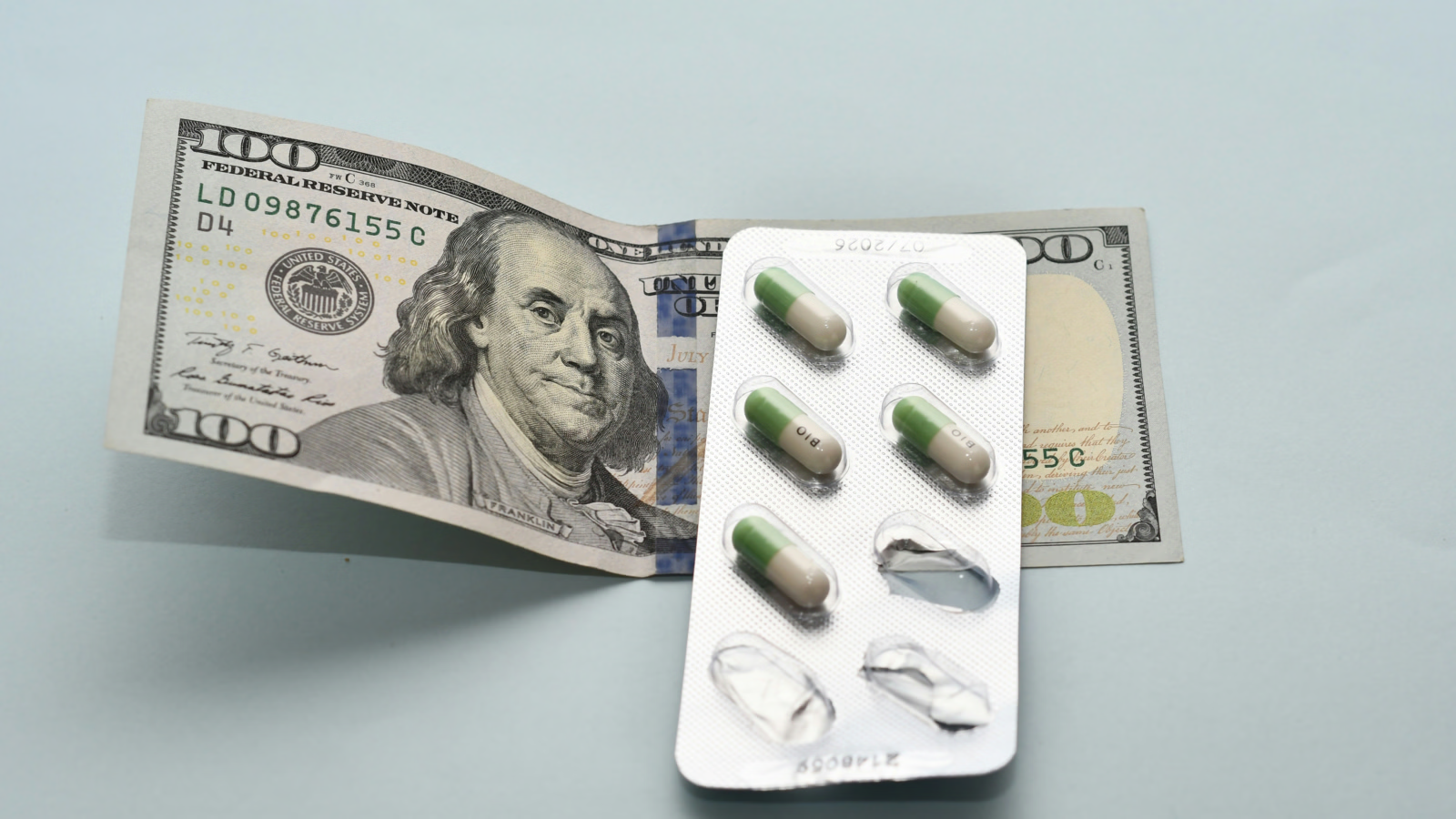


Paying medical bills with a credit card is mostly a math problem, not a moral one. The hospital or medical practice charges a processing fee. Your card pays a rewards rate. Subtract the second from the first and you have your answer in dollars. Most of the time you lose money, sometimes you break even, and a few specific scenarios pay you to put the bill on plastic. The trick is knowing which one you're in before you swipe.
This guide walks through the actual mechanics: what processing fees U.S. medical providers charge in 2026, when the math works in your favor, when it doesn't, how to use an HSA or FSA card the right way, how insurance interacts with all of this, and which alternatives beat credit cards outright. It also clears up one question that comes up constantly with a wrong answer attached: whether the IRS Form 8300 reporting rule applies to large credit card medical payments. (It doesn't. More on that below.)
Quick answer
Most U.S. medical providers and hospitals accept credit cards either with no surcharge (because they absorb the interchange fee themselves) or with a 2% to 3% processing fee passed through to the patient. A 2% flat-rate cash-back card loses money at any provider charging more than 2%. The two scenarios where credit cards do beat alternatives: using a large medical bill to clear a new card's welcome bonus, or financing a bill on a 0% intro APR card you can pay off before the promo period ends. For ongoing recurring medical spend, the HSA or FSA card almost always wins outright, because the tax savings beat any rewards rate.
How medical billing actually works in 2026
When you pay a hospital or medical office by credit card, one of three things happens behind the scenes:
- The provider absorbs the fee. Most large hospital systems and many physician practices accept credit cards with no surcharge. They eat the 1.5% to 2.5% interchange the card networks charge and treat it as a cost of doing business. As of April 2026, this is still the most common setup at major hospital networks like HCA Healthcare, Kaiser Permanente (where applicable), and most academic medical centers.
- The provider passes a processing fee through to you. A growing share of independent practices, dental offices, and outpatient specialty clinics now add a 2% to 3% "processing fee" or "convenience fee" on top of the bill when you pay by card. The fee shows up as a separate line item, not buried in the procedure cost. Some providers cap the fee at a dollar amount on very large bills.
- The provider routes you through a third-party patient billing platform. Companies like InstaMed, Phreesia, and Rectangle Health handle patient payments for tens of thousands of medical practices. Their fee structure varies by provider, but a 2.5% to 2.85% pass-through fee is common in 2026.
To find out which case applies to you, look at the bill itself or the provider's online payment portal. The fee, if there is one, is disclosed before you confirm the payment. Don't trust a number from a forum thread or a 2022 blog post. Practices change their billing setups every year or two.
The math that decides everything
The decision comes down to one calculation:
Net rewards = (Card rewards rate × Bill amount) - (Processing fee × Bill amount)
If the rewards rate is higher than the fee, you make money. If it's lower, you lose money. This is the same math that governs paying tuition or property taxes by credit card, and the answer follows the same pattern: most of the time, ongoing rewards lose to the fee.
The losing case: ongoing rewards on a 2% card
A worked example. You have a $3,000 medical bill, a Citi Double Cash earning 2% back on everything, and a provider charging a 2.85% processing fee.
- Rewards earned: $3,000 × 2% = $60
- Fee paid: $3,000 × 2.85% = $85.50
- Net: -$25.50
You paid $25.50 for the convenience of putting a $3,000 medical bill on your card. The same arithmetic applies to the Wells Fargo Active Cash (2% back), Capital One Venture (2x miles, valued around 1.85 cents apiece using common transfer redemptions), and any other flat-rate 2% card. Above the fee threshold, ongoing rewards lose every time.
The only way ongoing-rewards math wins is when the provider absorbs the fee entirely. In that case, even a 1.5% card pays you back with no offset cost.
The winning case: a welcome bonus
The math flips when you're using the medical bill to clear a welcome-bonus spending threshold on a new card.
Take a real scenario as of April 2026: an $8,000 elective surgery bill, paid through a provider charging a 2.85% processing fee, on a brand-new Chase Sapphire Preferred with its standard public offer of 75,000 Ultimate Rewards points after $4,000 in spend during the first three months.
- Spend on the new card: $8,000
- Processing fee at 2.85%: $228
- Bonus value (75,000 UR points at ~2 cents apiece transferred to Hyatt or Virgin Atlantic): ~$1,500
- Base earning on $8,000 at 1x = 8,000 points (~$160)
- Net: $1,500 + $160 - $228 = ~$1,432
That's a real win. The bonus alone covers the fee more than six times over.
The mistake is extending the same logic to the rest of your medical spending. Every dollar above the $4,000 bonus threshold earns at the card's base 1x rate (worth roughly 1 cent per dollar) and still costs 2.85% in processing fees. Above the threshold, you're back to the losing math.
The right play: charge $4,000 of the bill to clear the bonus, then either pay the remaining $4,000 from your HSA, on a different card with no processing fee, or directly from a checking account through the provider's free payment option.
Stacking welcome bonuses across multiple bills
If you're facing multiple medical events in a year (surgery in spring, a procedure for a family member in fall), the same approach Kay-style stackers use for tuition or taxes works for medical bills:
- First bill: open Card A, pay enough to clear its welcome bonus, settle the rest by ACH or HSA.
- Second bill, four to six months later: open Card B, repeat.
Two cautions apply. First, watch Chase 5/24. If you're working toward Chase cards (Sapphire Reserve, Ink Business Preferred, Hyatt-cobrand Sapphire Preferred), don't burn 5/24 slots on cards opened just for medical bonuses. Five new cards in 24 months from any issuer locks you out of new Chase cards for a while. Plan the order: Chase first, others after. Second, issuer family rules. Capital One generally limits you to one Venture-family bonus per six months. American Express card bonuses are once-per-lifetime per product. Don't apply for a card you've already held.
When the 0% intro APR strategy actually works
The other scenario where a credit card can beat the alternatives is when you can't pay the bill in cash today and the realistic alternative is a high-interest medical loan, a hospital payment plan with interest, or a CareCredit-style deferred-interest card.
Several traditional cards offer extended 0% intro APR on new purchases as of April 2026:
- Wells Fargo Reflect. 21 months of 0% APR on purchases.
- U.S. Bank Visa Platinum. 18 months of 0% APR on purchases.
- Citi Simplicity. 12 months of 0% APR on purchases.
If you charge a $6,000 bill to a Wells Fargo Reflect with 21 months at 0%, pay a 2.85% processing fee ($171) up front, and pay $286 a month for 21 months, you finish the bill with no interest accrued and no rewards earned. The effective annualized "cost" of the 2.85% fee over 21 months works out to about 1.63%. Compare that to a personal medical loan at 9% to 13% APR or a private medical financing product, and the 0% card wins clearly.
A real warning: this only works if you actually pay it off inside the promo window. Once the 0% period ends, the standard purchase APR kicks in (typically 19% to 27% in 2026), and any remaining balance starts compounding at that rate immediately. Set up automatic payments that finish the balance with two or three months of buffer. Don't cut it close.
Avoid deferred-interest medical cards
CareCredit and similar dental or medical financing cards advertise "no interest if paid in full within 12 months." Read the fine print. These products use deferred interest, not true 0% APR. If you don't pay the full original balance by the promo end date, the card retroactively charges interest on the entire original amount from the date of purchase, often at 26.99% or higher. A traditional 0% APR card from a major issuer is almost always the better tool for the same use case.
How HSAs and FSAs change the math
If you have a Health Savings Account or Flexible Spending Account, the credit card vs. HSA decision is almost always settled in the HSA's favor for ongoing eligible expenses.
Here's why. An HSA is funded with pre-tax dollars. If your marginal tax rate is 22% federal plus 5% state, every dollar paid out of an HSA effectively cost you about 73 cents in take-home pay. That's a 27% built-in discount on every eligible medical expense. No credit card rewards rate touches that.
For routine eligible expenses (prescriptions, copays, dental, vision, qualifying over-the-counter items), use the HSA debit card directly at the point of sale or pharmacy counter. Most HSA providers issue a debit card that works on the major networks, and most pharmacies and medical providers accept it just like any other card. There's no processing fee passed through, and you keep the tax advantage in full.
The case where credit cards re-enter the picture: large bills that exceed your HSA balance, or expenses you want to pay out of pocket today and reimburse from your HSA later (a legitimate strategy if you want to let HSA funds grow in investments long-term). For the second case, you can pay by credit card now, save the receipt, and reimburse yourself from the HSA at any point in the future, even years later. The tax advantage holds. If you can clear a welcome bonus on the credit card payment in the meantime, you stack the rewards on top of the eventual tax-free reimbursement.
FSAs work similarly for the eligible-expense list, with one important difference: FSA funds are use-it-or-lose-it within the plan year (some plans allow a small carryover or grace period). Spend the FSA balance first, then use credit cards for any overflow.
How insurance changes the picture (HMO, PPO, high-deductible plans)
Your insurance type doesn't change the credit card math directly, but it changes how often you're using a credit card for medical bills in the first place.
- PPO plans typically have higher premiums but lower deductibles and copays. Credit card use tends to come up for elective procedures, out-of-network care, or specialist visits beyond the copay structure.
- HMO plans typically run lower copays for in-network care but require referrals for specialists. Credit card use here usually means an unexpected out-of-network charge or a planned procedure with a meaningful out-of-pocket component.
- High-deductible health plans (HDHPs). This is where credit cards see the most action, because the patient pays everything until the deductible is met. HDHPs are also the only plan type that pairs with an HSA, which means HDHP patients have both the highest out-of-pocket exposure and the most powerful tool for managing it.
If you're on an HDHP and have an HSA, the playbook is straightforward: max the HSA contribution if cash flow allows, use the HSA card for in-network eligible expenses, and reserve credit cards for the welcome-bonus and 0% APR scenarios above.
Form 8300 does not apply to credit card medical payments
A persistent misconception worth correcting: IRS Form 8300 (the rule that requires reporting of cash payments over $10,000) does not apply to credit card payments. It applies to actual cash, cashier's checks, money orders, and bank drafts. Paying a $15,000 medical bill on a Chase Sapphire Reserve does not trigger an 8300 filing by the provider, doesn't generate a 1099, and isn't reported to the IRS as income.
This shows up in the form of medical providers occasionally pushing back on large credit card payments, citing "the $10,000 reporting rule." That rule doesn't apply here. If a provider declines a card payment over $10,000, the reason is something else (their merchant processing limits, their own policy, the cap on a single transaction at their payment platform), not 8300.
You can split a large bill across two cards or two transactions if the provider's processing platform won't accept a single charge above some ceiling, but you don't need to do it for tax-reporting reasons.
When medical financing beats both credit cards and personal loans
In two narrow scenarios, the right answer isn't a credit card and isn't a personal loan: it's the provider's own payment plan.
- The provider offers true 0% interest in-house. Many hospital systems and dental practices offer interest-free payment plans for 6 to 24 months when you set them up directly with the billing office, before the bill goes to collections. No processing fee, no interest, no impact on credit utilization. This beats a 0% APR credit card outright because there's no 2.85% fee at all.
- You qualify for hospital financial-assistance programs. Most nonprofit hospitals are required to offer charity care and discounted rates to patients below certain income thresholds. The discounts can range from 30% to 100% off the bill. Apply for these before paying anything by card. Once you've paid, you generally can't claw back a financial-assistance discount.
The order to evaluate:
- Apply for hospital financial assistance if income-eligible.
- Negotiate a prompt-pay discount (10% to 30% off is common if you can pay in full immediately).
- Set up a no-interest in-house payment plan.
- Use a credit card for the welcome bonus or 0% APR strategy if those apply.
- Use a personal medical loan only if all of the above are unavailable.
Cards worth using for the medical-bill strategy
Two card types matter: cards with strong welcome bonuses (for the bonus play), and 2x flat-rate cards (for the cases where the provider absorbs the processing fee).
For welcome bonuses
- Chase Sapphire Preferred ($95 annual fee). 75,000-point bonus after $4,000 spend in three months as of April 2026. Hyatt and Virgin Atlantic transfer access make Ultimate Rewards points the highest-value flexible currency for most readers.
- Capital One Venture ($95 annual fee). 75,000-mile bonus after $4,000 spend in three months. 2x miles on everything as a base rate, useful both for the bonus and for any ongoing fee-free medical spending.
For ongoing 2x earning at fee-free providers
- Citi Double Cash. 2% cash back on everything. No annual fee.
- Wells Fargo Active Cash. 2% cash back on everything. No annual fee.
These two are interchangeable for most readers. Pick the one with the best welcome offer at the time you apply.
A note on credit utilization
A large medical bill can spike your credit utilization ratio, which represents the share of your available credit currently in use. Utilization makes up about 30% of a typical FICO score, and a sudden jump can drop your score temporarily even if you pay the bill in full each month.
Two ways to soften the impact:
- Pay the bill down before the statement closing date, not just before the payment due date. Issuers report your balance to the credit bureaus on the statement date, so a balance paid down a few days before that date shows lower utilization on your report.
- Spread a large bill across two or three cards rather than putting it all on one. Total utilization stays the same, but per-card utilization stays lower, which most scoring models weight separately.
Watch utilization especially closely if you plan to apply for a mortgage, auto loan, or new credit card within the next two or three months. A temporary 30-point dip is fine if nothing's pending. It's not fine if it pushes you below a credit-score tier on a mortgage application.
Putting it together
Most readers facing a medical bill should run through this short checklist before paying anything:
- Apply for hospital financial assistance if your income qualifies.
- Ask about a prompt-pay discount and a no-interest in-house payment plan.
- If you have an HSA or FSA, pay eligible expenses from those accounts first.
- If you're opening a new credit card and the bill is large enough to clear the welcome-bonus threshold, charge that portion to the new card.
- For any remaining balance: if you can pay in full before your statement closes, the 0% APR cards aren't needed. If you can't, a 0% intro APR card can replace a personal medical loan over 12 to 21 months.
- Skip CareCredit and other deferred-interest medical cards.
The goal isn't to maximize rewards on every medical dollar. It's to avoid the obvious traps (deferred-interest cards, processing fees that exceed your rewards rate, missed financial-assistance applications) and hit the two scenarios where credit cards genuinely add value: welcome bonuses and 0% APR financing on bills you can't pay in cash today.
This article contains affiliate links. If you apply through our links, we may earn a commission at no cost to you, which helps us continue sharing points and miles strategies with the community.
Some of the links in this article are affiliate links. We may receive a small commission at no extra cost to you if you apply through these links. This helps us keep the site running and continue creating free content.