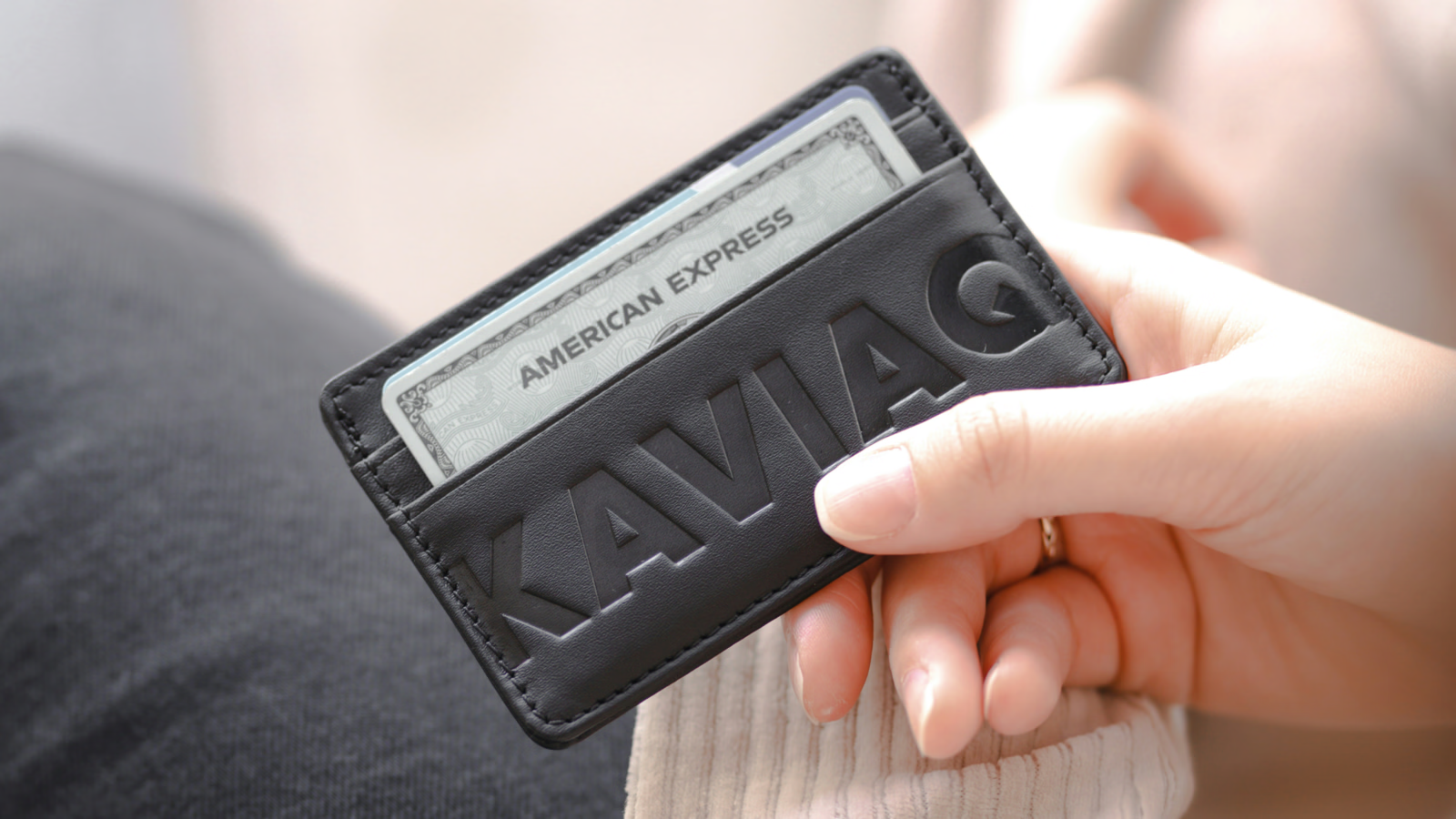
Amex turned its premium cards into coupon books, and then it doubled the coupons. The Platinum Card now lists more than $3,500 in annual credits against an $895 fee. The Business Platinum sits at the same $895 with a different stack. The refreshed Gold Card charges $325 and hands back more than its fee in dining credits alone.
That's the headline. The footnote is what matters: most of those credits expire in chunks before you remember they exist, half of them require enrollment that nobody tells you about, and at least a third of them are designed to push you into spending you wouldn't otherwise do.
I've been working these cards for years. Here's how to actually extract the value without turning your wallet into a part-time job.
The credit stack mental model
Before any specific tactic, the framing.
Amex credits come in three categories. The first is money you'd spend anyway: hotels you'd book, food you'd eat, the streaming subscriptions already on your statement. These are the only credits that matter for the math. Pretend the others don't exist.
The second is money you'd spend anyway, but only if the credit nudges you toward a specific merchant. The Uber Cash credit falls here for most people. So does the Resy credit if you eat at participating restaurants. These are real value, but only if the nudge is friction-free. A $50 credit that requires you to drive twenty minutes to a restaurant you didn't pick is not a $50 credit.
The third is money you wouldn't spend without the credit. The Walmart+ credit on the Platinum if you've never set foot in a Walmart. The Equinox credit if there isn't a club within an hour. The lululemon credit if you don't wear lululemon. Mentally zero these out. If they happen to convert later, great. They don't go in the math.
The mistake I see most often is people summing the headline number ("the Platinum gives $3,500 in credits!") and then forcing themselves into category-three spending to make the math work. That's how you turn a $895 annual fee into $895 plus $400 of stuff you didn't want.
The right exercise is the inverse. Look at your last twelve months of spending. Circle the line items that overlap with Amex credit categories. That's your real credit value before you change a single behavior. Everything beyond that is upside, not floor.
Platinum Card: the full breakdown
The refreshed Platinum lands at $895 with a 175,000-point welcome offer in current public marketing. The credit stack, in order of how reliably people actually use them.
$600 hotel credit (split $300 + $300, semi-annual)
Up from $200 in the prior version. You earn up to $300 January through June and another $300 July through December on prepaid bookings through Fine Hotels + Resorts or The Hotel Collection on Amex Travel.
This is the credit that does the heaviest lifting in the math. Fine Hotels + Resorts bookings come with their own perks (usually a property credit at $100, breakfast for two, late checkout), and they earn elite-qualifying nights at most chains. The credit and the perks stack.
Tactic: book a Hyatt or Marriott property through FHR for one or two nights, use the credit to offset, take the property credit on top. You're paying close to nothing for a stay you'd already want, and you're picking up elite progress. For more on stretching hotel value, see our Hyatt sweet spots guide and the Marriott Bonvoy program guide.
The two pitfalls. First, the semi-annual structure means a $300 credit unused in June is gone. It doesn't pool with the July half. Calendar reminder, mid-May, book something refundable. Second, FHR is not always the cheapest channel; the credit is real value, but at properties where FHR runs $50+ above the direct rate, you're handing some of the credit back to Amex Travel as margin.
$400 Resy dining credit (split $100 quarterly)
New for the refresh. Up to $100 per quarter at participating U.S. Resy restaurants when you pay with an enrolled Platinum. Requires enrollment in the Amex app. The list is meaningfully selective (not every Resy restaurant qualifies), but the participating list includes plenty of urban dining options that people would book anyway.
Tactic: if you eat at restaurants in the Resy network in a normal month, this credit is essentially free money. If you don't, treat the $400 as zero. Don't drive to a restaurant you wouldn't otherwise visit to spend a $100 credit. You'll spend $140 to use $100.
Quarterly resets are the killer here. Three out of four people I know with this card miss at least one quarter the first year.
$300 Digital Entertainment Credit ($25 monthly)
Disney+, Hulu, ESPN+, the Disney bundle, the New York Times, the Wall Street Journal, Peacock, Paramount+, YouTube Premium, YouTube TV. Up to $25 a month, doesn't roll over.
This is the easiest credit on the card. The Disney bundle plus a Times digital subscription gets you most of the way every month, automatically. Set it once, forget about it, watch $300 of fee offset itself across the year.
The only thing to watch: Amex occasionally tweaks the qualifying merchant list. Check once at renewal that whatever you're auto-paying still triggers.
$200 Uber Cash + $120 Uber One credit
Two separate Uber benefits stack on the new Platinum. The $200 Uber Cash is $15 monthly with a $20 bonus in December, automatic once you've added the Platinum to your Uber account. The $120 Uber One credit covers an auto-renewing Uber One membership at $9.99 monthly.
Tactic: add every Platinum and Gold in the household to one Uber account. The Uber Cash from each card stacks. Add Uber One to autopay on the Platinum, and you've effectively turned the membership free while picking up the surcharge waivers, member rates on rides, and free Uber Eats delivery thresholds.
The retroactive payment-switch trick still works. After an Uber Eats order, you can switch the payment to a card with available Uber Cash even after the order is closed. Useful for the December $35 month when you're trying to clear stale credit.
$200 Airline Fee Credit (annual)
Pick one airline, get up to $200 back on incidental fees: baggage, seat selection, in-flight purchases. Despite Amex's "incidental fees only" language, plenty of partial-payment tactics still work consistently.
Tactic that works: pick United, load $200 into TravelBank in $50–100 chunks. The TravelBank loads code as fees and trigger the credit. Then spend the TravelBank balance on real flights. See our United MileagePlus complete guide for getting more out of the program once you've loaded the funds.
Tactic that also works: Southwest sub-$100 fares that you cancel within 24 hours, returning the value to your Southwest account as travel funds for the next year. The original purchase still triggers the credit.
Tactic that doesn't work consistently anymore: gift cards. Most airline gift card purchases stopped triggering this credit a few years back.
$189 CLEAR Plus credit (annual)
If you're a regular flier, CLEAR plus TSA PreCheck is the security combination that makes airports tolerable. The Platinum covers the full membership.
If you fly fewer than five times a year and stick to airports without long PreCheck lines, this is closer to zero value. Don't sign up for CLEAR to use the credit. Sign up for CLEAR if you'd use CLEAR.
$300 ChatGPT credit (Business Platinum, not consumer)
Worth flagging up front: the $300 annual ChatGPT credit announced in May 2026 is on the Business Platinum and Business Gold, not the consumer Platinum. And it's for ChatGPT Business, not ChatGPT Plus or the personal subscription. We'll cover it in the Business Platinum section below.
$300 lululemon, $300 Equinox, $200 Oura, $155 Walmart+, $50 Saks (through July 2026), Global Entry
These are the "if you would have spent it anyway" credits. Run them through the three-category test from earlier.
- lululemon: $75 quarterly. If you wear the brand, this is straightforward; pace your purchases across quarters. If you don't, zero.
- Equinox: $25 monthly toward an Equinox membership. Only works if there's a club near you and you'd join anyway. Most people: zero.
- Oura Ring: One-time $200 toward a ring purchase. Useful exactly once. Most cardholders: a few hundred dollars of value the first year, zero after.
- Walmart+: $12.95 monthly covers the membership. If you shop at Walmart and use the gas discount, this is $155 of real value. If you don't, zero.
- Saks: $50 semi-annually through July 1, 2026. After that, gone. Use the remaining credit on gift cards if you don't want anything from Saks immediately. They're stockable.
- Global Entry / TSA PreCheck: $120 every four years. Free renewal. Take it.
The pattern with this batch: pick the two that match your life, ignore the rest, and resist the urge to engineer use cases for the others.
Business Platinum: same fee, different stack
The Business Platinum also landed at $895 in the refresh, with the public welcome offer at 300,000 points. Most of the credit overlap is intentional: same hotel credit, same Uber Cash, same airline fee credit, same digital entertainment credit. The differences are where the math gets interesting for actual business spend.
$300 ChatGPT Business credit (annual, enrollment required)
Available since May 12, 2026. Up to $300 a year toward ChatGPT Business when OpenAI is the merchant of record. ChatGPT Business is roughly $300/user/year with a two-seat minimum, so the credit covers one seat.
For solo operators and small teams, this is the cleanest new credit on the card. If you'd already pay for ChatGPT Plus personally and have any business use, moving to ChatGPT Business and routing it through Amex turns the subscription free against the fee.
$150 Dell + $1,000 Dell stretch credit
Up to $150 in statement credits each year at Dell.com, plus an additional $1,000 credit after spending $5,000 at Dell in a calendar year. The first chunk is easy. The second is for people who'd already buy real Dell hardware.
Tactic: wait for Dell sales (they run constantly) and time legitimate purchases against the credit. Stack with Amex Offers ("spend $150 get $15 back" appears on Dell roughly quarterly) and a portal click through Rakuten for an extra 6 to 10%.
$200 Hilton credit + wireless + Adobe
Up to $200 a year on Hilton bookings (prepaid through Amex Travel), $120 a year on wireless phone bills, and an Adobe credit on top. The wireless credit is real value for anyone with a business line.
For Hilton specifically, the credit pairs naturally with Hilton Honors status if you carry the Aspire on the consumer side. Book Hilton properties through Amex Travel only when the credit math justifies it; otherwise book direct for points and recognition.
Year-one math for a Business Platinum, realistic profile
Solo operator who travels for business and uses ChatGPT:
- ChatGPT Business: $300
- Hotel ($600 across two stays they'd book anyway): $600
- Digital entertainment ($25/mo): $300
- Uber Cash + Uber One: $320
- Airline fee credit: $200
- Wireless: $120
- Dell ($150 baseline only): $150
That's $1,990 against the $895 fee. Add the 300,000-point welcome and the math is comfortably positive, even ignoring half the stack.
Gold Card: $325 fee, redesigned credit stack
The refreshed Gold sits at $325. The new stack is more focused than the old one: three dining credits plus Uber Cash.
- $120 dining credit: $10 monthly at Grubhub, Five Guys, Goldbelly, the Cheesecake Factory, Wine.com.
- $100 Resy credit: $50 semi-annually, U.S. participating Resy restaurants, enrollment required.
- $84 Dunkin' credit: $7 monthly at U.S. Dunkin' locations.
- $120 Uber Cash: $10 monthly, stacks with the Platinum Uber Cash if you carry both.
For anyone who eats out, orders delivery, or buys morning coffee, that's $424 in credits against $325. The Resy credit is the only one with real friction (enrollment plus participating restaurant requirement); the rest are passive once set up. The Gold is now the cleanest fee-to-credit-coverage math in the Amex lineup if you spend the way the credits assume.
The earning rate (4x at restaurants and U.S. supermarkets) is the actual reason to hold the card. The credits cover the fee; the points make the math worth it.
Monthly credit traps to know about
Five things that quietly kill credit value, in order of how often I see people get burned:
1. Enrollment requirements. Resy, Saks, lululemon, Equinox, Oura, airline fee: none of these work without enrollment in the Amex app first. Enroll the day the card arrives. I keep a checklist for myself at every renewal.
2. The autopay-discount tradeoff on wireless. Verizon, AT&T, and T-Mobile give a $5 to $10/line autopay discount only with bank account or debit card. If you put autopay on the Business Platinum to chase the $120 wireless credit, you might net negative against the lost discount on a multi-line plan. Run that math before switching.
3. Quarterly resets without calendar discipline. lululemon, Resy ($100/quarter on Platinum), Hilton Aspire airline — these don't roll. If you don't have a recurring quarterly reminder set, expect to lose at least one chunk a year.
4. The "use it before it disappears" trap. A $200 credit isn't worth $200 if you spent $260 of stuff you didn't want. The right behavior at end-of-quarter is to do the cheapest legitimate spend that triggers the credit, not the most aggressive.
5. FHR vs. direct booking gap. The hotel credit is best when FHR pricing is at or below the direct rate. At some properties, especially smaller boutique brands, FHR carries a $30 to $80 premium. The credit still nets out positive, but it's not the full $300 of free money you might be counting.
Year-one math at a realistic reader profile
Let's run this with someone who'd carry both the consumer Platinum and the Gold, common for the points-game audience this site is written for.
Platinum ($895 fee), credits actually used:
- Hotel ($600, two FHR nights they'd book regardless): $600
- Digital entertainment (Disney bundle + NYT autopay): $300
- Uber Cash ($200) + Uber One ($120): $320
- Resy credit ($300 of $400, missing Q1): $300
- Airline fee credit (United TravelBank): $200
- CLEAR Plus: $189
- Global Entry (year three of four): $0 this year
- lululemon/Equinox/Oura/Walmart+/Saks: $0 (don't use any of them)
Platinum total: $1,909 against $895. Net: +$1,014.
Gold ($325 fee):
- Dining credit: $120
- Dunkin': $84
- Resy: $100
- Uber Cash: $120
Gold total: $424 against $325. Net: +$99.
Combined across both cards: roughly $1,113 of value against $1,220 in fees, before you've earned a single Membership Reward point. Add 4x on dining and groceries via the Gold, 5x on flights via the Platinum, the welcome offers, and the math gets aggressive in the right direction.
That's the realistic profile. People who use more of the lifestyle credits will run higher. People who treat the Platinum as a pure travel card with the airline and hotel credits will run closer to break-even on credits and rely on the welcome offer and benefits (Centurion lounges, Marriott and Hilton Gold, the 5x on flights booked direct) for the rest.
Who shouldn't bother
A few profiles where the math doesn't work, no matter how you slice it.
You travel one or two times a year. The hotel credit, the airline credit, the lounge access, the CLEAR membership: the bulk of the Platinum's value is travel-coded. If you're not flying, the credits you can actually use net to roughly $500. That's against $895. The card isn't for you. The Capital One Venture X at $395 is the better starting point.
You hate enrolling and tracking. Five of the Platinum's credits require active enrollment. Three require quarterly attention. If that sounds exhausting, you'll leave $500 to $800 on the table every year, and the math goes negative. The Gold at $325 demands less and pays out more reliably for low-effort cardholders.
You shop at none of the lifestyle merchants. No Walmart, no Saks, no lululemon, no Equinox, no Oura ring. Fine, that's most people. But then run the Platinum math with those credits zeroed out, not with the headline $3,500 number. The card still pencils for travelers; it doesn't pencil for people without the travel use case to anchor it.
You churn aggressively for welcome offers. If your plan is to close the Platinum after year one anyway, you don't need to optimize the credit stack. You need the welcome offer math to clear the prorated fee. Different exercise.
Bottom line
The 2026 Amex credit stacks aren't a points game; they're an attention game. The cardholders who lose money on a refreshed Platinum aren't the ones with bad math. They're the ones who let three quarters pass without using the Resy credit, forgot to enroll in lululemon, and didn't realize the Saks credit ended in July.
If you set up the autopayable credits (digital entertainment, Uber One, Walmart+) on day one, calendar the quarterly resets, and resist the urge to chase the credits that don't fit your life, the math works. If you don't, the math doesn't, and the card becomes an $895 wallet ornament.
For more on how these cards fit the broader Amex lineup, see our best American Express credit cards guide and the deeper Platinum Card complete guide. If you're still deciding whether premium cards make sense at all, start with are travel credit cards worth it.
This article contains affiliate links. If you apply through our links, we may earn a commission at no cost to you, which helps us continue sharing points and miles strategies with the community.
Some of the links in this article are affiliate links. We may receive a small commission at no extra cost to you if you apply through these links. This helps us keep the site running and continue creating free content.