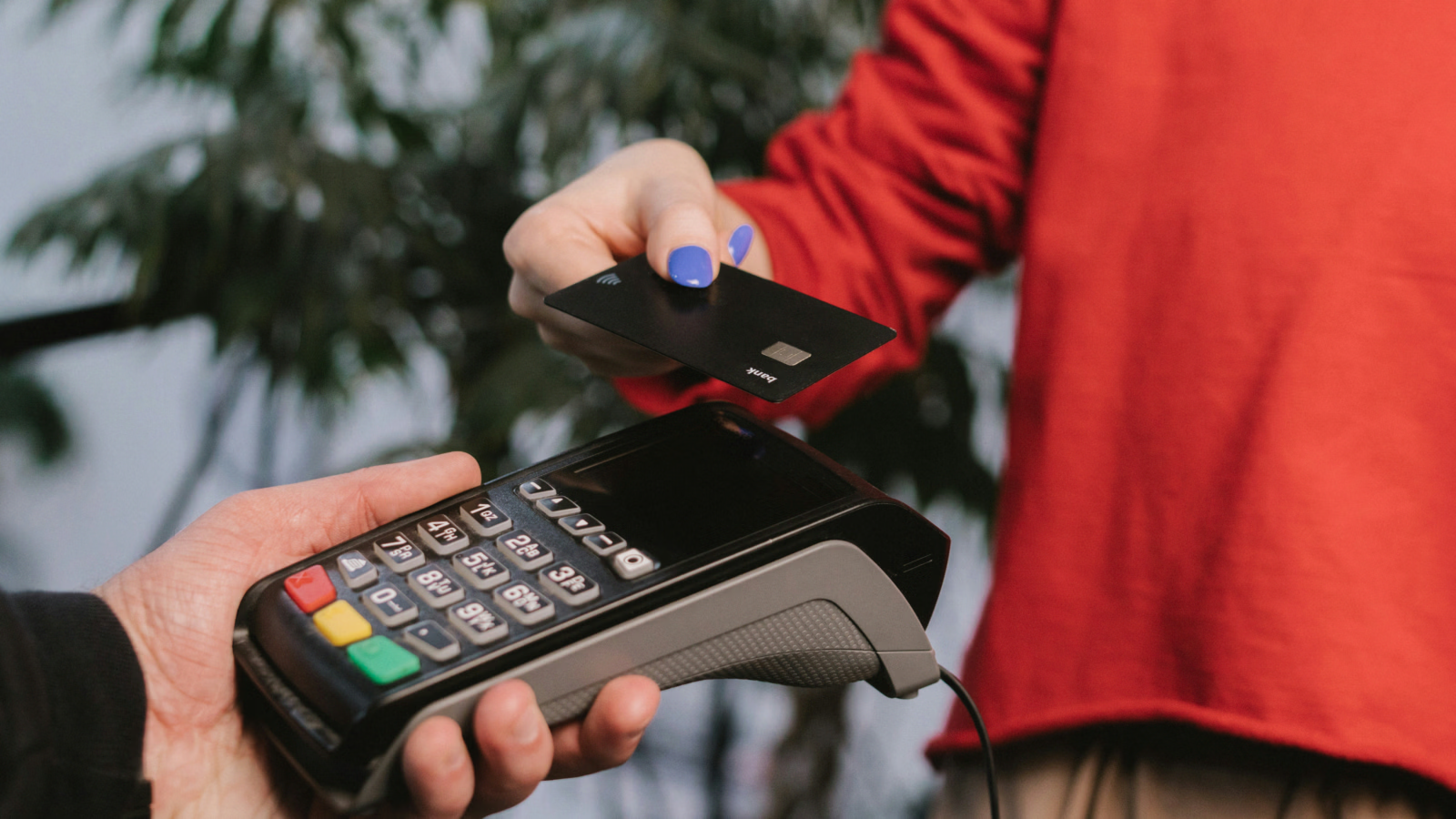
Most people leave money on the table at checkout. Not because they're careless, but because they're only claiming one layer of rewards when three or four are available on the same purchase. Stacking is the practice of running multiple programs on a single transaction: a shopping portal, a credit card with a bonus category, a card-linked offer, a store loyalty program, and sometimes a receipt-scanning app. These systems don't talk to each other, which is exactly the point. Each one pays out independently, and the layers add up faster than most people expect.
A $100 online purchase that earns 5% on a category card alone returns $5. The same purchase routed through a 6% shopping portal with a $10 Amex Offer attached and a store loyalty program in the background returns somewhere in the $25 range. That's not a trick or a loophole. It's just paying attention to which rewards are sitting there unclaimed.
This guide walks through the tools that make stacking work, which cards anchor the strategy, where the time investment actually pays off, and the mistakes that quietly cost real money. The goal isn't to turn shopping into a second job. It's to claim the rewards already attached to purchases you're going to make anyway, without spending more than a few minutes per transaction.
What Stacking Actually Means
Think of a single purchase as a stack of layers, each one paying out separately:
- Shopping portal (typically 1-10% cash back, sometimes 15%+ on promotions)
- Credit card category bonus (1-5x points or percent cash back)
- Card-linked offer from your issuer (5-20% back or a flat dollar credit)
- Store loyalty program (points, fuel discounts, coupons)
- Receipt-scanning app (small but consistent, often $0.25 to $5 per item)
You don't need all five every time. The point is that they layer cleanly because they're tracking different things. The portal tracks the click. The card tracks the transaction. The loyalty program tracks your phone number. The receipt app tracks the receipt itself. None of them are aware the others exist.
The Tools, Layer by Layer
Shopping Portals
Portals pay you for clicking through their site to a retailer before you buy. The retailer pays the portal a referral fee, and the portal shares part of it with you.
Rakuten is the biggest, with around 3,500 retailers and frequent promotional rates of 10-15% at major stores. You can take cash via PayPal or convert balances to American Express Membership Rewards points, which is the more valuable redemption if you have a transferable-points setup. TopCashback typically pays higher base rates because it passes through nearly all of its commission, and its payout threshold is a single penny, so the cash arrives quickly. MyPoints is the third worth knowing, with slightly different retailer coverage. That matters because portal rates for the same store can vary by 5x on any given day.
The rule is simple: before any online purchase, check Cashback Monitor to compare current rates across portals. It takes fifteen seconds and routinely changes which portal is best for that specific retailer.
Credit Card Category Bonuses
This is the layer most readers already use, but worth flagging the categories that pay the highest stacked returns:
Dining and travel. The Chase Sapphire Preferred earns 3x on dining and 2x on all other travel for a $95 annual fee. The Chase Sapphire Reserve goes to 3x on both travel and dining and comes with a $300 annual travel credit that effectively reduces the $550 fee to $250 for anyone who travels at all.
Everything else. The Chase Freedom Unlimited earns 1.5% (1.5x Ultimate Rewards points if paired with a Sapphire card) on every purchase with no annual fee. It's the default card when no category bonus applies, and pairing it with a Sapphire makes those 1.5x points worth 25 to 50% more through Chase's transfer partners.
U.S. supermarkets. The Amex Blue Cash Preferred earns 6% at U.S. supermarkets on up to $6,000 in annual spending. Note the merchant coding. Costco, Walmart, and Target don't code as supermarkets at Amex, so that 6% only applies to actual grocery stores like Kroger, Publix, or Safeway.
The wallet question isn't "which card is best," it's "which card pairs with the ones I already carry." If you already have a Sapphire Preferred, the Freedom Unlimited is the obvious second card. Same Ultimate Rewards ecosystem, no overlap on categories, no annual fee on the second card.
Card-Linked Offers
These are targeted deals that load directly to your card and trigger automatically when you shop at the merchant. The catch: you have to add them to your card before the purchase. They don't apply retroactively, and there's no appeal process if you forget.
Amex Offers live under the Offers tab in your account. Typical deals run $5 to $50 back, or 10-50% off, at restaurants, retailers, and travel sites. Chase Offers show up in the Chase app and on the website, often featuring grocery stores, gas stations, and travel bookings. Bank of America BankAmeriDeals and Citi Merchant Offers work the same way for those issuers.
Build a five-minute weekly habit of clicking through and adding everything plausibly relevant. Most offers are free to add and only trigger if you actually use them, so there's no downside to adding broadly.
Receipt-Scanning Apps
Smaller earnings, but they require almost no thought once installed. Fetch Rewards is the easiest. Snap any receipt and earn points based on the brands purchased, around 25 to 50 points per receipt on average, with bonuses for partner brands like General Mills and PepsiCo. Ibotta pays cash (not gift cards) and runs $0.25 to $5 per qualifying item, but you have to select offers before shopping. The two apps don't conflict with each other, so the same receipt can go to both for separate payouts.
Browser Extensions
Capital One Shopping and Rakuten's own extension auto-test promo codes and remind you about portal opportunities at checkout. Honey works similarly. The one rule: run a single extension at a time. Multiple extensions create tracking conflicts that can void portal cash back entirely, and it's not always obvious which extension caused the failure.
Store Loyalty Programs
The layer most people forget. Kroger Plus, CVS ExtraCare, Target Circle, Shell Fuel Rewards. These track via your phone number or loyalty card, completely independent of everything else. Sign up once, then they run in the background forever, stacking on top of whatever else you have active.
Stacking in Practice
Two scenarios that show how the layers add up.
A $150 Grocery Run at Kroger
- Kroger Plus card: about $12 in store discounts and fuel points
- Amex Blue Cash Preferred (or Sapphire Preferred if groceries aren't your top category): 6% = $9, or 3x = 450 points
- Ibotta offers selected before the trip: about $8 cash back
- Fetch Rewards on the receipt: about $0.50
- Digital coupons clipped to the Kroger account: about $7
Total: $36 in returns on $150, or roughly 24% back. Time investment: ten minutes to clip coupons and pick Ibotta offers before walking in.
A $600 Hotel Booking
- United MileagePlus shopping portal: 5 miles per dollar = 3,000 miles ($45-90 value)
- Chase Sapphire Reserve: 3x = 1,800 Ultimate Rewards points ($27-54 value)
- Hotel loyalty program: 600 hotel points ($12-18 value)
Total return: $84 to $162 on $600, or roughly 14-27% back depending on how you value the points.
One critical note on portals. You can only stack one shopping portal per transaction. Pick the one with the highest rate, or the one paying in the currency you value most. Two portals at once creates tracking conflicts and usually results in zero payout from either.
Advanced Plays
Gift card arbitrage. Buy a discounted gift card on Raise (2-10% off), routed through Rakuten for an additional 2%, paid for with a 2% cash-back card. A $100 Target gift card ends up costing around $91, and you still earn Target Circle rewards when you spend it. The math gets aggressive on larger denominations. A $500 gift card stack can return $50 to $80 before you've spent a dollar at the actual store.
Rotating category timing. Cards like the Chase Freedom Flex pay 5% on rotating quarterly categories, capped at $1,500 in spending per quarter. The play is to align your portal-and-card stack with whichever category is active. Gas stations one quarter, online shopping another, wholesale clubs in Q4. Calendar reminders matter here. The 5% category usually requires you to opt in each quarter, and missing the activation drops you back to 1%.
Mistakes That Cost Real Money
- Running multiple portals. You can only earn from one per purchase. Two portals equals a tracking conflict equals zero cash back.
- Forgetting to activate card-linked offers. They don't apply retroactively. If you didn't add the offer before swiping, the offer isn't there.
- Not tracking what posts. Cash back doesn't always show up. Keep a simple spreadsheet of expected rewards versus what actually landed, and dispute the misses. A handful of glitches a year easily adds up to $50 to $100.
- Spending to earn. A 25% stack on something you didn't need still means you spent 75% more than necessary. Stacking works on purchases you were already going to make, not as a reason to buy more.
- Mixing business and personal on one card. Business purchases at office supply stores can earn 5x on a Chase Ink Cash but only 1x on a personal card. Use the right card for the right purchase.
Tools That Manage the Stack
A few apps and sites that pay for themselves in saved time:
- Cashback Monitor. Compares portal rates across dozens of programs at once.
- MaxRewards. Recommends the best card in your wallet for each merchant based on current category bonuses.
- AwardWallet. Tracks loyalty program balances and expiration dates in one place, which prevents the slow leak of expired points.
You don't need any of these to start. A spreadsheet listing your cards, their categories, and the annual caps does the same job for free. The point is having one source of truth so you're not pulling out the wrong card at the wrong store.
Is the Effort Worth It?
It depends on transaction size.
For small purchases under $20, just use your best card and move on. The time investment doesn't justify the return.
For mid-size purchases between $50 and $300, portal plus card plus card-linked offer takes two to three minutes and adds 10 to 20% to the return. Worth it on anything you'd already buy online.
For large purchases over $500 and travel bookings, run the full stack. A $2,000 laptop with all layers active routinely returns $300 to $400 in rewards. That works out to roughly $1,800 per hour of effort, which is the best wage most readers will ever clear.
For most readers, basic stacking (portal plus the right credit card) adds $500 to $1,500 a year without changing anything about what you buy. Stackers who travel regularly and run the full toolkit on large purchases can clear $3,000 or more annually.
The reason this works isn't because of any one big strategy. It's the small habit. Check the portal before clicking buy. Add card-linked offers once a week. Scan the receipt when you get home. The compounding is quiet but consistent, and after six months it stops feeling like effort and starts feeling like the default way to shop.
If you're starting from one rewards card and curious where to go next, the Chase Sapphire Preferred plus the Chase Freedom Unlimited is the most common starter pair. Same points ecosystem, no overlap, modest combined annual fees, and it covers travel, dining, and everything else. Once that pair is in place, the portals and card-linked offers layer on top of it without any extra cards required.
This article contains affiliate links. If you apply through our links, we may earn a commission at no cost to you, which helps us continue sharing points and miles strategies with the community.
Some of the links in this article are affiliate links. We may receive a small commission at no extra cost to you if you apply through these links. This helps us keep the site running and continue creating free content.