Packing a carry-on well is one of those small skills that pays back every single time you fly. After enough trips, you stop thinking about what goes in the bag and start thinking about what each item earns its space for. Comfort on the plane, peace of mind during a long layover, a backup plan if the checked bag goes sideways: every item should justify the cubic inch it occupies.
This is the travel desk's working list for 2026. Most of it has not changed in years, because the fundamentals of air travel have not changed. What has changed: better tracking with AirTags now standard in checked bags, eSIMs replacing physical SIM cards for international trips, and a few credit cards quietly building in baggage and trip-delay protection that turns a ruined day into a reimbursable inconvenience. I'll flag those where relevant.
Start with the bag itself
Before anything goes inside, make sure the bag fits. Most domestic carriers cap carry-on dimensions at 22 by 14 by 9 inches, including wheels and handles. Budget carriers are stricter. Spirit and Frontier in particular run smaller, and they will measure at the gate when they sense a revenue opportunity. International carriers vary more widely, with several European low-cost carriers limiting carry-ons to around 21.5 by 15.7 by 7.9 inches.
A personal item (the smaller bag that goes under the seat) is separate, and the size limits are airline-specific. For mainline US carriers, a standard backpack or tote works. For budget carriers, double-check the dimensions before you fly.
Hard-side spinners look sleek but waste interior volume on the wheel wells. Soft-side bags compress slightly when overhead bins are tight, which matters on regional jets where the bins are smaller than the published carry-on size. Pick what fits your usual route.
Comfort items: the difference between arriving rested and arriving wrecked
A red-eye in economy is a different experience depending on what you packed. Four items do most of the work.
A contoured sleep mask blocks cabin light without pressing on your eyes. The flat ones bunch up and slide off. Spend the extra few dollars on a molded version with deeper eye cups.
Noise-canceling headphones (over-ear or in-ear, your preference) cut engine drone enough to drop your heart rate and let you actually sleep. They also let you hear movie dialogue at a sane volume, which matters because cabin entertainment systems are tuned to compete with ambient noise.
A neck pillow earns its space only if you use it. Inflatable versions pack flat and weigh almost nothing. Memory foam is more comfortable but bulky. Test before you commit to one for a long trip.
Extra socks sound trivial. They are not. Feet swell at altitude, shoes come off, and a fresh pair before landing makes a real difference on arrival. Compression socks for flights over six hours help with circulation and reduce ankle swelling, worth it on transatlantic and transpacific routes.
Entertainment and work
Onboard wifi is improving but still inconsistent, especially on international routes. Download what you want to watch, read, or work on before you board.
A tablet or e-reader covers most leisure use. A laptop covers actual work, and most aircraft now have power outlets at the seat, though not all of them, and not always working. Assume nothing.
A portable charger is non-negotiable. FAA rules cap lithium-ion battery capacity at 100 watt-hours for carry-on, which covers every consumer power bank on the market. Larger capacities (100-160 Wh) require airline approval, and anything over 160 Wh is prohibited. Most 20,000 mAh power banks come in around 74 Wh, well within limits.
A book is the lowest-risk entertainment option. No battery to die, no glare, no cabin lighting issues. Bring one even if you also have a tablet.
Hygiene and the 3-1-1 rule
The TSA's liquids rule still governs carry-on packing in May 2026. Containers must be 3.4 ounces (100 ml) or smaller. All containers must fit in a single quart-sized clear bag. One bag per passenger.
The TSA has been piloting new CT scanners at several US airports that may eventually relax the 3-1-1 rule, but as of now the limit holds. Until the rollout completes and the rule officially changes, pack as if 3-1-1 applies.
Travel-sized toiletries to keep in the bag year-round: toothbrush and toothpaste, deodorant, lip balm, hand sanitizer, a small bottle of moisturizer, and any prescriptions. Solid versions of shampoo, conditioner, and soap bypass the liquid rule entirely if you want to save quart-bag real estate.
Bring an empty reusable water bottle. Fill it after security. Cabin air is dry (humidity in the cabin typically sits around 10-20%, drier than most deserts) and dehydration accounts for a lot of post-flight fatigue. For international trips where tap water is iffy, a bottle with a built-in filter like a LifeStraw or Grayl is worth the weight.
Healthy snacks save you from the $14 airport chicken wrap. Nuts, dried fruit, protein bars, jerky: anything shelf-stable and not liquid. Solids pass through security without restrictions. Avoid anything that the TSA might classify as a gel or paste (hummus and yogurt count, surprisingly).
Documents and organization
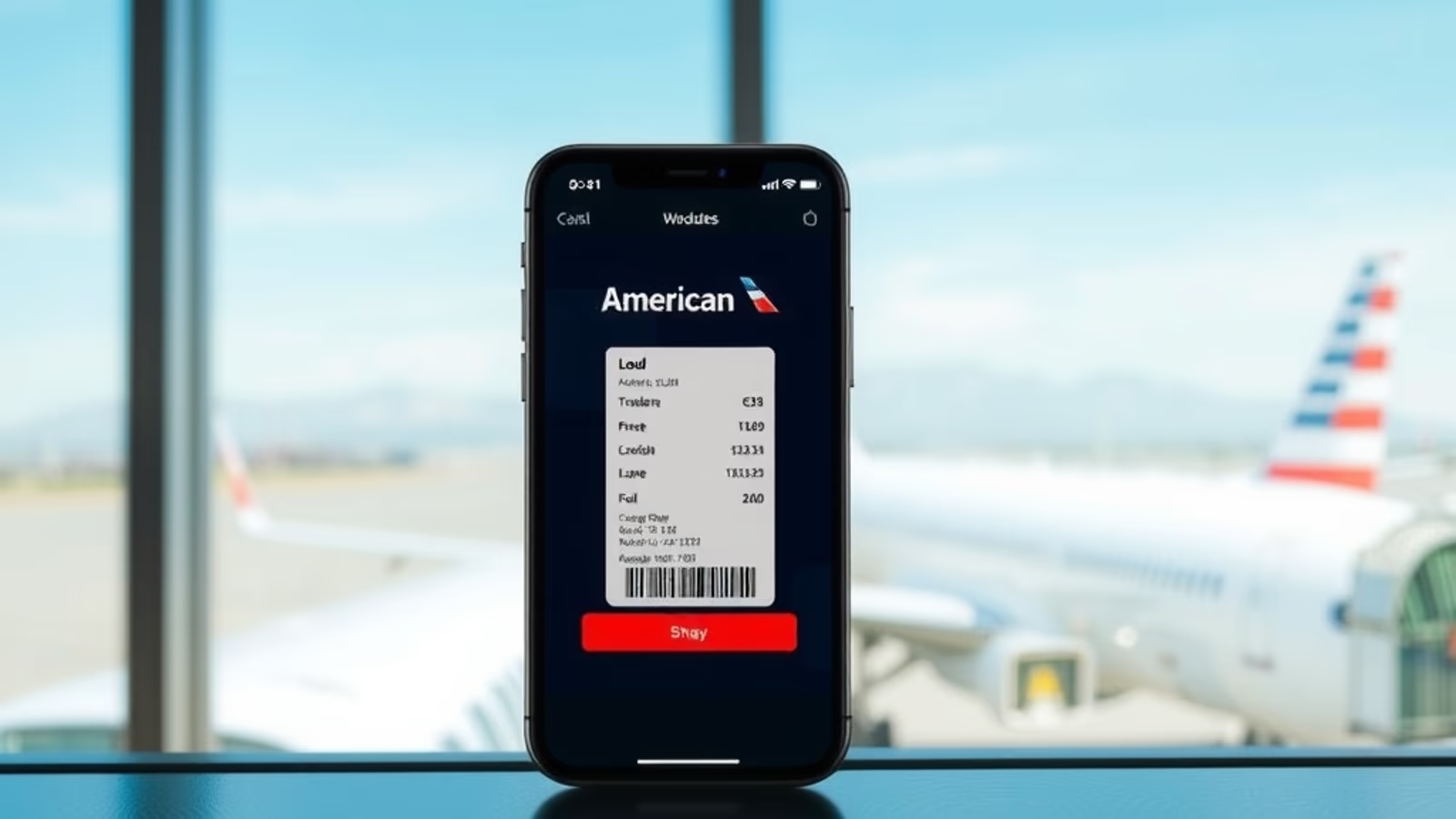
A document holder keeps your passport, vaccination records, boarding passes, and any visa paperwork in one place. Losing a passport mid-trip is the kind of problem that ruins a week, so keep it consolidated and put it back in the same pocket every time.
A cord organizer keeps charging cables from turning into a tangled rope. Small zippered pouches work fine. No need to overspend on a branded version.
A pen and a small notebook still earn their place. Customs forms exist on many international routes, and the cabin pens always go missing. Notes on local recommendations, addresses, and phone numbers belong on paper when your phone battery is the failure mode you're worried about.
A foldable reusable shopping bag tucks into a pocket and saves you from a duty-free bag failure on the way back. It also doubles as a laundry bag.
The backup-plan items
This is where most packing guides stop. The travel desk's version doesn't.
Pack a single change of clothes (underwear, socks, a t-shirt, lightweight pants or shorts) in the carry-on even if your full wardrobe is checked. If the checked bag goes missing for 24 hours, you can shower and change before doing anything else. This single habit has saved more vacations than any other piece of advice on this list.
A lightweight blanket or large scarf serves three purposes: cabin warmth, a wrap during cold airport waits, and a clean layer for hotel pillows you don't trust. Merino wool is the right material because it stays warm, packs light, and doesn't pick up odors.
Medications stay in original packaging. The TSA accepts prescription medications in any quantity in carry-on, but the original label prevents questions at security and at customs in stricter destinations. Pack a few extra days' worth in case of delays.
A small first-aid kit with band-aids, ibuprofen, antihistamines, hydrocortisone cream, and electrolyte tablets covers most in-flight and on-arrival annoyances. Hotel front desks rarely have what you need at 2 a.m.
Tracking and connectivity
Two items have shifted from optional to standard since 2024.
Apple AirTags in both your checked bag and your carry-on are now the baseline. The carry-on tag matters less for tracking and more for the case where the airline forces you to gate-check a full overhead bin, because you want to know where the bag ends up if the connection gets tight. The Find My network coverage is dense enough in major airports and cities to give you a near-real-time location.
An eSIM or international SIM card replaces the old scramble for a kiosk at arrival. Airalo, Holafly, and Saily all sell data-only eSIMs for most countries, activated before you land. For trips longer than a week, a local physical SIM is sometimes cheaper, but the convenience of arriving with data already working is hard to beat.
A universal travel adapter handles the plug situation. The compact all-in-one models cover US, UK, EU, and Australian outlets in a single unit. Pack one for international trips and leave it in the bag permanently. The moment you start packing it per trip is the moment you forget it.
Where credit cards save the day
Pack the cards too, because the right one converts a baggage problem from a personal disaster into a reimbursable inconvenience.
The Chase Sapphire Reserve includes baggage delay coverage of up to $100 per day for five days (so up to $500 in essentials) when your bag is delayed more than six hours. It also includes trip delay reimbursement of up to $500 per ticket if a covered delay lasts more than six hours or requires an overnight stay. Both kick in when the trip is paid for with the card.
The Chase Sapphire Preferred offers similar baggage delay coverage ($100/day for five days) and trip delay reimbursement of up to $500 per ticket after a 12-hour delay or overnight stay. Lower annual fee than the Reserve, same baggage delay structure.
The Amex Platinum includes baggage delay coverage up to $500 when the trip is paid with the card. Trip delay coverage is up to $500 per trip on covered delays of more than six hours.
These protections only activate if the entire fare was paid with the card. Booking the flight on a card with no travel protection and then expecting reimbursement later does not work.
A practical packing order
Pack from the inside out. Heavy and infrequently accessed items at the bottom (laptop in its sleeve, change of clothes, blanket). Mid-frequency items in the middle (toiletries quart bag, document holder, cord pouch). Most-used items in the top compartment or in the personal item under the seat (headphones, portable charger, snacks, sleep mask, book).
The personal item should hold everything you need at your seat without standing up. Once the bin closes, that bag is your entire universe for the flight.
What not to pack
A few items belong in the checked bag or not at all.
Anything liquid over 3.4 ounces. The TSA does not negotiate. Pour it out, ship it ahead, or check it.
Power tools, full-size aerosols, and most camping equipment with fuel canisters go in the checked bag or stay home.
Hardcover books beyond one. They are heavy. An e-reader handles a library at 8 ounces.
Multiple pairs of shoes. Wear one, pack one if absolutely necessary, and that's it.
Anything you would not be willing to lose if the bag did get gate-checked into the cargo hold. Cabin bins fill up fast on full flights, and the gate agent's decision to involuntarily check your carry-on is not a negotiation.
The bag stays packed
The single biggest time-saver is keeping the carry-on partially packed between trips. The toiletries quart bag, the charging cable pouch, the document holder, the universal adapter, the sleep mask, the spare socks, the empty water bottle: all of it lives in the bag year-round. Adding trip-specific items (clothes, the right shoes, weather gear) takes 15 minutes instead of two hours.
Pair this list with a tracked AirTag, a card with baggage protection, and an eSIM activated before takeoff, and most travel disasters become inconveniences instead of emergencies.
This article contains affiliate links. If you apply through our links, we may earn a commission at no cost to you, which helps us continue sharing points and miles strategies with the community.
Some of the links in this article are affiliate links. We may receive a small commission at no extra cost to you if you apply through these links. This helps us keep the site running and continue creating free content.