How Debt Affects Travel Rewards Card Approvals
Carrying a balance does not automatically lock you out of travel rewards cards. What locks you out is the ratio of that balance to your available credit, also known as your utilization. Two readers can both owe $8,000 and have very different approval odds, depending on how much of their credit limits they are using and how those balances are spread across cards.
This guide walks through how issuers actually evaluate debt when you apply, why utilization (not raw balance) is the lever that moves your FICO score, and how to keep earning travel rewards while you pay down what you owe. The math here is meaningful: a single approved Chase Sapphire Preferred application can put 60,000 Ultimate Rewards points in your account, easily worth $750 or more in transferred travel value as of April 2026. Missing that approval because of avoidable utilization mistakes is a real cost.
Quick Answer
Issuers care about your overall credit utilization (balances divided by credit limits), your number of recent accounts, your debt-to-income ratio, and your payment history. Of those, utilization moves your FICO score the fastest. It can swing 30 to 80 points in a single statement cycle. Get utilization under 10 percent before applying for premium travel cards, keep older cards open to preserve available credit, and consider a 0 percent balance transfer to reset utilization while you pay down debt.
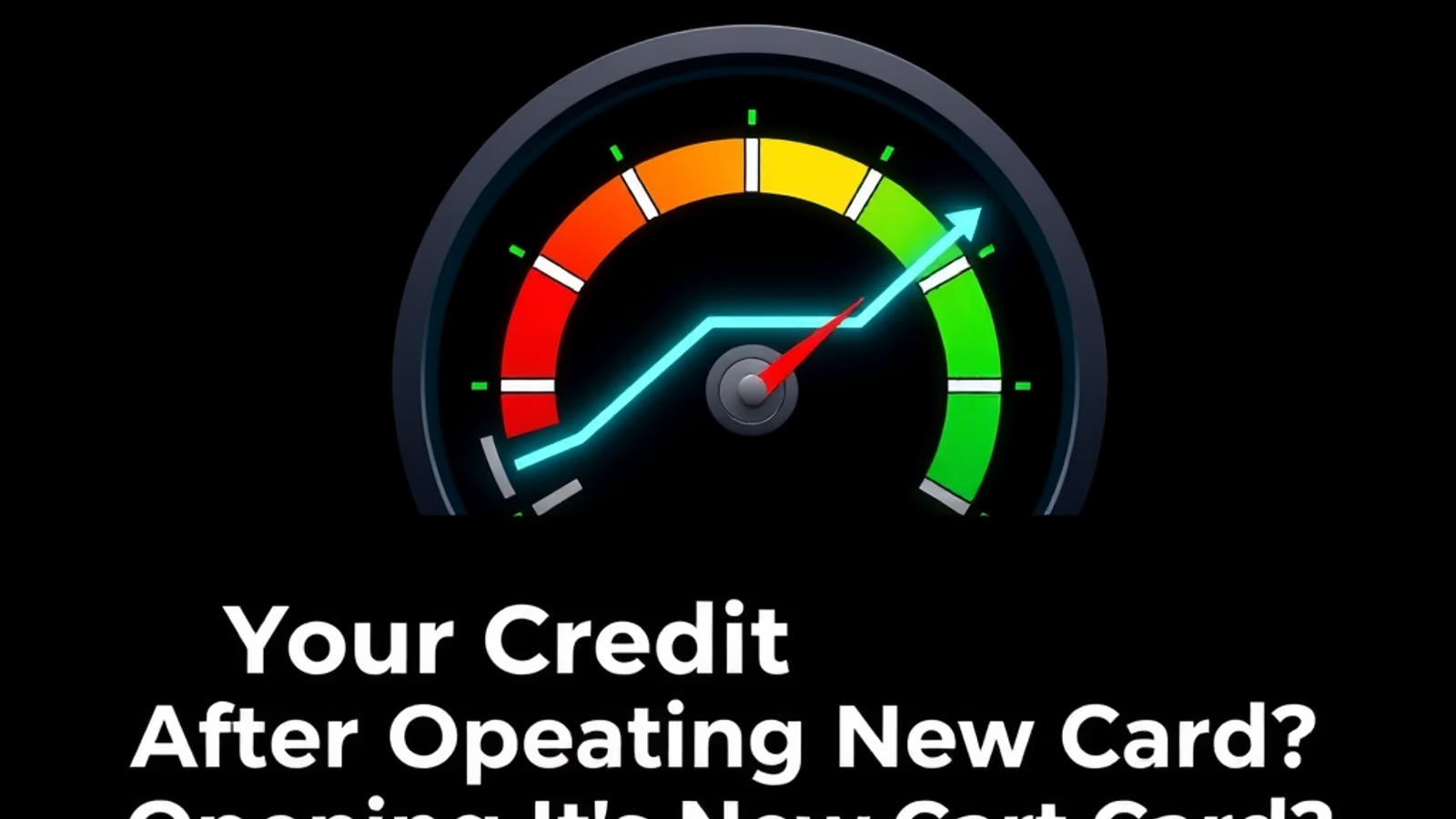
Utilization, Not Balance, Drives Your FICO Score
This is the single most important concept in this entire guide, and it is the one most readers get wrong.
FICO does not score you on how much you owe in dollars. It scores you on the percentage of your available credit you are using. A reader with a $5,000 balance on a card with a $50,000 limit (10 percent utilization) will, all else equal, score higher than a reader with a $2,500 balance on a card with a $5,000 limit (50 percent utilization). The first reader owes twice as much, but the second reader looks far riskier to the FICO model.
The "amounts owed" category makes up roughly 30 percent of your FICO 8 score. Within that category, the most-watched number is your overall utilization, which means total balances across all revolving accounts divided by total credit limits. FICO also looks at per-card utilization, which is why one maxed-out card can drag your score down even if your overall utilization is healthy.
The practical thresholds, as of April 2026:
- Under 10 percent overall utilization. Best scoring tier. This is where you want to be when applying for premium cards.
- 10 to 30 percent. Acceptable for most travel cards. Approval odds are good but not maximized.
- 30 to 50 percent. Score takes a meaningful hit. Premium card approvals get harder. Sub-prime offers start showing up.
- Over 50 percent. Most rewards card approvals become unlikely. Your score is being actively suppressed.
The fix is faster than most people expect. Utilization is recalculated every time a new statement closes, so a single large payment timed before the statement date can move your score within 30 to 45 days. There is no "aging" required. Unlike a late payment, which sits on your report for seven years, high utilization is a snapshot that updates as soon as the next statement reports.
How High Utilization Caps Welcome Bonus Approvals
The major issuers all run their own application logic on top of the FICO score. Knowing how each one weighs debt is the difference between getting approved for a 60,000-point bonus and burning a hard inquiry for nothing.
Chase: the 5/24 rule plus a hidden utilization screen. The 5/24 rule is well-known. Chase generally declines applicants who have opened five or more new credit accounts (across any issuer) in the past 24 months. What gets less attention is that even applicants under 5/24 get declined when their utilization is high. Chase's underwriting looks at both your overall utilization and your utilization on existing Chase cards. If you are sitting at 40 percent utilization across the board, being under 5/24 will not save the application. The Sapphire Preferred and Sapphire Reserve are particularly sensitive here.
Bank of America: the 2/3/4 rule. BoA caps applicants at two new BoA cards in any rolling 2-month window, three in 12 months, and four in 24 months. Like Chase, BoA also runs a separate utilization check, and high overall utilization triggers automatic declines on the Premium Rewards and Travel Rewards cards.
American Express: pop-up jail. Amex does not publish a 5/24-style rule, but the system has a notorious "pop-up." That pop-up is a screen that appears mid-application telling you that based on your history with Amex, you are not eligible for the welcome bonus on this card. The pop-up is triggered by a mix of factors, but high utilization at the time of application is a known input. Pop-up jail is application-specific: you can still get approved for the card, just without the bonus, which defeats the entire purpose.
Capital One: more lenient on utilization, stricter on hard pulls. Capital One pulls all three credit bureaus on a single application, which is more aggressive than other issuers. They tend to be more forgiving of moderate utilization but very strict about recent inquiries.
The takeaway: every issuer has a utilization gate, even when they do not advertise it. If your overall utilization is over 30 percent, the smart move is to pay it down before applying, not after a denial.
Pay Down Before You Apply, Not After
The order of operations matters more than most readers realize.
Imagine two scenarios. In the first, you apply for a Chase Sapphire Preferred at 35 percent utilization, get denied, and then pay down your balances. You have now burned a 5/24 slot, taken a hard inquiry hit, and still need to wait at least six months before reapplying, since Chase generally does not reconsider applications inside that window. In the second scenario, you pay down balances first, wait one statement cycle for the lower utilization to report, then apply at 8 percent utilization. The application sails through, the 60,000-point bonus is yours, and the 5/24 slot was used productively.
The mechanical steps:
- Calculate your current utilization across all revolving accounts. Add up balances, add up limits, divide.
- Identify the cards above 30 percent individually. Per-card utilization matters too, so a single card at 80 percent hurts even if your overall is fine.
- Pay down to under 10 percent on both the overall and per-card numbers before applying.
- Pay before the statement closing date, not just before the due date. The balance reported to the bureaus is whatever shows on the statement, so paying after the statement closes does not help your reported utilization for that month.
- Wait one full statement cycle after the payment posts before applying. This gives the new, lower balance time to report to the bureaus.
This timeline (pay down, wait 30 to 45 days, then apply) is the single biggest leverage point for anyone with debt who wants to keep earning travel rewards.
The Wrong Way: Closing Cards While Paying Down Debt
A common mistake among readers paying down credit card debt is to close the cards once they are paid off. The instinct is reasonable: remove the temptation, simplify the wallet. The execution wrecks your utilization.
Here is the math. Say you have three cards: Card A with a $2,000 balance and $4,000 limit, Card B with a $0 balance and $10,000 limit, Card C with a $0 balance and $6,000 limit. Your total utilization is $2,000 / $20,000, or 10 percent. Healthy.
Now you close Cards B and C because you are not using them. Your total utilization is now $2,000 / $4,000, or 50 percent. You did not change your debt at all, but you just dropped your FICO score by 30 to 60 points and made yourself ineligible for most premium travel cards.
The rule: when you are working on debt, keep paid-off cards open. They preserve your available credit and protect your utilization ratio. The exceptions are cards with annual fees you cannot justify (where you can ask for a product change to a no-fee version of the same card to preserve the credit line and account age) and cards you are tempted to run back up. For everything else, leave them alone.
Balance Transfers: Lower Utilization While Still Earning Rewards
A 0 percent APR balance transfer does two useful things at once for someone trying to earn travel rewards while paying down debt: it stops interest from compounding against you, and depending on which card you transfer to, it can lower the per-card utilization on the cards you actually want to use for new rewards spending.
The mechanic, with real numbers. Say you owe $6,000 on a Chase Freedom Unlimited with a $7,500 limit. That is 80 percent per-card utilization, which is severely dragging your score. You open a balance transfer card with a $10,000 limit and a 21-month 0 percent APR offer. After paying the balance transfer fee (typically 3 to 5 percent, call it $240 on a $6,000 transfer at 4 percent), you move the full balance to the new card.
Before: Freedom Unlimited at 80 percent utilization, $0 monthly interest savings. After: Freedom Unlimited at 0 percent utilization, balance transfer card at 60 percent utilization, but with no interest accruing for 21 months and zero score impact from per-card utilization on the Freedom (the new card's utilization is part of the same overall calculation, but the per-card hit moves off the card you actually use).
Now you can put new spending on the Freedom Unlimited or apply for a new travel rewards card and earn its welcome bonus, with the $200 to $300 in saved interest plus the new bonus more than covering the transfer fee. The catch is that you must actually pay the transferred balance off before the promo period ends, or the rate snaps back to a standard APR (usually 18 to 27 percent as of April 2026) on the remaining balance.
Three rules for using this strategy with travel rewards in mind:
- Do not run the original card back up. The whole point is the lower utilization. New spending on the freed-up card defeats it.
- Pick a transfer card you do not need for rewards. The transfer card will sit at high utilization for the promo period. That is fine if it is a dedicated balance transfer card. It is not fine if it is a card you wanted to use for travel spending.
- Math the fee against the avoided interest. A 3 percent fee on a $6,000 balance is $180. At a typical 24 percent APR, that interest accrues in roughly 45 days. If your payoff plan takes longer than that, the transfer is a clear win.
Earning Rewards While Rebuilding Credit
For readers with deeper credit issues, such as recent late payments, high utilization that will take more than a year to clear, or limited credit history, the premium travel cards are not the right starting point. But you can still earn rewards while you rebuild.
Capital One Quicksilver Secured. This card requires a refundable security deposit (typically $200 to start), reports to all three bureaus, and earns 1.5 percent cash back on every purchase. It is one of the few secured cards that earns rewards at the same rate as its unsecured counterpart. Capital One has a clear graduation path: accounts in good standing typically get unsecured within 6 to 12 months, with the deposit returned. The cash back is not transferable to airline partners, but at 1.5 percent it is competitive with most flat-rate unsecured cards while you rebuild.
Discover it Secured. Earns 2 percent at gas stations and restaurants (on the first $1,000 in combined quarterly spending) and 1 percent on everything else. Discover also matches all cash back earned in the first year, which effectively doubles the rewards rate during the rebuilding period.
Chase Freedom Rise. Designed for readers with limited or rebuilding credit, no annual fee, and earns 1.5 percent cash back. Chase has indicated that responsible use can lead to upgrade offers for Sapphire-family cards down the line.
The strategy is to use one of these to rebuild for 12 to 18 months while keeping utilization under 10 percent and every payment on time. Once your score crosses into the 700s and your utilization is clean, you graduate to the actual travel cards. At that point, your earlier rewards card is still earning while it ages your credit history.
Common Mistakes to Avoid
- Applying with high utilization, hoping the issuer will overlook it. They do not. Pay down first, wait a cycle, then apply.
- Closing paid-off cards. This raises utilization and shortens credit history. Keep them open or product-change to no-fee versions.
- Paying after the statement closes instead of before. The bureaus see the statement balance, not the post-payment balance. Pay before the statement date to get credit for the lower number.
- Rolling new spending onto a card you just paid down. The point of the payoff was lower utilization. Putting new charges back on it during the application window defeats the strategy.
- Ignoring per-card utilization. Even with healthy overall utilization, one near-maxed card hurts your score. Spread balances or pay down the highest-utilization card first.
Conclusion
Debt affects travel rewards eligibility through one main lever: credit utilization. Get that under 10 percent before you apply, keep your paid-off cards open, and use 0 percent balance transfers to stop interest from compounding while you work the payoff plan. None of this is fast (figure on 30 to 45 days minimum from a meaningful utilization cut to a higher reported score) but it is reliable. The readers who get into trouble are usually the ones who apply first and fix utilization later. Reverse that order and the math works out.
This article contains affiliate links. If you apply through our links, we may earn a commission at no cost to you, which helps us continue sharing points and miles strategies with the community.
Some of the links in this article are affiliate links. We may receive a small commission at no extra cost to you if you apply through these links. This helps us keep the site running and continue creating free content.