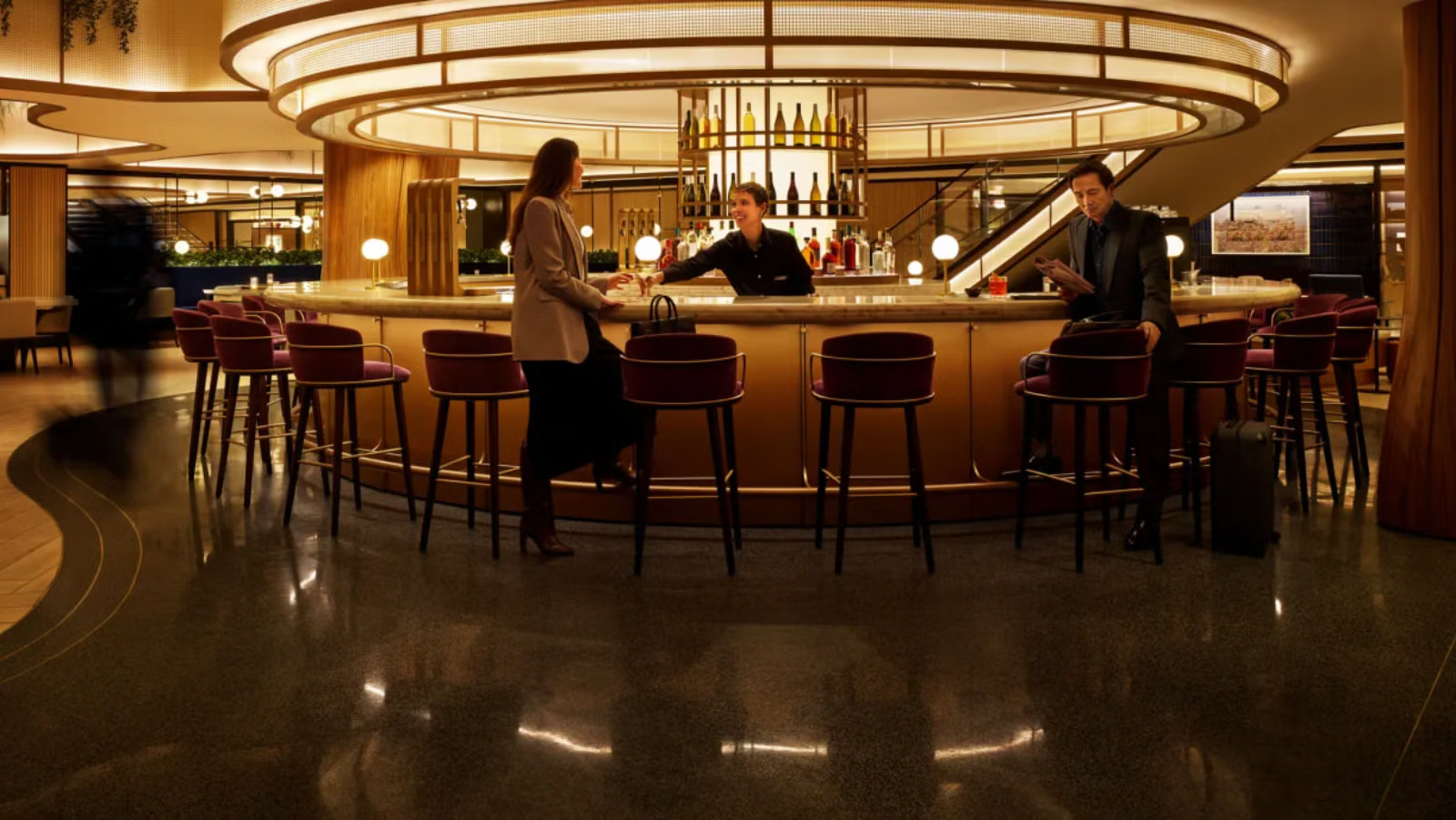
Chase built a lounge network. Chase did not build it for the flights your Ultimate Rewards points actually book. That's the paradox, and once you see it you can't unsee it: the cards earn points that transfer to international carriers you'll mostly fly on, the lounges sit in airports where those carriers don't fly the routes you'd redeem for, and on paper it looks like a strategic mismatch. The real picture is messier than that. For most international premium-cabin redemptions the paradox doesn't actually bite, because the operating carrier opens its own lounge to your premium ticket regardless of what's in your wallet. Where it does bite is narrower than the takes online suggest, and the fix is simpler than building a second card portfolio from scratch.
This piece walks through the current Sapphire Lounge footprint as of May 2026, who gets in and at what tier, where the transfer-partner-versus-lounge mismatch is real, where it's a non-issue because your premium award ticket already comes with better lounge access, and where the gap actually hurts (mostly domestic premium cabins, not international ones). I'll also lay out the dual-stack card portfolio that closes the remaining gaps without $1,500 a year in annual fees you don't need.
The Chase Sapphire Lounge network, May 2026
The Sapphire Lounge by The Club network has expanded steadily since the first location opened at Hong Kong International in 2022. As of May 2026, the U.S. footprint includes lounges at Boston Logan (BOS), New York LaGuardia (LGA) Terminal B, New York JFK Terminal 4, Philadelphia (PHL), Las Vegas Harry Reid (LAS), Phoenix Sky Harbor (PHX), San Diego (SAN), Austin-Bergstrom (AUS), and a Chicago O'Hare location that opened in early 2026. The international roster covers Hong Kong (the original) and one location in London Heathrow's Terminal 4. Lounge counts and openings move; check Chase's official lounge page for the current list before you plan around any specific airport.
A few notes on access tiers.
Sapphire Reserve cardholders get unlimited complimentary access for themselves and up to two guests. Bringing more than two guests costs $27 per additional guest. That access is the headline benefit of the $550 annual fee, and it's the only Chase product that includes Sapphire Lounge entry at no incremental cost. Reserve also includes Priority Pass Select with restaurant credits for airports without a Sapphire Lounge.
Sapphire Preferred cardholders do not get Sapphire Lounge access. The $95 annual fee tier earns the points; it doesn't get the lounge.
Ritz-Carlton Card holders (the legacy product closed to new applications for years) get access with the same guest rules as Reserve.
Priority Pass members with select-access membership can get into some Sapphire Lounges, but the rules vary by location. Boston, JFK, and LaGuardia generally accept Priority Pass select with restrictions on day of week and time. PHL, PHX, and LAS lean toward Reserve-only or paid guest access. The honest answer is that if you're not a Reserve cardholder and you don't have a same-day premium-cabin ticket that opens the lounge another way, plan on either paying for guest access or going somewhere else.
Most U.S. locations also sell standalone day passes at $50 to $75. You don't need a Chase card to buy one, which is worth knowing if you're stuck at PHL or AUS with time to kill.
The transfer partner roster, and where the planes actually go
Chase Ultimate Rewards transfers 1:1 to thirteen partners: United, Air Canada Aeroplan, Air France-KLM Flying Blue, British Airways Executive Club, Iberia Plus, Virgin Atlantic Flying Club, Aer Lingus AerClub, Emirates Skywards, JetBlue TrueBlue, Southwest Rapid Rewards, Singapore KrisFlyer, Marriott Bonvoy, World of Hyatt, and IHG One Rewards. Three hotel partners, ten airlines.
Look at where those airlines actually fly out of in the U.S. and the lounge mismatch starts to clarify.
United flies out of every major U.S. airport but its hubs are Newark, Chicago O'Hare, Denver, Houston Intercontinental, San Francisco, Los Angeles, and Washington Dulles. Of those, only O'Hare now has a Sapphire Lounge.
The Air France-KLM Flying Blue redemptions you'd actually book (transatlantic business class, primarily on Air France out of JFK/IAD/BOS/SFO/LAX/ATL/MIA or on KLM out of JFK/IAD/BOS/ATL/IAH/LAX) depart from a mix. JFK and BOS have Sapphire Lounges. Most of the others don't.
Virgin Atlantic transfers are the sweet-spot play for ANA business class (out of JFK/IAD/ORD/SFO/LAX/IAH/SEA), Delta One on partner availability, and Virgin Atlantic's own metal out of BOS/JFK/IAD/LAX/MIA/SFO/SEA/ATL. BOS, JFK, and ORD now have Sapphire Lounges. IAD, SFO, LAX, IAH, SEA, MIA, ATL don't.
Aeroplan flies you on Air Canada and Star Alliance partners. Star Alliance long-haul out of the U.S. is mostly United metal (no Sapphire Lounge at the hubs except ORD) plus Lufthansa, Swiss, ANA, EVA, Singapore, Turkish, and a handful of others at various airports.
British Airways out of the U.S. flies almost exclusively into London Heathrow from major U.S. cities. Iberia similarly into Madrid. Both ex-JFK/BOS/ORD work with the Sapphire Lounge footprint; ex-IAD/SFO/LAX/MIA/IAH/DFW/PHX/SEA/ATL do not.
Singapore KrisFlyer transfers are the unicorn play for Singapore Suites out of JFK and LAX. JFK aligns; LAX doesn't.
Emirates is JFK/BOS/ORD/IAD/SFO/LAX/IAH/DFW/MIA. JFK, BOS, ORD overlap. The rest don't.
JetBlue and Southwest are the domestic-leaning partners. Southwest flies out of nearly everywhere; PHX, LAS, SAN, AUS are real Southwest airports and all have Sapphire Lounges, so the alignment there is genuinely tight. JetBlue's focus cities are JFK, BOS, LGA, FLL, MCO, LAX, EWR — and four of those (JFK, BOS, LGA, plus a stretch case for EWR if you count the LGA lounge as close enough) overlap with Sapphire Lounges.
What the map shows: for high-value international premium-cabin transfers, you're usually departing from an airport without a Sapphire Lounge. For domestic Southwest and JetBlue redemptions, the alignment is actually pretty good. The mismatch is real but it's specifically a mismatch for the high-end international play, not a mismatch across the board.
Why this matters less than it sounds like for international premium cabins
Here's the part that the "Chase Lounge Paradox" framing leaves out. When you redeem points for a premium international award ticket, the operating carrier opens its own lounge to you at the departure airport, regardless of which credit card paid for your meal yesterday.
Concrete examples. You transfer 75,000 Aeroplan miles to fly ANA business class from Chicago O'Hare to Tokyo Narita. ANA's contract lounge in ORD is the United Polaris Lounge, which is open to ANA business class passengers as a Star Alliance partner. The Sapphire Lounge at ORD is a nice-to-have; the Polaris Lounge is the better product and you're already in.
Another: you transfer 50,000 Virgin Atlantic points to fly ANA business class JFK to Haneda. Same dynamic. Star Alliance business class out of JFK Terminal 7 means you're in the United Club at minimum and often have access to the Lufthansa Business Lounge or the Air India Maharajah Lounge depending on day of week. The Sapphire Lounge at JFK Terminal 4 is a different terminal entirely.
Another: 57,500 Flying Blue miles for Air France business class Boston to Paris. You're in the Air France Lounge at BOS. Done. The Sapphire Lounge BOS is open to you as a Reserve cardholder if you want both, but the Air France Lounge is the one designed for your specific flight.
The pattern: paid or award premium-cabin international tickets carry their own lounge access via the operating carrier or the alliance. Sapphire Lounge access at the same airport is additive, not substitutive. If you're transferring Chase points for transatlantic or transpacific premium cabin and you're worried about the lounge, you're worrying about the wrong thing. The carrier already has you covered.
There's one specific edge case worth flagging. Virgin Atlantic's award redemptions on Delta One flights (where you book Delta metal using Virgin points) do open the Delta Sky Club at departure. ANA award redemptions on United metal open the United Club or Polaris Lounge. Aer Lingus award redemptions on Aer Lingus's own metal out of BOS/ORD/JFK/IAD/LAX/SEA open the Aer Lingus partner lounge, usually a contract space, sometimes the British Airways lounge. Check the specific routing, but the default is that your premium award ticket buys lounge access independent of your card.
Where the paradox actually hurts
The mismatch matters in three specific scenarios.
Domestic premium-cabin awards where status, not cabin, gates the lounge. If you redeem United miles for United P.S. (the premium transcontinental product) JFK to LAX, the United Club entry is gated by Star Alliance Gold status or a same-day international itinerary, neither of which a domestic premium domestic ticket gives you. American flagship business class on JFK-LAX or JFK-SFO is similar — the Flagship Lounge requires same-day international or Concierge Key status. Neither airline opens its premium domestic ticket to its own lounge. Here the Sapphire Lounge or your card-based lounge access is doing real work.
Economy international award redemptions. When you transfer 30,000 Flying Blue miles for a Promo Award economy ticket to Europe, you're in coach. The Air France lounge at BOS isn't opening for you. The Sapphire Lounge BOS, on the other hand, doesn't care what cabin you booked. If you're a Reserve cardholder leaving from a Sapphire Lounge airport in economy, the lounge is the real benefit.
Layovers in airports where you're not departing on a premium international ticket. Stop-overs in your award itinerary, return legs in mixed cabins, and connections through Sapphire Lounge airports on the back end of an international award are all situations where the Sapphire Lounge access acts independently of the operating carrier's lounge.
If your travel profile is "transfer Chase points to United or Flying Blue or Virgin Atlantic for business class twice a year, fly economy on shorter domestic trips the rest of the time," the Sapphire Lounge access on a Reserve card is doing more work on the domestic-economy half of that equation than on the international-business half. Worth understanding when you're deciding whether the $550 Reserve fee is paying for what you think it's paying for.
The dual-stack card portfolio fix
If you want to close the remaining gaps without overbuilding your wallet, the cleanest dual-stack pairs the Sapphire Reserve with an Amex card that opens the Centurion Lounge network. Amex Platinum is the obvious pick. Annual fee is $695, gets you into Centurion Lounges at most of the United hubs the Sapphire Lounge network doesn't cover (SFO, LAX, DEN, IAH, DFW, MIA, ATL, IAD, plus more), Priority Pass with no restaurant credits, Delta Sky Club access on same-day Delta flights, and a stack of credits that mostly cancel out the fee if you'll use them.
The Reserve plus Platinum together costs $1,245 in annual fees before any credits. That's real money. Whether it's worth it depends on how often you fly out of airports that are in one network and not the other.
A cheaper alternative for some readers: drop the Platinum and pick up Capital One Venture X at $395. Venture X gets you Capital One Lounges (currently at IAD/DFW/DEN and a few others, with more in the pipeline), unlimited Priority Pass with up to two guests, and a $300 annual travel credit through Capital One Travel that effectively brings the net fee to $95. The Capital One Lounge network is smaller than Amex's but it covers some of the United hubs the Sapphire Lounge network misses and the Priority Pass benefit picks up most of the rest.
The portfolio I'd suggest for a points-and-miles reader who flies out of multiple airports and wants lounge access without paying $1,200 in annual fees: Sapphire Reserve for the Ultimate Rewards transfers and Sapphire Lounge access, Capital One Venture X for the secondary lounge network and the duplicative Priority Pass coverage. Combined annual fee net of credits runs about $645 before any other credits, and you've got lounge access at almost every U.S. hub the Chase transfer partners actually fly out of.
If you're flying primarily United and the international premium-cabin question is theoretical because you mostly fly domestic, the cleaner answer is a United co-brand card for United Club access (the United Club Infinite Card includes membership) plus a cheaper Chase product for the Ultimate Rewards earn rate. That stack costs $525 in annual fees and gets you actual United Club access at every United hub, which is what your transfer-partner economics were pointing at in the first place.
What this changes about the calculus
The Chase Sapphire Lounge network is genuinely useful for Reserve cardholders at the specific airports where the lounges sit, particularly for domestic flights and economy international flights where the operating carrier isn't going to open its lounge to you. The transfer-partner misalignment is real on paper but mostly evaporates in practice for premium-cabin international redemptions because the airline's own lounge contract takes over.
The places where the gap actually shows up are narrower than the takes online suggest: domestic premium cabins where lounge access is status-gated, economy international redemptions where the card is doing all the lounge-access work, and layovers/connections outside your departure city. Those are real, but they're a subset of trips. For most readers, the Sapphire Lounge access on the Reserve is doing different work than the transfer partner program is doing, and you don't need both pieces to point at the same airport for both to be earning their keep.
The dual-stack solution, if you decide you need it, is cheaper and cleaner than the maximalist three-card portfolio that the older guides recommend. Reserve plus Venture X covers the network gap at about half the annual-fee cost of Reserve plus Platinum, and for most readers that's the right tradeoff.
This article contains affiliate links. If you apply through our links, we may earn a commission at no cost to you, which helps us continue sharing points and miles strategies with the community.
Some of the links in this article are affiliate links. We may receive a small commission at no extra cost to you if you apply through these links. This helps us keep the site running and continue creating free content.