

Chase + Coinbase Partnership: How Ultimate Rewards Crypto Redemption Works in 2026
Key Points
- Chase cardholders can now redeem Ultimate Rewards points for USDC stablecoin at one cent per point through a linked Coinbase account.
- The conversion rate matches cash redemption value, which is poor compared to transfer partners that routinely deliver two cents or more per point.
- Treat this as a convenience feature for crypto-curious cardholders, not a sweet spot. Keep travel transfers as your primary redemption strategy.
Introduction
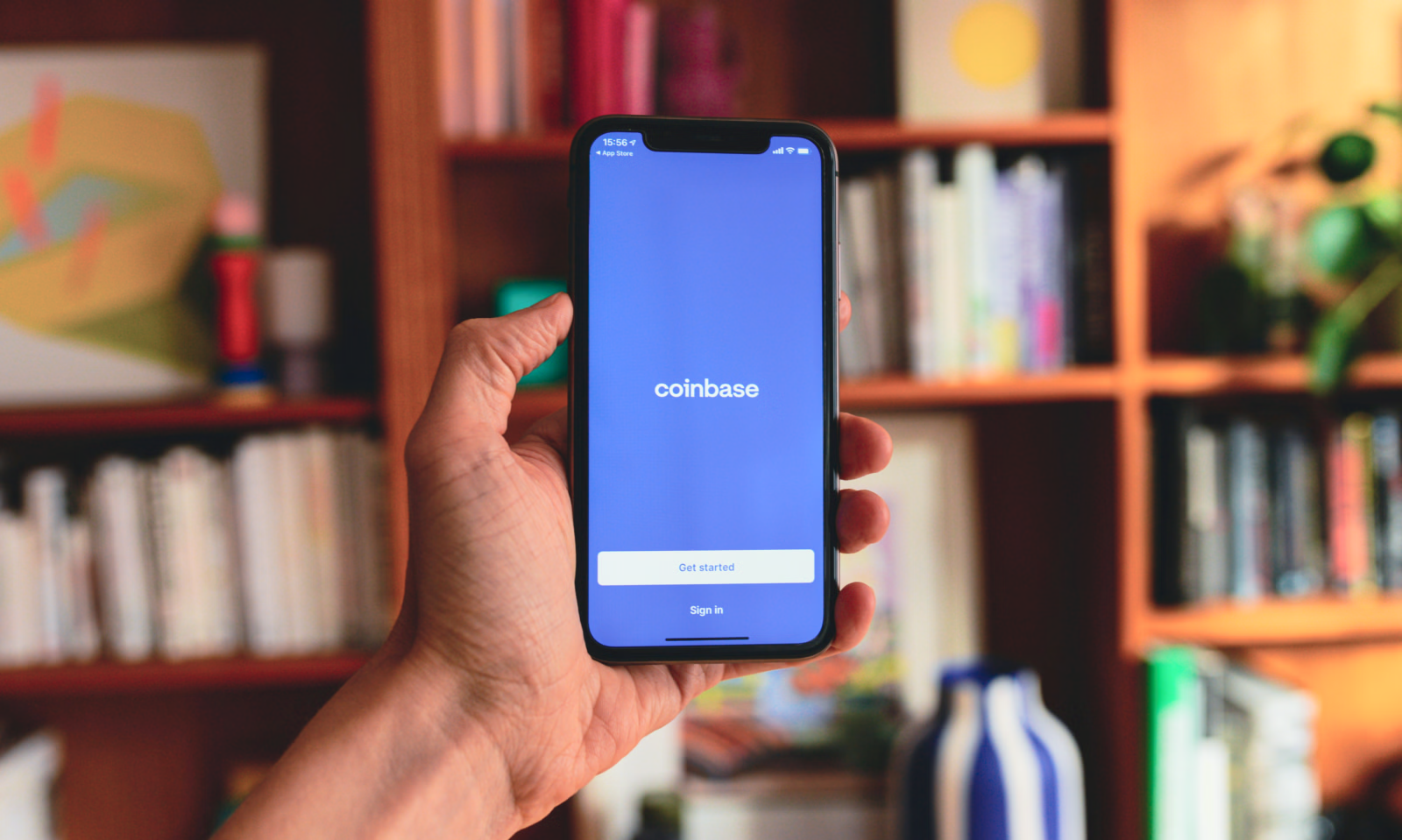
The Chase and Coinbase partnership announced in mid-2025 is now live. As of April 2026, Chase cardholders can convert Ultimate Rewards points directly into USDC, a US dollar-pegged stablecoin, through a linked Coinbase account. That makes Chase the first major issuer to offer points-to-crypto redemption inside its native rewards program.
The mechanics are simple and the marketing is loud. The math, less so. At one cent per point, this redemption sits at the bottom of the value table for Ultimate Rewards. That is the same rate as a cash-back statement credit. Here is what changed, how it works, and why most Chase cardholders should keep doing what they were already doing.
What Actually Launched
The partnership rolled out in two phases. Chase credit cards became fundable on Coinbase in the fall of 2025. The points-to-USDC conversion went live for eligible Ultimate Rewards cardholders earlier in 2026, alongside direct bank-to-Coinbase wallet integration that bypasses third-party processors like Plaid.
Eligible cards are the ones that earn full Ultimate Rewards points: Chase Sapphire Preferred, Chase Sapphire Reserve, Chase Ink Business Preferred, and Chase Ink Business Unlimited. Freedom-branded cards earn a cash-back variant of Ultimate Rewards and cannot transfer points to partners or to USDC without first being moved into a premium card account.
To redeem, you link a verified Coinbase account inside the Chase Ultimate Rewards portal, choose how many points to convert, and the equivalent USDC lands in your Coinbase wallet. Conversion is one point to one cent of USDC, or 100 points per dollar.
Why One Cent Per Point Is the Wrong Number
Ultimate Rewards points have a wide value range depending on how you redeem them. The crypto conversion sits at the floor of that range.
- Statement credit or cash: 1.0 cent per point.
- Chase Travel portal (Sapphire Preferred): 1.25 cents per point.
- Chase Travel portal (Sapphire Reserve): 1.5 cents per point as of April 2026. Confirm in-portal before redeeming, since Chase has been adjusting Reserve benefits.
- Transfer partners (Hyatt, United, Air Canada Aeroplan, Air France-KLM Flying Blue): routinely 2 to 4-plus cents per point on premium-cabin and aspirational hotel redemptions.
Converting 60,000 points to USDC nets you $600 worth of stablecoin. Transferring those same 60,000 points to Hyatt for two nights at a Category 6 property, say a US resort running 30,000 to 35,000 points per night at peak pricing, can produce $1,200 to $1,800 in real lodging value. The crypto redemption gives up that gap.
Stablecoins do not appreciate. USDC is designed to hold a one-dollar value, so this is not a "buy low, sell high" play. You are converting points to dollars and parking those dollars in a crypto wallet.
How It Compares to Other Crypto Rewards Options
Chase is not the first card-linked crypto product, just the first major issuer to bolt the option onto an existing transferable-points currency.
The Coinbase Card already offers up to 4 percent back in crypto on spend, with the rewards posting directly to your Coinbase account. Venmo's credit card lets cardholders auto-convert cash-back rewards to Bitcoin, Ethereum, Litecoin, or Bitcoin Cash. Several smaller issuers have offered Bitcoin-back products since 2021.
What the Chase product adds is the ability to use existing Ultimate Rewards balances, not just future spend, to acquire stablecoin. That is genuinely new. Whether it is useful depends entirely on what you would have done with those points otherwise.
Who This Actually Helps
This redemption makes sense in a narrow set of cases.
You are already cashing points out at one cent. If you have been pulling Ultimate Rewards as statement credits and using the cash to fund a Coinbase account, the new conversion removes a step. Same value, fewer clicks.
You want stablecoin exposure and have orphan points. If you have a small Ultimate Rewards balance from a closed card or a sunsetting bonus that you cannot transfer efficiently, USDC is a reasonable parking spot.
You are crypto-curious and prefer integration over optimization. If a unified Chase-Coinbase view matters to you and you have already decided that one cent per point is acceptable, the convenience is real.
For everyone else, which is most readers here, the math has not changed. Transfer partners still deliver the best value on Ultimate Rewards, and the Chase Sapphire Preferred remains a strong entry point precisely because of that transfer flexibility. Compare the broader Chase versus Amex transfer ecosystem in our Membership Rewards vs. Ultimate Rewards breakdown, and see our roundup of the best Chase cards for travel points for the cards that actually earn at premium category rates. New to the program? You can apply for the Chase Sapphire Preferred here.
What to Watch Going Forward
Two things are worth tracking over the next year.
First, whether Chase introduces a points-to-crypto bonus. A 1.25-cent or 1.5-cent conversion rate would change the calculus considerably. There is no public indication this is coming, but transfer-bonus mechanics already exist for partners, and a stablecoin promotion is plausible.
Second, the tax treatment. The IRS has not issued specific guidance on rewards-points-to-crypto conversions. Most issuers treat points themselves as a non-taxable rebate, but converting them to a digital asset and later disposing of that asset can create capital-gains reporting obligations even if the asset never appreciated. Keep records of the conversion date, the point quantity, and the dollar value at conversion. Talk to a tax professional if you convert significant balances.
The Bottom Line
The Chase-Coinbase partnership delivered exactly what was announced: a real, working pipeline from Ultimate Rewards points into USDC stablecoin at one cent per point. It is a useful product for a specific kind of customer.
It is not a value upgrade. The partnership widens the menu of redemption options without adding a high-value entry to that menu. Travel transfers still win, the portal still beats cash, and crypto conversion still ranks where cash ranks: at the bottom of the table on cents-per-point alone.
If you have been redeeming Ultimate Rewards for travel, keep doing that. If you have been cashing out points anyway, this is a slightly more convenient way to do the same thing. And if you are new to Ultimate Rewards and trying to figure out the right starting card, the answer has not changed in 2026.
This article contains affiliate links. If you apply through our links, we may earn a commission at no cost to you, which helps us continue sharing points and miles strategies with the community.
Some of the links in this article are affiliate links. We may receive a small commission at no extra cost to you if you apply through these links. This helps us keep the site running and continue creating free content.