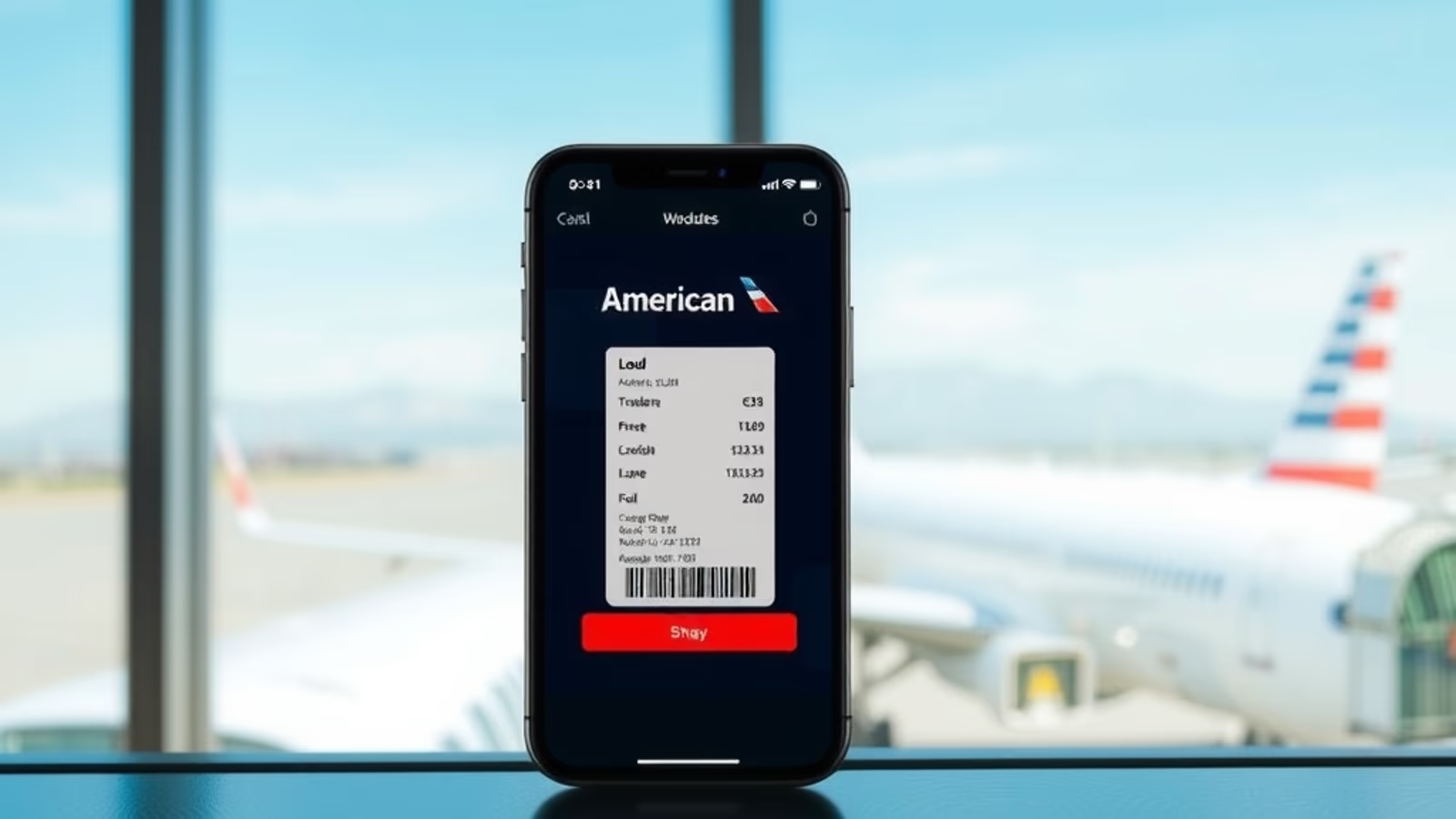
Buying airline miles or hotel points is one of the most over-marketed and under-analyzed decisions in the loyalty world. Every program runs sales. Every sale email implies the points are a deal. The honest answer is that buying points is rarely a good idea, and the cases where it works are narrow, math-driven, and almost never spontaneous.
The single rule that prevents most bad buys is this: do not purchase points speculatively. The exception is a strategic top-up when you have already identified a specific redemption, priced it in cash, priced it in points, and confirmed availability. If any one of those steps is missing, you are not buying points. You are gambling that you will eventually need them, and the program has already priced that gamble against you.
What follows is the math, the scenarios where buying works, the program-by-program rates as of mid-2026, and the five-step process to apply before you click purchase.
The math behind a buy decision
Every buy decision reduces to two numbers: cost per point and value per point.
Cost per point is total dollars paid, divided by total points received including any bonus. If United sells 50,000 miles for $1,880 at the standard rate, that is 3.76 cents per mile. If a 100% bonus drops the same package to $1,880 for 100,000 miles, the cost falls to 1.88 cents per mile.
Value per point depends on the redemption. A business-class award that retails for $5,500 in cash and costs 75,000 miles is worth 7.3 cents per mile. A domestic economy ticket retailing at $220 for 25,000 miles is worth 0.88 cents per mile. The mile is identical in both cases. The redemption creates the value.
A buy makes sense only when value per point comfortably exceeds cost per point. "Comfortably" matters because the calculation has to absorb risk: a devaluation between purchase and booking, schedule changes that force a replan, and the opportunity cost of cash committed today for travel later.
The baseline rates worth memorizing as of mid-2026, before any promotion:
- United MileagePlus: roughly 3.5 to 3.8 cents per mile, with sales often near 2.0 cents
- American AAdvantage: roughly 2.95 to 3.55 cents per mile, with sales near 1.77 cents
- Delta SkyMiles: roughly 3.5 cents per mile, with smaller and less frequent discounts
- Marriott Bonvoy: roughly 1.25 cents per point, with sales near 0.625 cents
- World of Hyatt: roughly 2.4 cents per point, with sales rare and modest
- IHG One Rewards: roughly 1.4 cents per point, with sales near 0.5 cents at 100% bonus
- Hilton Honors: roughly 1.0 cent per point, with sales near 0.5 cents at 100% bonus
Those baselines change. Always confirm the current price at purchase.
When buying actually makes sense
Three scenarios defend a point purchase as something other than marketing. All three share a feature: the redemption is identified first, and the purchase fills a known gap.
The first is the strategic top-up. You are 8,000 Hyatt points short of a confirmed Park Hyatt redemption priced at $1,800 cash. A 25% sale puts the 8,000 points at roughly $144. You pay $144 to save approximately $1,800, and the math survives any reasonable devaluation between now and check-in.
The second is transfer-bonus stacking. Some programs allow point purchases that, combined with a transfer bonus from a flexible currency, push effective cost well below baseline. The mechanic only works when both promotions are live, the redemption is bookable, and the program permits the transfer direction. Rare but powerful.
The third is locking award space. You have found a transcon business-class seat that will be gone within 24 hours. You are short 12,000 American miles. At sale pricing the gap costs $215; the cash fare is $2,400. Buying to book now, rather than missing the seat while you accumulate, is rational if the math clears after the buy.
What these three share: the redemption exists before the purchase, cost per point is below value per point by a meaningful margin, and the cash equivalent would otherwise come out of pocket.
When buying is a mistake
Sale marketing tends to obscure the three most common bad-buy patterns.
Speculative bulk buying is the most expensive mistake. Purchasing 150,000 hotel points because "they might be useful" assumes a future redemption at a value you have not verified, in a program whose award chart can change at any time. Marriott, Hilton, and IHG have all repriced redemptions upward in recent years. Points bought speculatively in 2024 often redeemed for fewer nights in 2025 than expected.
Standard-rate buying is the second mistake. Programs publish a baseline price specifically because it is high enough to be unprofitable for most uses. Buying United miles at 3.76 cents to book an economy ticket worth 2 cents per mile is a guaranteed loss. The only reliable win is buying during a real sale, ideally near the lowest historical price for that program.
Overbuying past what you need is the third. If a redemption requires 60,000 points and you have 47,000, the right purchase is 13,000, not the 60,000 package the program upsells. Larger packages look cheaper per point, but the extra points become speculative the moment they sit unused. Buy the gap, not the package.
Program-by-program
These are the standard prices and typical sale prices as of mid-2026. Confirm current pricing at the moment of purchase, because promotional cadences and standard rates shift periodically.
United MileagePlus. Standard price roughly $35 per 1,000 miles. Annual cap 200,000 miles. Sales run quarterly; the deepest bring effective cost to about 2.0 cents per mile. Worth buying only when paired with a confirmed Star Alliance partner business-class redemption, where values often clear 5 cents per mile.
American AAdvantage. Standard price roughly $32.66 per 1,000 miles plus a 7.5% federal excise tax. Annual cap 150,000 miles. The strongest sales cut effective cost to about 1.77 cents per mile. Best paired with off-peak partner awards or specific Web Special pricing.
Delta SkyMiles. Standard price roughly $35 per 1,000 miles. Delta sales tend to be smaller in magnitude than United or American's, and the program's dynamic award pricing makes high-value redemptions harder to identify. Buying SkyMiles is defensible only when a specific Flash Sale redemption or partner award is already on hold.
Marriott Bonvoy. Standard price roughly $12.50 per 1,000 points. Annual cap 100,000 points. Marriott runs sales close to monthly; the best 50% bonus offers drop effective cost to about 0.625 cents per point. Worth considering only for a specific high-category property redemption where the cash rate cleanly exceeds the points cost.
World of Hyatt. Standard price roughly $24 per 1,000 points. Hyatt rarely runs deep sales and the annual cap is 55,000 points. Because Hyatt award rates are already strong against cash, top-ups for a confirmed Park Hyatt, Andaz, or Alila redemption are the cleanest use case.
IHG One Rewards. Standard price roughly $14 per 1,000 points. Frequent 100% bonus promotions drop the effective cost to about 0.5 cents per point. The economics work for Intercontinental and Vignette Collection redemptions where cash rates can exceed $400 a night.
Hilton Honors. Standard price roughly $10 per 1,000 points. Annual cap 80,000 points. Hilton's 100% bonus offers appear several times a year, dropping effective cost near 0.5 cents per point. Worth buying for top-tier Waldorf Astoria or Conrad properties where the cash-to-points spread is widest.
The five-step decision process
Before any purchase, run this sequence. If any step fails, the buy does not proceed.
-
Find the redemption first. Identify the specific flight or hotel night, confirm award space, and note the points cost and any cash co-pay. No redemption, no purchase.
-
Calculate the cash equivalent. Price the same flight or night in cash, including taxes and fees. This is what the points need to clear to be worth buying.
-
Determine the purchase cost. Total dollars paid, including federal excise tax where applicable, divided by points received including any sale bonus.
-
Compare values. Divide cash equivalent by points required to get value per point. A purchase is worth making only when value per point exceeds cost per point by a meaningful margin, generally 2x or more, to absorb devaluation and replan risk.
-
Consider alternatives. A new card welcome bonus often delivers more points at a lower effective cost. Transferable points from a flexible currency can cover the same redemption. Family pooling, where supported, may close the gap from a partner's account.
Running all five steps prevents most bad purchases. Skipping step one is what produces the speculative buys that drive program profits.
Promotional cadences worth tracking
United runs sales roughly four times a year, strongest in spring and fall. Marriott runs sales close to monthly, though most are modest 30% bonuses; the 50% offers worth waiting for surface several times annually. IHG and Hilton both run 100% bonus promotions multiple times a year, often around holiday booking periods. American's sales appear less predictably but generally clear 1.77 cents per mile when they do.
Subscribe to program emails or set a reminder to check pricing quarterly. Programs rarely extend their best promotions, but they repeat the cadence. Waiting four to six weeks for a better sale is usually the right call when the redemption is not time-sensitive.
Payment method matters
Always pay with a credit card, not a debit card. Credit cards provide purchase protection and dispute rights if the points do not post correctly, most cards offer at least 1x earning on the purchase for a small rebate, and debit transactions skip the protections that matter when something goes wrong. Cards that earn flexible currencies add modest value on top of the buy, though the transaction usually codes as a standard purchase rather than travel.
Risks and constraints
Three risks deserve weight in any buy decision.
Devaluations happen and are rarely announced in advance. Marriott repriced its top properties without notice. Delta has shifted award pricing repeatedly. American adjusted partner awards in 2024 and again in subsequent quarters. Points held for more than 12 months between purchase and redemption carry real devaluation risk.
Expiration policies vary. Most major programs keep points alive indefinitely as long as the account shows activity within an 18- to 24-month window. A few smaller programs still expire points more aggressively. Confirm the policy before buying.
Annual purchase limits cap exposure but also constrain strategy. United's 200,000-mile cap is generous; Marriott's 100,000-point cap and Hilton's 80,000-point cap are tighter. Hitting the cap means a top-up is not possible, another reason to find the redemption first.
Better alternatives in 95% of cases
Most points needs are better solved without buying. Welcome bonuses are the single largest source of points value in the loyalty ecosystem. A new card offer of 75,000 to 100,000 transferable points, in exchange for spend you would do anyway, almost always beats a point sale on an effective-cost basis. A Chase Sapphire Preferred or Capital One Venture X bonus, transferred to the right partner, can fund a full redemption that would otherwise require a $1,500-plus point purchase.
Transferable currencies (Chase Ultimate Rewards, American Express Membership Rewards, Capital One miles, Citi ThankYou Points) provide flexibility that purchased program points cannot. The same Ultimate Rewards balance can pivot to United, Air Canada, Hyatt, or Southwest depending on where availability appears. Family pooling, where supported (British Airways Avios, JetBlue, Frontier among others), can consolidate scattered balances from household members into a single redemption-ready pool.
For most readers, a single new card welcome bonus delivers more points at a lower effective cost than even the best point sale of the year.
Worked examples
Good buy, top-up. A Hyatt member is 12,000 points short of a four-night Park Hyatt Maldives redemption. Cash rate: $9,200. Points cost: 120,000. A 25% Hyatt sale puts 12,000 points at roughly $216. Cost per point at sale is 1.8 cents; value per point on this redemption is 7.7 cents. Rational buy.
Good buy, locking award space. A United flyer spots a one-way 787 Polaris seat to Tokyo for 88,000 miles plus $5.60 in taxes. Cash fare: $4,800. They are 8,000 miles short. At United's sale price of roughly 2.0 cents per mile, filling the gap costs $160. Value per mile on redemption: 5.4 cents. Rational buy.
Bad buy, speculative bulk. A reader sees a Marriott 50% bonus and buys the maximum 100,000 points for $625 because the price looks low. They have no redemption identified. Six months later, Marriott shifts award pricing on the property they had vaguely considered, and the points now cover one fewer night than expected. The purchase becomes a worse value over time.
Bad buy, standard rate. A Delta flyer buys 25,000 miles at the standard rate of approximately $875 to top up for a domestic economy ticket priced at $310 in cash and 25,000 miles. Cost per mile: 3.5 cents. Value per mile: 1.2 cents. The buy is a guaranteed loss.
Action plan
Before the next sale email lands, do three things. Identify one or two redemptions worth pursuing in the next 6 to 12 months and price them in both cash and points. Note which programs you are short in for those redemptions. Bookmark the sale baselines above so you can evaluate any future promotion in under two minutes.
Then wait. The next strong sale will come. When it does, run the five-step process and only buy the gap if every step clears.
Most loyalty members lose money on point sales not because they bought at the wrong price, but because they bought before they had a redemption. Reverse the order, redemption first, math second, purchase third, and the category becomes a useful tool rather than a marketing trap.
This article contains affiliate links. If you apply through our links, we may earn a commission at no cost to you, which helps us continue sharing points and miles strategies with the community.
Some of the links in this article are affiliate links. We may receive a small commission at no extra cost to you if you apply through these links. This helps us keep the site running and continue creating free content.