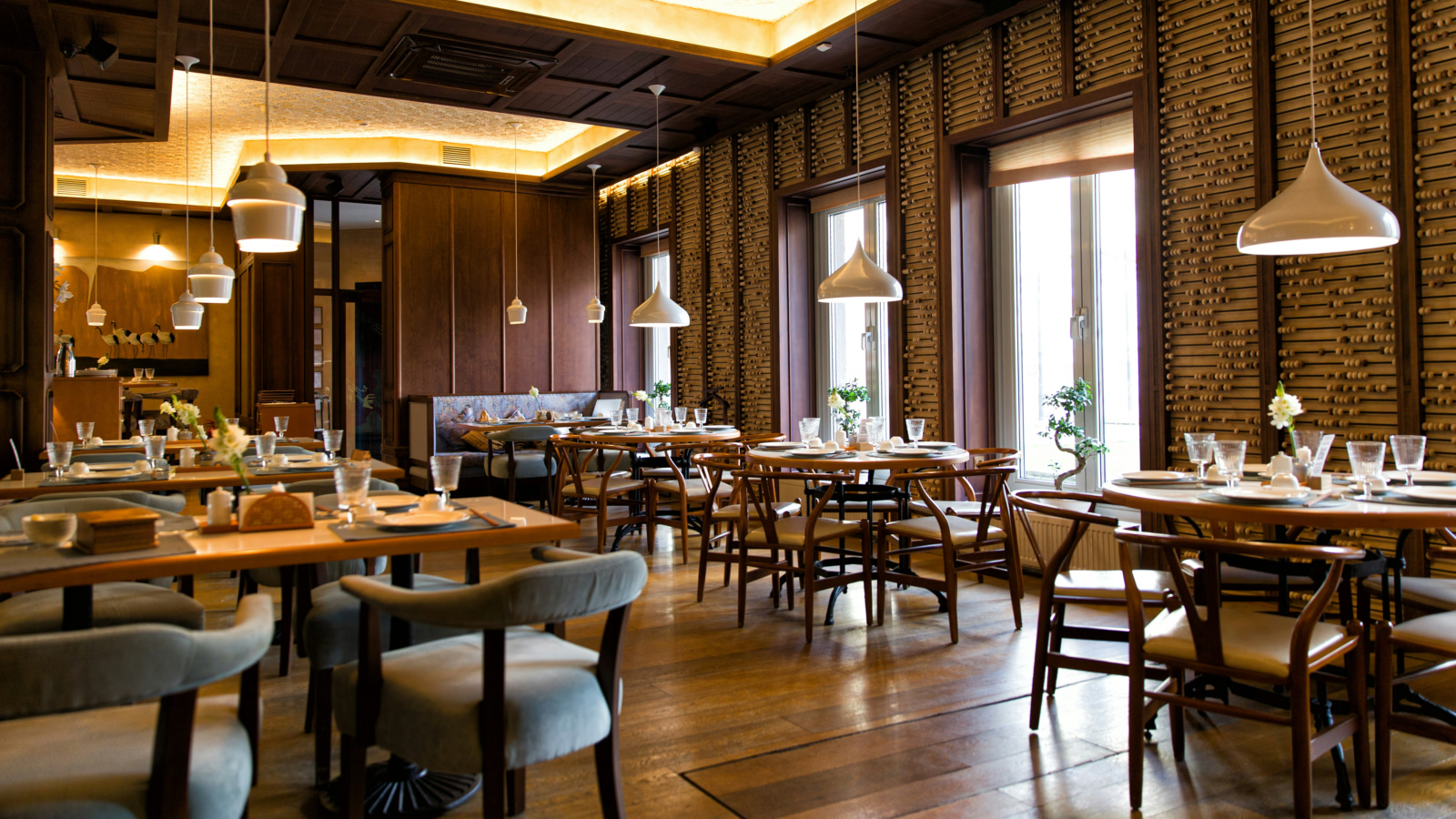
Bilt Dining is the points stack most people aren't using and should be. It sits on top of any major credit card you already carry, it doesn't require a Bilt card, and it works at more than 20,000 restaurants. The setup takes five minutes. Then it runs in the background while you eat dinner.
The reason it's underused is mostly that it's quiet. There's no welcome bonus, no glossy launch event, no influencer running a thread about it. You link a card to your Bilt Wallet, you eat at a participating restaurant, you pay with the card, and a week later bonus Bilt points show up. That's the whole product.
I'll walk through how it actually works, where it stacks well, where it falls flat, and the handful of mistakes that cost most users points they should have earned.
How Bilt Dining actually works
Bilt Dining is a card-linked offer program. You add a Visa, Mastercard, or American Express to your Bilt Wallet inside the Bilt Rewards app. When you pay with that card at a participating restaurant, Bilt sees the transaction and credits you 1, 2, or 3 bonus Bilt points per dollar. The tier depends on the restaurant. The points typically post within seven days.
This is bonus earning. Your credit card still earns whatever it normally earns on dining. If you pay with an Amex Gold at a 3X Bilt Dining restaurant, you get 4 Membership Rewards from Amex and 3 Bilt points from Bilt on the same dollar. Two different programs, same transaction, no opt-in beyond the initial card link.
You don't need a Bilt credit card to participate. A free Bilt Rewards account is enough. The Bilt card adds other benefits (rent earning, transfer bonuses, the Rent Day mechanic), but the dining program is open to anyone willing to install the app and link a card.
Stacking strategies that actually pencil out
The point of Bilt Dining isn't the 1 to 3 bonus points by itself. It's the stack. Pair it with a strong dining card and the per-dollar number gets interesting.
Amex Gold + Bilt Dining at a 3X restaurant. The Gold earns 4 Membership Rewards points per dollar on dining. Add 3 Bilt points from the dining program and you're at 7 points per dollar across two separate currencies. At rough valuations of 2 cents per MR point and 2.2 cents per Bilt point, that's about 14.6 cents back per dollar spent. For a category as common as restaurants, that's near the top of what's achievable without chasing rotating bonuses.
Chase Sapphire Preferred + Bilt Dining at a 3X restaurant. The Sapphire Preferred earns 3 Ultimate Rewards on dining. Stack the 3 Bilt points and you're at 6 points per dollar, sitting in two of the most flexible transfer-points ecosystems in the U.S. market.
Capital One Venture + Bilt Dining at a 3X restaurant. Venture earns 2 miles per dollar on everything. The 3 Bilt points push the total to 5. Lower ceiling than the Gold or Preferred, but worth it for anyone who's already running their everyday spend on Capital One.
If you carry a Bilt Mastercard with dining as your bonus category, the stack happens inside one program: 3 base Bilt points from the card plus up to 3 from Bilt Dining at the right restaurant. 6 Bilt points per dollar at ~2.2 cents each is roughly 13 cents back, all in one currency you can transfer to Hyatt, Alaska, Aeroplan, and the rest of the Bilt partner list.
The rule of thumb: use the card that earns the highest dining rate you have. Bilt Dining is additive. It doesn't replace card category bonuses, it sits on top of them.
Finding participating restaurants
Open the Bilt app, go to the Neighborhood tab, tap Dining. You'll see participating restaurants filtered by location, with the bonus tier (1X, 2X, or 3X) labeled on each. You can sort by cuisine, price, rating, and proximity.
The coverage reality: this works best in major metros. New York, LA, San Francisco, Chicago, Miami all have hundreds of participating restaurants, including a healthy share at the 3X tier. Second-tier cities like Austin, Denver, Nashville, and Portland have respectable lists. Smaller markets get thinner. You'll find a handful of options in a college town, fewer in suburban areas, and sometimes nothing useful in rural zips.
Two practical notes on the app itself. The tier label (1X, 2X, 3X) sits right on the restaurant tile, so you don't have to dig. And the list updates regularly. Restaurants come on and off the program, so a place that wasn't earning a bonus six months ago might be earning one now. I check the app before a new neighborhood spot the same way I check Google Maps for hours.
The practical move is to check before you pick a restaurant, not after. If you're already going to eat dinner out, and a 3X spot is two blocks from the place you were planning to go, that's a real decision. Without checking, you'd never know.
Setting up the Bilt Wallet
The setup is mechanical. In the Bilt app, go to Wallet, add card, enter the card number. Repeat for every card you might reasonably use on a dinner out. Two minutes per card.
Link the dining cards first: Amex Gold, Sapphire Preferred or Reserve, Capital One Venture, the Bilt card if you have one. Then add your general-spend backups. The more cards you have linked, the less likely you'll grab the wrong card at dinner and miss the bonus.
The one rule that catches people: a given card can only be earning Bilt Dining bonuses for one Bilt Wallet at a time. If you and your partner share a card, only the most recently linked Bilt account earns on it. If you both add the same card, the second person to add it takes the bonus. Pick who carries which card in their wallet before you both start linking.
Once a card is linked, you don't have to do anything else. You don't activate offers per restaurant, you don't tap into the app at the table. The transaction processes, Bilt sees it, the bonus posts in a week.
What Bilt Dining doesn't cover
The most common reason a transaction looks like it should have earned a bonus and didn't: it went through a third party.
DoorDash, Uber Eats, Grubhub, Caviar, ChowNow, anything where the delivery platform is the merchant of record on your statement instead of the restaurant, does not trigger Bilt Dining. Bilt is looking for a charge from the restaurant itself. If your statement says "DoorDash," that's the merchant Bilt sees, and DoorDash isn't enrolled.
Same logic applies to a lot of online ordering. If the restaurant uses Toast Online Ordering, ChowNow, or a similar embedded checkout, the transaction may route through the platform rather than the restaurant. Sometimes it earns, sometimes it doesn't, and you can't tell in advance.
The reliable path: dine in, or call the restaurant directly for pickup and pay at the counter. The charge lands as the restaurant, Bilt sees it, the bonus posts.
Rent Day dining
On the first of every month, Bilt runs Rent Day, which usually layers a dining promotion on top of the regular dining program. Past Rent Days have included reservation access to high-demand restaurants, multi-city dining events (one recent example covered 42 restaurants across 8 cities), Valentine's Day reservation pulls, and chef collaboration dinners. February 2026's Rent Day featured Neighborhood Dining experiences across eight cities plus launch nights at Skewr in New York and Electric Jane in Nashville.
These are worth checking each month, especially in major metros. The reservation access alone has real value at restaurants that are otherwise booked weeks out. Some Rent Day experiences are paid with points; others just give you reservation access and you pay the restaurant in cash on a regular Bilt Dining bonus.
Outside major cities, the Rent Day dining offers thin out. Still, the check itself takes 30 seconds in the app on the first of the month, so the bar to look is low.
Comparing to the alternatives
Bilt Dining isn't the only dining-rewards program in the market. The two relevant comparisons:
Amex Offers. Amex regularly puts dining offers on cardholder accounts: spend $X at restaurant Y, get $5 back, or earn 5X bonus points. The economics on a specific Amex Offer can beat Bilt Dining for that one transaction, sometimes by a lot. The catch is they're targeted, limited-time, and not predictable. You can't plan around them, you can only check before you go.
The play is to use both. Check Amex Offers before dinner. If there's an active offer at the restaurant, use the Amex it's loaded on. If not, fall back to whichever card maxes your Bilt Dining stack.
Restaurant chain loyalty programs. Chipotle Rewards, Starbucks Rewards, Panera MyPanera. These run independently of Bilt Dining and don't conflict. If the chain is on Bilt's list, you get both. If it isn't, you still get the chain's program.
Chase Dining and Citi Entertainment. Both offer reservation access at hand-picked restaurants for cardholders of their premium products. Useful if you already hold the Sapphire Reserve or a Citi Strata Premier and want hard-to-get bookings. They don't compete with Bilt Dining on bonus earning. They're a different product, focused on access. Run them in parallel.
Common mistakes
The four that cost the most points:
Not linking proactively. People hear about Bilt Dining, think "I'll set that up later," then notice three months later they've eaten at a dozen participating restaurants and earned nothing because they never linked the card. There's no retroactive credit. Link now, even if you don't plan to optimize, because the cost is two minutes and the upside is automatic.
Assuming online and delivery orders qualify. They mostly don't. If the bonus matters on a specific meal, dine in or call the restaurant.
Missing the higher-earning option. Two participating restaurants on the same block, one at 1X and one at 3X. The difference on a $100 dinner is 200 Bilt points, roughly $4.40 in transfer value. Not life-changing on any one meal, but real money across a year of dining out. Check the tier before you pick the spot.
Sharing a card without coordinating. If you and a partner both link the same shared card, only the second person to add it earns. Pick who gets which card before you both start adding.
Not checking which tier you're at. Two restaurants from the same chain in different locations can be at different tiers, or one location might not be enrolled at all. Don't assume the brand is enrolled across the board. Filter by the address you're actually going to.
Paying with a card you forgot to link. Easy fix: link everything you might plausibly grab. Even the no-annual-fee backup card you carry for emergencies is worth thirty seconds of setup.
When Bilt Dining makes sense and when to skip
It makes sense if you live in or travel to major metros, dine out more than once a week, already carry a strong dining card, and have a use case for Bilt points (Hyatt redemptions, Alaska Atmos, Aeroplan, the rest of the transfer partner roster).
It's lower priority if you're in a small market with few participating restaurants, if you mostly cook at home, or if you don't have a plan for Bilt points beyond "save them up." Bilt points are most valuable transferred to airline and hotel partners. If your redemption is going to be a statement credit or a gift card, the per-point math gets worse, and the dining bonus matters less.
The honest version: nobody should reorganize their card strategy around Bilt Dining. But anyone who already has a Bilt Wallet should link every dining card they carry. The downside is zero, the upside is a few hundred dollars in transfer-points value across a year of restaurant spend you were already doing.
The action plan
Five steps, in order:
- Create a Bilt Rewards account if you don't have one. It's free.
- Link every Visa, Mastercard, and Amex you regularly use for dining. Two minutes each.
- If you share a card, coordinate which person's wallet adds it. Only one earns.
- Before your next dinner out, open the app, find the highest-tier participating restaurant nearby, and go there.
- Check the app on the first of each month for Rent Day dining promotions.
That's the whole program. There's no advanced layer to chase later. The optimization is in the setup, and the setup is done in an afternoon.
Bilt Dining isn't the centerpiece of anyone's points strategy. It's the kind of thing that quietly produces 20,000 to 40,000 extra Bilt points a year for a couple who dines out twice a week, which at a 2.2-cent valuation is enough for a domestic flight or a couple of Hyatt nights. You don't have to think about it. That's the point.
This article contains affiliate links. If you apply through our links, we may earn a commission at no cost to you, which helps us continue sharing points and miles strategies with the community.
Some of the links in this article are affiliate links. We may receive a small commission at no extra cost to you if you apply through these links. This helps us keep the site running and continue creating free content.