

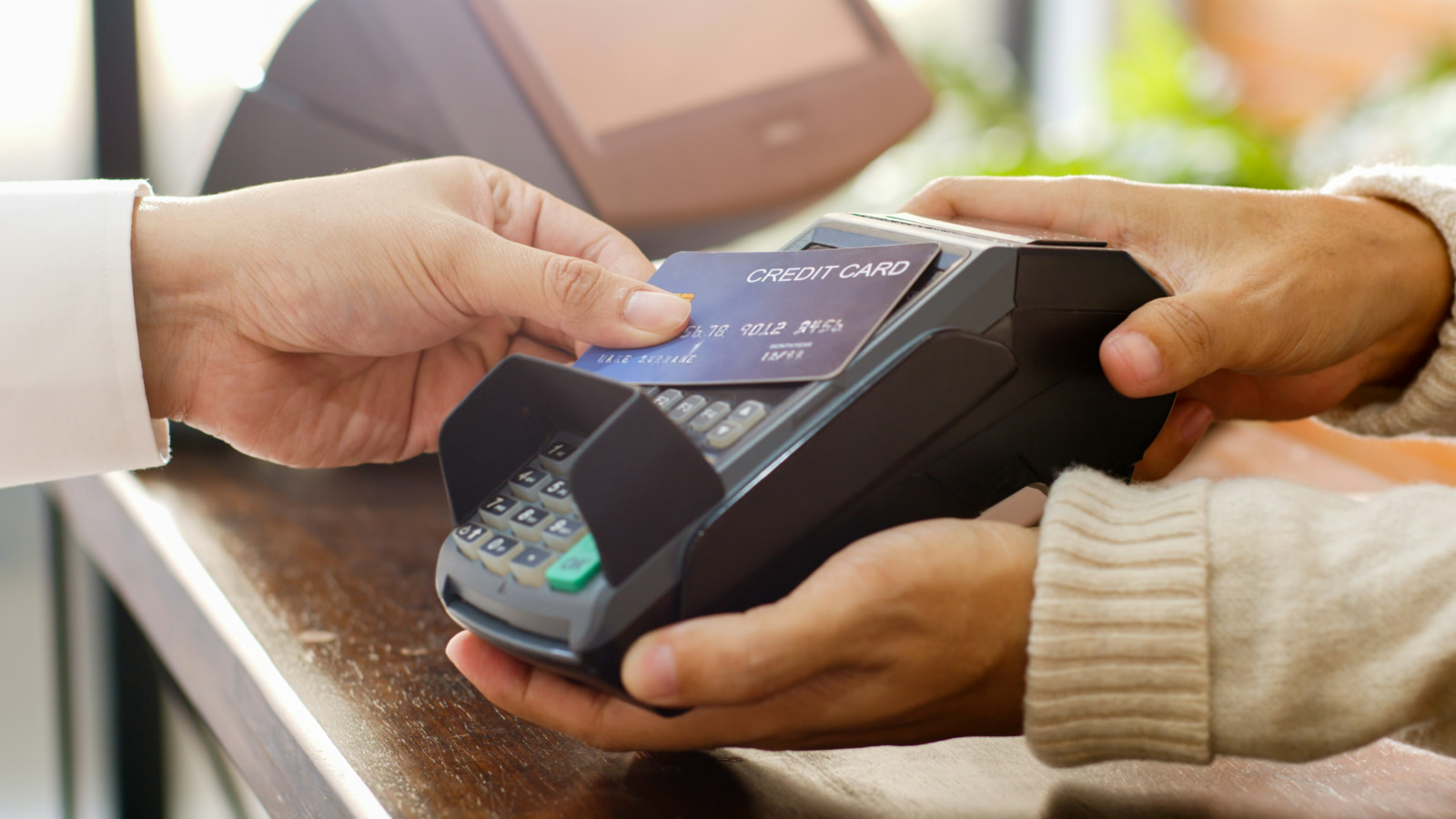
You just got approved for a new card with a $4,000 minimum spend in 90 days, and your flight leaves in five days. Waiting on the mail isn't a strategy. Several issuers now hand you a working card number on the approval screen, and you can drop that number into Apple Pay or paste it into a checkout cart in the same sitting. The catch: "instant" depends on a clean approval, and not every issuer plays the same game. This review walks through which cards reliably issue instant numbers in April 2026 and what you can do with the digital number before the physical card arrives.
Quick Summary
Best For: Anyone racing a welcome-bonus clock, traveling within the week, or replacing a stolen card.
Standout Benefit: Spend on the new card the same day you're approved, in mobile wallets and online checkouts.
Biggest Drawback: Most physical-card-required scenarios (hotel front desks, car rental counters, gas pumps without contactless) still need the plastic, which typically arrives in 7 to 10 business days.
Current Pattern: American Express is the most reliable issuer; Capital One has caught up across most travel and cash-back cards; Chase and Citi remain inconsistent.
What an Instant Card Number Actually Is
An instant card number is a 15- or 16-digit primary account number (PAN) that the issuer makes available immediately after approval, almost always inside their mobile app. It comes with an expiration date and a CVV, exactly like a physical card.
Two flavors exist. Some issuers (American Express most notably) show the same permanent number that ships on the physical card. Others provide a temporary number that gets replaced when the card activates. The distinction matters for autopay setup: a temporary number means ten updates after the plastic arrives.
Once you have the number, you can use it three ways. The cleanest is mobile wallet: add it to Apple Pay or Google Pay, and the wallet generates a tokenized version so the merchant never sees the actual PAN. This works at every contactless terminal, in-app purchase, and online checkout that supports wallet pay. The second is manual online entry: type the number, expiration, and CVV into any merchant that accepts the network. The third is telephone or app-based payment for hotel pre-authorizations or rental holds, though some merchants eventually want the matching physical card.
American Express: The Strongest Issuer
Amex is the strongest issuer for this feature, full stop. Nearly every personal and business card supports instant access through the Amex mobile app, and the number you see is the permanent one that ships on the physical card. The five cards readers ask about most:
The Platinum Card from American Express. Premium travel card with the deepest lounge access network on the market. Earns 5x Membership Rewards on flights booked direct or through Amex Travel (capped at $500,000 per calendar year) and 5x on prepaid hotels via Amex Travel. The $695 annual fee carries real offsets, including the $200 airline fee credit, the $200 hotel credit on Fine Hotels & Resorts and The Hotel Collection bookings of two nights or more, and the Centurion Lounge network. For a traveler clearing $20,000+ on flights and hotels annually, the math works.
American Express Gold Card. The category-spending workhorse. 4x Membership Rewards at restaurants worldwide and at U.S. supermarkets (the supermarket cap is $25,000 per calendar year, then drops to 1x; the restaurant 4x is uncapped). Plus 3x on flights booked direct with airlines. Annual fee runs $325 in the current 2026 version, partially offset by $120 in dining credits and $120 in Uber Cash, both delivered monthly.
Blue Cash Preferred from American Express. The grocery card that beats most cards on grocery math. 6% at U.S. supermarkets on the first $6,000 in purchases per year (then 1%), 6% on select U.S. streaming subscriptions, 3% on transit and at U.S. gas stations, 1% otherwise. $95 annual fee. A household at $500 a month at U.S. supermarkets clears $360 in cash back annually before the fee, netting $265 before any streaming or gas adds.
American Express Green Card. Often overlooked. 3x Membership Rewards on travel (broadly defined to include transit, rideshare, and tolls), 3x at restaurants worldwide, 1x otherwise. The $150 annual fee includes a $189 CLEAR Plus credit and a $100 LoungeBuddy credit. For someone in a transit-heavy city, the broader travel definition can outearn cards with higher headline rates.
Business Platinum and Business Gold. Most Amex business cards behave the same way. Sole proprietors clearing a large welcome-bonus spend lean here for that reason. The pattern across the Amex lineup: apply, get approved, open the Amex app, and your number is there with a one-tap "Add to Apple Wallet" button. The smoothest instant-access experience on the market.
Capital One: Reliable Across Most Cards
Capital One has been steadily rolling out instant card numbers, and the feature is now reliable across most travel and cash-back cards. The number appears in the Capital One mobile app right after approval.
Capital One Venture X Rewards Credit Card. Premium travel card. 2x miles on every purchase, 10x miles on hotels and rental cars booked through Capital One Travel, and 5x miles on flights through the same portal. $395 annual fee, offset by a $300 annual Capital One Travel credit and 10,000 anniversary bonus miles (worth about $100 toward travel). For a traveler hitting the $300 credit reliably each year, the effective fee is closer to $95.
Capital One Venture Rewards Credit Card. The mid-tier sibling. Flat 2x miles on everything, $95 annual fee. Miles transfer to the same airline and hotel partners as Venture X. For someone who wants transferable miles without the premium-card fee, this is the cleaner pick.
Capital One SavorOne and Quicksilver. Two no-annual-fee cash-back cards. SavorOne earns 3% on dining, entertainment, popular streaming services, and at grocery stores (excluding superstores like Walmart and Target), and 1% otherwise. Quicksilver is flat 1.5% on everything. Both typically issue instant numbers on approval, though instant access on the no-annual-fee tier is more recent than on the Venture line. If you don't see the number in the app within an hour, call to confirm.
Citi: Sometimes, Not Always
Citi has expanded instant access to a wider set of cards than it had two years ago, but the rollout still isn't universal. The Citi Custom Cash Card (5% cash back in your top spending category each billing cycle, capped at $500 per cycle) sometimes issues instant numbers, as do the Citi Premier and the Citi Double Cash. The pattern: log into the Citi app immediately after approval and check whether your card shows a "View card number" option. If it does within an hour or two, you're set. If not, the feature wasn't enabled for your application and you're waiting for the mail. Citi cards aren't the right pick if instant access is a hard requirement.
Chase: Mostly Not, with Exceptions
Chase remains the most conservative major issuer on instant card numbers. Most Chase approvals do not get one. The notable exceptions are some Sapphire Preferred and Sapphire Reserve approvals, where a subset of applicants report seeing the card appear in the Chase app within minutes of approval. The pattern is inconsistent enough that you shouldn't apply for a Chase card on the assumption that you'll get instant access.
If timing is critical and you're choosing between a Chase Sapphire and an Amex Gold for similar purposes, the Amex is the stronger pick on this single dimension. Chase has plenty of strengths: the Ultimate Rewards transfer partner network is best-in-class, and the Sapphire Preferred is a top-tier starter travel card. Instant approval-to-spend speed simply isn't on the list.
A note on Discover: historically slower than the four issuers above on digital-first features, and Discover cards don't reliably issue instant numbers. If instant access matters, route around Discover.
What You Can Do Before the Plastic Arrives
The practical question once you have the digital number: where does it actually work?
Mobile wallet purchases. Add the card to Apple Pay or Google Pay and every contactless terminal in the country accepts it: grocery stores, restaurants, gas pumps that support tap-to-pay, airport lounges, transit systems, vending machines.
Online checkouts. Type the number, expiration, and CVV. Works at Amazon, every airline site, every hotel site. If you're racing a welcome-bonus clock, this is where most of week-one spending lands.
Gift card purchases. A favorite tactic for clearing welcome-bonus spend that you weren't planning to do organically. Buy gift cards for retailers you'll actually use (your supermarket, your gas station) at a grocery store gift card display, pay with the new card via Apple Pay, and you've converted future spending into present spending.
In-app purchases. Anywhere you can paste a card number into an app (DoorDash, Uber, Lyft, in-app subscriptions) works the same way as web checkout.
What doesn't work: most hotel front desks (they want the physical card swiped, even if you booked with the digital number), most car rental counters, older gas pumps without contactless readers, and any point-of-sale terminal that requires a chip insert and lacks NFC.
Tokenization and Security
Mobile wallet adds a security layer. When you load a card into Apple Pay or Google Pay, the wallet replaces the PAN with a device-specific token. Merchants see the token, not the real number, so a compromised merchant can't expose your card number. Manual online entry doesn't get that protection: the merchant sees the real PAN. For a $5 coffee it doesn't matter. For a $3,000 booking on an unfamiliar travel site, prefer the wallet route.
Pros and Cons
Pros
- Same-day spend on a new card means no welcome-bonus runway lost to shipping time.
- Mobile wallet integration is near-universal at major retailers in 2026.
- Tokenized payments through Apple Pay and Google Pay add a security layer over manual PAN entry.
Cons
- About 5% to 10% of approvals get routed to manual review and don't see an instant number, with no way to predict which.
- Hotel and car rental check-ins still typically require the physical card.
- Some issuers (Citi, Chase, Bank of America personal cards) remain inconsistent, so the feature can't be assumed.
Choosing Among Issuers if Instant Access Is Your Priority
Pick Amex first if instant access is your top filter. Most reliable, permanent number, smoothest app integration. Pick Capital One if Amex doesn't carry the card you want, since most Capital One travel and cash-back cards now issue instantly with strong app support. Treat Chase and Citi instant access as a bonus, not a guarantee. Apply for the underlying card on its merits and treat any instant number that appears as a windfall.
If you spend $1,500 a month on groceries and dining and want a card working tonight, the Amex Gold is the strongest pick. If you spend $500 a month at U.S. supermarkets, the Blue Cash Preferred clears that math. If you book most travel through a portal and want $300 in annual travel credit, the Venture X is the cleaner play.
Final Verdict
Instant card numbers don't matter on most applications and matter a lot on the right ones. If you're racing a welcome-bonus clock, traveling within the week, or replacing a stolen card, the difference between an issuer that hands you a digital number on approval and one that mails you plastic in seven business days is real money: points lost, trips compromised, autopay fails. American Express is the safest bet, Capital One has caught up across most of its travel and cash-back lineup, and Chase and Citi are case-by-case. Apply with the right issuer for your timing, set up Apple Pay in the first ten minutes after approval, and the welcome-bonus runway you were worried about losing is back in play.
This article contains affiliate links. If you apply through our links, we may earn a commission at no cost to you, which helps us continue sharing points and miles strategies with the community.
Some of the links in this article are affiliate links. We may receive a small commission at no extra cost to you if you apply through these links. This helps us keep the site running and continue creating free content.