

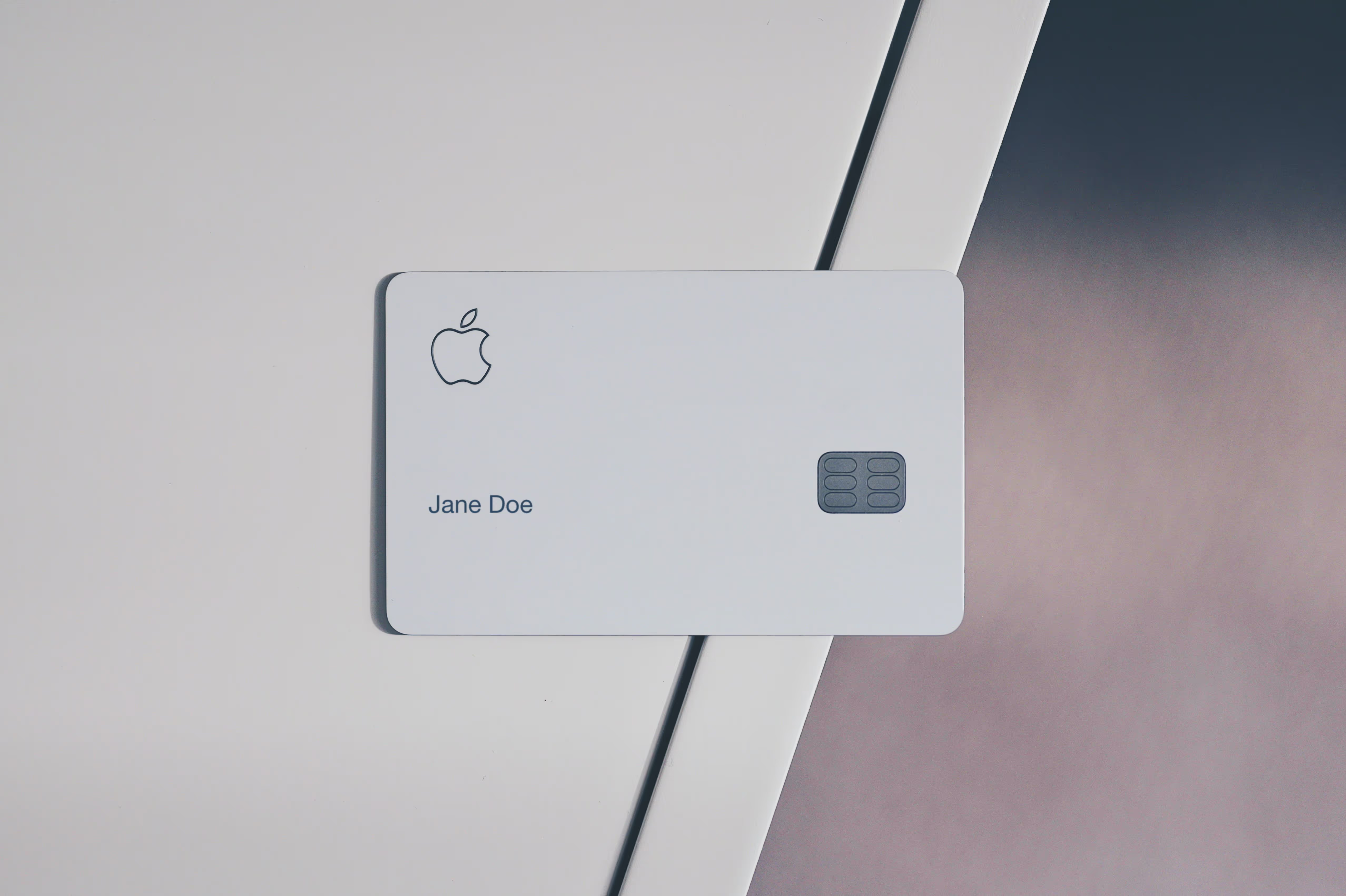
The Apple Card has always been a strange product to review. It earns 3% on Apple purchases through Apple Pay, 2% on every other Apple Pay transaction, and 1% when you swipe the titanium card. It charges no fees of any kind. It deposits your cash back the same day, not at the end of the cycle. And as of April 2026, it's in the middle of an issuer transition that nobody has fully explained to cardholders. So the question isn't really "is the Apple Card good?" The question is "is the Apple Card the right card for you, given what's changing under the hood?" Let's get into it.
Quick Summary
Best For: Heavy Apple buyers who pay with Apple Pay everywhere they can and want a zero-fee card that's effortless to manage from an iPhone.
Standout Benefit: No fees, anywhere, ever. No annual fee, no late fee, no foreign transaction fee, no over-limit fee. That's not just marketing.
Biggest Drawback: The 1% rate on the physical card is below industry standard, and there's no welcome bonus, no purchase protection, no extended warranty, and no travel insurance.
Current Offer: No welcome bonus. The Apple Card has never offered one and likely never will, even after the issuer transition.
What's Actually Happening with the Issuer
This part you need to understand before applying. The Apple Card launched in 2019 with Goldman Sachs as the issuing bank. Goldman has spent the past two years winding down its consumer lending operations after losing billions on the partnership, and through 2024 and 2025 Apple openly searched for a new issuer. As of April 2026, JPMorgan Chase has been reported as the leading candidate to take over the portfolio, though the deal terms are still in flux. Synchrony has also been mentioned in industry reports.
What this means for you as an applicant in April 2026: the card is still being issued today under Goldman's terms. Existing cardholders are likely to be grandfathered into current terms when the transition completes, though Apple hasn't formally confirmed that. New applicants after the handover may face different approval standards, different APR ranges, or feature changes, depending on the new issuer's systems.
I'm not going to tell you to "apply now before it changes" because that's the kind of pressure tactic that makes people end up with a card that doesn't fit. But if the Apple Card already fits your spending pattern, the current zero-fee structure is worth locking in while it's available.
The Earning Structure, in Plain Terms
The Apple Card earns at three rates. The rates haven't changed since launch, and there's no public indication they'll change with the issuer swap.
3% on Apple Purchases via Apple Pay
This applies to direct Apple purchases (iPhones, Macs, AirPods, Apple Watch, Apple TV+, Apple Music, iCloud storage, App Store purchases, Apple Care) and a small list of partner merchants (currently Uber, Walgreens, T-Mobile, Nike, ExxonMobil, and a handful of others). To earn 3%, you must pay through Apple Pay or use the Apple Card directly inside Apple's payment flow. Buy a $1,599 MacBook Pro and you'll get $48 back the same day.
The Apple-purchases bonus is uncapped, which is the detail that gets buried. If you spend $4,000 in a year on Apple gear and services, that's $120 back on what you were going to buy anyway.
2% on Apple Pay Purchases
Any merchant that accepts Apple Pay, the Apple Card earns 2%. This is the rate that makes or breaks the card for most users. Apple Pay acceptance is now well over 80% of U.S. retailers, but the holdouts matter: Walmart, Home Depot, and Lowe's still don't accept it, and many smaller merchants only have older terminals. If you do most of your spending at Apple Pay-friendly retailers, you're effectively getting a flat 2% cash-back card.
1% on the Physical Titanium Card
Use the actual card, and you earn 1%. This is below the no-annual-fee industry standard of 1.5%, and the gap matters more than it sounds. If you spend $10,000 a year at merchants who don't accept Apple Pay, you're earning $100 with the Apple Card versus $150 on a Citi Double Cash or $200 on a flat 2% card. The 1% rate is the structural weakness of the product.
Daily Cash and What You Can Do with It
Daily Cash posts the same day a charge clears. There are no points, no statements to wait for, no portals to log into. You get three options for what to do with the cash:
- Send it to your Apple Cash card, where it's instantly spendable through Apple Pay.
- Apply it as a statement credit to your Apple Card balance.
- Auto-deposit it into Apple Savings, which has been running competitive APYs (4%-plus through 2025, currently around 3.75% as of April 2026).
The Apple Savings integration is genuinely useful if you already keep idle cash there. One thing to know: Apple Savings runs through the Apple Card relationship, which means the issuer transition could affect it. Apple has indicated savings accounts will continue under the new issuer but hasn't published specifics.
The Zero-Fee Structure
This is the part of the card that's hardest to argue with. No annual fee. No late fee, ever, even if you miss a due date by a week. No foreign transaction fee, which puts it in the same category as travel-focused cards. No over-limit fee. No returned-payment fee.
For context, a typical card charges up to $40 for a late payment and 3% on foreign purchases. If you travel internationally twice a year and spend $2,000 abroad on each trip, the foreign-transaction-fee waiver alone saves you $120 a year. That's real money, and it's why the Apple Card quietly earns its place in some travelers' wallets even as a secondary card.
Where It Lives in the Wallet
The Apple Card is fully native to the iPhone Wallet app. Spending categorizes itself into colored circles. The payment wheel shows you exactly how much interest you'll pay if you make different payment amounts, which is the single most useful feature for anyone carrying a balance. You can pause the card, request a credit limit increase, lock it, view your APR, and dispute a charge, all from the phone, no website login required.
Apple Card Family lets you add up to five members, with co-owner status (jointly responsible) or participant status (authorized user). For families building credit together, it's one of the better tools in the category. You can also share the card with a spouse where both names appear on the credit report, which is unusual.
Where the Apple Card Is Outclassed
This is where you need to be honest with yourself about your spending.
Travel Rewards Seekers
If you're trying to earn miles for international flights, the Apple Card isn't the right tool. The 2% cash back caps your value at face value. The Capital One Venture earns 2x miles on every purchase and those miles transfer to airline partners at decent ratios for premium-cabin redemptions. The Chase Sapphire Preferred earns 3x on dining and 5x on Chase-portal travel, and Chase Ultimate Rewards transfer partners include Hyatt, United, and Flying Blue. For travel goals, both of these earn meaningfully more value per dollar than the Apple Card's flat 2%.
High-Spend Dining and Groceries
The Amex Gold Card earns 4x at restaurants worldwide and 4x at U.S. supermarkets, both capped at $50,000 per category per year. If you spend $500 a month on dining, that's 24,000 Membership Rewards per year vs. the Apple Card's $120 of cash back at 2%. At 2 cents per point through transfer partners, the Gold's earning is worth roughly $480 — four times what the Apple Card delivers on the same spend.
Rotating Categories
The Discover It Cash Back, Chase Freedom Flex, and Citi Custom Cash all rotate quarterly 5% categories that cap at $1,500 per quarter. If you actively manage rotating categories, you'll out-earn the Apple Card on roughly $6,000 of annual spending. That's not a small gap.
How It Compares Head-to-Head
Apple Card vs. Citi Double Cash
The Citi Double Cash earns 2% on everything (1% when you buy plus 1% when you pay), no annual fee, no Apple Pay requirement. For physical-card spending, the Double Cash beats the Apple Card 2% to 1%. For Apple Pay spending, they tie at 2%. For Apple purchases, the Apple Card wins 3% to 2%. If you're not deep in the Apple ecosystem, the Double Cash is the simpler, stronger pick.
Apple Card vs. Capital One Quicksilver
The Quicksilver earns a flat 1.5% on everything with a $200 welcome bonus after $500 in spend in the first three months. The Apple Card has no welcome bonus, so right out of the gate, the Quicksilver is $200 ahead. The Apple Card catches up only if you put $20,000+ a year through Apple Pay (the 0.5% rate gap × $20,000 = $100, plus the 3% Apple-purchases bonus on the heavy Apple buyer).
Apple Card vs. the Amex Gold Card
Different leagues. The Gold has a $325 annual fee in 2026 and earns 4x on dining and supermarkets, plus statement credits ($120 dining, $120 Uber, both delivered in $10 monthly chunks at specific partners). The Apple Card costs nothing and earns 2% flat on Apple Pay. For dining-heavy spenders, the Gold's earning gap easily clears its fee. For everyone else, the Apple Card's zero fee is hard to beat.
Pros and Cons
Pros
- Zero fees of any kind, including foreign transaction fees and late fees.
- 3% on Apple purchases is uncapped and applies to AppleCare and Apple subscriptions.
- Daily Cash posts the same day, with three flexible redemption paths.
- Apple Savings integration with competitive APY.
- Apple Card Family with true co-owner status, useful for households building credit together.
- Privacy-focused: no third-party data selling per Apple's terms.
Cons
- 1% on the physical card is below the no-fee industry standard.
- No welcome bonus, no purchase protection, no extended warranty, no travel insurance.
- Issuer transition creates uncertainty about future terms.
- 2% requires Apple Pay acceptance, which still has notable holdouts.
- Application requires a current iPhone, which excludes Android users entirely.
- A 2024 CFPB action fined Apple and Goldman Sachs $89 million for customer service failures during disputes.
Who Should Get the Apple Card
Great Fit For
- Heavy Apple ecosystem users who buy a new phone every two years, run multiple Apple subscriptions, and consistently use Apple Pay.
- Anyone who wants a card that's effortless to manage and would otherwise carry a balance occasionally (the no-late-fee policy is genuinely valuable here).
- Travelers who want a no-fee secondary card with no foreign transaction fees.
- Families using Apple Card Family to build credit together.
Outclassed For
- Travel rewards seekers. The Capital One Venture earns more value per dollar through transfer partners.
- High-spend dining or grocery households. The Amex Gold Card outearns the Apple Card by roughly 4x in those categories.
- Rotating-category optimizers. Chase Freedom Flex and Citi Custom Cash beat the Apple Card on the categories they cycle.
- Android users. You can't apply without an iPhone, so this isn't even a question of fit.
If you want the deeper background on credit-card application logistics, our guide to applying for a credit card walks through what affects approval. The Apple Card's credit requirements sit in the fair-to-excellent range, generally 660 and up.
The Effective Math at Modest Spending
Let's run a realistic scenario for a moderate Apple Card user:
- $2,000/year on Apple purchases (new phone every 2 years, AppleCare, iCloud, Apple Music) at 3% = $60
- $15,000/year on Apple Pay-accepting merchants at 2% = $300
- $5,000/year on physical-card swipes at 1% = $50
Total annual cash back: $410, against a $0 annual fee. That's a real return for a no-fee card, and for an Apple ecosystem user it requires zero behavioral change.
Now compare to a heavy travel-rewards user putting the same $22,000 through a card optimized for travel: at 2x miles transferred at 2 cpp average, that's $880 of value. The gap is real, and it grows as your spending grows. The Apple Card is a strong card for the right user. It's a mediocre card if you've got bigger ambitions for your annual spend.
Final Verdict
The Apple Card is the answer to one specific question: I want a zero-fee card that's deeply integrated with my iPhone, posts rewards instantly, and never charges me for being a day late on a payment. If that's the question, the answer is yes. The 3% on Apple purchases and 2% on Apple Pay are competitive, and the no-fee structure is genuinely consumer-friendly in an industry that often isn't.
But if you're aiming for premium travel redemptions, optimizing across rotating categories, or need traditional perks like purchase protection and extended warranty, the Apple Card is outclassed by purpose-built alternatives. The Capital One Venture and Chase Sapphire Preferred are stronger picks for travelers, and the Amex Gold Card earns more for dining-heavy households.
The issuer transition adds a layer of uncertainty in 2026 that didn't exist a year ago. Current cardholders are likely safe, but the long-term shape of the product is genuinely unknown until JPMorgan Chase or whichever issuer takes over publishes new terms. If you're tempted, my honest read is this: apply if it fits your spending, ignore the artificial urgency, and re-evaluate after the transition closes. For premium-card alternatives, our best premium travel rewards credit cards breakdown covers the higher-fee tier in detail.
This article contains affiliate links. If you apply through our links, we may earn a commission at no cost to you, which helps us continue sharing points and miles strategies with the community.
Some of the links in this article are affiliate links. We may receive a small commission at no extra cost to you if you apply through these links. This helps us keep the site running and continue creating free content.