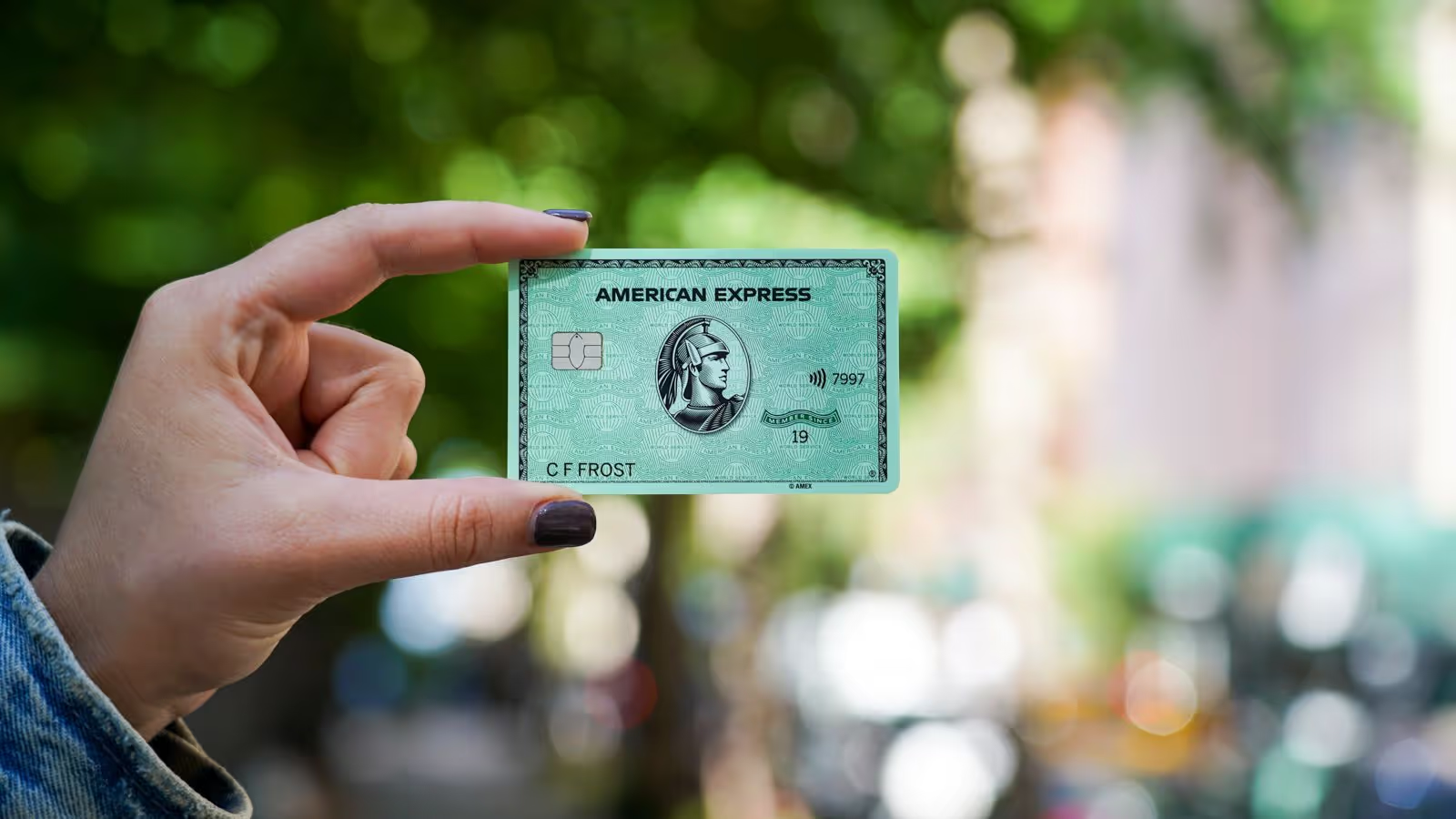
The American Express Green Card sits in an awkward, useful spot. It costs $150 a year, which is more than the no-fee crowd and less than half of what the Amex Gold Card runs in 2026. It earns 3x Membership Rewards points on dining, travel, and transit, with no category caps. And it bundles two statement credits, CLEAR Plus and LoungeBuddy, that can turn the $150 fee negative if you actually use them. The question for most readers isn't whether the Green Card is a good card. It's whether the Green Card is the right card for you given what you already carry. Let's run the numbers and find out. If you decide it fits, you can apply for the Amex Green Card directly through Amex.
Quick Summary
Best For: Mid-tier travelers who spend regularly on dining, transit, and travel and will use the CLEAR Plus and LoungeBuddy credits.
Standout Benefit: Uncapped 3x on three of the most common spending categories, plus credits that more than offset the annual fee.
Biggest Drawback: No lounge access of its own, no airline credit, and the Amex Gold beats it on dining for foodies (until you hit Gold's $50,000 cap).
Current Offer: 40,000 Membership Rewards points after $3,000 in eligible purchases in the first six months.
What the Green Card Actually Is
The Green Card is the entry point to the Amex Membership Rewards ecosystem at a fee that doesn't sting. The Gold Card costs $325 a year as of 2026 and the Platinum runs $695. The Green's $150 buys you the same Membership Rewards currency, meaning the same airline and hotel transfer partners, at a price most travelers can stomach without doing pretzels of math to justify it.
It's a charge card by Amex's standard rules (pay in full each month, with Pay Over Time available on eligible charges), it has no foreign transaction fees, and it earns at three flat multipliers across broad categories. No quarterly activations. No rotating bonuses. No spending caps on the bonus categories. That last point matters more than it looks, and we'll come back to it when we compare the Green to the Gold.
Welcome Bonus: 40,000 Points After $3,000 in Six Months
The current public offer is 40,000 Membership Rewards points after spending $3,000 on eligible purchases within the first six months of card membership. At a conservative 2 cents per point through transfer partners, that's roughly $800 of value, or over five years of annual fees in one bonus. The $3,000 spend is $500 a month, which most cardholders hit on groceries, dining, and gas without changing behavior.
If you're new to Amex Membership Rewards entirely, this is the cheapest way to start a points balance you can later combine with a Gold or Platinum down the road. Membership Rewards points pool across all Amex cards under your login, so the 40,000 you earn here can stack with future bonuses on other Amex products. You can check the current Amex Green Card welcome offer before you apply, since Amex occasionally runs targeted bumps above the public 40,000-point baseline.
The 3x Earning Categories: What Actually Codes
Three categories at 3x, with no caps, is the Green Card's structural pitch. Here's what each one covers and what it's worth at typical spending levels.
Dining (3x worldwide)
Restaurants, bars, takeout, delivery, coffee shops, food trucks. Worldwide, not just U.S. The "worldwide" qualifier matters when you're traveling, because most cards' bonus dining categories are U.S.-only.
If you spend $500 a month on dining, that's $6,000 a year × 3 = 18,000 Membership Rewards points, worth roughly $360 at 2 cents per point. At $1,000 a month, you're at 36,000 MR, or about $720 a year from dining alone.
Travel (3x)
Flights booked directly with airlines or with Amex Travel, hotels, cruises, car rentals, and vacation rentals. Note: this excludes most third-party booking sites that aren't Amex Travel. If you're a Booking.com or Expedia loyalist, those purchases earn 1x, not 3x.
For a household that spends $4,000 a year on flights and hotels, that's 12,000 MR ≈ $240 of value annually.
Transit (3x)
This is the category that quietly carries the card for urban readers. It covers rideshare (Uber, Lyft), taxis, parking, tolls, public transit (subway, bus, commuter rail), and trains. It does not cover gas stations.
If you spend $200 a month on rideshare and parking, which is modest for anyone in a major city, that's $2,400 a year × 3 = 7,200 MR ≈ $144. Combine all three categories at the spending levels above and you're looking at roughly 37,000 MR a year from category bonuses, worth around $740 at 2 cpp through transfer partners. That math is the case for the card.
The Two Credits That Move the Math
The Green Card carries two statement credits that, used in full, take the effective annual fee from $150 to negative.
CLEAR Plus Credit (Up to $209/year)
CLEAR Plus runs $199 a year currently and gets you to the front of the security line at a long list of U.S. airports. The Green Card reimburses up to $209 annually. If you use it, the credit covers the entire CLEAR Plus membership and then some.
Math: $150 annual fee minus $209 CLEAR Plus credit = the credit alone has already overshot the fee by $59. If you fly even three or four times a year through a CLEAR-equipped airport, this credit pays for the card on its own.
LoungeBuddy Credit ($100/year)
LoungeBuddy lets you buy single-visit airport lounge passes at airports where you don't have other lounge access. Day passes typically run $25 to $50, so $100 covers two to four lounge visits a year. If you're an occasional flyer who can't justify the $695 Platinum just for lounge access, this is the workaround.
Stack the two credits: $209 CLEAR + $100 LoungeBuddy = up to $309 in credits against a $150 fee. Used fully, the card pays you $159 a year before you've earned a single point.
Travel Protections Worth Naming
The Green Card includes a few protections that punch above its fee tier:
- Trip Delay Insurance: Up to $300 per trip when your trip is delayed 12+ hours, max two claims per 12-month period.
- Car Rental Loss and Damage Insurance: Secondary coverage up to $50,000 when you decline the rental company's collision waiver and pay with the card.
- Purchase Protection: Up to $1,000 per item, $50,000 per account per year, for items damaged or stolen within 90 days of purchase.
These won't be the reason you pick the card, but they're real. Trip delay coverage in particular is something many no-fee cards drop entirely.
Membership Rewards Transfer Partners: Where the Real Value Lives
Cash redemptions through Amex Travel are 1 cent per point at best, sometimes less. The reason MR points are worth carrying is the transfer partners. The Green Card earns the same MR currency the Gold and Platinum earn, so transfer access is identical. See our Amex Membership Rewards transfer partners overview for the full chart and current ratios.
A few sweet spots worth knowing:
- Virgin Atlantic Flying Club for ANA business class to Tokyo: 47,500 to 60,000 points one-way during select promotions.
- Air France-KLM Flying Blue Promo Rewards for Europe in coach: occasionally as low as 10,000 to 15,000 points one-way from select U.S. gateways.
- Avianca LifeMiles for Star Alliance partner business class.
- Delta SkyMiles for domestic short-hauls when Flash Sales drop awards into the 5,000 to 8,000 mile range.
A 40,000-point welcome bonus, transferred well, can cover a one-way premium-cabin international flight or two to three domestic round-trips. That's the realistic ceiling, not the marketing ceiling.
Pros and Cons
Pros
- Uncapped 3x on dining, travel, and transit, the three categories most readers spend on most.
- Credits ($209 CLEAR + $100 LoungeBuddy) can fully offset the annual fee.
- Same Membership Rewards transfer partners as the Gold and Platinum, at less than half the fee.
- No foreign transaction fees, with worldwide dining bonus included.
Cons
- No lounge access of its own. The LoungeBuddy credit is a workaround, not a Centurion-tier benefit.
- No airline credit, no Uber credit, no Saks credit. The Green is lean by design.
- The 3x dining is outclassed by the Gold's 4x for serious foodies (with caveats; see below).
- Charge card rules: balance is due in full each month for most charges.
How the Green Compares
Green vs. Amex Gold Card
The Gold earns 4x at U.S. supermarkets (capped at $25,000 per calendar year), 4x at restaurants worldwide (capped at $50,000 per calendar year), and 3x on flights booked direct or through Amex Travel. Annual fee: $325. See our Amex Gold Card review for the full breakdown.
The math: if you spend $5,000 a year at restaurants, the Gold earns 20,000 MR vs. the Green's 15,000 MR, a 5,000-point gap worth roughly $100. The Gold's annual fee is $175 higher than the Green's. Even after the Gold's $120 dining credit (split into $10 monthly chunks at specific partners) and $120 Uber credit (similarly chunked), the Gold's effective fee is $85 higher than the Green's after credits, and you've earned $100 more in points. You're $15 ahead.
But: spend $20,000 a year on dining (a household that eats out four to five times a week), and the Gold pulls 80,000 MR vs. the Green's 60,000, a $400 gap. The Gold wins decisively for high-spend foodies. The Green wins for moderate dining spenders, especially those who spend significantly on transit, which the Gold doesn't bonus.
Green vs. Chase Sapphire Preferred
The CSP costs $95 annually, earns 5x on travel through Chase, 3x on dining, and 3x on online groceries and select streaming. Chase Ultimate Rewards transfer partners are deep (Hyatt, United, Air Canada, Virgin Atlantic, Flying Blue). See our Chase Sapphire Preferred review for the full picture.
The Green wins on transit (CSP doesn't bonus it), no foreign transaction fees, and the credit stack. The CSP wins on lower fee, Hyatt access (Hyatt is the single best Ultimate Rewards transfer partner), and 5x on Chase-portal travel.
This is less a head-to-head and more an ecosystem question: do you want to live in the Amex universe or the Chase universe? If you commute and travel internationally, Green. If you redeem heavily for Hyatt stays and prefer Chase's lower-fee structure, CSP.
Green vs. Amex Platinum
The Platinum is $695 a year and is built for travelers who'll burn its $200 airline credit, $200 Uber credit, $189 CLEAR credit, $200 hotel credit, $300 Equinox credit, and Centurion Lounge access. If you genuinely use those credits, the Platinum wins. If you don't fly enough to justify $695 in fees, the Green is the better fit. Don't pay $695 for benefits you won't actually use; that's the most expensive way to feel premium.
Who Should Get the Green Card
Great Fit For
- Travelers who spend $400+ a month combined on dining, travel, and transit and will use both credits.
- Urban professionals with regular rideshare, parking, and transit spend.
- Readers building toward an Amex Platinum or Gold and want a low-fee on-ramp to Membership Rewards.
- Anyone who wants worldwide dining bonus without a high annual fee.
If you're in any of those buckets, the Amex Green Card is worth a serious look.
Outclassed For (Better Alternatives Below)
- Heavy dining spenders ($15,000+/year): the Amex Gold Card earns more from dining alone.
- Hyatt loyalists: the Chase Sapphire Preferred routes points to Hyatt at 1:1; the Green can't.
- Frequent travelers who want lounge access and airline credits: the Amex Platinum, despite its $695 fee, is the right tool for that job.
If your spending fits the first list, the Amex Green Card is one of the better $150 cards on the market in 2026. If you want to confirm current offer details, check Amex's current Green Card terms before applying.
The Effective Fee Math, in One Place
- Annual fee: $150
- CLEAR Plus credit: up to $209 (covers entire $199 CLEAR Plus membership)
- LoungeBuddy credit: $100
- Credits stack: $309 against $150 fee
- Effective annual fee with both credits used: -$159
That's before you've earned a single point. Add 18,000 MR/year from $500/month dining ≈ $360, and the card is netting you over $500 a year in value at modest spending levels.
Final Verdict
The Green Card is the answer to a specific question: I want Membership Rewards earning across the categories I actually spend on, I want enough travel benefit to make the fee disappear, and I don't want to pay $325 or $695 to get there. If that's the question, the Green is the answer. If your spending heavily concentrates in dining only, the Gold beats it. If you live in the Chase ecosystem, the CSP beats it. If you fly 30+ times a year and burn premium-card credits, the Platinum beats it. For everyone else with mid-tier travel and transit spend, the Green earns its place in the wallet. Ready to add it? You can start your Amex Green Card application on Amex's site and pull up current offer terms there.
This article contains affiliate links. If you apply through our links, we may earn a commission at no cost to you, which helps us continue sharing points and miles strategies with the community.
Some of the links in this article are affiliate links. We may receive a small commission at no extra cost to you if you apply through these links. This helps us keep the site running and continue creating free content.