Key Points
- Airbnb relaunched Experiences and rolled out Services (chefs, massages, trainers, photographers) in May 2025 as part of CEO Brian Chesky's push to turn the platform into an "everything app."
- A year on, Services has expanded beyond its 100-city debut and the relaunched Experiences platform now spans hundreds of markets, but Airbnb has not introduced a points-based loyalty program of the kind that competes with Marriott Bonvoy or Hilton Honors.
- For travelers, the practical change is that you can now book a private chef or in-home massage alongside a stay; the underlying value math still hinges on credit-card category bonuses, not Airbnb's own currency.
TL;DR
Airbnb's 2025 "everything app" expansion added Services and relaunched Experiences. A year in, both have scaled. There's still no Airbnb-branded points program. Best reward value on Airbnb stays still comes through credit-card travel categories.
Introduction
Airbnb spent the past year trying to become more than a place to book a stay. At its May 2025 Summer Release, CEO Brian Chesky framed the company's roadmap around a pitch that has since been quoted in roughly every earnings preview written about the company: Airbnb wants to be "the everything app for travel and beyond." The product expansion that followed, anchored by a new Services category and a relaunched Experiences platform, is the most aggressive product widening since Experiences first launched in 2016.
A year on, the rollout is far enough along to evaluate. Here's what actually shipped, what didn't, and what it means for travelers who book through Airbnb.
What Airbnb Rolled Out
The 2025 Summer Release, announced May 13, 2025, contained two headline launches and a redesigned app to house them.
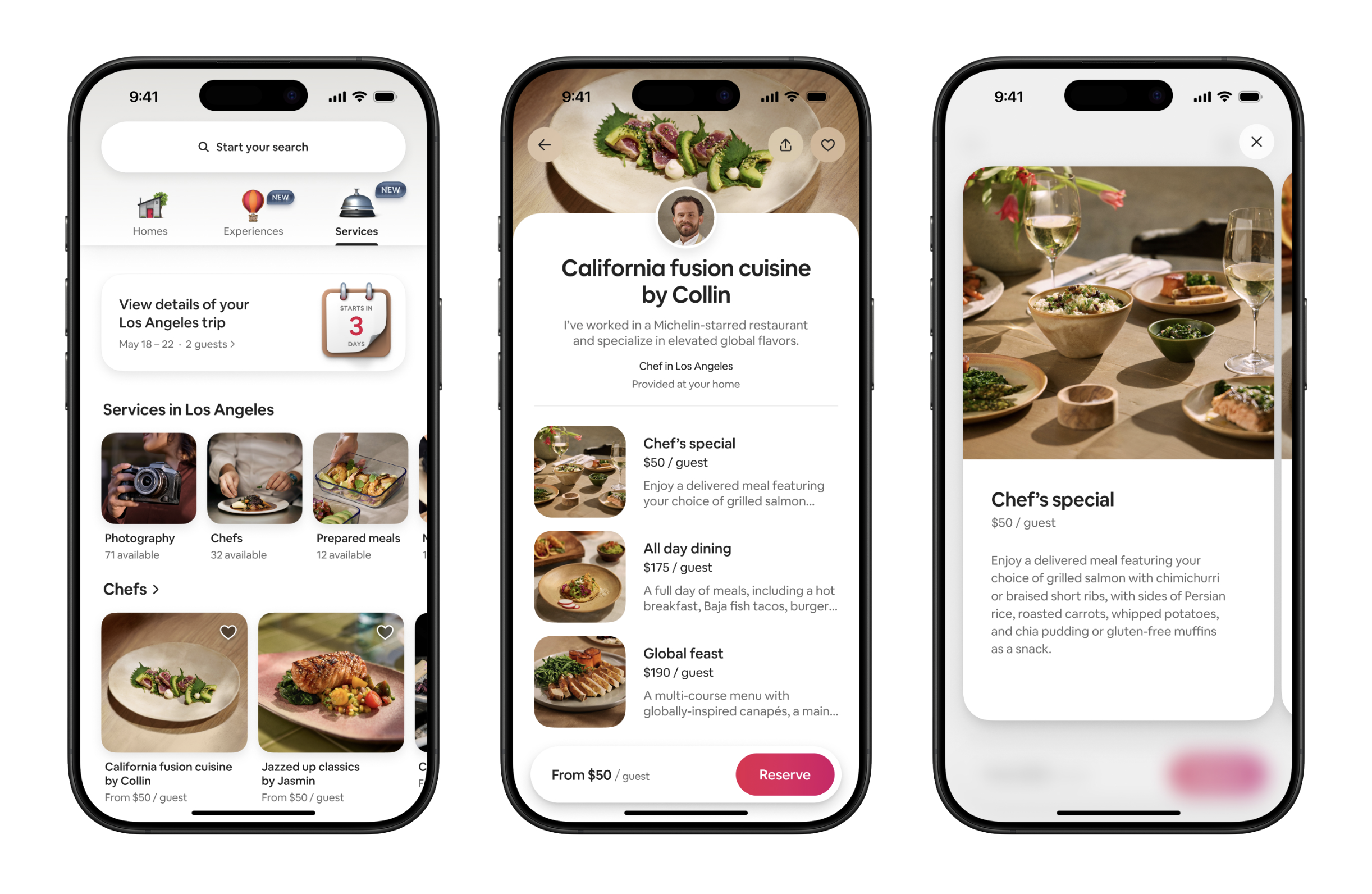
Services. A new category for in-stay bookings: private chefs, massage therapists, personal trainers, photographers, hair and makeup, spa treatments, and prepared meals. At launch Airbnb said Services were available in roughly 100 cities across more than 50 countries. The footprint has expanded over the past year, and high-end markets like New York, Los Angeles, and London now show plenty of triple-digit listings alongside the $50-to-$100 entries Airbnb highlighted in its launch materials.
Experiences, relaunched. Airbnb shut down its original Experiences product in 2023 to rebuild it. The 2025 version sits inside the main app rather than as a sidebar, and the catalog spans hundreds of markets as of spring 2026. Highlights include "Originals" (the celebrity-fronted activities Airbnb advertised at launch) plus longer multi-day formats.
A redesigned app. The interface moved to a three-tab layout (Homes, Experiences, Services) with each category surfaced equally on the home screen. Airbnb also rolled out a redesigned host dashboard the same week.
What did not ship: a points-and-tiers loyalty program. Despite years of speculation, Airbnb's executives have continued to publicly downplay the idea that traditional points-based loyalty mechanics are the right fit for the kind of bookings the platform handles. The "Guest Favorites" badge that does exist on Airbnb today is a quality marker for top-rated listings, not a member-tier program with earning and redemption.
Why Chesky Pushed for It
The "everything app" framing isn't only marketing. Airbnb's core business, entire-home and private-room stays, has matured. Nights booked growth has slowed from the post-pandemic surge into the high single digits, and the company has been candid with investors about needing new revenue lines. Services and Experiences are the most defensible adjacencies the company can build without acquiring a tour operator or a hotel brand.
Chesky has also been explicit that he's modeling the product strategy on Asian super-apps, citing WeChat and Grab in interviews tied to the launch. The pitch to Wall Street is that Airbnb already has the supply (hosts), the demand (300 million-plus active travelers), and the trust layer (reviews, payments). What it hasn't done is monetize those assets outside of the booking transaction.
How It's Landed
The reception has been mixed. Industry analysts at Skift and TPG flagged real concerns at launch: liability questions around in-home services, host willingness to vet third-party providers, and consumer trust in spa or massage treatments delivered to a short-term rental rather than a licensed facility. Airbnb's response has been to require background checks on Service providers and to lean on its existing host-rating system, but the lift on hosts is real.
Bookings, however, have moved. Airbnb has flagged Services attach rates on stays in launch cities as growing across 2025 and into 2026, though the company has been careful in earnings commentary not to anchor expectations to specific percentages. The takeaway is that attach is real but small relative to the core stays business, and the line item is meaningful mostly because it represents brand-new revenue from a standing start.
For hotel competitors, the signal matters less than the staffing change. Marriott and Hilton have both publicly downplayed Airbnb's moves into adjacent services, but both chains have also accelerated their own in-property activity rollouts in the past twelve months. Whether that's coincidence or response is hard to say. Either way, the competitive frame for short-term rentals is no longer "Airbnb vs. hotels." It's "Airbnb vs. the rest of the trip."
What Travelers Should Know
For readers booking through Airbnb today, three things have changed:
You can now bundle a stay with a service inside a single Airbnb checkout. The pricing is generally in line with what the same provider would charge directly (sometimes slightly above) plus Airbnb's standard service fee. The trade-off is the platform's payment protection and dispute process, which is genuinely useful if a chef no-shows or a massage doesn't match the listing.
Experiences are worth a second look if you wrote them off in 2022. The relaunched catalog skews higher-quality, partly because Airbnb cut underperforming hosts during the rebuild. Pricing transparency has also improved. Total cost now shows on the listing rather than after add-ons.
Credit-card category coding is unchanged. Airbnb stays still code as travel on most major issuers, which means the Chase Sapphire Preferred, Capital One Venture X, and American Express Gold continue to be the best earn-rate options for these bookings. There is no Airbnb-specific loyalty currency to chase. If you're picking a card for Airbnb spend, it's the same conversation as any other travel booking. See our best travel credit cards breakdown for the current shortlist.
The Bottom Line
The "everything app" pitch is, a year in, a real product expansion rather than a slogan. Services and the relaunched Experiences platform have shipped, scaled, and started generating revenue. What hasn't shipped, and likely won't soon, is the Airbnb-branded points program some readers were hoping to start chasing. For now, the reward math on Airbnb stays still runs through your credit card, not through Airbnb itself.
This article contains affiliate links. If you apply through our links, we may earn a commission at no cost to you, which helps us continue sharing points and miles strategies with the community.
Some of the links in this article are affiliate links. We may receive a small commission at no extra cost to you if you apply through these links. This helps us keep the site running and continue creating free content.